Between 1956 and 1992, Russian actor Vsevolod Safonov (1926-1992) appeared in 60 Russian and international films.

Russian postcard by Izdanije Byuro Propogandy Sovietskogo Kinoiskusstva, no. A 09298, 1965. Photo: Ter-Ovanesova. (This postcard was printed in an edition of 200.000 cards. The price was 8 kop.)
Vsevolod Dmitriyevich Safonov (Все́волод Дми́триевич Сафо́нов)) was born in Moscow, Soviet Union (now Russia), in 1926. His twin brother died a day after birth. Vsevolod never met his father who died in his early childhood. He was brought up by his mother. His childhood was marked by poverty and hunger. The family lived in a tiny two-room flat with a large private garden on the outskirts of the capital, on Surikov Street in the Sokol settlement. As a child, Vsevolod dreamed of becoming a pilot.
When the Great Patriotic War began, Vsevolod was fifteen years old. He longed to go to the front and enrolled at an aviation technical college. In 1945, he graduated though not with a pilot’s qualification but with a technical one. He was eager to do his bit to defeat the Nazi invaders. However, to his disappointment, the medical board deemed him unfit for military service on health grounds. Friends of Safonov with whom he attended an amateur theatre club recommended that he try to enter a theatrical school. Vsevolod was accepted at the Boris Shchukin Theatre Institute (Театральный институт имени Бориса Щукина) where he graduated in 1949. He was immediately noticed by Alexander Tairov, artistic director of the Kamerny Theatre (an experminmental chamber theatre in Moscow) and was invited to work in his troupe. After the closing of the Kamerny Theatre in 1950, he worked at the Moscow Satire Theatre (Московский академический театр сатиры).
In 1955, he was accepted into the Film Actors’ Studio Theatre at the Lenfilm film studio in Leningrad and began to appear regularly in Soviet films. Safonov made his first film appearance in the leading role of Lieutenant Yuri Kerzhentsev in Soldaty / Four Soldiers from Stalingrad (Aleksandr Ivanov, 1956). This war drama was set in Russia during the Battle of Stalingrad in WWII. The war is shown through the eyes of simple soldiers. They dream of love in a peaceful life, which most will never have. This debut was followed by more starring parts in films like Shtorm / The Storm (Mikhail Dubson, 1957) the war drama Po tu storonu / On the Other Side (Fyodor Filippov, 1958) and the Bulgarian-Russian co-production Nakanune / On the Eve (Vladimir Petrov, 1959), with Oleg Tabakov.
Safonov became famous with the detective film Delo Pyostrykh / A Motley Case (Nikolay Dostal, 1958). He played the leading role of police lieutenant Sergey Korshunov, investigator of the Moscow Criminal Investigations Department. His girlfriend want him to quit his dangerous job, but Sergey instead gets a new case and not a simple one. In the 1960s followed roles in such films as Optimisticheskaya tragediya / Optimistic Tragedy (Samson Samsonov, 1963), and the romantic comedy Lyogkaya zhizn / An Easy Life (Venyamin Dorman, 1964), which was seen by 24.6 million Soviet filmgoers during its initial release.
He starred in the Sci-Fi film Giperboloid inzhenera Garina / The Hyperboloid of Engineer Garin (Aleksandr Gintsburg, 1965), based on Aleksey Tolstoy's novel of the same name. His other films include Na dikom berege / At Wild Shore (Anatoli Granik, 1966), in Osenniye svadby / Autumn Weddings (Boris Yashin, 1967), and Svoboda ili smart / Freedom of Death (Nikola Korabov, 1969).
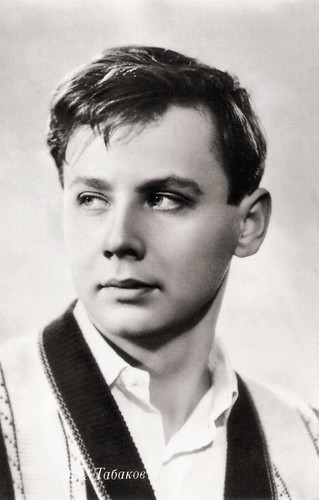
Oleg Tabakov. Russian postcard by Izdanije Byuro Propogandy Sovietskogo Kinoiskusstva, no. A 07154.
In the 1970s, Vsevolod Safonov appeared in several East German films, including Die Russen kommen / The Russians Are Coming (Heiner Carow, 1971) with Gert Krause-Melzer. He received 'all-union stardom'in the Soviet Union after the sympathetic drama Belorusski vokzal / Belorussian Station (Andrei Smirnov, 1970) about the reunion of four WWII veterans appeared on the Soviet Union's cinema screens. Safonov played the role of the Soviet journalist Alexei Kiryushin, a former front-line soldier. In 1972, he played in the 2-part epic Ukroshcheniye ognya / Taming of the Fire (Daniil Khrabrovitsky, 1972). The film dramatises the Soviet viewpoint of the Space Race. From the 1920s when Sergei Korolev (Kirill Lavrov), the founder of the Russian space and missile industry and its founder to Yuri Gagarin, the first man in space in 1961. The film features actual footage of the powerful, three-stage rockets built to launch Gagarin into space on Vostok 1.
Safonov played the lead in the TV mini-series Zhizn i smert Ferdinanda Lyusa / Life and Death of Ferdinand Lues (Anatoli Bobrovsky, 1976) opposite Donatas Banionis.
In the following decade, he played small parts in popular films like the historical detective film Larets Marii Medichi / Maria Medici’s Casket (Rudolf Fruntov, 1980), the biopic Anna Pavlova / A Woman for All Time (Emil Loteanu, 1983), depicting the life of the Russian ballet dancer Anna Pavlova, and the Polish-Russian gangster film Dezha vyu / Déjà vu (Juliusz Machulski, 1988) with Jerzy Stuhr.
His last films were the American-Japanese production Back in the U.S.S.R. (Deran Sarafian, 1991), starring Frank Whaley and Roman Polanski, and the Ukranian historical drama Sekretnyy eshelon / The Secret Echelon (Yaroslav Lupij, 1993). Back in the U.S.S.R. was a gangster thriller, set in the Soviet Union during Gorbatchov's Perestroika.
Vsevolod Safonov died of lung cancer in Moscow in 1992. He was 69. He was buried at the Khovanskoye Cemetery in Moscow. Safonov was married twice, to the actresses Valeria Ivanovna Rubleva and Elza Ivanovna Lezhdey. He had a daughter, well-known actress Yelena Safonova. The actor appeared in nearly 60 films. In 1974, he was awarded the title People's Artist of the USSR.

Donatas Banionis. Soviet-Russian postcard.
Sources: Find A Grave, Wikipedia (English, French and Russian) and IMDb.
This post was last updated on 19 October 2026.
Russian postcard by Izdanije Byuro Propogandy Sovietskogo Kinoiskusstva, no. A 09298, 1965. Photo: Ter-Ovanesova. (This postcard was printed in an edition of 200.000 cards. The price was 8 kop.)
The Russians are coming
Vsevolod Dmitriyevich Safonov (Все́волод Дми́триевич Сафо́нов)) was born in Moscow, Soviet Union (now Russia), in 1926. His twin brother died a day after birth. Vsevolod never met his father who died in his early childhood. He was brought up by his mother. His childhood was marked by poverty and hunger. The family lived in a tiny two-room flat with a large private garden on the outskirts of the capital, on Surikov Street in the Sokol settlement. As a child, Vsevolod dreamed of becoming a pilot.
When the Great Patriotic War began, Vsevolod was fifteen years old. He longed to go to the front and enrolled at an aviation technical college. In 1945, he graduated though not with a pilot’s qualification but with a technical one. He was eager to do his bit to defeat the Nazi invaders. However, to his disappointment, the medical board deemed him unfit for military service on health grounds. Friends of Safonov with whom he attended an amateur theatre club recommended that he try to enter a theatrical school. Vsevolod was accepted at the Boris Shchukin Theatre Institute (Театральный институт имени Бориса Щукина) where he graduated in 1949. He was immediately noticed by Alexander Tairov, artistic director of the Kamerny Theatre (an experminmental chamber theatre in Moscow) and was invited to work in his troupe. After the closing of the Kamerny Theatre in 1950, he worked at the Moscow Satire Theatre (Московский академический театр сатиры).
In 1955, he was accepted into the Film Actors’ Studio Theatre at the Lenfilm film studio in Leningrad and began to appear regularly in Soviet films. Safonov made his first film appearance in the leading role of Lieutenant Yuri Kerzhentsev in Soldaty / Four Soldiers from Stalingrad (Aleksandr Ivanov, 1956). This war drama was set in Russia during the Battle of Stalingrad in WWII. The war is shown through the eyes of simple soldiers. They dream of love in a peaceful life, which most will never have. This debut was followed by more starring parts in films like Shtorm / The Storm (Mikhail Dubson, 1957) the war drama Po tu storonu / On the Other Side (Fyodor Filippov, 1958) and the Bulgarian-Russian co-production Nakanune / On the Eve (Vladimir Petrov, 1959), with Oleg Tabakov.
Safonov became famous with the detective film Delo Pyostrykh / A Motley Case (Nikolay Dostal, 1958). He played the leading role of police lieutenant Sergey Korshunov, investigator of the Moscow Criminal Investigations Department. His girlfriend want him to quit his dangerous job, but Sergey instead gets a new case and not a simple one. In the 1960s followed roles in such films as Optimisticheskaya tragediya / Optimistic Tragedy (Samson Samsonov, 1963), and the romantic comedy Lyogkaya zhizn / An Easy Life (Venyamin Dorman, 1964), which was seen by 24.6 million Soviet filmgoers during its initial release.
He starred in the Sci-Fi film Giperboloid inzhenera Garina / The Hyperboloid of Engineer Garin (Aleksandr Gintsburg, 1965), based on Aleksey Tolstoy's novel of the same name. His other films include Na dikom berege / At Wild Shore (Anatoli Granik, 1966), in Osenniye svadby / Autumn Weddings (Boris Yashin, 1967), and Svoboda ili smart / Freedom of Death (Nikola Korabov, 1969).
Oleg Tabakov. Russian postcard by Izdanije Byuro Propogandy Sovietskogo Kinoiskusstva, no. A 07154.
Back in the U.S.S.R.
In the 1970s, Vsevolod Safonov appeared in several East German films, including Die Russen kommen / The Russians Are Coming (Heiner Carow, 1971) with Gert Krause-Melzer. He received 'all-union stardom'in the Soviet Union after the sympathetic drama Belorusski vokzal / Belorussian Station (Andrei Smirnov, 1970) about the reunion of four WWII veterans appeared on the Soviet Union's cinema screens. Safonov played the role of the Soviet journalist Alexei Kiryushin, a former front-line soldier. In 1972, he played in the 2-part epic Ukroshcheniye ognya / Taming of the Fire (Daniil Khrabrovitsky, 1972). The film dramatises the Soviet viewpoint of the Space Race. From the 1920s when Sergei Korolev (Kirill Lavrov), the founder of the Russian space and missile industry and its founder to Yuri Gagarin, the first man in space in 1961. The film features actual footage of the powerful, three-stage rockets built to launch Gagarin into space on Vostok 1.
Safonov played the lead in the TV mini-series Zhizn i smert Ferdinanda Lyusa / Life and Death of Ferdinand Lues (Anatoli Bobrovsky, 1976) opposite Donatas Banionis.
In the following decade, he played small parts in popular films like the historical detective film Larets Marii Medichi / Maria Medici’s Casket (Rudolf Fruntov, 1980), the biopic Anna Pavlova / A Woman for All Time (Emil Loteanu, 1983), depicting the life of the Russian ballet dancer Anna Pavlova, and the Polish-Russian gangster film Dezha vyu / Déjà vu (Juliusz Machulski, 1988) with Jerzy Stuhr.
His last films were the American-Japanese production Back in the U.S.S.R. (Deran Sarafian, 1991), starring Frank Whaley and Roman Polanski, and the Ukranian historical drama Sekretnyy eshelon / The Secret Echelon (Yaroslav Lupij, 1993). Back in the U.S.S.R. was a gangster thriller, set in the Soviet Union during Gorbatchov's Perestroika.
Vsevolod Safonov died of lung cancer in Moscow in 1992. He was 69. He was buried at the Khovanskoye Cemetery in Moscow. Safonov was married twice, to the actresses Valeria Ivanovna Rubleva and Elza Ivanovna Lezhdey. He had a daughter, well-known actress Yelena Safonova. The actor appeared in nearly 60 films. In 1974, he was awarded the title People's Artist of the USSR.
Donatas Banionis. Soviet-Russian postcard.
Sources: Find A Grave, Wikipedia (English, French and Russian) and IMDb.
This post was last updated on 19 October 2026.
No comments:
Post a Comment