On 15 May 2026, German actress Angelica Domröse (1941) passed away in Berlin. She was one of the most famous actresses of former East Germany. Domröse became a superstar through her role as the young mother Paula in the cult classic Die Legende von Paul und Paula (1973). The actress was 85.
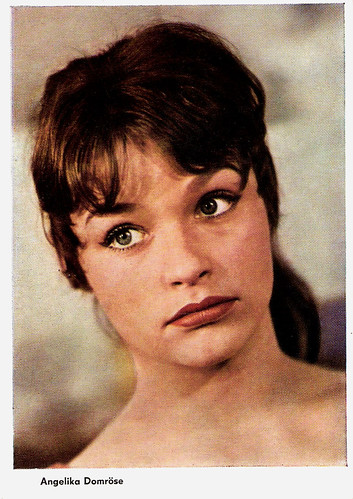
East German postcard by VEB Progress Film-Vertrieb, Berlin, no. 1326 F, 1960. Photo: DEFA-Neufeld.
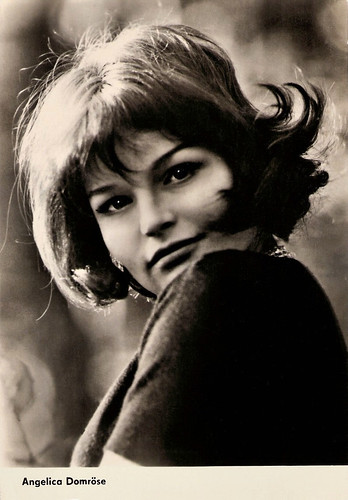
East German postcard by VEB Progress Film-Vertrieb, Berlin, no. 2091, 1964. Retail price: 0,20 DM. Photo: Klaus Fischer.

East German postcard by VEB Progress Film-Vertrieb, Berlin, no. 2255, 1965. Photo: Schirmer.

East German card by VEB Progress Film-Vertrieb, no. 2400, 1965. Photo: Balinski.
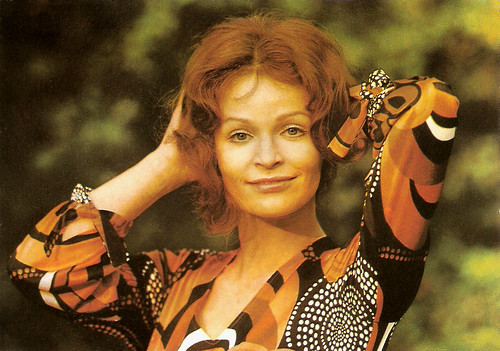
East German postcard by VEB Progress Film-Vertrieb, Berlin, no. 4/F/73, 1973. Retail price: 0,20 MDN. Photo: Linke.
Angelica Domröse was born in Berlin in 1941. Her Mediterranean appearance is the result of her biological father being a POW (prisoner of war) from France. Her mother married a locksmith, Rudolf Otto, to legalise her daughter, but Angelica did not get along with her stepfather.
After training as a stenographer, Domröse worked in a state-run foreign trade company in the GDR. In 1958, director Slátan Dudow selected her out of 15,000 competitors to appear in his film Verwirrung der Liebe / Confusion of Love (Slátan Dudow, 1958). This was the only East German film made at the time that lacked the usual state propaganda. Therefore, it was panned by the official GDR critics.
Meanwhile, Angelica also attended the Hochschule für Film und Fernsehen Potsdam (Film and Television Academy at Potsdam-Babelsberg) until 1961. During her acting training, she already received the offer to play the title role of Irene Sauer in the TV film Papas neue Freundin / Dad's New Girlfriend (Georg Leopold, 1961), and she became known to a broad audience.
From 1961 to 1966, she joined the Berliner Ensemble, the company founded by Bertolt Brecht and his wife Helene Weigel. Here she performed in Brecht's 'Dreigroschenoper' (Threepenny Opera), 'Schwejk im Zweiten Weltkrieg' (Schweik in the Second World War) and 'Die Tage der Commune' (The Days of the Commune), as well as in Helmut Baierl's 'Frau Flinz' (Mrs. Flinz).
In 1966, she was chosen 'Actress of the Year'. Thereafter, she worked with the Volksbühne Berlin until 1979. She starred in plays by George Bernard Shaw, William Shakespeare and Peter Hacks.

East German postcard by Progress Starfoto, no. 1034, 1959.Photo: Neufeld / DEFA. Angelica Domröse in Verwirrung der Liebe / Confusion of Love (Slátan Dudow, 1958).
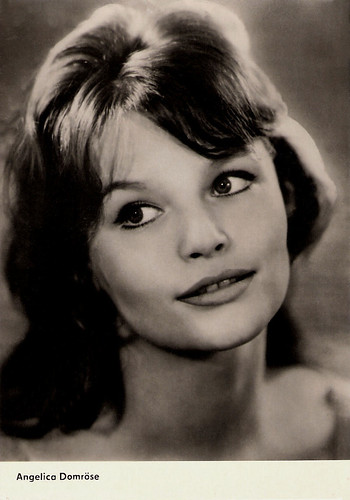
East German postcard by VEB Progress Film-Vertrieb, Berlin, no. 1401, 1961. Retail price: 0,20 DM. Photo: Jadke.
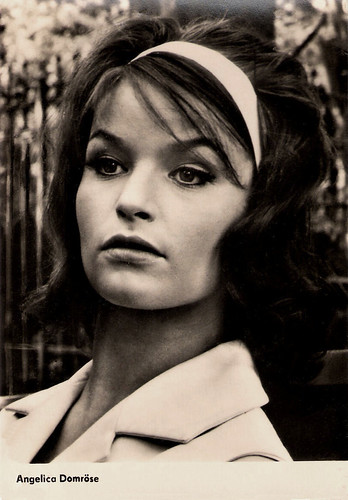
East German postcard by VEB Progress Film-Vertrieb, Berlin, no. 1649, 1961. Retail price: 0,20 DM. Photo: Schütt / DEFA.
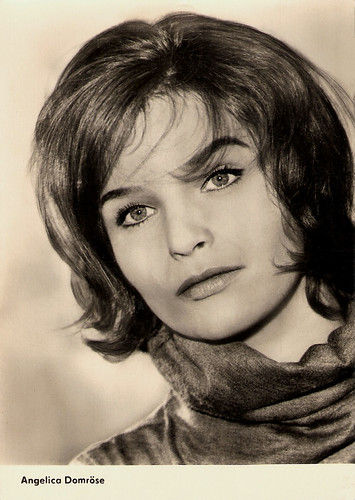
East German postcard by VEB Progress Film-Vertrieb, Berlin, no. 1650, 1961. Retail price: 0,20 DM. Photo: W. Denger.
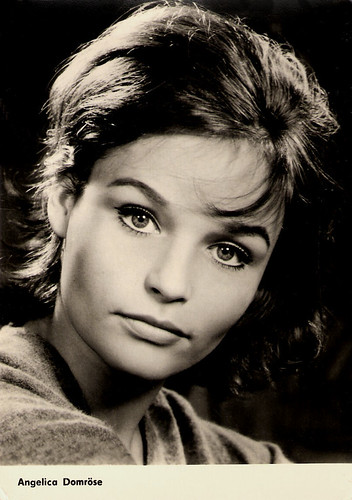
East German postcard by VEB Progress Film-Vertrieb, Berlin, no. 1724, 1962. Retail price: 0,20 DM. Photo: W. Denger.
Angelica Domröse also worked for the Deutsche Film-Aktiengesellschaft (DEFA) in films like the war drama An französischen Kaminen / At a French Fireside (Kurt Maetzig, 1962), Chronik eines Mordes / Story of a Murder (Joachim Hasler, 1965), based on a book by Leonhard Frank, and Die Abenteuer des Werner Holt / The Adventures of Werner Holt (Joachim Kunert, 1965).
She also appeared on the Deutscher Fernsehfunk (the East German TV). In 1971, 1973 and 1975, she was nominated as the 'DDR-Fernsehkünstlerin des Jahres' (GDR television artist of the year), and in 1976 she won the 'Nationalpreis der DDR II' (National Prize of East Germany).
Very popular were her (TV) films Effi Briest (Wolfgang Luderer, 1970) based on the book by Theodor Fontane, Unterm Birnbaum / Under the Pear Tree (Ralf Kirsten, 1972) based on another book by Fontane, and especially Die Legende von Paul und Paula / The Legend of Paul and Paula (Heiner Carow, 1973), probably the most successful East German film ever. The film is a realistic and honest view of everyday life in East Berlin in the 1970s. Eva-Maria Hagen and Winfried Glatzeder also feature in the film.
GDR leader Erich Honecker finally permitted the film to be shown, and 3 million of the 17 million people of East Germany went to see the film. The romance of Paul and Paula has a simple charm that captivates audiences. Her role made Domröse a superstar in her country.
Five years later, she made another film with Carow, Bis daß der Tod euch scheidet / Until Death Do Us Part (Heiner Carow, 1978). After signing the resolution of protest against the expulsion of Wolf Biermann from the GDR in November 1976, she was increasingly hampered in her work. In 1979, she did a guest performance as Helena in a production of 'Faust' at the Thalia Theatre in Hamburg. In 1980, she and her husband, Hilmar Thate, emigrated to West Germany, where they could continue their careers with demanding roles.
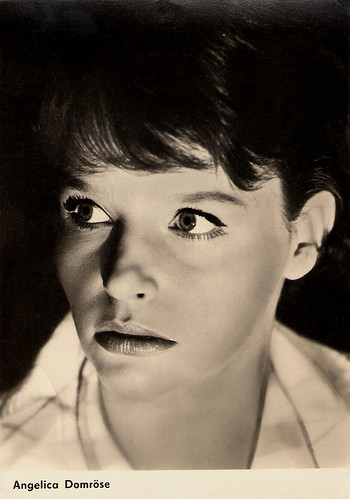
East German postcard by VEB Progress Film-Vertrieb, Berlin, no. 1919, 1963. Retail price: 0,20 DM. Photo: Blümel / DEFA.
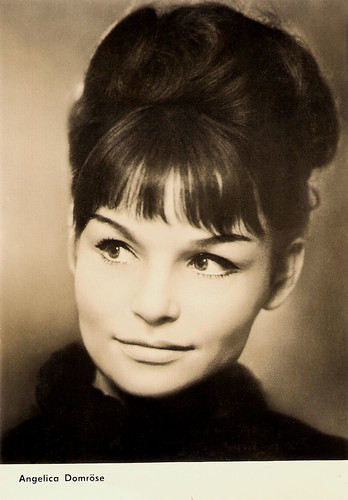
East German postcard by VEB Progress Film-Vertrieb, Berlin, no. 2229, 1965. Retail price: 0,20 DM. Photo: Schwarz.
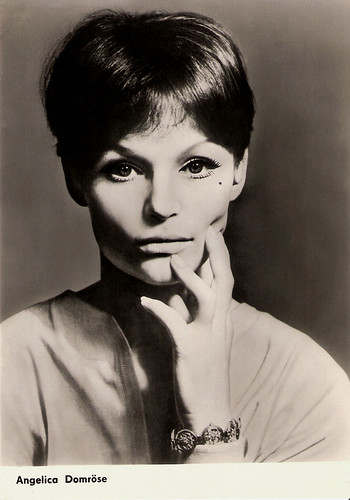
East German postcard by VEB Progress Film-Vertrieb, Berlin, no. 2589, 1966. Retail price: 0,20 DM. Photo: Arno Fischer.

East German postcard by VEB Progress Film-Vertrieb, Berlin, no. 2781, 1967. Photo: Schirmer. Angelica Domröse and Jiří Vršťala.

East German postcard by VEB Progress Film-Vertrieb, Berlin, no. 2779, 1967. Photo: Schirmer.
Angelica Domröse worked mostly in the Schiller Theatre in Berlin, but she also made guest appearances in Stuttgart, Hamburg, Bochum and Vienna. On TV, she was seen in such productions as the ironic mini-series Kir Royal (Helmut Dietl, 1986) with Franz-Xaver Kroetz, and the Krimi series Der Alte / The Old Fox (1988-1990).
She appeared in TV films by directors like Egon Günther (Hanna von acht bis acht / Hanna From Eight to Eight (1983) and Mamas Geburtstag / Mom's Birthday (1985)), Michael Haneke (Fraulein / Miss (1986)) and Carl Schenkel (Kalte Küsse / Cold Kisses (1997)). In 1988, she was awarded the Josef Kainz Medal.
In the early 1990s, she worked again with Heiner Carow for the cinema on Die Verfehlung / The Offence (Heiner Carow, 1992) with Gottfried John. On TV, she starred as Commissioner Vera Bilewski in the crime series Polizeiruf 110 / Police Call 110 (1994-1998), including the controversial episode Samstags, wenn Krieg ist (Saturdays, when it is war). After 1992, she has occasionally worked as a lecturer at the Universität der Künste (Art University) and the Ernst-Busch-Schule (Ernst Busch School) in Berlin. That same year, she directed at the Studio Theatre in Berlin and at the Meininger Theatre.
In 2003, her autobiography was published with the title 'Ich fang mich selbst ein – Mein leben' (I Catch Myself – My Life). Her most recent film was Tal der Ahnungslosen / Valley of the Unsuspecting (Branwen Okpako, 2003). In 2006, she needed to be treated in a hospital after a collapse. Her husband had found her lifeless in the bathroom. She returned triumphantly on stage at the Komödie am Kurfürstendamm as the aged diva Maria Callas in Terrence McNally's play 'Master Class'. She also starred opposite Hilmar Thate in the no less successful production of Peter Turrini's play 'Joseph and Mary', and played the role of Mary Tyrone in Eugene O'Neill's 'Long Day's Journey Into Night'.
In 2008, after more than three decades, the 'Traumpaar' (dream couple) of Paul and Paula were reunited on stage. Angelica Domröse and Winfried Glatzeder co-starred in Eduardo de Filippo's tragicomedy 'Filumena Marturano'. In September 2009, Domröse suddenly entered a sanatorium after a nervous breakdown, but she recovered soon. In 1976, Angelica Domröse married actor Hilmar Thate. From 1966 to 1975, she was married to actor Jiří Vršťala. The city of Berlin decided to name a path along a lake the 'Paul und Paula Ufer' with a 'Paul und Paula' bench to sit on. Domröse returned to the cinema in the melancholic comedy Bis zum Horizont, dann links / Fly Away (Bernd Böhlich, 2012) with Otto Sander. She played an old lady whose family sent her to an elderly home, where she takes part in a revolt. It was her final film role. Angelica Domröse died on 15 May 2026 after a long illness at the age of 85. She last lived in Berlin-Charlottenburg.

East German postcard by VEB Progress Film-Vertrieb, Berlin, no. 3140, 1968. Retail price: 0,20 DM. Photo: Schwarz. Angelica Domröse and Jiří Vršťala.

Big East German card by Progress Starfoto, no. 176/69. Photo: Linke.
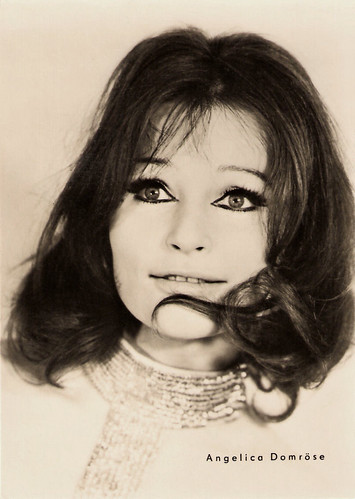
East German postcard by VEB Progress Film-Vertrieb, Berlin, no. 179/70, 1970. Retail price: 0,20 DM. Photo: Linke.
Scene from Die Legende von Paul und Paula / The Legend of Paul and Paula (1973). Source: yDelicious (YouTube).
Sources: Stephanie D’heil (Steffi-line - German), Filmportal.de, Bild.de (German), Berliner Zeitung (German - now defunct), Wikipedia and IMDb.
East German postcard by VEB Progress Film-Vertrieb, Berlin, no. 1326 F, 1960. Photo: DEFA-Neufeld.
East German postcard by VEB Progress Film-Vertrieb, Berlin, no. 2091, 1964. Retail price: 0,20 DM. Photo: Klaus Fischer.
East German postcard by VEB Progress Film-Vertrieb, Berlin, no. 2255, 1965. Photo: Schirmer.
East German card by VEB Progress Film-Vertrieb, no. 2400, 1965. Photo: Balinski.
East German postcard by VEB Progress Film-Vertrieb, Berlin, no. 4/F/73, 1973. Retail price: 0,20 MDN. Photo: Linke.
Confusion of love
Angelica Domröse was born in Berlin in 1941. Her Mediterranean appearance is the result of her biological father being a POW (prisoner of war) from France. Her mother married a locksmith, Rudolf Otto, to legalise her daughter, but Angelica did not get along with her stepfather.
After training as a stenographer, Domröse worked in a state-run foreign trade company in the GDR. In 1958, director Slátan Dudow selected her out of 15,000 competitors to appear in his film Verwirrung der Liebe / Confusion of Love (Slátan Dudow, 1958). This was the only East German film made at the time that lacked the usual state propaganda. Therefore, it was panned by the official GDR critics.
Meanwhile, Angelica also attended the Hochschule für Film und Fernsehen Potsdam (Film and Television Academy at Potsdam-Babelsberg) until 1961. During her acting training, she already received the offer to play the title role of Irene Sauer in the TV film Papas neue Freundin / Dad's New Girlfriend (Georg Leopold, 1961), and she became known to a broad audience.
From 1961 to 1966, she joined the Berliner Ensemble, the company founded by Bertolt Brecht and his wife Helene Weigel. Here she performed in Brecht's 'Dreigroschenoper' (Threepenny Opera), 'Schwejk im Zweiten Weltkrieg' (Schweik in the Second World War) and 'Die Tage der Commune' (The Days of the Commune), as well as in Helmut Baierl's 'Frau Flinz' (Mrs. Flinz).
In 1966, she was chosen 'Actress of the Year'. Thereafter, she worked with the Volksbühne Berlin until 1979. She starred in plays by George Bernard Shaw, William Shakespeare and Peter Hacks.
East German postcard by Progress Starfoto, no. 1034, 1959.Photo: Neufeld / DEFA. Angelica Domröse in Verwirrung der Liebe / Confusion of Love (Slátan Dudow, 1958).
East German postcard by VEB Progress Film-Vertrieb, Berlin, no. 1401, 1961. Retail price: 0,20 DM. Photo: Jadke.
East German postcard by VEB Progress Film-Vertrieb, Berlin, no. 1649, 1961. Retail price: 0,20 DM. Photo: Schütt / DEFA.
East German postcard by VEB Progress Film-Vertrieb, Berlin, no. 1650, 1961. Retail price: 0,20 DM. Photo: W. Denger.
East German postcard by VEB Progress Film-Vertrieb, Berlin, no. 1724, 1962. Retail price: 0,20 DM. Photo: W. Denger.
The legend of Paul and Paula
Angelica Domröse also worked for the Deutsche Film-Aktiengesellschaft (DEFA) in films like the war drama An französischen Kaminen / At a French Fireside (Kurt Maetzig, 1962), Chronik eines Mordes / Story of a Murder (Joachim Hasler, 1965), based on a book by Leonhard Frank, and Die Abenteuer des Werner Holt / The Adventures of Werner Holt (Joachim Kunert, 1965).
She also appeared on the Deutscher Fernsehfunk (the East German TV). In 1971, 1973 and 1975, she was nominated as the 'DDR-Fernsehkünstlerin des Jahres' (GDR television artist of the year), and in 1976 she won the 'Nationalpreis der DDR II' (National Prize of East Germany).
Very popular were her (TV) films Effi Briest (Wolfgang Luderer, 1970) based on the book by Theodor Fontane, Unterm Birnbaum / Under the Pear Tree (Ralf Kirsten, 1972) based on another book by Fontane, and especially Die Legende von Paul und Paula / The Legend of Paul and Paula (Heiner Carow, 1973), probably the most successful East German film ever. The film is a realistic and honest view of everyday life in East Berlin in the 1970s. Eva-Maria Hagen and Winfried Glatzeder also feature in the film.
GDR leader Erich Honecker finally permitted the film to be shown, and 3 million of the 17 million people of East Germany went to see the film. The romance of Paul and Paula has a simple charm that captivates audiences. Her role made Domröse a superstar in her country.
Five years later, she made another film with Carow, Bis daß der Tod euch scheidet / Until Death Do Us Part (Heiner Carow, 1978). After signing the resolution of protest against the expulsion of Wolf Biermann from the GDR in November 1976, she was increasingly hampered in her work. In 1979, she did a guest performance as Helena in a production of 'Faust' at the Thalia Theatre in Hamburg. In 1980, she and her husband, Hilmar Thate, emigrated to West Germany, where they could continue their careers with demanding roles.
East German postcard by VEB Progress Film-Vertrieb, Berlin, no. 1919, 1963. Retail price: 0,20 DM. Photo: Blümel / DEFA.
East German postcard by VEB Progress Film-Vertrieb, Berlin, no. 2229, 1965. Retail price: 0,20 DM. Photo: Schwarz.
East German postcard by VEB Progress Film-Vertrieb, Berlin, no. 2589, 1966. Retail price: 0,20 DM. Photo: Arno Fischer.
East German postcard by VEB Progress Film-Vertrieb, Berlin, no. 2781, 1967. Photo: Schirmer. Angelica Domröse and Jiří Vršťala.
East German postcard by VEB Progress Film-Vertrieb, Berlin, no. 2779, 1967. Photo: Schirmer.
I catch myself
Angelica Domröse worked mostly in the Schiller Theatre in Berlin, but she also made guest appearances in Stuttgart, Hamburg, Bochum and Vienna. On TV, she was seen in such productions as the ironic mini-series Kir Royal (Helmut Dietl, 1986) with Franz-Xaver Kroetz, and the Krimi series Der Alte / The Old Fox (1988-1990).
She appeared in TV films by directors like Egon Günther (Hanna von acht bis acht / Hanna From Eight to Eight (1983) and Mamas Geburtstag / Mom's Birthday (1985)), Michael Haneke (Fraulein / Miss (1986)) and Carl Schenkel (Kalte Küsse / Cold Kisses (1997)). In 1988, she was awarded the Josef Kainz Medal.
In the early 1990s, she worked again with Heiner Carow for the cinema on Die Verfehlung / The Offence (Heiner Carow, 1992) with Gottfried John. On TV, she starred as Commissioner Vera Bilewski in the crime series Polizeiruf 110 / Police Call 110 (1994-1998), including the controversial episode Samstags, wenn Krieg ist (Saturdays, when it is war). After 1992, she has occasionally worked as a lecturer at the Universität der Künste (Art University) and the Ernst-Busch-Schule (Ernst Busch School) in Berlin. That same year, she directed at the Studio Theatre in Berlin and at the Meininger Theatre.
In 2003, her autobiography was published with the title 'Ich fang mich selbst ein – Mein leben' (I Catch Myself – My Life). Her most recent film was Tal der Ahnungslosen / Valley of the Unsuspecting (Branwen Okpako, 2003). In 2006, she needed to be treated in a hospital after a collapse. Her husband had found her lifeless in the bathroom. She returned triumphantly on stage at the Komödie am Kurfürstendamm as the aged diva Maria Callas in Terrence McNally's play 'Master Class'. She also starred opposite Hilmar Thate in the no less successful production of Peter Turrini's play 'Joseph and Mary', and played the role of Mary Tyrone in Eugene O'Neill's 'Long Day's Journey Into Night'.
In 2008, after more than three decades, the 'Traumpaar' (dream couple) of Paul and Paula were reunited on stage. Angelica Domröse and Winfried Glatzeder co-starred in Eduardo de Filippo's tragicomedy 'Filumena Marturano'. In September 2009, Domröse suddenly entered a sanatorium after a nervous breakdown, but she recovered soon. In 1976, Angelica Domröse married actor Hilmar Thate. From 1966 to 1975, she was married to actor Jiří Vršťala. The city of Berlin decided to name a path along a lake the 'Paul und Paula Ufer' with a 'Paul und Paula' bench to sit on. Domröse returned to the cinema in the melancholic comedy Bis zum Horizont, dann links / Fly Away (Bernd Böhlich, 2012) with Otto Sander. She played an old lady whose family sent her to an elderly home, where she takes part in a revolt. It was her final film role. Angelica Domröse died on 15 May 2026 after a long illness at the age of 85. She last lived in Berlin-Charlottenburg.
East German postcard by VEB Progress Film-Vertrieb, Berlin, no. 3140, 1968. Retail price: 0,20 DM. Photo: Schwarz. Angelica Domröse and Jiří Vršťala.
Big East German card by Progress Starfoto, no. 176/69. Photo: Linke.
East German postcard by VEB Progress Film-Vertrieb, Berlin, no. 179/70, 1970. Retail price: 0,20 DM. Photo: Linke.
Scene from Die Legende von Paul und Paula / The Legend of Paul and Paula (1973). Source: yDelicious (YouTube).
Sources: Stephanie D’heil (Steffi-line - German), Filmportal.de, Bild.de (German), Berliner Zeitung (German - now defunct), Wikipedia and IMDb.
No comments:
Post a Comment