In the late 1950s, sweet and sexy French actress Pascale Petit (1938) formed serious competition for Brigitte Bardot as the Sex Symbol of French cinema. She appeared in more than fifty films from 1957 to 2001.

Vintage postcard.

Dutch postcard by Takken, Utrecht, no. 4068. Photo: N.V. Standaardfilms, Amsterdam. Pascale Petit in Les Tricheurs / Youthful Sinners (Marcel Carné, 1958).

Dutch postcard by Uitg. Takken, Utrecht, no. AX 4069. Photo: NV Standaardfilms, Amsterdam. Jacques Charrier and Pascale Petit in Les Tricheurs / The Cheaters (Marcel Carné, 1958).
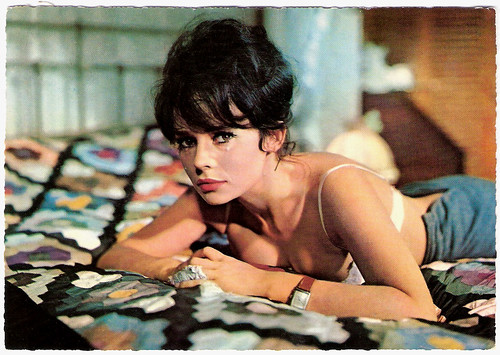
German postcard by Krüger, no. 902/65.

Dutch postcard by Internationale Filmpers, Amsterdam, no. WPS 32, for Song Parade. Pascale Petit in Les Tricheurs / Youthful Sinners (Marcel Carné, 1958).

German postcard by Krüger, no. 902/90. Photo: Sam Lévin.

West German postcard by Rüdel-Verlag, Hamburg-Bergedorf, no. 3048. Photo: Constantin-Film. Pascale Petit in Julie la rousse / Julie the Redhead (Claude Boissol, 1959). The German title was Rote Haare - freche Lippen.

French postcard by Editions P.I., Paris, no. FK 29. Photo: Unifrance / Ufa. Pascale Petit in Faibles femmes / Three Murderesses (Michel Boisrond, 1959).

Yugoslav postcard by Studio Sombor, no. 203.
Pascale Petit was born as Anne-Marie Petit in Paris, France, in 1938. She had a brother and a sister. Petit spent her childhood and adolescence in Vaires-sur-Marne. Before becoming an actress, she worked as a beautician.
In 1956, married the actor Jacques Portet, from whom she divorced in 1960. She worked at the Carita hair salon, where she was spotted by a client, the actress Françoise Lugagne. Lugagnne was the wife of the director-actor Raymond Rouleau, who was searching for young actresses for his directorial debut, Les Sorcières de Salem / The Crucible.
Petit made her cinema debut in the role of Mary Warren, erstwhile accuser at the Salem witch trials of 1692 and later confessed 'witch', in Les Sorcières de Salem / The Crucible (Raymond Rouleau, 1957), starring Yves Montand and Simone Signoret. Famous author Jean-Paul Sartre wrote the screenplay, based on the play by Arthur Miller.
The following year, she was awarded the Prix Suzanne Bianchetti in 1958 for her role as the servant girl Rosalie in Une Vie / One Life (Alexandre Astruc, 1958), starring Maria Schell and Christian Marquand. Despite never having had any formal acting training, she was awarded the prestigious Prix Suzanne Bianchetti in 1958, presented annually to a promising young French actress.
Then followed her role as a rich, existentialist kid in Les tricheurs / The Cheaters (Marcel Carné, 1958), which made her a star. A scene in which one of her breasts was shown caused a sensation. Hal Erickson at AllMovie: "Of the cast, Pascale Petit stands out as a trendy young girl whose willingness to follow the crowd leads to tragedy." Upon the film’s release, she was regarded as one of the most talented actresses of the time, her naturalness and spontaneity setting her apart from the more conventional actresses of the day. Famous French film critic and historian Georges Sadoul even ranked her among the ‘four most gifted actors’ of the era.

West German postcard by Ufa, Berlin-Tempelhof, no. CK-312. Photo: Sam Lévin / Ufa.
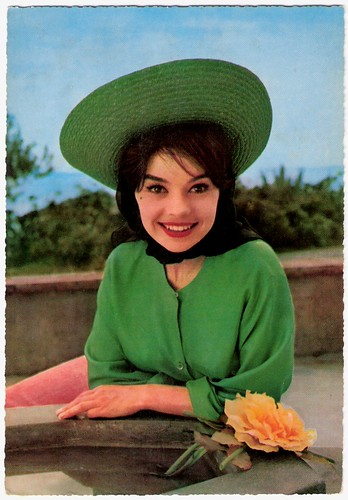
German postcard by Krüger, no. 902/44.

German postcard by Krüger, no. 902/89. Photo: Sam Levin.

German postcard by Krüger, no. 902/88. Photo: Sam Lévin.

German postcard by Krüger, no. 902/160. Photo: Fried Agency / Ufa.

French postcard by PSG, no. 33, offered by Corvisart. Photo: Lucienne Chevert.

French postcard by Editions P.I., Paris, no. 1067, offered by Corvisart, Epinal. Photo: Sam Lévin.

French postcard by PSG, no. 70, offered by Corvisart. Photo: Sam Lévin.
Pascale Petit followed up her success with a title role in the comedy Julie la rousse / Julie the Redhead (Claude Boissol, 1959) opposite Daniel Gélin. Soon, she received more roles as a seductive femme fatale, and for a while, the media compared PP to BB, Brigitte Bardot. She played in such comedies as Faibles femmes / Three Murderesses (Michel Boisrond, 1959) with Alain Delon and Mylène Demongeot, and Une fille pour l'été / A Girl for the Summer (Edouard Molinaro, 1960) opposite Micheline Presle.
In 1959, at the Moscow Film Festival, she met the poet and actor Giani Esposito and later married him during the filming of Une fille pour l'été / A Girl for the Summer (Edouard Molinaro, 1960). She followed him to Italy, where the couple had a daughter, Nathalia, known as Bojidarka, born in 1963.
She portrayed Cleopatra during the internecine struggles with her brother Ptolemy in The Italian-French coproduction Una regina per Cesare / Cléopâtre une reine pour César / A Queen for Caesar (Piero Pierotti, Victor Tourjansky, 1962) with George Ardisson and Gordon Scott. 20th Century Fox bought the rights for the film to keep it out of release lest it compete with their own Cleopatra (y Joseph L. Mankiewicz, 1963), starring Elizabeth Taylor.
In the mid-1960s, Pascale Petit’s film career shifted towards B-movies, particularly German and Italian productions, which caused her to fade from the French spotlight. An example is the Spaghetti Western Joe... cercati un posto per morire! / Find a Place to Die (Giuliano Carnimeo, Hugo Fregonese, 1968) with Jeffrey Hunter.
In 1969, she divorced Esposito and married American actor Ray Danton, her co-star of the Spy thriller Corrida pour un espion / Code Name: Jaguar (Maurice Labro, 1965) and the Spanish/West German/Italian Western The Last Mercenary (Mel Welles a.k.a. Dieter Müller, 1968).
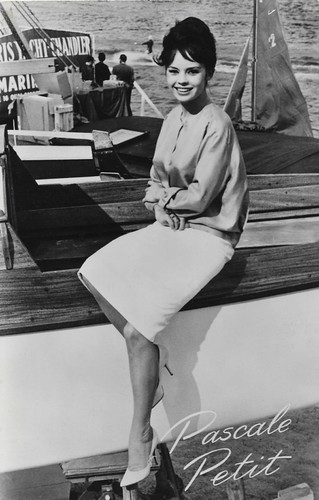
Dutch postcard by Takken, Utrecht, no. AX 5153. A gift by Marlene Pilaete.

French postcard by Editions du Globe, Paris, no. 765. Photo: Lucienne Chevert.

French postcard by Editions du Globe, Paris, no. 785. Photo: Studio Vauclair.

French postcard by Editions du Globe, Paris, no. 807. Photo: Lucienne Chevert.

French postcard by Editions du Globe, Paris, no. 824. Photo: Sam Lévin.

French postcard by Editions du Globe, Paris, no. 825. Photo: Sam Lévin / Ufa.

French postcard by Editions du Globe, Paris, no. 825. Photo: Lucienne Chevert.

French postcard by Editions du Globe, Paris, no. 826. Photo: Lucienne Chevert.
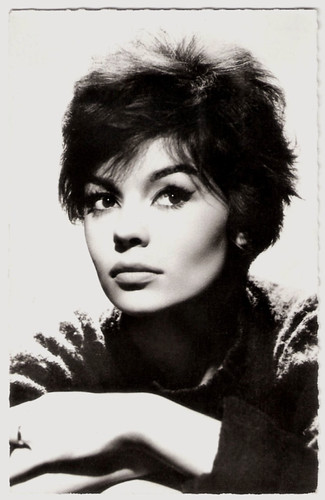
French postcard by Editions du Globe, Paris, no. 827. Photo: Lucienne Chevert.
In the early 1970s, Pascale Petit tried to make a comeback in France, as well as in the cinema with Chronique d'un Couple... / Chronicle of a Couple (Roger Coggio, 1971), as well as in the music scene with 'Il ne reste que moi...' (What's Left is Me, 1973).
The success was lukewarm, and in the following decades, she worked as a character actress in mostly unremarkable international films and TV productions.
Interesting was a small Dutch gem, A Strange Love Affair (Eric De Kuyper, Paul Verstraten, 1984). Her most recent film is Ville à vendre / City for Sale (Jean-Pierre Mocky, 1992), starring Michel Serrault and Richard Bohringer.
She also appeared in two TV films by Brigitte Bardot's Svengali, Roger Vadim, the mini-series La nouvelle tribu / The New Tribe (1996), and Un coup de baguette magique / A Magic Wand (1997), both featuring Marie-Christine Barrault. In 2022, she published a memoir entitled 'Une vie sans tricher' (A Life without Cheating). In 2023, she appeared in the Netflix series Pax Massilia / Blood Coast (Olivier Marchal, 2023).
Pascale Petit has two daughters, Nathalia, from her marriage to Giani Esposito and Mickaëla (1966), from her relationship with Ray Danton. At the age of twenty, Nathalia became an ambassador for Disney France. Under the name Douchka, she recorded in the 1980s numerous songs for children, inspired by Walt Disney cartoon heroes.

Dutch postcard by Gebr. Spanjersberg N.V., Rotterdam, no. 1239. Photo: Ufa, Berlin-Tempelhof.

Dutch postcard, ca. 1961.

Dutch postcard by Gebr. Spanjersberg, Rotterdam, no. 5543.

West German postcard by Ufa/Film-Foto, Berlin-Tempelhof, no. FK 4825. Photo: Fried Agency.

French postcard, no. 7. Photo: Sam Lévin. Mexichrome.

French postcard by Editions du Globe, Paris, no. 39. Photo: Sam Lévin.

French postcard by E.D.U.G., no. 64. Photo: Sam Lévin.

German postcard by Krüger, ca. 1961.
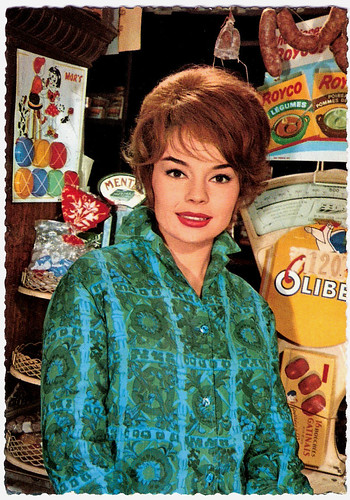
German postcard by Krüger, no. 902/134. Photo: Ufa.

German postcard by Ufa, Berlin-Tempelhof, no. CK 341. Retail price: 30 Pfg. Photo: Gérard Decaux / Ufa.
Sources: I.S. Mowis (IMDb), Hal Erickson (AllMovie - Page Now Defunct), AllMovie, Wikipedia (French and English) and IMDb. Thanks to Marlène Pilaete for the additional info!
Vintage postcard.
Dutch postcard by Takken, Utrecht, no. 4068. Photo: N.V. Standaardfilms, Amsterdam. Pascale Petit in Les Tricheurs / Youthful Sinners (Marcel Carné, 1958).
Dutch postcard by Uitg. Takken, Utrecht, no. AX 4069. Photo: NV Standaardfilms, Amsterdam. Jacques Charrier and Pascale Petit in Les Tricheurs / The Cheaters (Marcel Carné, 1958).
German postcard by Krüger, no. 902/65.
Dutch postcard by Internationale Filmpers, Amsterdam, no. WPS 32, for Song Parade. Pascale Petit in Les Tricheurs / Youthful Sinners (Marcel Carné, 1958).
German postcard by Krüger, no. 902/90. Photo: Sam Lévin.
West German postcard by Rüdel-Verlag, Hamburg-Bergedorf, no. 3048. Photo: Constantin-Film. Pascale Petit in Julie la rousse / Julie the Redhead (Claude Boissol, 1959). The German title was Rote Haare - freche Lippen.
French postcard by Editions P.I., Paris, no. FK 29. Photo: Unifrance / Ufa. Pascale Petit in Faibles femmes / Three Murderesses (Michel Boisrond, 1959).
Yugoslav postcard by Studio Sombor, no. 203.
Seductive femme fatale
Pascale Petit was born as Anne-Marie Petit in Paris, France, in 1938. She had a brother and a sister. Petit spent her childhood and adolescence in Vaires-sur-Marne. Before becoming an actress, she worked as a beautician.
In 1956, married the actor Jacques Portet, from whom she divorced in 1960. She worked at the Carita hair salon, where she was spotted by a client, the actress Françoise Lugagne. Lugagnne was the wife of the director-actor Raymond Rouleau, who was searching for young actresses for his directorial debut, Les Sorcières de Salem / The Crucible.
Petit made her cinema debut in the role of Mary Warren, erstwhile accuser at the Salem witch trials of 1692 and later confessed 'witch', in Les Sorcières de Salem / The Crucible (Raymond Rouleau, 1957), starring Yves Montand and Simone Signoret. Famous author Jean-Paul Sartre wrote the screenplay, based on the play by Arthur Miller.
The following year, she was awarded the Prix Suzanne Bianchetti in 1958 for her role as the servant girl Rosalie in Une Vie / One Life (Alexandre Astruc, 1958), starring Maria Schell and Christian Marquand. Despite never having had any formal acting training, she was awarded the prestigious Prix Suzanne Bianchetti in 1958, presented annually to a promising young French actress.
Then followed her role as a rich, existentialist kid in Les tricheurs / The Cheaters (Marcel Carné, 1958), which made her a star. A scene in which one of her breasts was shown caused a sensation. Hal Erickson at AllMovie: "Of the cast, Pascale Petit stands out as a trendy young girl whose willingness to follow the crowd leads to tragedy." Upon the film’s release, she was regarded as one of the most talented actresses of the time, her naturalness and spontaneity setting her apart from the more conventional actresses of the day. Famous French film critic and historian Georges Sadoul even ranked her among the ‘four most gifted actors’ of the era.
West German postcard by Ufa, Berlin-Tempelhof, no. CK-312. Photo: Sam Lévin / Ufa.
German postcard by Krüger, no. 902/44.
German postcard by Krüger, no. 902/89. Photo: Sam Levin.
German postcard by Krüger, no. 902/88. Photo: Sam Lévin.
German postcard by Krüger, no. 902/160. Photo: Fried Agency / Ufa.
French postcard by PSG, no. 33, offered by Corvisart. Photo: Lucienne Chevert.
French postcard by Editions P.I., Paris, no. 1067, offered by Corvisart, Epinal. Photo: Sam Lévin.
French postcard by PSG, no. 70, offered by Corvisart. Photo: Sam Lévin.
German and Italian B pictures
Pascale Petit followed up her success with a title role in the comedy Julie la rousse / Julie the Redhead (Claude Boissol, 1959) opposite Daniel Gélin. Soon, she received more roles as a seductive femme fatale, and for a while, the media compared PP to BB, Brigitte Bardot. She played in such comedies as Faibles femmes / Three Murderesses (Michel Boisrond, 1959) with Alain Delon and Mylène Demongeot, and Une fille pour l'été / A Girl for the Summer (Edouard Molinaro, 1960) opposite Micheline Presle.
In 1959, at the Moscow Film Festival, she met the poet and actor Giani Esposito and later married him during the filming of Une fille pour l'été / A Girl for the Summer (Edouard Molinaro, 1960). She followed him to Italy, where the couple had a daughter, Nathalia, known as Bojidarka, born in 1963.
She portrayed Cleopatra during the internecine struggles with her brother Ptolemy in The Italian-French coproduction Una regina per Cesare / Cléopâtre une reine pour César / A Queen for Caesar (Piero Pierotti, Victor Tourjansky, 1962) with George Ardisson and Gordon Scott. 20th Century Fox bought the rights for the film to keep it out of release lest it compete with their own Cleopatra (y Joseph L. Mankiewicz, 1963), starring Elizabeth Taylor.
In the mid-1960s, Pascale Petit’s film career shifted towards B-movies, particularly German and Italian productions, which caused her to fade from the French spotlight. An example is the Spaghetti Western Joe... cercati un posto per morire! / Find a Place to Die (Giuliano Carnimeo, Hugo Fregonese, 1968) with Jeffrey Hunter.
In 1969, she divorced Esposito and married American actor Ray Danton, her co-star of the Spy thriller Corrida pour un espion / Code Name: Jaguar (Maurice Labro, 1965) and the Spanish/West German/Italian Western The Last Mercenary (Mel Welles a.k.a. Dieter Müller, 1968).
Dutch postcard by Takken, Utrecht, no. AX 5153. A gift by Marlene Pilaete.
French postcard by Editions du Globe, Paris, no. 765. Photo: Lucienne Chevert.
French postcard by Editions du Globe, Paris, no. 785. Photo: Studio Vauclair.
French postcard by Editions du Globe, Paris, no. 807. Photo: Lucienne Chevert.
French postcard by Editions du Globe, Paris, no. 824. Photo: Sam Lévin.
French postcard by Editions du Globe, Paris, no. 825. Photo: Sam Lévin / Ufa.
French postcard by Editions du Globe, Paris, no. 825. Photo: Lucienne Chevert.
French postcard by Editions du Globe, Paris, no. 826. Photo: Lucienne Chevert.
French postcard by Editions du Globe, Paris, no. 827. Photo: Lucienne Chevert.
A small Dutch gem
In the early 1970s, Pascale Petit tried to make a comeback in France, as well as in the cinema with Chronique d'un Couple... / Chronicle of a Couple (Roger Coggio, 1971), as well as in the music scene with 'Il ne reste que moi...' (What's Left is Me, 1973).
The success was lukewarm, and in the following decades, she worked as a character actress in mostly unremarkable international films and TV productions.
Interesting was a small Dutch gem, A Strange Love Affair (Eric De Kuyper, Paul Verstraten, 1984). Her most recent film is Ville à vendre / City for Sale (Jean-Pierre Mocky, 1992), starring Michel Serrault and Richard Bohringer.
She also appeared in two TV films by Brigitte Bardot's Svengali, Roger Vadim, the mini-series La nouvelle tribu / The New Tribe (1996), and Un coup de baguette magique / A Magic Wand (1997), both featuring Marie-Christine Barrault. In 2022, she published a memoir entitled 'Une vie sans tricher' (A Life without Cheating). In 2023, she appeared in the Netflix series Pax Massilia / Blood Coast (Olivier Marchal, 2023).
Pascale Petit has two daughters, Nathalia, from her marriage to Giani Esposito and Mickaëla (1966), from her relationship with Ray Danton. At the age of twenty, Nathalia became an ambassador for Disney France. Under the name Douchka, she recorded in the 1980s numerous songs for children, inspired by Walt Disney cartoon heroes.
Dutch postcard by Gebr. Spanjersberg N.V., Rotterdam, no. 1239. Photo: Ufa, Berlin-Tempelhof.
Dutch postcard, ca. 1961.
Dutch postcard by Gebr. Spanjersberg, Rotterdam, no. 5543.
West German postcard by Ufa/Film-Foto, Berlin-Tempelhof, no. FK 4825. Photo: Fried Agency.
French postcard, no. 7. Photo: Sam Lévin. Mexichrome.
French postcard by Editions du Globe, Paris, no. 39. Photo: Sam Lévin.
French postcard by E.D.U.G., no. 64. Photo: Sam Lévin.
German postcard by Krüger, ca. 1961.
German postcard by Krüger, no. 902/134. Photo: Ufa.
German postcard by Ufa, Berlin-Tempelhof, no. CK 341. Retail price: 30 Pfg. Photo: Gérard Decaux / Ufa.
Sources: I.S. Mowis (IMDb), Hal Erickson (AllMovie - Page Now Defunct), AllMovie, Wikipedia (French and English) and IMDb. Thanks to Marlène Pilaete for the additional info!
Wow - she is beautiful! Happy PFF.
ReplyDeleteShe is beautiful! Although not as nice as those handsome male stars you post! :)
ReplyDeleteVery beautiful. How a career or fame is determined by the chance choice of films.
ReplyDeleteI could see she would be a beauty that would cause some serious competitiveness for Brigette. Love that name Pascale.
ReplyDeleteYou always have such beautiful women up on your blog (the men are pretty good too!) Happy PFF!
ReplyDeleteShe was extremely attractive, she may still be, but I have to say I've never heard her name before.
ReplyDeleteGreat bit of film history. I've never seen one of her films even though I'm an ardent Francophile.
ReplyDeletestunning cards as ever...i've always loved those large format european postcards with scalloped edges. happy belated PFF!
ReplyDeleteThank you for all your comments. Hope to meet again, next week at PFF.
ReplyDeleteSo beautiful!
ReplyDelete