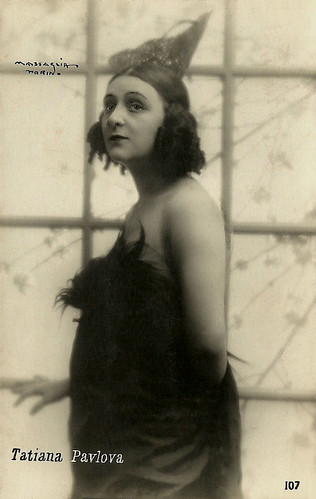
Italian postcard, no. 107. Photo: Ercole Massaglia, Torino. Collection: Didier Hanson.

Italian postcard by Edizioni A. Traldi, Milano, no. 877. Photo: Fontana.

Vintage postcard.
Ambrosio
Tat'jana Pavlova Zeitman (Russian: Татьяна Павловна Павлова) was born in Yekaterinoslav, Russian Empire (now Dnipropetrovsk, Ukraine), in 1893. In 1911, she began her career as a young stage actress. She first worked in the touring company of Pavel Orlenev and later in Moscow theatres. She made her Moscow debut in 1916 in the lead role of Fröken Julie (Miss Julie) by August Strindberg.
Following the revolution, she abandoned Moscow and worked in Paris, Odessa and Constantinople. In 1919, she went to Italy, where she participated in silent films of the Ambrosio studio like La catena / The Chain (Alessandro Rosenfeld, Aleksandr Uralsky, 1920) with Russian actor Ossip Runitsch.
It was followed by other films by Rosenfeld and Uralsky, like L'Orchidea fatale / The Fatal Orchid (1920) with Ossip Runitsch. In the meanwhile she studied Italian from Cesare Dondini and Carlo Rosaspina.
In 1923, she founded a theatre company with her own money. It debuted at the Teatro Valle in Rome with 'Sogno d'amore'(Mecta Ljubvi / Dream of love) by Alexander Kosorotov. She interpreted and directed authors such as Leonid Andreev, Anton Chekhov, Maxim Gorky, and Ferenc Molnár, with an originality that gave her credit for having helped to create the stage direction in Italy. In her company was a young Tina Lattanzi together with Vittorio de Sica.
Pavlova also continued to work as a film actress. Her films include Creature della note / Creatures of the notes (Amleto Palermi, 1934) with Isa Pola, and La signora di tutti / Everybody's Woman (Max Ophuls, 1934), starring Isa Miranda. In 1935, she settled in Rome, having been invited by Silvio D'Amico to direct courses in the newly founded National Academy of Dramatic Arts. In 1938, she married the writer and fascist Nino D'Aroma.

Italian postcard. Photo Crimella. Tatiana Pavlova and Renato Cialente in the stage play 'Gelosia' (Jealousy) by Michail Arcybašev. The play had its premiere at the Teatro Goldini in Venice in 1926, and was a huge success. Director was Ernesto Sabbatini. It had a reprisal e.g. in 1929 at the Teatro dell' Accademia dei Filodrammatici in Milan, the regular seat of the stage company of Tatiana Pavlova.
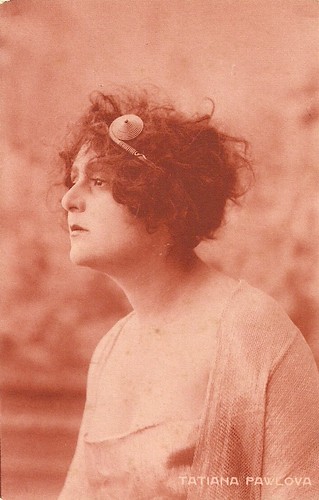
Italian postcard.

Italian postcard, no. 106. Photo: Massaglia, Torino.
Visconti
After the war, Tatiana Pavlova increasingly diminished her appearances as an actress. In 1946, he played the role of the mother in the play 'The Glass Menagerie' by Tennessee Williams, directed by Luchino Visconti.
Her post-war films include Una lettera all'alba / Letter at Dawn (Giorgio Bianchi, 1948) with Fosco Giachetti, and the Italian-American production Cagliostro / Black Magic (Gregory Ratoff, 1949) starring Orson Welles.
Later, she devoted herself mainly to directing operas.
In 1965, she played in three films, including Menage all'italiana / Menage Italian Style (Franco Indovina, 1965) with Ugo Tognazzi, and Io la conoscevo bene / I Knew Her Well (Antonio Pietrangeli, 1965) with Stefania Sandrelli.
Tatiana Pavlova passed away in 1975 at the age of 81 in the nursing home Villa Letizia of Grottaferrata.
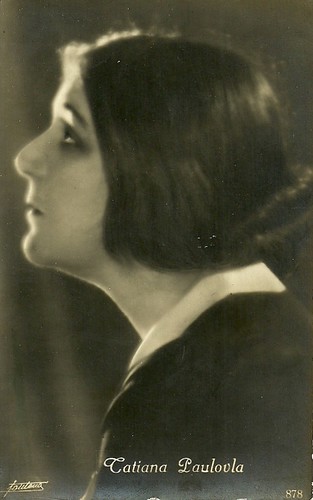
Italian postcard by Ed. A. Traldi, Milano, no. 878. Photo: Fontana. Pavlova's name is misspelt on the card as Paulovla.

Italian postcard by Ed. Vettori, Bologna, no. 420.

Italian postcard by Rizzoli, Milano, 1934-XII. Photo: Novella-Film. Isa Miranda, Tatiana Pavlova and Memo Benassi in La signora di tutti / Everybody's Woman (Max Ophüls, 1934).

Italian postcard by Rizzoli, Milano, 1934-XII. Photo: Novella-Film. Isa Miranda and Tatiana Pavlova in La signora di tutti / Everybody's Woman (Max Ophüls, 1934).
Sources: Treccani (Italian), Wikipedia (Italian) and IMDb.
This post was last updated on 6 March 2026.
No comments:
Post a Comment