Today, we read that British film and stage actress Nova Pilbeam died on 17 July 2015. She was a forgotten star with an odd name. As a teenager, she played in two Alfred Hitchcock classics, The Man Who Knew Too Much (1934) and Young and Innocent (1937). In 1948, she vanished from the British cinema. Nova Pilbeam was 95.
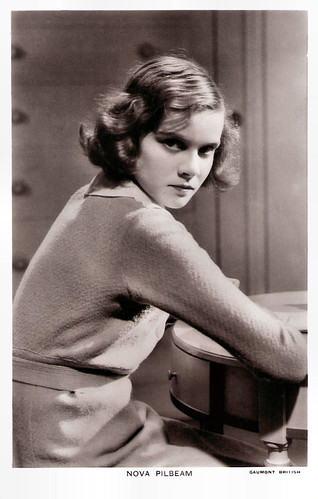
British postcard in the Picturegoer Series, London, no. 877. Photo: Gaumont-British.
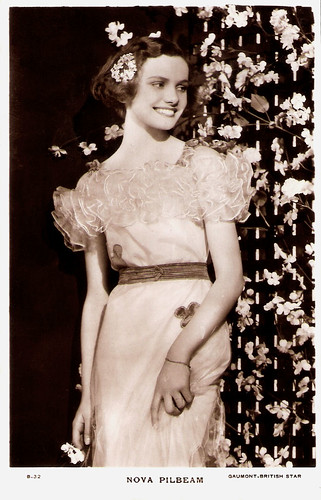
British postcard, no. B-32. Photo: Gaumont-British.

British hand-coloured postcard in the Film Partners Series, no PC 236. Photo: Gaumont British. Derrick De Marney and Nova Pilbeam in Young and Innocent / The Girl Was Young (Alfred Hitchcock, 1937).
Nova Margery Pilbeam was born in Wimbledon, London, in 1919. Her parents were actor and theatrical manager Arnold Pilbeam, and his wife Margery Stopher Pilbeam. Nova made her stage debut at the age of five in a charity performance produced by her father.
As soon as the law allowed, she made her professional debut. At 12, she played Marigold in 'Toad of Toad Hall' at the Savoy Theatre in 1931. This led to more stage work in her teen years and to an audition for Robert Stevenson at Gaumont British in 1934.
She got a leading role in the British drama Little Friend (Berthold Viertel, 1934). She played a young girl who becomes an unwilling witness to the divorce of her parents (Matheson Lang and Lydia Sherwood). At Wicked Lady, Carole writes: “When the film was released, Pilbeam was a sensation. Kinematograph Weekly praised the ‘brilliant performance by the newly discovered English protégée’. Gaumont-British executives were impressed and signed her to a seven-year contract”.
Pilbeam first got a small but important role in Alfred Hitchcock's The Man Who Knew Too Much (1934), featuring Peter Lorre. Pilbeam played a sophisticated teenager who was kidnapped. The Man Who Knew Too Much became one of the most successful and critically acclaimed thrillers of Hitchcock's British period.
Brendon Hanley at AllMovie: ”Though Alfred Hitchcock would remake the movie himself in 1956 with a bigger budget, the original 1934 version of The Man Who Knew Too Much is arguably a more historically significant and aesthetically interesting film. It was Hitchcock's first true international hit. Though he wouldn't have a major success in America until The Lady Vanishes, Man and the subsequent The 39 Steps helped establish the director's distinctive style and lay the groundwork for his popularity. Along with Hitchcock's trademark blend of suspense and humour and blurring of the normal and abnormal, the film also features his characteristically grand showpieces, most memorably the recreation of the true-life ‘Sidney Street Siege’ and the famous Albert Hall scene.”

British postcard in the Picturegoer Series, no. 995a. Photo: Gaumont British.

British postcard. Photo: Gaumont British.

British postcard by Real Photograph, no. 162. Photo: Gaumont-British Pictures.
Nova Pilbeam then played a lead role as the 16-year-old Lady Jane Grey in Tudor Rose (Robert Stevenson, 1935), a dramatisation of Grey's short life, from her forced marriage to Henry VIII to her brief reign as queen of England and finally to her beheading. Carole at WickedLady: “Pilbeam looked glorious in the sumptuous Tudor costumes and was extremely touching in the role. She subsequently won the Film Weekly medal for the best performance by a performer in a British Film.”
Still only seventeen, Pilbeam then had a starring role opposite Derrick de Marney in Hitchcock's Young and Innocent (Alfred Hitchcock, 1937), for which she is now best known.
Hal Erickson at AllMovie: “Alfred Hitchcock was beginning to repeat himself, but audiences didn't mind so long as they were thoroughly entertaining-which they were, without fail. Derrick De Marney finds himself in a 39 Steps situation when he is wrongly accused of murder. While a fugitive from the law, De Marney is helped by heroine Nova Pilbeam, who three years earlier had played the adolescent kidnap victim in Hitchcock's The Man Who Knew Too Much. The obligatory 'fish out of water' scene, in which the principals are briefly slowed down by a banal everyday event, occurs during a child's birthday party. The actual villain, whose identity is never in doubt (Hitchcock made thrillers, not mysteries) is played by George Curzon, who suffers from a twitching eye. Curzon's revelation during an elaborate nightclub sequence is a Hitchcockian tour de force, the sort of virtuoso sequence taken for granted in these days of flexible cameras and computer enhancement, but which in 1937 took a great deal of time, patience and talent to pull off.”
After this, Pilbeam's film career may have stalled somewhat. She was considered for Hitchcock's The Lady Vanishes (1938), but lost the role to Margaret Lockwood. In 1939, she appeared on the early British television drama Prison Without Bars (1939) with Jill Esmond, and in the Ealing comedy Cheer Boys Cheer (Walter Forde, 1939), depicting the rivalry between two firms of brewers.
In 1939, Nova Pilbeam married Penrose ‘Pen’ Tennyson, a great-grandson of the poet Alfred, Lord Tennyson. They had met at the set of Young and Innocent, where he was an assistant director to Alfred Hitchcock. Tennyson became a film director himself the year they were married.

British postcard by De Reszke Cigarettes, no. 39. Photo: Gaumont-British.

British postcard in the Colourgraph Series, no. C 332. Photo: Cannons.

British postcard by Real Photograph in the Art Photo Postcard series, no. 81. Photo: Gaumont-British.
Unlike other British film stars of the 1930s, Nova Pilbeam never made a film in Hollywood. Producer David O. Selznick wanted her for the lead as Mrs De Winter in Rebecca (Alfred Hitchcock, 1940) and thought she could be an international film star. However, her agent was worried about the length of a five-year contract, and Hitchcock thought she was too immature for the role.
It must have been a blow to Pilbeam that Hitchcock gave the role to Joan Fontaine and that her studio, Gaumont British, had collapsed in 1937 due to overexpansion and the inability to penetrate the American market. In 1941, her husband Pen Tennyson suddenly died in a tragic plane crash. He had been called up to film some instructional shorts for the war effort.
Despite all this, Pilbeam carried on. Throughout the 1940s, she appeared in British war and crime films along with many stage roles. In 1940, she played with Wilfrid Lawson in Pastor Hall (Roy Boulting, 1940), based on the true story of Pastor Martin Niemöller, who was sent to Dachau concentration camp for criticising the Nazi party. Another wartime propaganda film was The Next of Kin (Thorold Dickinson, 1942) about the danger of Nazi espionage. It became a great box office hit.
On stage, Pilbeam gave vibrant performances as the title role of 'Peter Pan', Viola in 'Twelfth Night', and Rosalind in 'As You Like It'. One of her last films was The Three Weird Sisters (1948). It was a Gothic tale of a dying Welsh mining town and the three old and afflicted ladies who oversee it. The screenplay is credited to five writers, including Dylan Thomas.
After the release, she retired from the screen. She was 29 at the time. In 1950, Pilbeam married BBC Radio journalist Alexander Whyte, and their daughter Sarah Jane was born in 1952. The couple stayed together until he died in 1972. Nova Pilbeam died of natural causes in London. She was 95.
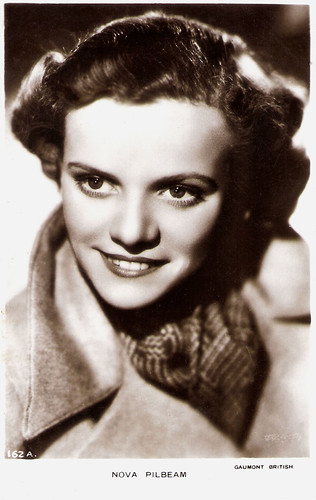
British postcard, no. 162 A. Photo: Gaumont-British.

British postcard in the Film Partners Series, London, no. P 236. Photo: Gaumont British. Derrick De Marney and Nova Pilbeam in Young and Innocent / The Girl Was Young (Alfred Hitchcock, 1937).

French postcard by Les enfants de cinéma / école et cinéma - les enfants du deuxième siècle, no. 1. Derrick De Marney, Nova Pilbeam and John Longden in Young and Innocent/The Girl Was Young (Alfred Hitchcock, 1937).
Opening of Little Friend (1934). Source: D Cairns (YouTube).
Scene from Young and Innocent (1937). Source: hitchcockmoments (YouTube).
Sources: Hal Erickson (AllMovie), Brendon Hanley (AllMovie), Carole (Wicked Lady), BritMovie, Lenin Imports, Wikipedia and IMDb.
This post was last updated on 2 April 2026.
British postcard in the Picturegoer Series, London, no. 877. Photo: Gaumont-British.
British postcard, no. B-32. Photo: Gaumont-British.
British hand-coloured postcard in the Film Partners Series, no PC 236. Photo: Gaumont British. Derrick De Marney and Nova Pilbeam in Young and Innocent / The Girl Was Young (Alfred Hitchcock, 1937).
Hitchcock's first true international hit
Nova Margery Pilbeam was born in Wimbledon, London, in 1919. Her parents were actor and theatrical manager Arnold Pilbeam, and his wife Margery Stopher Pilbeam. Nova made her stage debut at the age of five in a charity performance produced by her father.
As soon as the law allowed, she made her professional debut. At 12, she played Marigold in 'Toad of Toad Hall' at the Savoy Theatre in 1931. This led to more stage work in her teen years and to an audition for Robert Stevenson at Gaumont British in 1934.
She got a leading role in the British drama Little Friend (Berthold Viertel, 1934). She played a young girl who becomes an unwilling witness to the divorce of her parents (Matheson Lang and Lydia Sherwood). At Wicked Lady, Carole writes: “When the film was released, Pilbeam was a sensation. Kinematograph Weekly praised the ‘brilliant performance by the newly discovered English protégée’. Gaumont-British executives were impressed and signed her to a seven-year contract”.
Pilbeam first got a small but important role in Alfred Hitchcock's The Man Who Knew Too Much (1934), featuring Peter Lorre. Pilbeam played a sophisticated teenager who was kidnapped. The Man Who Knew Too Much became one of the most successful and critically acclaimed thrillers of Hitchcock's British period.
Brendon Hanley at AllMovie: ”Though Alfred Hitchcock would remake the movie himself in 1956 with a bigger budget, the original 1934 version of The Man Who Knew Too Much is arguably a more historically significant and aesthetically interesting film. It was Hitchcock's first true international hit. Though he wouldn't have a major success in America until The Lady Vanishes, Man and the subsequent The 39 Steps helped establish the director's distinctive style and lay the groundwork for his popularity. Along with Hitchcock's trademark blend of suspense and humour and blurring of the normal and abnormal, the film also features his characteristically grand showpieces, most memorably the recreation of the true-life ‘Sidney Street Siege’ and the famous Albert Hall scene.”
British postcard in the Picturegoer Series, no. 995a. Photo: Gaumont British.
British postcard. Photo: Gaumont British.
British postcard by Real Photograph, no. 162. Photo: Gaumont-British Pictures.
Extremely touching
Nova Pilbeam then played a lead role as the 16-year-old Lady Jane Grey in Tudor Rose (Robert Stevenson, 1935), a dramatisation of Grey's short life, from her forced marriage to Henry VIII to her brief reign as queen of England and finally to her beheading. Carole at WickedLady: “Pilbeam looked glorious in the sumptuous Tudor costumes and was extremely touching in the role. She subsequently won the Film Weekly medal for the best performance by a performer in a British Film.”
Still only seventeen, Pilbeam then had a starring role opposite Derrick de Marney in Hitchcock's Young and Innocent (Alfred Hitchcock, 1937), for which she is now best known.
Hal Erickson at AllMovie: “Alfred Hitchcock was beginning to repeat himself, but audiences didn't mind so long as they were thoroughly entertaining-which they were, without fail. Derrick De Marney finds himself in a 39 Steps situation when he is wrongly accused of murder. While a fugitive from the law, De Marney is helped by heroine Nova Pilbeam, who three years earlier had played the adolescent kidnap victim in Hitchcock's The Man Who Knew Too Much. The obligatory 'fish out of water' scene, in which the principals are briefly slowed down by a banal everyday event, occurs during a child's birthday party. The actual villain, whose identity is never in doubt (Hitchcock made thrillers, not mysteries) is played by George Curzon, who suffers from a twitching eye. Curzon's revelation during an elaborate nightclub sequence is a Hitchcockian tour de force, the sort of virtuoso sequence taken for granted in these days of flexible cameras and computer enhancement, but which in 1937 took a great deal of time, patience and talent to pull off.”
After this, Pilbeam's film career may have stalled somewhat. She was considered for Hitchcock's The Lady Vanishes (1938), but lost the role to Margaret Lockwood. In 1939, she appeared on the early British television drama Prison Without Bars (1939) with Jill Esmond, and in the Ealing comedy Cheer Boys Cheer (Walter Forde, 1939), depicting the rivalry between two firms of brewers.
In 1939, Nova Pilbeam married Penrose ‘Pen’ Tennyson, a great-grandson of the poet Alfred, Lord Tennyson. They had met at the set of Young and Innocent, where he was an assistant director to Alfred Hitchcock. Tennyson became a film director himself the year they were married.
British postcard by De Reszke Cigarettes, no. 39. Photo: Gaumont-British.
British postcard in the Colourgraph Series, no. C 332. Photo: Cannons.
British postcard by Real Photograph in the Art Photo Postcard series, no. 81. Photo: Gaumont-British.
Tragic plane crash
Unlike other British film stars of the 1930s, Nova Pilbeam never made a film in Hollywood. Producer David O. Selznick wanted her for the lead as Mrs De Winter in Rebecca (Alfred Hitchcock, 1940) and thought she could be an international film star. However, her agent was worried about the length of a five-year contract, and Hitchcock thought she was too immature for the role.
It must have been a blow to Pilbeam that Hitchcock gave the role to Joan Fontaine and that her studio, Gaumont British, had collapsed in 1937 due to overexpansion and the inability to penetrate the American market. In 1941, her husband Pen Tennyson suddenly died in a tragic plane crash. He had been called up to film some instructional shorts for the war effort.
Despite all this, Pilbeam carried on. Throughout the 1940s, she appeared in British war and crime films along with many stage roles. In 1940, she played with Wilfrid Lawson in Pastor Hall (Roy Boulting, 1940), based on the true story of Pastor Martin Niemöller, who was sent to Dachau concentration camp for criticising the Nazi party. Another wartime propaganda film was The Next of Kin (Thorold Dickinson, 1942) about the danger of Nazi espionage. It became a great box office hit.
On stage, Pilbeam gave vibrant performances as the title role of 'Peter Pan', Viola in 'Twelfth Night', and Rosalind in 'As You Like It'. One of her last films was The Three Weird Sisters (1948). It was a Gothic tale of a dying Welsh mining town and the three old and afflicted ladies who oversee it. The screenplay is credited to five writers, including Dylan Thomas.
After the release, she retired from the screen. She was 29 at the time. In 1950, Pilbeam married BBC Radio journalist Alexander Whyte, and their daughter Sarah Jane was born in 1952. The couple stayed together until he died in 1972. Nova Pilbeam died of natural causes in London. She was 95.
British postcard, no. 162 A. Photo: Gaumont-British.
British postcard in the Film Partners Series, London, no. P 236. Photo: Gaumont British. Derrick De Marney and Nova Pilbeam in Young and Innocent / The Girl Was Young (Alfred Hitchcock, 1937).
French postcard by Les enfants de cinéma / école et cinéma - les enfants du deuxième siècle, no. 1. Derrick De Marney, Nova Pilbeam and John Longden in Young and Innocent/The Girl Was Young (Alfred Hitchcock, 1937).
Opening of Little Friend (1934). Source: D Cairns (YouTube).
Scene from Young and Innocent (1937). Source: hitchcockmoments (YouTube).
Sources: Hal Erickson (AllMovie), Brendon Hanley (AllMovie), Carole (Wicked Lady), BritMovie, Lenin Imports, Wikipedia and IMDb.
This post was last updated on 2 April 2026.
No comments:
Post a Comment