Along with L’avventura, La notte, and Deserto rosso, L'eclisse is part of Michelangelo Antonioni’s ‘Great Tetralogy’, in which setting and environment are very important. In L'eclisse / The Eclipse (1962), Monica Vitti lives in EUR, a modernistic suburb of Rome. She meets Alain Delon, who plays a confident stockbroker in the old city centre. His materialistic nature eventually undermines their relationship. For the newest edition of the magazine Roma Aeterna, Ivo Blom wrote an article about the locations of L'eclisse. We updated our old post on Antonioni's masterpiece with pictures we took in 2010 when we followed his old footsteps in EUR.
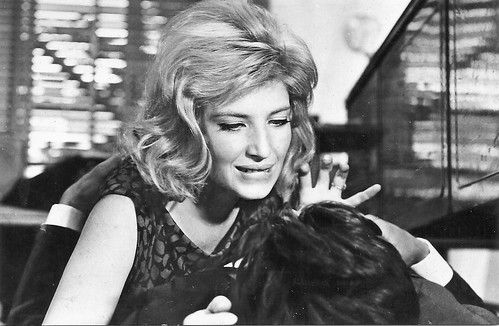
Romanian postcard by Casa Filmulu Acin. C.P.C.S. Photo: publicity still for L'eclisse / The Eclipse (Michelangelo Antonioni, 1962).
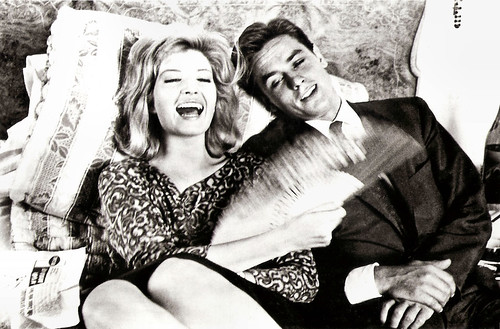
Romanian postcard by Casa Filmului Acin. Photo: publicity still for L'eclisse / The Eclipse (1962).

Spanish postcard by Archivo Bermejo, no. 322. Photo: Radio Film. Alain Delon in L'eclisse / The Eclipse (Michelangelo Antonioni, 1962).
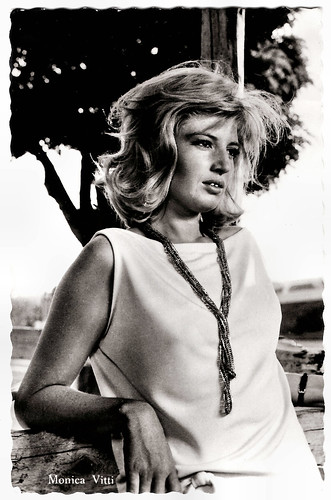
Dutch postcard by De Muinck en Co, Amsterdam, no. 809. Photo: publicity still for L'eclisse / The Eclipse (1962).
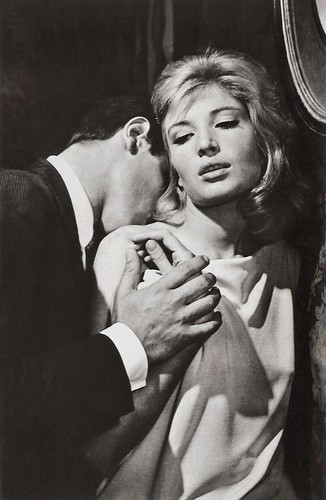
Romanian postcard by Casa Filmului Acin. Photo: publicity still for L'eclisse / The Eclipse (1962).
By Michelangelo Antonioni’s own account, his ideas for films are born of visual epiphanies, fleeting but revealing glimpses of the world around him. Modern architecture is symptomatic of the problems facing modern Western man, and the locations play a significant role in L'eclisse.
Monica Vitti plays a young translator, Vittoria, who leaves her lover, the writer Riccardo (Francisco Rabal), and terminates their 4-year relationship. Following several sleepless nights, Vittoria visits her estranged mother (Lila Brignone) at the stock exchange. There, the dynamic young stockbroker Piero (Alain Delon) casts his romantic gaze in Vittoria's direction. Although they have little in common, Vittoria visits Piero in his office, and they make plans to meet again that night and every night thereafter - for as long as their love will endure.
L'eclisse caps off Michelangelo Antonioni's previous two films, L'avventura (1960) and La Notte (1961), in much the same style. A characteristic of Antonioni's films is the long, significant periods of silence. The people in his film just cannot seem to communicate with each other. Eleanor Mannikka at AllMovie: "There is much to appreciate in this man who is not overly intellectual and is blessedly free of complications, and the same can be said of Vittoria. Yet their innermost fears play upon both of them in ways that go against an honest expression of their love - and against a lasting relationship."
Antonioni’s Rome works as a mirror to the characters. EUR, the quarter where most of L'eclisse evolves, was then – and still is – a zone for the well-to-do, but for the modern ones; not the conservative rich who cling to the historic centre with its century-old palazzi and antiques. At the start of the film, Vittoria is suffocated by the heat and by her relationship and looks outside, but instead of nature, she sees a giant water tower. The tower, nicknamed ‘mushroom'(fungo), resembles the atomic bomb. When the film was shot, in 1961, the atomic arms race was a fact. We also notice the enormous Palazzo dello Sport, built by the architects Piero Nervi and Marcello Piacentini. Piacentini was the master architect of the whole quarter in the fascist era, when EUR was destined for the World Expo of 1942 or E42 (which never took place, of course), hence EUR (Esposizione Universale di Roma). The Sports Palace was built for the 1960 Olympic Games, like so many modern buildings in Rome.
Piero works at the Old Stock Exchange in the so-called Temple of Hadrian in Piazza di Pietra. The contrast with EUR cannot be bigger: the enormous noise of buyers and sellers at the stock exchange floor, the hysteria of Vittoria’s mother fixated on money, and the speedy Piero. Vittoria and Piero regularly meet in Vittoria’s quarter, at a crossroad near the Olympic Hippodrome. While they are there, Antonioni cherishes all the details of this location, such as trees, sprinklers, a nurse with a pram, a bus passing by, water running from a tree to a sewer, streetlamps, etc. This makes it their personal location and monumentalises it. All these details come back in the final scene. The place is rather disturbing. And still it is Vittoria’s place.

Rome, EUR, 2010.

The most representative building of the 'Fascist' style at EUR is Palazzo della Civiltà Italiana (1938-1943), an iconic project which has since become known as the 'Colosseo Quadrato (Square Colosseum).

Rome, EUR, Fungo (water tower).

San Pietro e San Paolo church, Via Ostiense, EUR, Rome, Italy. Architect: Arnoldo Foschini. This church is directly inspired by (the other) Michelangelo’s plan for St. Peter’s, which was based on a Greek cross shape. It was built from 1935 to 1955.

Rome, EUR, 2010.
With her wild blond hair, Monica Vitti is perfect as the confused Vittoria. She displays just enough emotion to realise the character, but is malleable enough for Antonioni to illustrate his theme through her. Alain Delon never looked more handsome than in L'eclisse. He conveys emotions easily with just the flick of an eyebrow. Delon portrays the materialistic, spiritually empty stockbroker quite effectively.
L'eclisse rejects action in favour of contemplation. Images and design are more important than character and story. The long takes and elegant compositions, filmed by Gianni De Venanzo, and the elongated views on a building or a streetlight, manage to create a form of poetry.
Antonioni shows us a very different Rome in L’eclisse than the one we are used to. The empty, new EUR, a sleekly designed neighbourhood, then still without patina, contrasts with the chaos, noise and traffic of the city centre, where a trade fair is housed in an antique Roman building.
In another Roman classic, Roman Holiday (1953), director William Wyler imagined Rome as a compressed city where monuments are emphasised, and everyone seems to know each other. Michelangelo Antonioni emphasises the suburbs, the new housing estate, a very different kind of Rome than we are used to. Antonioni's Rome is a city where people struggle to maintain relationships and are mainly preoccupied with themselves or materialistic matters. Antonioni seems to say to Vittoria: 'Living here has got to make you unhappy, the city seems as empty as your heart. But if you take enough time to look around you, listen and pay attention to meaningful details, there is much to discover even in an empty new housing estate like this.'
L'eclisse won the Special Jury Award at the 1962 Cannes Film Festival and was nominated for the Palme d'Or. Although the film won several more awards, L'eclisse was never a commercial success, and many people seem to find the film boring. It is not. Go and watch it closely and let yourself be hypnotised by Antonioni.
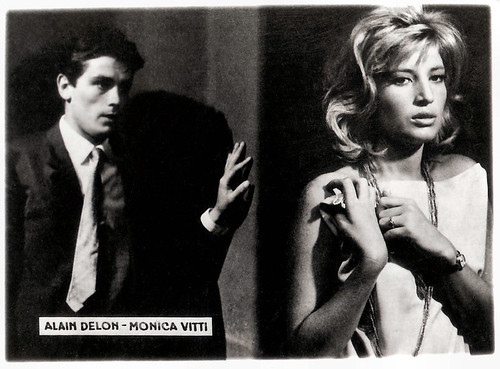
Small Romanian collector card by Casa Filmului Acin. Photo: publicity still for L'eclisse / The Eclipse (1962).
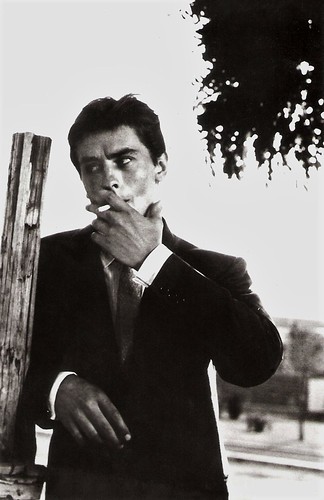
Romanian postcard by Casa Filmului Acin. Photo: Alain Delon in L'eclisse / The Eclypse (Michelangelo Antonioni, 1962).

Spanish postcard by Archivo Bermejo, no. 7643. Photo: Radio Film. Alain Delon in L'eclisse / The Eclipse (Michelangelo Antonioni, 1962).

French poster postcard by Éditions Zreik, Paris, in the Collection Télérama, la mémoire du cinéma, no. 74. French affiche for L'eclipse / L'eclisse / The Eclipse (Michelangelo Antonioni, 1962) starring Monica Vitti and Alain Delon.
Original trailer for L'eclisse / The Eclipse (1962) with the title song by Mina. Source: xx999xx999 (YouTube).
Trailer L'eclisse / The Eclipse (1962). Source: moviolamagics (YouTube).
Sources: Ivo Blom (Cinematic City: L'Eclisse and Rome), Eleanor Mannikka (AllMovie - page now defunct), TCM (page now defunct), Wikipedia and IMDb.
And please check out Roma Aeterna.
Romanian postcard by Casa Filmulu Acin. C.P.C.S. Photo: publicity still for L'eclisse / The Eclipse (Michelangelo Antonioni, 1962).
Romanian postcard by Casa Filmului Acin. Photo: publicity still for L'eclisse / The Eclipse (1962).
Spanish postcard by Archivo Bermejo, no. 322. Photo: Radio Film. Alain Delon in L'eclisse / The Eclipse (Michelangelo Antonioni, 1962).
Dutch postcard by De Muinck en Co, Amsterdam, no. 809. Photo: publicity still for L'eclisse / The Eclipse (1962).
Romanian postcard by Casa Filmului Acin. Photo: publicity still for L'eclisse / The Eclipse (1962).
As long as their love will endure
By Michelangelo Antonioni’s own account, his ideas for films are born of visual epiphanies, fleeting but revealing glimpses of the world around him. Modern architecture is symptomatic of the problems facing modern Western man, and the locations play a significant role in L'eclisse.
Monica Vitti plays a young translator, Vittoria, who leaves her lover, the writer Riccardo (Francisco Rabal), and terminates their 4-year relationship. Following several sleepless nights, Vittoria visits her estranged mother (Lila Brignone) at the stock exchange. There, the dynamic young stockbroker Piero (Alain Delon) casts his romantic gaze in Vittoria's direction. Although they have little in common, Vittoria visits Piero in his office, and they make plans to meet again that night and every night thereafter - for as long as their love will endure.
L'eclisse caps off Michelangelo Antonioni's previous two films, L'avventura (1960) and La Notte (1961), in much the same style. A characteristic of Antonioni's films is the long, significant periods of silence. The people in his film just cannot seem to communicate with each other. Eleanor Mannikka at AllMovie: "There is much to appreciate in this man who is not overly intellectual and is blessedly free of complications, and the same can be said of Vittoria. Yet their innermost fears play upon both of them in ways that go against an honest expression of their love - and against a lasting relationship."
Antonioni’s Rome works as a mirror to the characters. EUR, the quarter where most of L'eclisse evolves, was then – and still is – a zone for the well-to-do, but for the modern ones; not the conservative rich who cling to the historic centre with its century-old palazzi and antiques. At the start of the film, Vittoria is suffocated by the heat and by her relationship and looks outside, but instead of nature, she sees a giant water tower. The tower, nicknamed ‘mushroom'(fungo), resembles the atomic bomb. When the film was shot, in 1961, the atomic arms race was a fact. We also notice the enormous Palazzo dello Sport, built by the architects Piero Nervi and Marcello Piacentini. Piacentini was the master architect of the whole quarter in the fascist era, when EUR was destined for the World Expo of 1942 or E42 (which never took place, of course), hence EUR (Esposizione Universale di Roma). The Sports Palace was built for the 1960 Olympic Games, like so many modern buildings in Rome.
Piero works at the Old Stock Exchange in the so-called Temple of Hadrian in Piazza di Pietra. The contrast with EUR cannot be bigger: the enormous noise of buyers and sellers at the stock exchange floor, the hysteria of Vittoria’s mother fixated on money, and the speedy Piero. Vittoria and Piero regularly meet in Vittoria’s quarter, at a crossroad near the Olympic Hippodrome. While they are there, Antonioni cherishes all the details of this location, such as trees, sprinklers, a nurse with a pram, a bus passing by, water running from a tree to a sewer, streetlamps, etc. This makes it their personal location and monumentalises it. All these details come back in the final scene. The place is rather disturbing. And still it is Vittoria’s place.
Rome, EUR, 2010.
The most representative building of the 'Fascist' style at EUR is Palazzo della Civiltà Italiana (1938-1943), an iconic project which has since become known as the 'Colosseo Quadrato (Square Colosseum).
Rome, EUR, Fungo (water tower).
San Pietro e San Paolo church, Via Ostiense, EUR, Rome, Italy. Architect: Arnoldo Foschini. This church is directly inspired by (the other) Michelangelo’s plan for St. Peter’s, which was based on a Greek cross shape. It was built from 1935 to 1955.
Rome, EUR, 2010.
A form of poetry
With her wild blond hair, Monica Vitti is perfect as the confused Vittoria. She displays just enough emotion to realise the character, but is malleable enough for Antonioni to illustrate his theme through her. Alain Delon never looked more handsome than in L'eclisse. He conveys emotions easily with just the flick of an eyebrow. Delon portrays the materialistic, spiritually empty stockbroker quite effectively.
L'eclisse rejects action in favour of contemplation. Images and design are more important than character and story. The long takes and elegant compositions, filmed by Gianni De Venanzo, and the elongated views on a building or a streetlight, manage to create a form of poetry.
Antonioni shows us a very different Rome in L’eclisse than the one we are used to. The empty, new EUR, a sleekly designed neighbourhood, then still without patina, contrasts with the chaos, noise and traffic of the city centre, where a trade fair is housed in an antique Roman building.
In another Roman classic, Roman Holiday (1953), director William Wyler imagined Rome as a compressed city where monuments are emphasised, and everyone seems to know each other. Michelangelo Antonioni emphasises the suburbs, the new housing estate, a very different kind of Rome than we are used to. Antonioni's Rome is a city where people struggle to maintain relationships and are mainly preoccupied with themselves or materialistic matters. Antonioni seems to say to Vittoria: 'Living here has got to make you unhappy, the city seems as empty as your heart. But if you take enough time to look around you, listen and pay attention to meaningful details, there is much to discover even in an empty new housing estate like this.'
L'eclisse won the Special Jury Award at the 1962 Cannes Film Festival and was nominated for the Palme d'Or. Although the film won several more awards, L'eclisse was never a commercial success, and many people seem to find the film boring. It is not. Go and watch it closely and let yourself be hypnotised by Antonioni.
Small Romanian collector card by Casa Filmului Acin. Photo: publicity still for L'eclisse / The Eclipse (1962).
Romanian postcard by Casa Filmului Acin. Photo: Alain Delon in L'eclisse / The Eclypse (Michelangelo Antonioni, 1962).
Spanish postcard by Archivo Bermejo, no. 7643. Photo: Radio Film. Alain Delon in L'eclisse / The Eclipse (Michelangelo Antonioni, 1962).
French poster postcard by Éditions Zreik, Paris, in the Collection Télérama, la mémoire du cinéma, no. 74. French affiche for L'eclipse / L'eclisse / The Eclipse (Michelangelo Antonioni, 1962) starring Monica Vitti and Alain Delon.
Original trailer for L'eclisse / The Eclipse (1962) with the title song by Mina. Source: xx999xx999 (YouTube).
Trailer L'eclisse / The Eclipse (1962). Source: moviolamagics (YouTube).
Sources: Ivo Blom (Cinematic City: L'Eclisse and Rome), Eleanor Mannikka (AllMovie - page now defunct), TCM (page now defunct), Wikipedia and IMDb.
And please check out Roma Aeterna.
No comments:
Post a Comment