Dutch cabaret and revue artist Louis Davids (1883-1939) appeared in twenty Dutch films, both silent and sound pictures. He is widely considered one of the Netherlands biggest names in performing arts, and many of his songs are evergreens in the Netherlands.

Dutch postcard by JosPe, no. 582. Photo: Godfried de Groot.
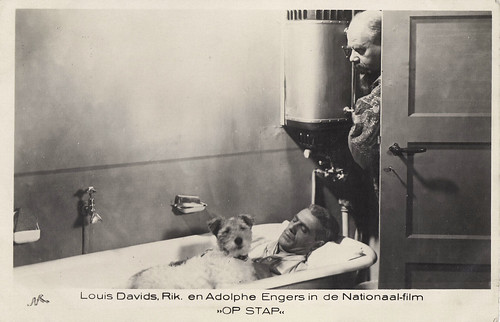
Louis Davids, Rik and Adolphe Engers in Op stap (1935). Dutch postcard by M.B. & Z. (M. Bonnist & Zonen, Amsterdam). Photo: Dick van Maarseveen, Den Haag / Nationaal Film. Publicity still for Op stap / On the Move (Ernst Winar, 1935). Collection: Marlene Pilaete.

Dutch postcard by Art Unlimited, Amsterdam, no. B 2137. Photo: Spaarnestad Fotoarchief, Harlem. Caption: Louis Davids in his dressing room, 1935 / 100th performance of the revue 'Hoe maller, hoe mooier' (The crazier, the better).
Louis Davids was born Simon David in 1883 in Rotterdam's notorious Zandstraat quarter into a poor Jewish family. He was the son of the comedian and cafe owner Levie David and Francina Terveen. Both parents were performing artists, and their children, Louis, his older brother Hakkie, and his younger sisters Rika and Heintje Davids, started their entertainment careers at a young age.
Five years old, Louis sang in a mini-costume and high hat at all the state fairs with his brother Hakkie playing the piano. Newspapers called little Louis a ‘Wonder Child’ or ‘Miniature Comedian’, and he was very successful. A big chance came a few years later. At seven, he signed a contract with the Tivoli Theatre in Rotterdam, where he performed as Louis Davids Jr.
Later, he performed with his sister Rika at fairs, in coffee houses and music halls and became a versatile artist. After an argument with his father, the 13-year-old left for England to assist the magician Akimoto. A year later, his father brought his son home, penniless but with a lot more experience in variety theatre. Together with his sister Rika, he managed to secure a job outside of the fairs, working at the famous theatre Pschorr.
Brother and sister Davids moved to Amsterdam to work with the variety director Frits van Haarlem at the Carré circus theatre, where they had plenty of success in creating revues after English fashion. In the cafe-chantant Victoria in the Nes, a street in the old centre of Amsterdam, they performed songs like 'Een reisje langs den Rijn' (A trip along the Rhine). During that time, the Nes and the artists who performed there were not highly rated. Louis, therefore, hoped to return to Frits van Haarlem. After Rika married English magician John Weil and moved to England, Louis formed a new duo with his youngest sister Henriëtte (Heintje). The second Davids duo was also a success. Heintje’s husband, Philip Pinkhof, wrote texts for the duo. In 1906, Davids married Rebecca Kokernoot, with whom he had a daughter, Kitty. He was unhappy in his marriage.
Louis’ breakthrough was Koning 'Kziezoowat in Amsterdam / King Sissiwat in Amsterdam (1906). This was the first major revue in the Netherlands, written by Louis Davids and Frits van Haarlem, with Davids in the leading role. For this revue, four short films with Louis and Heintje Davids were produced by Frits van Haarlem, which became part of the revue. In 1909, Davids furthered his success by working with theatre director Henri ter Hall in the revue 'Doe er een deksel op' (Make it a cover). The performances took place in Rotterdam, his birthplace. Rika was back, and Heintje had a characteristic role. As with the previous revue, it was especially up to local events, and the surprise element was the key to its success.

German postcard by Ross Verlag, no. 803, 1925-1926.
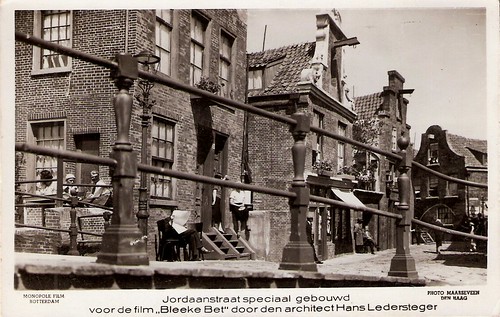
Dutch postcard by Monopole Film, Rotterdam. Photo: Dick van Maarseveen. Still of a set built for Bleeke Bet (Alex Benno, Richard Oswald, 1934), a street in the old neighbourhood of De Jordaan in Amsterdam. The set designer was Hans Ledersteger.
While on tour, Louis Davids met British dancer Margie Morris, who had moved to the Netherlands in 1913. Louis and Maggie formed the duo ‘He, She and the Piano’, where Maggie would take on the role of pianist and composer. They wrote dozens of songs together. He wrote the text, she the music. The charming Morris led him from the comic repertoire towards more mature songs. Margie encouraged Louis' artistic talents and helped him develop his own style. Thanks to the influence of English and American music in her compositions, the level of Louis’s songs increased. Their innovative, a bit jazz-like repertoire soon became known across the country. Davids and Morris also starred in countless revues such as 'Loop naar den Duivel' (Walk to the Devil) in 1915, for which they wrote 'We gaan naar Zandvoort aan de zee' (We go to Zandvoort by the sea), now a Dutch evergreen.
They also started to appear in the Dutch cinema. Their silent films include Amerikaansche meisjes / American Girls (Maurits Binger, Louis Davids, 1918) with Lola Cornero and Beppie de Vries, and De duivel in Amsterdam / The Devil in Amsterdam (Theo Frenkel, 1919) with Eduard Verkade and Louis Bouwmeester.
A famous stage musical from this period, for which they wrote several classic songs, is 'De Jantjes' (The Tars), written by Herman Bouber and Davids in 1920. This hugely successful stage play was also released as a silent film, De Jantjes / The Tars (Maurits Binger, B.E. Doxat-Pratt, 1922), starring Beppie de Vries and Johan Elsensohn, and as a sound film, De Jantjes / The Tars (Jaap Speyer, 1934).
Bouber, Davids and Morris also wrote the stage musicals Bleeke Bet / Bleak Beth (1917) and Oranje Hein / Orange Hein (1918), all situated in the Jordaan. Davids also appeared in other silent films such as the Herman Heijermans adaptation Schakels / Links (Maurits Binger, 1920) with Jan van Dommelen, Adelqui Migliar and Annie Bos, and Menschenwee/ People woe (Theo Frenkel, 1921) with Willem van der Veer and Coen Hissink.
Davids celebrated his 25th anniversary as an artist in 1919 in Rotterdam's Pschorr Theatre. After his jubilee, Louis travelled with Margie, Rika and Heintje to India for a year and a half. In 1922, Margie Morris left him because of his countless infidelities. The couple had never married, but they had a son together, Louis. His wife, Betsy, refused to divorce Louis, so they remained officially married until his death. Louis’s children would never have a good relationship with their father in their mature lives.

Dutch postcard by Hollandia Film Prod. / Loet C. Barnstijn. Photo: publicity still for De Jantjes/The Tars (Jaap Speyer, 1934) with Jan van Ees, Willy Costello and Johan Kaart Jr. as the three 'Jantjes'.

Dutch postcard by M. B. & Z. (M. Bonnist & Zonen, Amsterdam). Photo: Nationaal-film. Henriëtte Davids and Louis Davids in Op Stap / On the Move (Ernst Winar, 1935).
Between 1922 and 1926, Louis Davids was the director of the Casino Variété in Rotterdam, but directing did not hold his attention for long. In 1929, Davids appeared in the revue 'Lach en vergeet' (Laugh and Forget) with the song which would probably become his most popular title, 'De kleine man' (The Little Man). It was written by Jacques van Tol, with whom Davids would work closely until he died in 1939, but Van Tol would be working anonymously.
Although he was born in Rotterdam, Louis Davids was a popular performer of the ‘Jordaan repertoire’. The Jordaan is a 17th-century-built working-class neighbourhood in the heart of Amsterdam. Davids also appeared in typical ‘Jordaan films’, a genre based on the popular plays by Herman Bouber and Davids and Morris, such as Bleeke Bet / Bleak Beth (Alex Benno, 1923) with Alida van Gijtenbeek and Jan van Dommelen, and Oranje Hein / Orange Hein (Alex Benno, 1925), starring Johan Elsensohn and Aaf Bouber.
Davids moved to sound film in the short Hollandsch Hollywood / Dutch Hollywood (Ernst Winar, 1933), also with Heintje Davids and Fien de la Mar. After the enormous success of the sound version of De Jantjes / The Tars (Jaap Speyer, 1934), he made one more film, Op stap / On the Move (Ernst Winar, 1935), co-starring Fien de la Mar and Frits van Dongen (a.k.a. Philip Dorn). In this musical, Davids sang several songs, including his evergreen 'Als je voor een dubbeltje geboren bent' (When you are born for a nickel).
At the time, Davids was especially renowned for his work for the Scheveningen Kurhaus Cabaret in the summers from 1931 to 1938. There, Davids founded the careers of Dutch cabaret stars like Wim Kan, Corry Vonk, and Wim Sonneveld. In 1937, Davids had to give up his cabaret work at the Kurhaus due to his asthma. That year, he was named a Knight in the Order of Orange-Nassau.
In 1939, Louis Davids died in Amsterdam at 55. Some sources, like IMDb, mention cancer as the cause, while other sources mention a heart attack or his asthma as the cause. During the Second World War, Rika and Harkie Davids were both murdered in 1943 in the Sobibor concentration camp. Heintje knew how to survive the Nazis. After the war, she continued to perform and keep the repertoire of her brother alive. Today, Louis Davids’s songs are still popular. They can be heard on the soundtrack of films like Rooie Sien / Red Sien (Frans Weisz, 1975) featuring Willeke Alberti, and TV series like Moeder, ik wil bij de revue / Mother, I want to join the revue (Rita Horst, 2012) with Egbert Jan Weeber.
Heintje Davids and Sylvain Poons sing 'Omdat ik zoveel van je hou' (Because I love you so much) in De Jantjes/The Tars (Jaap Speyer, 1934). Source: Pieter de Groot (YouTube).
Louis Davids sings 'Als je voor een dubbeltje geboren bent' (When you are born for a nickel) in Op stap / On the Move (Ernst Winar, 1935). Source: brassens66 (YouTube).
Sources: Heintje Davids, Johan Luger, H.P. van den Aardweg (Louis Davids, Een kleine man die je nooit vergeet – Dutch), M.E.H.N. Mout (Huygens.nl - Dutch), Een leven lang theater (Dutch), Stadsarchief Rotterdam (Dutch), Wikipedia and IMDb.
Dutch postcard by JosPe, no. 582. Photo: Godfried de Groot.
Louis Davids, Rik and Adolphe Engers in Op stap (1935). Dutch postcard by M.B. & Z. (M. Bonnist & Zonen, Amsterdam). Photo: Dick van Maarseveen, Den Haag / Nationaal Film. Publicity still for Op stap / On the Move (Ernst Winar, 1935). Collection: Marlene Pilaete.
Dutch postcard by Art Unlimited, Amsterdam, no. B 2137. Photo: Spaarnestad Fotoarchief, Harlem. Caption: Louis Davids in his dressing room, 1935 / 100th performance of the revue 'Hoe maller, hoe mooier' (The crazier, the better).
Wonder child
Louis Davids was born Simon David in 1883 in Rotterdam's notorious Zandstraat quarter into a poor Jewish family. He was the son of the comedian and cafe owner Levie David and Francina Terveen. Both parents were performing artists, and their children, Louis, his older brother Hakkie, and his younger sisters Rika and Heintje Davids, started their entertainment careers at a young age.
Five years old, Louis sang in a mini-costume and high hat at all the state fairs with his brother Hakkie playing the piano. Newspapers called little Louis a ‘Wonder Child’ or ‘Miniature Comedian’, and he was very successful. A big chance came a few years later. At seven, he signed a contract with the Tivoli Theatre in Rotterdam, where he performed as Louis Davids Jr.
Later, he performed with his sister Rika at fairs, in coffee houses and music halls and became a versatile artist. After an argument with his father, the 13-year-old left for England to assist the magician Akimoto. A year later, his father brought his son home, penniless but with a lot more experience in variety theatre. Together with his sister Rika, he managed to secure a job outside of the fairs, working at the famous theatre Pschorr.
Brother and sister Davids moved to Amsterdam to work with the variety director Frits van Haarlem at the Carré circus theatre, where they had plenty of success in creating revues after English fashion. In the cafe-chantant Victoria in the Nes, a street in the old centre of Amsterdam, they performed songs like 'Een reisje langs den Rijn' (A trip along the Rhine). During that time, the Nes and the artists who performed there were not highly rated. Louis, therefore, hoped to return to Frits van Haarlem. After Rika married English magician John Weil and moved to England, Louis formed a new duo with his youngest sister Henriëtte (Heintje). The second Davids duo was also a success. Heintje’s husband, Philip Pinkhof, wrote texts for the duo. In 1906, Davids married Rebecca Kokernoot, with whom he had a daughter, Kitty. He was unhappy in his marriage.
Louis’ breakthrough was Koning 'Kziezoowat in Amsterdam / King Sissiwat in Amsterdam (1906). This was the first major revue in the Netherlands, written by Louis Davids and Frits van Haarlem, with Davids in the leading role. For this revue, four short films with Louis and Heintje Davids were produced by Frits van Haarlem, which became part of the revue. In 1909, Davids furthered his success by working with theatre director Henri ter Hall in the revue 'Doe er een deksel op' (Make it a cover). The performances took place in Rotterdam, his birthplace. Rika was back, and Heintje had a characteristic role. As with the previous revue, it was especially up to local events, and the surprise element was the key to its success.
German postcard by Ross Verlag, no. 803, 1925-1926.
Dutch postcard by Monopole Film, Rotterdam. Photo: Dick van Maarseveen. Still of a set built for Bleeke Bet (Alex Benno, Richard Oswald, 1934), a street in the old neighbourhood of De Jordaan in Amsterdam. The set designer was Hans Ledersteger.
He, she and the piano
While on tour, Louis Davids met British dancer Margie Morris, who had moved to the Netherlands in 1913. Louis and Maggie formed the duo ‘He, She and the Piano’, where Maggie would take on the role of pianist and composer. They wrote dozens of songs together. He wrote the text, she the music. The charming Morris led him from the comic repertoire towards more mature songs. Margie encouraged Louis' artistic talents and helped him develop his own style. Thanks to the influence of English and American music in her compositions, the level of Louis’s songs increased. Their innovative, a bit jazz-like repertoire soon became known across the country. Davids and Morris also starred in countless revues such as 'Loop naar den Duivel' (Walk to the Devil) in 1915, for which they wrote 'We gaan naar Zandvoort aan de zee' (We go to Zandvoort by the sea), now a Dutch evergreen.
They also started to appear in the Dutch cinema. Their silent films include Amerikaansche meisjes / American Girls (Maurits Binger, Louis Davids, 1918) with Lola Cornero and Beppie de Vries, and De duivel in Amsterdam / The Devil in Amsterdam (Theo Frenkel, 1919) with Eduard Verkade and Louis Bouwmeester.
A famous stage musical from this period, for which they wrote several classic songs, is 'De Jantjes' (The Tars), written by Herman Bouber and Davids in 1920. This hugely successful stage play was also released as a silent film, De Jantjes / The Tars (Maurits Binger, B.E. Doxat-Pratt, 1922), starring Beppie de Vries and Johan Elsensohn, and as a sound film, De Jantjes / The Tars (Jaap Speyer, 1934).
Bouber, Davids and Morris also wrote the stage musicals Bleeke Bet / Bleak Beth (1917) and Oranje Hein / Orange Hein (1918), all situated in the Jordaan. Davids also appeared in other silent films such as the Herman Heijermans adaptation Schakels / Links (Maurits Binger, 1920) with Jan van Dommelen, Adelqui Migliar and Annie Bos, and Menschenwee/ People woe (Theo Frenkel, 1921) with Willem van der Veer and Coen Hissink.
Davids celebrated his 25th anniversary as an artist in 1919 in Rotterdam's Pschorr Theatre. After his jubilee, Louis travelled with Margie, Rika and Heintje to India for a year and a half. In 1922, Margie Morris left him because of his countless infidelities. The couple had never married, but they had a son together, Louis. His wife, Betsy, refused to divorce Louis, so they remained officially married until his death. Louis’s children would never have a good relationship with their father in their mature lives.
Dutch postcard by Hollandia Film Prod. / Loet C. Barnstijn. Photo: publicity still for De Jantjes/The Tars (Jaap Speyer, 1934) with Jan van Ees, Willy Costello and Johan Kaart Jr. as the three 'Jantjes'.
Dutch postcard by M. B. & Z. (M. Bonnist & Zonen, Amsterdam). Photo: Nationaal-film. Henriëtte Davids and Louis Davids in Op Stap / On the Move (Ernst Winar, 1935).
The little man
Between 1922 and 1926, Louis Davids was the director of the Casino Variété in Rotterdam, but directing did not hold his attention for long. In 1929, Davids appeared in the revue 'Lach en vergeet' (Laugh and Forget) with the song which would probably become his most popular title, 'De kleine man' (The Little Man). It was written by Jacques van Tol, with whom Davids would work closely until he died in 1939, but Van Tol would be working anonymously.
Although he was born in Rotterdam, Louis Davids was a popular performer of the ‘Jordaan repertoire’. The Jordaan is a 17th-century-built working-class neighbourhood in the heart of Amsterdam. Davids also appeared in typical ‘Jordaan films’, a genre based on the popular plays by Herman Bouber and Davids and Morris, such as Bleeke Bet / Bleak Beth (Alex Benno, 1923) with Alida van Gijtenbeek and Jan van Dommelen, and Oranje Hein / Orange Hein (Alex Benno, 1925), starring Johan Elsensohn and Aaf Bouber.
Davids moved to sound film in the short Hollandsch Hollywood / Dutch Hollywood (Ernst Winar, 1933), also with Heintje Davids and Fien de la Mar. After the enormous success of the sound version of De Jantjes / The Tars (Jaap Speyer, 1934), he made one more film, Op stap / On the Move (Ernst Winar, 1935), co-starring Fien de la Mar and Frits van Dongen (a.k.a. Philip Dorn). In this musical, Davids sang several songs, including his evergreen 'Als je voor een dubbeltje geboren bent' (When you are born for a nickel).
At the time, Davids was especially renowned for his work for the Scheveningen Kurhaus Cabaret in the summers from 1931 to 1938. There, Davids founded the careers of Dutch cabaret stars like Wim Kan, Corry Vonk, and Wim Sonneveld. In 1937, Davids had to give up his cabaret work at the Kurhaus due to his asthma. That year, he was named a Knight in the Order of Orange-Nassau.
In 1939, Louis Davids died in Amsterdam at 55. Some sources, like IMDb, mention cancer as the cause, while other sources mention a heart attack or his asthma as the cause. During the Second World War, Rika and Harkie Davids were both murdered in 1943 in the Sobibor concentration camp. Heintje knew how to survive the Nazis. After the war, she continued to perform and keep the repertoire of her brother alive. Today, Louis Davids’s songs are still popular. They can be heard on the soundtrack of films like Rooie Sien / Red Sien (Frans Weisz, 1975) featuring Willeke Alberti, and TV series like Moeder, ik wil bij de revue / Mother, I want to join the revue (Rita Horst, 2012) with Egbert Jan Weeber.
Heintje Davids and Sylvain Poons sing 'Omdat ik zoveel van je hou' (Because I love you so much) in De Jantjes/The Tars (Jaap Speyer, 1934). Source: Pieter de Groot (YouTube).
Louis Davids sings 'Als je voor een dubbeltje geboren bent' (When you are born for a nickel) in Op stap / On the Move (Ernst Winar, 1935). Source: brassens66 (YouTube).
Sources: Heintje Davids, Johan Luger, H.P. van den Aardweg (Louis Davids, Een kleine man die je nooit vergeet – Dutch), M.E.H.N. Mout (Huygens.nl - Dutch), Een leven lang theater (Dutch), Stadsarchief Rotterdam (Dutch), Wikipedia and IMDb.
No comments:
Post a Comment