Within the framework of the British research project Museum of Dream Worlds, EFSP collaborator Ivo Blom co-organises two workshops at Il Cinema Ritrovato 2026. The first workshop was dedicated to Gli ultimi giorni di Pompei / The Last Days of Pompeii (1926). Today is the second workshop, which focuses on the new restoration by the Cineteca di Bologna of Enrico Guazzoni's Quo vadis? (1913), starring Amleto Novelli and Gustavo Serena. The film was shown yesterday at the Cinema Modernissimo and will be shown tomorrow at the Sala Mastroianni. At both workshops, the new website, www.museumofdreamworlds.org, will be discussed by Maria Wyke and Ivo Blom, respectively. All the postcards of this colossal epic in this post are from Ivo's collection.
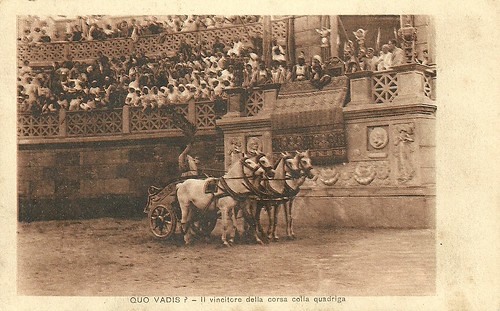
Italian postcard. Photo: Cines. Publicity still for Quo vadis? (Enrico Guazzoni, 1913). Caption: The winner of the chariot race.
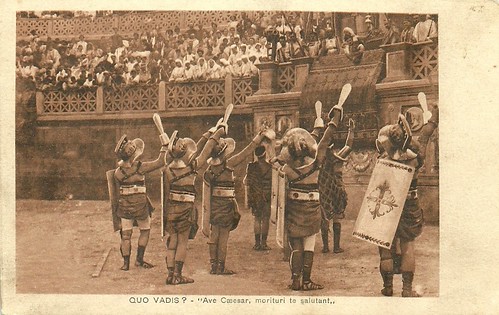
Italian postcard. Photo: Cines. Publicity still for Quo vadis? (Enrico Guazzoni, 1913). Caption: "Ave Caesar, those who are about to die salute you." This image cites a famous 19th-century painting (1859) by Jean-Léon Gérôme. It was often quoted, also in the Asterix comics.
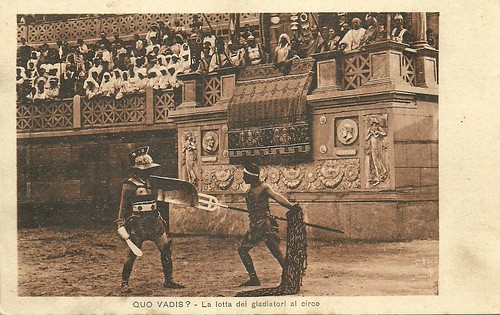
Italian postcard. Photo: Cines. Publicity still for Quo vadis? (Enrico Guazzoni, 1913). Caption: The fight of the gladiators in the arena.
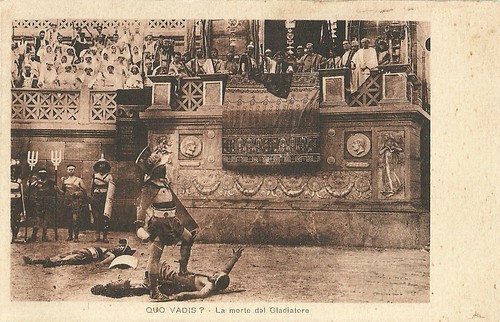
Italian postcard. Photo: Cines. Publicity still for Quo vadis? (Enrico Guazzoni, 1913). Caption: The death of the gladiator. This image cites Jean-Léon Gérôme's famous painting Pollice verso (Thumbs down, 1872) and was often used in publicity for the film. In the back, the emperor Nero (Carlo Cattaneo) makes the sign of thumbs down, a sign for the conqueror to kill his adversary. Flanking Nero are left Tigellinus (Cesare Moltroni) and right Petronius (Gustavo Serena). Left of the imperial box, the Vestal Virgins are seated.
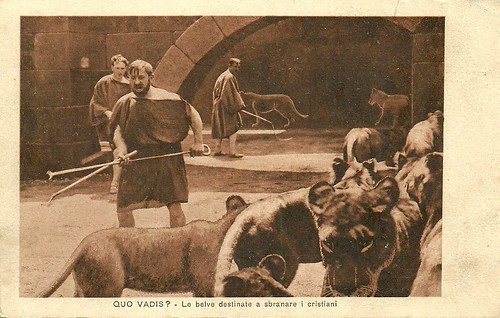
Italian postcard. Photo: Cines. Publicity still for Quo vadis? (Enrico Guazzoni, 1913). Caption: The wild animals are destined to tear the Christians to pieces. The lion keepers activate the lions under the circus before sending them above ground.

Italian postcard. Photo: Cines. Scene from Quo vadis? (Enrico Guazzoni, 1913). Caption: The Christians were exposed to the beasts at the circus.
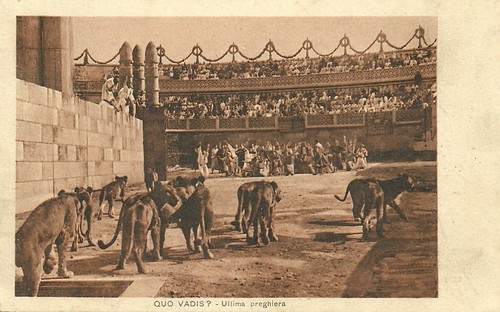
Italian postcard. Photo: Cines. Publicity still for Quo vadis? (Enrico Guazzoni, 1913). Caption: The last prayer. This scene quotes Jean-Léon Gérôme's painting The Christian Martyrs' Last Prayer (1863-1883).
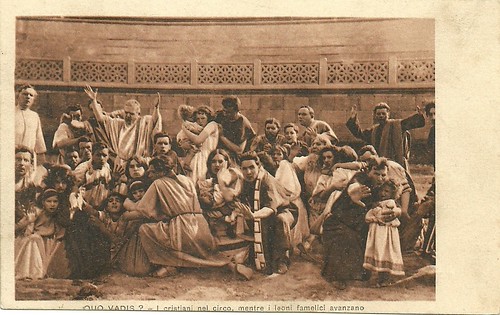
Italian postcard. Photo: Cines. Publicity still for Quo vadis? (Enrico Guazzoni, 1913). Caption: The Christians in the circus, while the hungry lions approach.
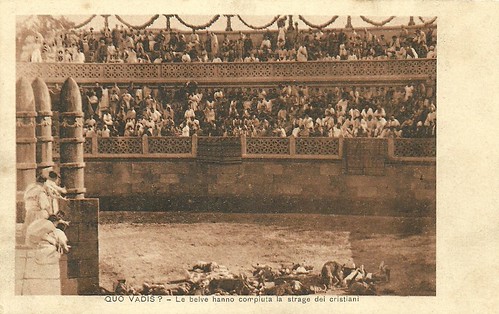
Italian postcard. Photo: Cines. Publicity still for Quo vadis? (Enrico Guazzoni, 1913). The beasts have committed the massacre of the Christians.
Quo vadis? is Latin for 'Where are you going?' and alludes to the apocryphal Acts of Peter, in which Peter flees Rome but on his way meets Jesus and asks him why he is going to Rome. Jesus says, "I am going back to be crucified again", which makes Peter go back to Rome and accept martyrdom.
Quo vadis?, written by Henryk Sienkiewicz, tells the love story between a young and beautiful Christian woman, Lygia, and a military tribune and Roman patrician, Marcus Vinicius. The story takes place in the city of Rome under Emperor Nero, around AD 64.
Published in instalments in three Polish dailies in 1895, Quo vadis? came out in book form in 1896 and has since been translated into more than 50 languages. This novel contributed to Sienkiewicz's Nobel Prize for literature in 1905.
In 1901, Pathé Frères produced the first screen version, Quo vadis? (Lucien Nonguet, Ferdinand Zecca, 1901). It is only 65 meters long (duration: about three minutes) and was restored by the Centre national du cinéma et de l’image animée (CNC) in Paris.
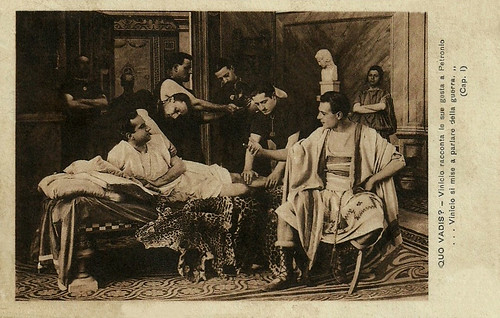
Italian postcard. Photo: Cines. Publicity still for Quo vadis? (Enrico Guazzoni, 1913). Gustavo Serena as Petronius Arbiter and Amleto Novelli as Marcus Vinicius. Caption: Vinicius tells Petronius of his acts. Vinicius started to talk about the war (Chapter I).
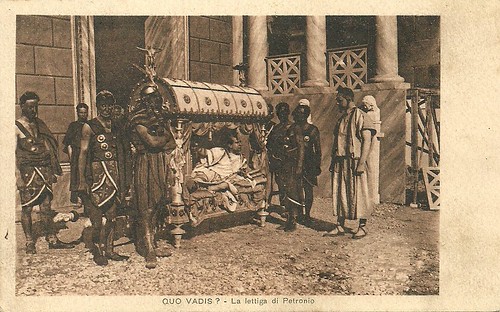
Italian postcard. Photo: Cines. Publicity still for Quo vadis? (Enrico Guazzoni, 1913). Caption: The litter of Petronius. In front of Nero's palace, Petronius (Gustavo Serena) says goodbye to his cousin Vinicius (Amleto Novelli) and promises to have a good word to Nero about Vinicius getting Lygia.
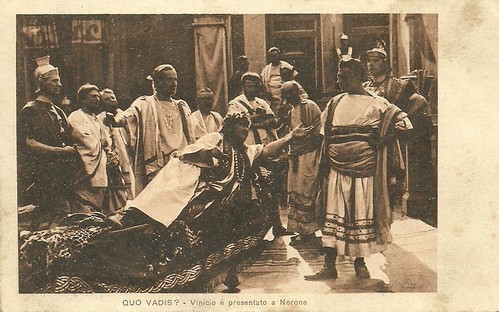
Italian postcard. Photo: Cines. Publicity still for Quo vadis? (Enrico Guazzoni, 1913). Caption: Vinicius (Amleto Novelli) is presented to Nero (Carlo Cattaneo). Behind Nero stands Petronius (Gustavo Serena).
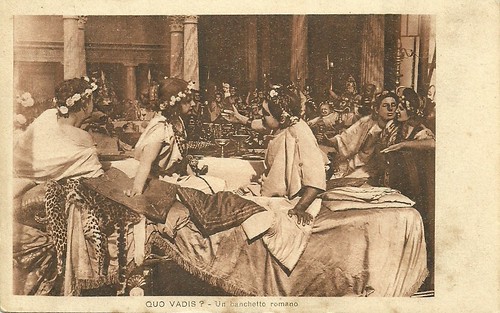
Italian postcard. Photo: Cines. Publicity still for Quo vadis? (Enrico Guazzoni, 1913). A Roman banquet. In the front, Lea Giunchi as Lygia and Amleto Novelli as Vinicius.
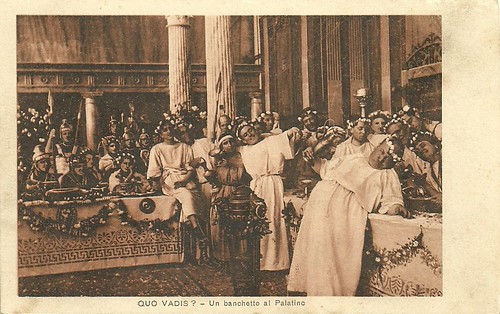
Italian postcard. Photo: Cines. Publicity still for Quo vadis? (Enrico Guazzoni, 1913). Caption: A banquet on the Palatine. The fat and drunken man in front is Giuseppe Gambardella (Vitellius), who was also famous as Checco in short Italian comedies.
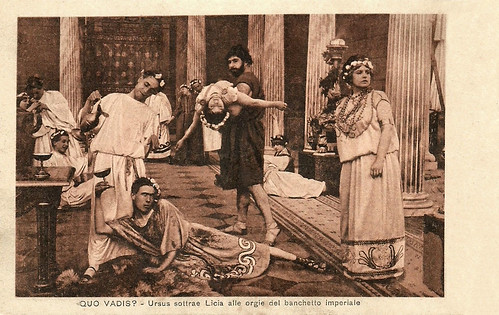
Italian postcard. Photo: Cines. Publicity still for Quo vadis? (Enrico Guazzoni, 1913). Helped by Acte, Nero's former mistress, Ursus (Bruto Castellani) subtracts Lygia (Lea Giunchi) from the orgy of the imperial banquet, where the drunken Roman Vinicius tries to rape her.
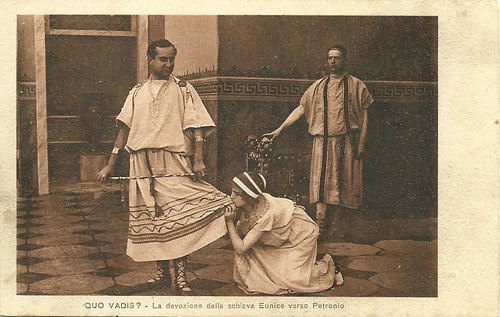
Italian postcard. Photo: Cines. Publicity still for Quo vadis? (Enrico Guazzoni, 1913). Caption: The devotion of the slave Eunice (Amelia Cattaneo) to Petronius (Gustavo Serena).
More than ten years after Quo vadis? (Lucien Nonguet, Ferdinand Zecca, 1901), Italian director Enrico Guazzoni made a colossal epic for the Cines studio, starring Amleto Novelli and Gustavo Serena. He masterfully combined huge spectacle with intimate scenes.
In 1913, Guazzoni's Quo vadis? premiered, and the results at the box office quickly proved it a smashing success. Wikipedia: "It was arguably the first blockbuster in the history of cinema, with 5,000 extras, lavish sets, and a running time of two hours, setting the standard for 'superspectacles' for decades to come".
Throughout the world, Quo vadis? became popular not only among readers but also among fans of the new phenomenon, cinema. The film influenced Giovanni Pastrone's Cabiria (1914) and D.W. Griffith's Intolerance (1916).
Hal Erickson at AllMovie: "Quo Vadis? is nonetheless an important milestone in movie history. The film ran 12 reels (approximately three hours) at a time when most American productions were still within the 1- to 4-reel length. American film distributor George Kleine pared the film down to 8 reels for US distribution, but this still was an uncommonly long production for its day."
In 1997, the film was photochemically restored by Eye Filmmuseum in Amsterdam, but today, a new, digital restoration by the Cineteca di Bologna will be screened. This version contains a reconstruction of the original Italian intertitles by Giovanni Lasi.
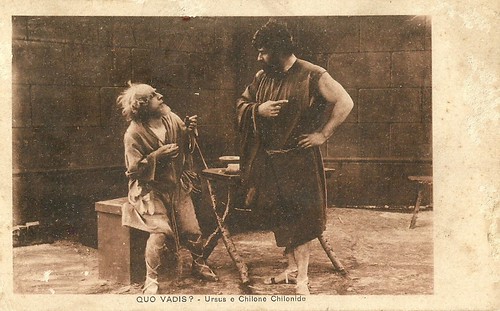
Italian postcard. Photo: Cines. Publicity still for Quo vadis? (Enrico Guazzoni, 1913). Caption: Ursus (Bruto Castellani) and Chilo Chilonides (Augusto Mastripietri).
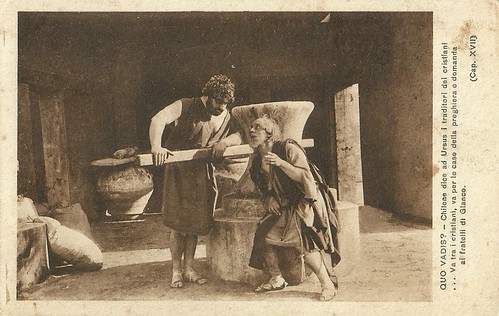
Italian postcard. Photo: Cines. Publicity still for Quo vadis? (Enrico Guazzoni, 1913). Chilo (Augusto Mastripietri) sweet-talks to Ursus (Bruto Castellani) to find out where Lygia is hidden. Caption: Chilo talks to Ursus about the traitors of the Christians. (Ursus:) Go to the Christians, go to their godhouses and ask for the brothers of Glaucus. (Chapter XVII of the book).
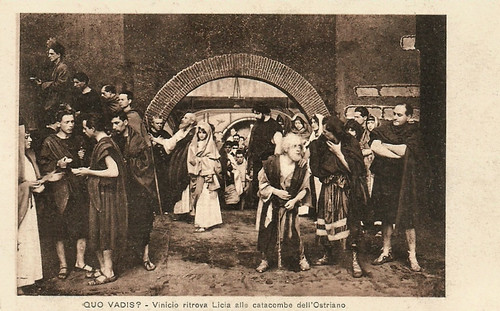
Italian postcard. Photo: Cines. Publicity still for Quo vadis? (Enrico Guazzoni, 1913). Vinicius (Amleto Novelli) finds Lygia (Lea Giunchi) at the catacombs of Ostrianum. Left of Lygia is St. Peter (Giovanni Gizzi), right of her, her protector, Ursus (Bruto Castellani). Vinicius plots to abduct Lygia, with the help of the Greek Chilo (Augusto Mastripietri) and a gladiator.
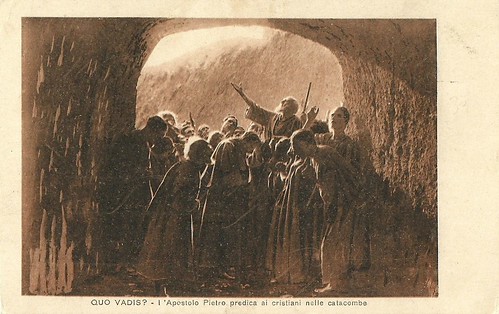
Italian postcard. Photo: Cines. Publicity still for Quo vadis? (Enrico Guazzoni, 1913). Caption: The apostle Peter (Giovanni Gizzi) preaching to the Christians in the catacombs.
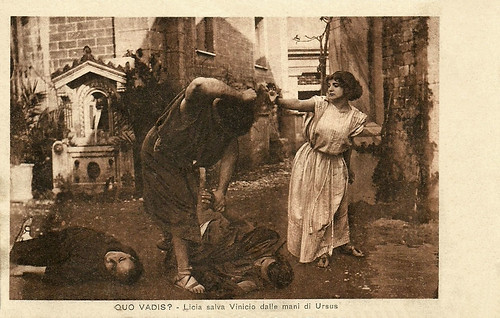
Italian postcard by Uff.Rev. St. Terni. Photo: Cines. Publicity still for Quo vadis? (Enrico Guazzoni, 1913). Lygia (Lea Giunchi) saves Vinicius (Amleto Novelli) from the hands of Ursus (Bruto Castellani). Ursus, protector of Lygia, has just killed a gladiator who had been hired by Vinicius to kill Ursus while he planned to abduct Lygia.
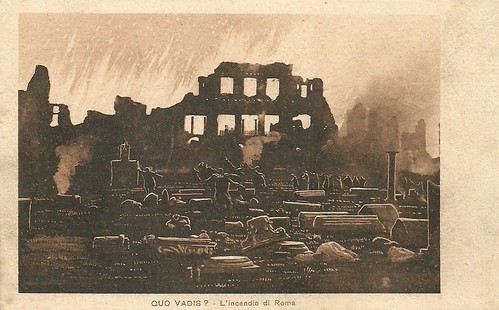
Italian postcard. Photo: Cines. Publicity still for Quo vadis? (Enrico Guazzoni, 1913). Caption: The fire of Rome.
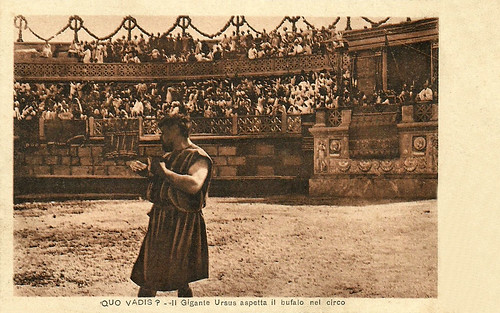
Italian postcard. Photo: Cines. Publicity still for Quo vadis? (Enrico Guazzoni, 1913). The Giant Ursus (Bruto Castellani) awaits the bull in the circus. After his long captivity, Ursus is almost blinded when he enters the arena. Then a wild bull enters the arena, on whose back Lygia is bound. Ursus will kill the bull with his bare hands, much to the delight of the audience and the emperor.
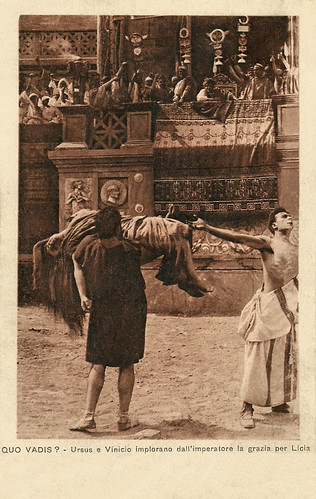
Italian postcard. Photo: Cines. Publicity still for Quo vadis? (Enrico Guazzoni, 1913). Ursus (Bruto Castellani) and Vinicius (Amleto Novelli) implore the audience and Emperor Nero to grace the Christian Lygia (Lea Giunchi), after Ursus has killed the bull on whose back Lygia had been bound. The audience raves because of Ursus' tour de force. Vinicius has stripped his clothes to show his scars from the wars, while Ursus holds up Lygia. All people around Nero hold their thumbs up for grace, even if this sign seems to have been a 19th-century invention and is historically incorrect.
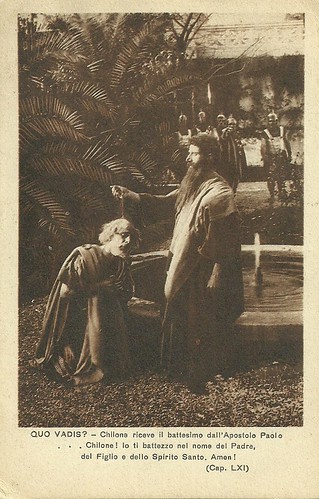
Italian postcard. Photo: Cines. Publicity still for Quo vadis? (Enrico Guazzoni, 1913). Caption: Chilo (Augusto Mastripietri) is baptised by the apostle Paul (of Tarsus). Chilo! I baptise you in the name of the Father, the Son and the Holy Ghost. Amen! (Chapter LXI of the book).
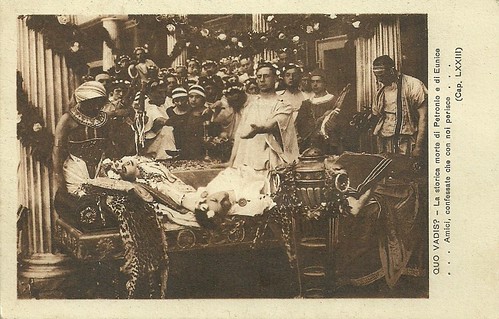
Italian postcard. Photo: Cines. Publicity still for Quo vadis? (Enrico Guazzoni, 1913). Caption: The historical death of Petronius (Gustavo Serena) and Eunice (Amelia Cattaneo). "Friends, confess that with us perishes..." (Chapter LXXIII).

British postcard by J.F. Grimm & Co., London F.C. Photo: Cines. Amleto Novelli in Quo vadis? (Enrico Guazzoni, 1913).

British postcard by J.F. Grimm & Co., London FC. Photo: Cines. Amleto Novelli as Vinicius visiting his uncle Petronius (Gustavo Serena) and telling him about his discovery of Lygia, at the start of Quo vadis? (Enrico Guazzoni, 1913).

British postcard by J.F. Grimm & Co., London F.C. Photo: Cines. Scene from Quo vadis? (Enrico Guazzoni, 1913). Caption: Watching the massacre of the Christians. Nero (Carlo Cattaneo) is instead watching Petronius (Gustavo Serena) and asking him what he thinks of the spectacle. "It is worthy of you", the latter responds.

Belgian postcard by Ed. A. Deloga, Bruxelles. Photo: Cines. On 18 July 191?/192? (exact year unknown), the Brussels cinema Majestic, 62, Boulevard du Nord (now Boulevard Adolphe Max), re-released the Italian silent epic Quo vadis? (Enrico Guazzoni, 1913) because, as the postcard says, of general demand. The film took two hours, which was quite long for those years, and was shown in its entirety, with a new musical score. Quo vadis? was so popular that it had many relaunches, all through the silent era. The still depicted is a citation from Jean-Léon Gérôme's well-known painting 'The Christian Martyr's Last Prayers' (1883). It was recycled in the publicity for the film, on posters, in brochures and in advertisements in magazines.
Sources: Museum of Dreamworlds, Hal Erickson (AllMovie - Page now defunct), Wikipedia and IMDb.
Italian postcard. Photo: Cines. Publicity still for Quo vadis? (Enrico Guazzoni, 1913). Caption: The winner of the chariot race.
Italian postcard. Photo: Cines. Publicity still for Quo vadis? (Enrico Guazzoni, 1913). Caption: "Ave Caesar, those who are about to die salute you." This image cites a famous 19th-century painting (1859) by Jean-Léon Gérôme. It was often quoted, also in the Asterix comics.
Italian postcard. Photo: Cines. Publicity still for Quo vadis? (Enrico Guazzoni, 1913). Caption: The fight of the gladiators in the arena.
Italian postcard. Photo: Cines. Publicity still for Quo vadis? (Enrico Guazzoni, 1913). Caption: The death of the gladiator. This image cites Jean-Léon Gérôme's famous painting Pollice verso (Thumbs down, 1872) and was often used in publicity for the film. In the back, the emperor Nero (Carlo Cattaneo) makes the sign of thumbs down, a sign for the conqueror to kill his adversary. Flanking Nero are left Tigellinus (Cesare Moltroni) and right Petronius (Gustavo Serena). Left of the imperial box, the Vestal Virgins are seated.
Italian postcard. Photo: Cines. Publicity still for Quo vadis? (Enrico Guazzoni, 1913). Caption: The wild animals are destined to tear the Christians to pieces. The lion keepers activate the lions under the circus before sending them above ground.
Italian postcard. Photo: Cines. Scene from Quo vadis? (Enrico Guazzoni, 1913). Caption: The Christians were exposed to the beasts at the circus.
Italian postcard. Photo: Cines. Publicity still for Quo vadis? (Enrico Guazzoni, 1913). Caption: The last prayer. This scene quotes Jean-Léon Gérôme's painting The Christian Martyrs' Last Prayer (1863-1883).
Italian postcard. Photo: Cines. Publicity still for Quo vadis? (Enrico Guazzoni, 1913). Caption: The Christians in the circus, while the hungry lions approach.
Italian postcard. Photo: Cines. Publicity still for Quo vadis? (Enrico Guazzoni, 1913). The beasts have committed the massacre of the Christians.
Where are you going?
Quo vadis? is Latin for 'Where are you going?' and alludes to the apocryphal Acts of Peter, in which Peter flees Rome but on his way meets Jesus and asks him why he is going to Rome. Jesus says, "I am going back to be crucified again", which makes Peter go back to Rome and accept martyrdom.
Quo vadis?, written by Henryk Sienkiewicz, tells the love story between a young and beautiful Christian woman, Lygia, and a military tribune and Roman patrician, Marcus Vinicius. The story takes place in the city of Rome under Emperor Nero, around AD 64.
Published in instalments in three Polish dailies in 1895, Quo vadis? came out in book form in 1896 and has since been translated into more than 50 languages. This novel contributed to Sienkiewicz's Nobel Prize for literature in 1905.
In 1901, Pathé Frères produced the first screen version, Quo vadis? (Lucien Nonguet, Ferdinand Zecca, 1901). It is only 65 meters long (duration: about three minutes) and was restored by the Centre national du cinéma et de l’image animée (CNC) in Paris.
Italian postcard. Photo: Cines. Publicity still for Quo vadis? (Enrico Guazzoni, 1913). Gustavo Serena as Petronius Arbiter and Amleto Novelli as Marcus Vinicius. Caption: Vinicius tells Petronius of his acts. Vinicius started to talk about the war (Chapter I).
Italian postcard. Photo: Cines. Publicity still for Quo vadis? (Enrico Guazzoni, 1913). Caption: The litter of Petronius. In front of Nero's palace, Petronius (Gustavo Serena) says goodbye to his cousin Vinicius (Amleto Novelli) and promises to have a good word to Nero about Vinicius getting Lygia.
Italian postcard. Photo: Cines. Publicity still for Quo vadis? (Enrico Guazzoni, 1913). Caption: Vinicius (Amleto Novelli) is presented to Nero (Carlo Cattaneo). Behind Nero stands Petronius (Gustavo Serena).
Italian postcard. Photo: Cines. Publicity still for Quo vadis? (Enrico Guazzoni, 1913). A Roman banquet. In the front, Lea Giunchi as Lygia and Amleto Novelli as Vinicius.
Italian postcard. Photo: Cines. Publicity still for Quo vadis? (Enrico Guazzoni, 1913). Caption: A banquet on the Palatine. The fat and drunken man in front is Giuseppe Gambardella (Vitellius), who was also famous as Checco in short Italian comedies.
Italian postcard. Photo: Cines. Publicity still for Quo vadis? (Enrico Guazzoni, 1913). Helped by Acte, Nero's former mistress, Ursus (Bruto Castellani) subtracts Lygia (Lea Giunchi) from the orgy of the imperial banquet, where the drunken Roman Vinicius tries to rape her.
Italian postcard. Photo: Cines. Publicity still for Quo vadis? (Enrico Guazzoni, 1913). Caption: The devotion of the slave Eunice (Amelia Cattaneo) to Petronius (Gustavo Serena).
A colossal epic
More than ten years after Quo vadis? (Lucien Nonguet, Ferdinand Zecca, 1901), Italian director Enrico Guazzoni made a colossal epic for the Cines studio, starring Amleto Novelli and Gustavo Serena. He masterfully combined huge spectacle with intimate scenes.
In 1913, Guazzoni's Quo vadis? premiered, and the results at the box office quickly proved it a smashing success. Wikipedia: "It was arguably the first blockbuster in the history of cinema, with 5,000 extras, lavish sets, and a running time of two hours, setting the standard for 'superspectacles' for decades to come".
Throughout the world, Quo vadis? became popular not only among readers but also among fans of the new phenomenon, cinema. The film influenced Giovanni Pastrone's Cabiria (1914) and D.W. Griffith's Intolerance (1916).
Hal Erickson at AllMovie: "Quo Vadis? is nonetheless an important milestone in movie history. The film ran 12 reels (approximately three hours) at a time when most American productions were still within the 1- to 4-reel length. American film distributor George Kleine pared the film down to 8 reels for US distribution, but this still was an uncommonly long production for its day."
In 1997, the film was photochemically restored by Eye Filmmuseum in Amsterdam, but today, a new, digital restoration by the Cineteca di Bologna will be screened. This version contains a reconstruction of the original Italian intertitles by Giovanni Lasi.
Italian postcard. Photo: Cines. Publicity still for Quo vadis? (Enrico Guazzoni, 1913). Caption: Ursus (Bruto Castellani) and Chilo Chilonides (Augusto Mastripietri).
Italian postcard. Photo: Cines. Publicity still for Quo vadis? (Enrico Guazzoni, 1913). Chilo (Augusto Mastripietri) sweet-talks to Ursus (Bruto Castellani) to find out where Lygia is hidden. Caption: Chilo talks to Ursus about the traitors of the Christians. (Ursus:) Go to the Christians, go to their godhouses and ask for the brothers of Glaucus. (Chapter XVII of the book).
Italian postcard. Photo: Cines. Publicity still for Quo vadis? (Enrico Guazzoni, 1913). Vinicius (Amleto Novelli) finds Lygia (Lea Giunchi) at the catacombs of Ostrianum. Left of Lygia is St. Peter (Giovanni Gizzi), right of her, her protector, Ursus (Bruto Castellani). Vinicius plots to abduct Lygia, with the help of the Greek Chilo (Augusto Mastripietri) and a gladiator.
Italian postcard. Photo: Cines. Publicity still for Quo vadis? (Enrico Guazzoni, 1913). Caption: The apostle Peter (Giovanni Gizzi) preaching to the Christians in the catacombs.
Italian postcard by Uff.Rev. St. Terni. Photo: Cines. Publicity still for Quo vadis? (Enrico Guazzoni, 1913). Lygia (Lea Giunchi) saves Vinicius (Amleto Novelli) from the hands of Ursus (Bruto Castellani). Ursus, protector of Lygia, has just killed a gladiator who had been hired by Vinicius to kill Ursus while he planned to abduct Lygia.
Italian postcard. Photo: Cines. Publicity still for Quo vadis? (Enrico Guazzoni, 1913). Caption: The fire of Rome.
Italian postcard. Photo: Cines. Publicity still for Quo vadis? (Enrico Guazzoni, 1913). The Giant Ursus (Bruto Castellani) awaits the bull in the circus. After his long captivity, Ursus is almost blinded when he enters the arena. Then a wild bull enters the arena, on whose back Lygia is bound. Ursus will kill the bull with his bare hands, much to the delight of the audience and the emperor.
Italian postcard. Photo: Cines. Publicity still for Quo vadis? (Enrico Guazzoni, 1913). Ursus (Bruto Castellani) and Vinicius (Amleto Novelli) implore the audience and Emperor Nero to grace the Christian Lygia (Lea Giunchi), after Ursus has killed the bull on whose back Lygia had been bound. The audience raves because of Ursus' tour de force. Vinicius has stripped his clothes to show his scars from the wars, while Ursus holds up Lygia. All people around Nero hold their thumbs up for grace, even if this sign seems to have been a 19th-century invention and is historically incorrect.
Italian postcard. Photo: Cines. Publicity still for Quo vadis? (Enrico Guazzoni, 1913). Caption: Chilo (Augusto Mastripietri) is baptised by the apostle Paul (of Tarsus). Chilo! I baptise you in the name of the Father, the Son and the Holy Ghost. Amen! (Chapter LXI of the book).
Italian postcard. Photo: Cines. Publicity still for Quo vadis? (Enrico Guazzoni, 1913). Caption: The historical death of Petronius (Gustavo Serena) and Eunice (Amelia Cattaneo). "Friends, confess that with us perishes..." (Chapter LXXIII).
British postcard by J.F. Grimm & Co., London F.C. Photo: Cines. Amleto Novelli in Quo vadis? (Enrico Guazzoni, 1913).
British postcard by J.F. Grimm & Co., London FC. Photo: Cines. Amleto Novelli as Vinicius visiting his uncle Petronius (Gustavo Serena) and telling him about his discovery of Lygia, at the start of Quo vadis? (Enrico Guazzoni, 1913).
British postcard by J.F. Grimm & Co., London F.C. Photo: Cines. Scene from Quo vadis? (Enrico Guazzoni, 1913). Caption: Watching the massacre of the Christians. Nero (Carlo Cattaneo) is instead watching Petronius (Gustavo Serena) and asking him what he thinks of the spectacle. "It is worthy of you", the latter responds.
Belgian postcard by Ed. A. Deloga, Bruxelles. Photo: Cines. On 18 July 191?/192? (exact year unknown), the Brussels cinema Majestic, 62, Boulevard du Nord (now Boulevard Adolphe Max), re-released the Italian silent epic Quo vadis? (Enrico Guazzoni, 1913) because, as the postcard says, of general demand. The film took two hours, which was quite long for those years, and was shown in its entirety, with a new musical score. Quo vadis? was so popular that it had many relaunches, all through the silent era. The still depicted is a citation from Jean-Léon Gérôme's well-known painting 'The Christian Martyr's Last Prayers' (1883). It was recycled in the publicity for the film, on posters, in brochures and in advertisements in magazines.
Sources: Museum of Dreamworlds, Hal Erickson (AllMovie - Page now defunct), Wikipedia and IMDb.
No comments:
Post a Comment