German humorist, couplet singer and actor Arnold Rieck (1876-1924) was a forerunner of the modern stand-up comedians. He was also one of the first stage actors who started to perform in films.

German postcard by Rotophot in the Film Sterne series, no. 185/3. Photo: Nicola Perscheid, Berlin / Messter Film, Berlin.
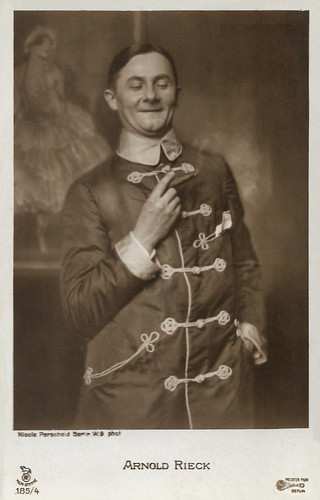
German postcard by Rotophot in the Film Sterne series, no. 185/4. Photo: Nicola Perscheid, Berlin / Messter Film, Berlin.

German postcard by Rotophot in the Film Sterne series, no. 185/5. Photo: Nicola Perscheid, Berlin / Messter Film, Berlin.

German postcard by Rotophot in the Film Sterne series, no. 185/6. Photo: Nicola Perscheid, Berlin / Messter Film, Berlin.
Arnold Rieck was born in 1876 in Berlin. As a boy, he always joined the gallery of the Royal Playhouse to see 'Hamlet' or 'Romeo and Juliet'. He took acting lessons, but his slender height dashed his aspirations of becoming a tragic hero and - against his will – he became a comedian. Rieck first made his name as a singer of couplets and as a solo entertainer with humorous antics. Thus he became the forerunner of the classic stand-up comedian.
In 1897 he made his stage debut in Gera. In 1899, the Berliner Operette was born at the Apollo Theatre, and Rieck got the role of tailor Lämmermeyer in the new operetta 'Frau Luna' (Ms. Moon) composed by Paul Lincke. The success was sensational. From then on, Rieck appeared on several metropolitan stages. His most successful period was as a star of the Berlin Thalia Theatre. There he could be seen in such popular comedies as 'Charleys Tante' (Charley's aunt) and in the operettas by composer Jean Gilbert, one of the fathers of the new Berlin operetta.
According to him, Arnold Rieck was also the first German stage actor to move to cinema. At the turn of the century, he appeared as the title figure in such short farces as Der Geck im Damenbade / The Dude in the ladies' bath and Piefke mit dem Floh / Piefke with the flea. Initially, Rieck got a dozen plates per shooting day instead of payment. Later he received as a first fee 18 marks per day with a three-day shooting schedule.
At the Messter studio, he starred in such short comedies as Die fünf Sinne / The Five Senses (N.N., 1906) and Prinzess Rosine / Princess Rosine (N.N., 1907). The following year, he appeared for the Duskes film studio in other comedy shorts like Prosit Neujahr 1909 / Happy New Year 1909 (N.N., 1908) with Emmy Wehlen, and Die Dollar-Prinzessin / The Dollar Princess (Alfred Duskes, 1908).
With Guido Thielscher, Leo Peukert and Guido Herzfeld, Rieck became one of the best-known representatives of early film farces. In 1910, he made for the Vitascope company in Berlin the military comedy short Es wär’ so schön gewesen / It Would Have Been So Nice (director unknown, 1910).
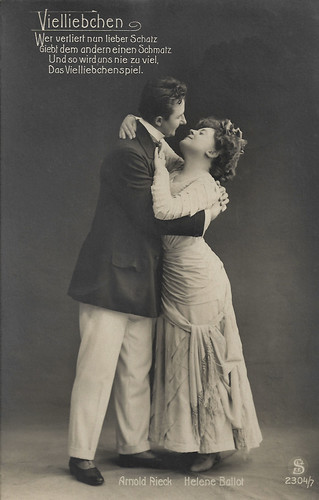
Arnold Rieck and Helene Ballot perform the song 'Essen wir mal Vielliebchen'. German postcard by F.F. S. L.J., no. 2304/7, 1909. Caption: "Vielliebchen. Wer verliert nun lieber Schatz, Giebt dem Andern einen Schmatz, Und so wird uns nie zu viel, Das Vielliebchenspiel." (Philopena. Who now loses dear treasure, Give the other a smack, And so it's never too much, The Many-lovers-game.) 'Essen wir mal Vielliebchen' was a song from the operetta 'Mitternachtsmädchen' by Victor Hollaender, first performed at the Odeon in Berlin in 1908.
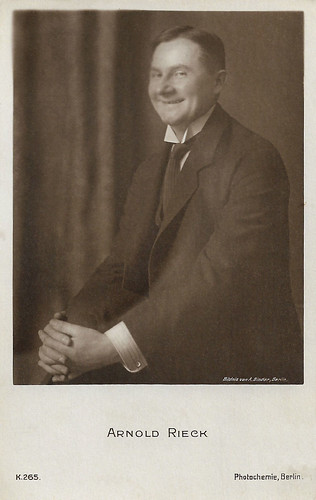
German postcard by Photochemie, no. K. 265. Photo: Alex Binder, Berlin.
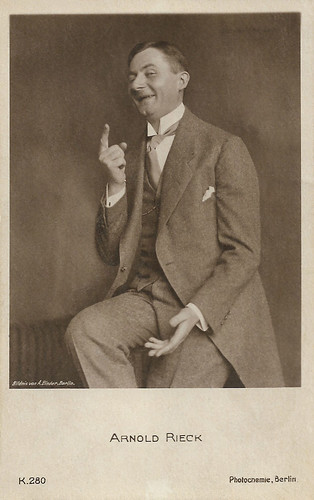
German postcard by Photochemie, no. K. 280. Photo: Alex Binder, Berlin.
During the First World War, Arnold Rieck amused in numerous silent comedies as a stock stiff, comical type in an ancient costume. Successful examples are the comedies Musketier Kaczmarek / Musketeer Kaczmarek (Carl Froelich, 1915) with Ressel Orla, Der standhafte Benjamin / The staunch Benjamin (Robert Wiene, 1916) with Guido Herzfeld, and Brautfahrt / Lehmann's Honeymoon (Robert Wiene, 1916).
In Brautfahrt / Lehmann's Honeymoon, he played a stiff gymnasium Professor of Greek history who dreams that he travels to ancient Hellas and falls in love with a Greek beauty. To persuade the daydreaming Professor to marry his cousin, his family dress themselves up as Ancient Greeks.
With his high hat, ropy skirt, umbrella and embroidered travel bag, Rieck reminded his public of long outdated times, and he was not afraid to ridicule himself. Shortly after the war, his type of humour felt outdated, and Rieck was replaced by more subtle comedians. American stars such as Charles Chaplin and Buster Keaton now dominated the German screens.
In the 1920s, Rieck refocused on his stage career and worked as a humorist at Berlin's Komische Oper and the new Operetta Theater in Leipzig. His later films included Yvette, die Modeprinzessin / Yvette, the Fashion Princess (Friedrich Zelnik, 1922) starring Lya Mara, Zwei Welten / Two Worlds (Richard Löwenbein, 1922) starring Sascha Gura, and Das Weib auf dem Panther / The Woman on the Panther (Alfred Halm, 1923) with Grete Reinwald and Hermann Thimig.
In 1924, Arnold Rieck collapsed on stage in Leipzig and died unexpectedly, only 48 years old. His final film appearance had been a supporting role in the Henny Porten drama Mutter und Kind / Mother and Child (Carl Froelich, 1924). Sound recordings of the comedian have survived on gramophone and Zonophon records and Edison cylinders.
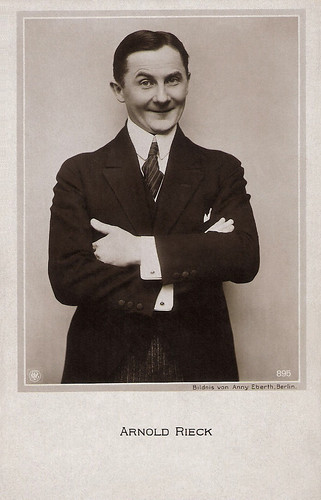
German postcard by NPG, no. 895. Photo: Anny Eberth, Berlin.
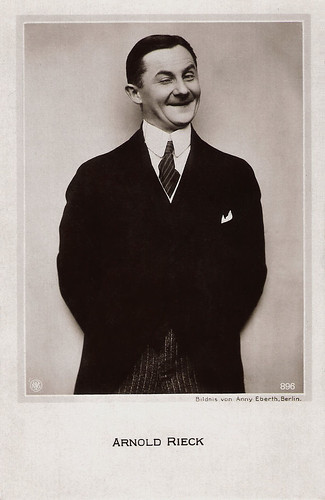
German postcard by NPG, no. 896. Photo: Anny Eberth, Berlin.
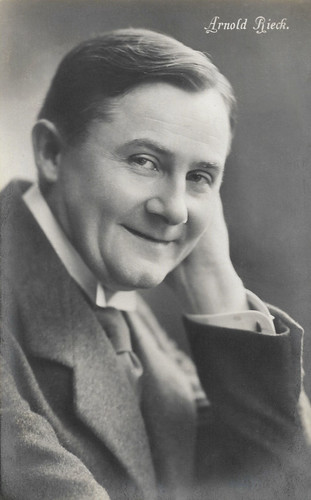
German postcard by NBC.
Sources: Gerold Ducke (Die Geschichte Berlins – German), Wikipedia (German and English) and IMDb.
This post was last updated on 21 July 2026.
German postcard by Rotophot in the Film Sterne series, no. 185/3. Photo: Nicola Perscheid, Berlin / Messter Film, Berlin.
German postcard by Rotophot in the Film Sterne series, no. 185/4. Photo: Nicola Perscheid, Berlin / Messter Film, Berlin.
German postcard by Rotophot in the Film Sterne series, no. 185/5. Photo: Nicola Perscheid, Berlin / Messter Film, Berlin.
German postcard by Rotophot in the Film Sterne series, no. 185/6. Photo: Nicola Perscheid, Berlin / Messter Film, Berlin.
A comedian against his will
Arnold Rieck was born in 1876 in Berlin. As a boy, he always joined the gallery of the Royal Playhouse to see 'Hamlet' or 'Romeo and Juliet'. He took acting lessons, but his slender height dashed his aspirations of becoming a tragic hero and - against his will – he became a comedian. Rieck first made his name as a singer of couplets and as a solo entertainer with humorous antics. Thus he became the forerunner of the classic stand-up comedian.
In 1897 he made his stage debut in Gera. In 1899, the Berliner Operette was born at the Apollo Theatre, and Rieck got the role of tailor Lämmermeyer in the new operetta 'Frau Luna' (Ms. Moon) composed by Paul Lincke. The success was sensational. From then on, Rieck appeared on several metropolitan stages. His most successful period was as a star of the Berlin Thalia Theatre. There he could be seen in such popular comedies as 'Charleys Tante' (Charley's aunt) and in the operettas by composer Jean Gilbert, one of the fathers of the new Berlin operetta.
According to him, Arnold Rieck was also the first German stage actor to move to cinema. At the turn of the century, he appeared as the title figure in such short farces as Der Geck im Damenbade / The Dude in the ladies' bath and Piefke mit dem Floh / Piefke with the flea. Initially, Rieck got a dozen plates per shooting day instead of payment. Later he received as a first fee 18 marks per day with a three-day shooting schedule.
At the Messter studio, he starred in such short comedies as Die fünf Sinne / The Five Senses (N.N., 1906) and Prinzess Rosine / Princess Rosine (N.N., 1907). The following year, he appeared for the Duskes film studio in other comedy shorts like Prosit Neujahr 1909 / Happy New Year 1909 (N.N., 1908) with Emmy Wehlen, and Die Dollar-Prinzessin / The Dollar Princess (Alfred Duskes, 1908).
With Guido Thielscher, Leo Peukert and Guido Herzfeld, Rieck became one of the best-known representatives of early film farces. In 1910, he made for the Vitascope company in Berlin the military comedy short Es wär’ so schön gewesen / It Would Have Been So Nice (director unknown, 1910).
Arnold Rieck and Helene Ballot perform the song 'Essen wir mal Vielliebchen'. German postcard by F.F. S. L.J., no. 2304/7, 1909. Caption: "Vielliebchen. Wer verliert nun lieber Schatz, Giebt dem Andern einen Schmatz, Und so wird uns nie zu viel, Das Vielliebchenspiel." (Philopena. Who now loses dear treasure, Give the other a smack, And so it's never too much, The Many-lovers-game.) 'Essen wir mal Vielliebchen' was a song from the operetta 'Mitternachtsmädchen' by Victor Hollaender, first performed at the Odeon in Berlin in 1908.
German postcard by Photochemie, no. K. 265. Photo: Alex Binder, Berlin.
German postcard by Photochemie, no. K. 280. Photo: Alex Binder, Berlin.
A stock stiff, comical type in an ancient costume
During the First World War, Arnold Rieck amused in numerous silent comedies as a stock stiff, comical type in an ancient costume. Successful examples are the comedies Musketier Kaczmarek / Musketeer Kaczmarek (Carl Froelich, 1915) with Ressel Orla, Der standhafte Benjamin / The staunch Benjamin (Robert Wiene, 1916) with Guido Herzfeld, and Brautfahrt / Lehmann's Honeymoon (Robert Wiene, 1916).
In Brautfahrt / Lehmann's Honeymoon, he played a stiff gymnasium Professor of Greek history who dreams that he travels to ancient Hellas and falls in love with a Greek beauty. To persuade the daydreaming Professor to marry his cousin, his family dress themselves up as Ancient Greeks.
With his high hat, ropy skirt, umbrella and embroidered travel bag, Rieck reminded his public of long outdated times, and he was not afraid to ridicule himself. Shortly after the war, his type of humour felt outdated, and Rieck was replaced by more subtle comedians. American stars such as Charles Chaplin and Buster Keaton now dominated the German screens.
In the 1920s, Rieck refocused on his stage career and worked as a humorist at Berlin's Komische Oper and the new Operetta Theater in Leipzig. His later films included Yvette, die Modeprinzessin / Yvette, the Fashion Princess (Friedrich Zelnik, 1922) starring Lya Mara, Zwei Welten / Two Worlds (Richard Löwenbein, 1922) starring Sascha Gura, and Das Weib auf dem Panther / The Woman on the Panther (Alfred Halm, 1923) with Grete Reinwald and Hermann Thimig.
In 1924, Arnold Rieck collapsed on stage in Leipzig and died unexpectedly, only 48 years old. His final film appearance had been a supporting role in the Henny Porten drama Mutter und Kind / Mother and Child (Carl Froelich, 1924). Sound recordings of the comedian have survived on gramophone and Zonophon records and Edison cylinders.
German postcard by NPG, no. 895. Photo: Anny Eberth, Berlin.
German postcard by NPG, no. 896. Photo: Anny Eberth, Berlin.
German postcard by NBC.
Sources: Gerold Ducke (Die Geschichte Berlins – German), Wikipedia (German and English) and IMDb.
This post was last updated on 21 July 2026.
No comments:
Post a Comment