
American postcard by Fotofolio, no. Z1133. Photo: Annie Leibovitz. Caption: Demi Moore, pregnant with Scout LaRue Willis, Smashbox Studios, Culver City, California, 1991.
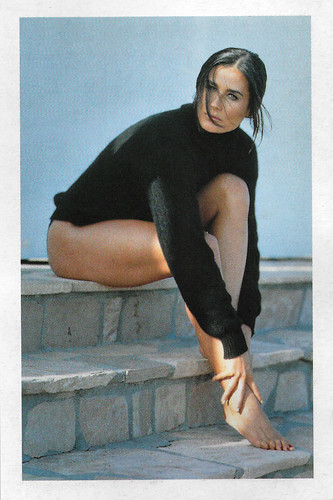
Belgian postcard in the 'De 50 mooiste vrouwen van de eeuw' (The 50 most beautiful women of the century) series by P-Magazine, no. 7. Photo: Lance Steadler / Outline.
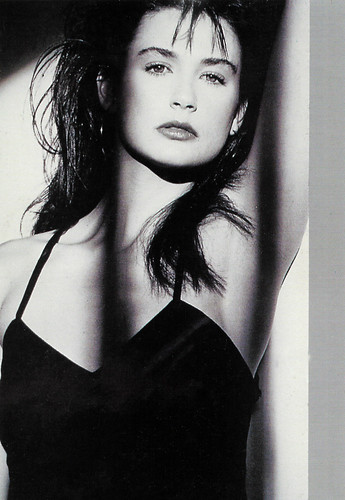
British postcard by Heroes Publishing Ltd, London, no. SPC 2572.

English postcard, no. C095. Caption: Demi Moore - Car.
The girl of the Brat Pack
Demi Moore was born Demetria Gene Guynes in Roswell, New Mexico, in 1962. Her father, Air Force airman Charles Harmon, left her then 18-year-old mother Victoria (née King) after a two-month marriage and before Demi was born. When Demi Moore was three months old, her mother married Dan Guynes, a newspaper salesman, who she later saw as her real father.
The family moved frequently because of her stepfather's work, more than thirty times. Her stepfather committed suicide when Demi was fifteen, two years after divorcing her mother. At age 15, Demi was raped by a friend of her mother’s, and at age 16 she dropped out of high school. Her mother, Virginia Guynes, was arrested many times, including for arson and drunk driving, and attempted suicide several times. Moore broke off contact with her in 1990 but later reconciled with her shortly before she died of cancer in 1998 at the age of 54.
In 1979, three months before her 17th birthday, Demi met the rock musician Freddy Moore, and they married in 1980. The marriage lasted four years. Moore signed with the Elite Modelling Agency and then enrolled in drama classes after being inspired by her next-door neighbour, 17-year-old German actress Nastassja Kinski. She appeared on the cover of the January 1981 issue of the French adult magazine Oui, taken from a photo session in which she had posed nude, and made her film debut with a brief role in the teen drama Choices (Silvio Narizzano, 1981).
Her career took off in 1982 when she was cast as an investigative reporter in the popular hospital soap General Hospital (1982-1983). She celebrated her first cinema success in the romantic comedy Blame It on Rio (Stanley Donen, 1983) opposite Michael Caine. Around the same time, she became addicted to cocaine. Her big break came with the film St. Elmo's Fire (Joel Schumacher, 1985). Reportedly, she was fired by Schumacher during filming because of her drug abuse, after which she went to rehab and returned a week later. Interestingly, her character in the film, Jules, was also addicted to cocaine. St. Elmo's Fire was a huge success, and Moore and her film counterparts were counted among the 'Brat Pack', a group of young actors with a promising future. She divorced Freddy Moore and began dating her St. Elmo’s Fire costar, Emilio Estevez.
Moore progressed to more serious material when she co-starred with Rob Lowe in the romantic comedy About Last Night... (Edward Zwick, 1986). It marked a positive turning point in her career. Roger Ebert in his review: "Lowe and Moore, members of Hollywood’s 'Brat Pack,' are survivors of last summer’s awful movie about yuppie singles, St. Elmo’s Fire. This is the movie St. Elmo’s Fire should have been. Last summer’s movie made them look stupid and shallow. About Last Night… gives them the best acting opportunities either one has ever had, and they make the most of them. Moore is especially impressive. There isn’t a romantic note she isn’t required to play in this movie, and she plays them all flawlessly." By then, Demi Moore had called off her engagement to Estevez and in 1987, she married actor Bruce Willis in a ceremony conducted by musician and ordained minister Little Richard.

Vintage card, no. 799, circa 1982.

Italian postcard in the collection 'Le più belle del mondo' by Teletutto, no. 9.

Spanish postcard in the Collección Estrellas de Actualidad by Cacitel, S.L., no. 151. Retail price: 100 pts.

Vintage photo. Rob Lowe, Demi Moore, James Belushi and Elizabeth Perkins in About Last Night (Edward Zwick, 1986).
A spot on the A-list
In 1990, Demi Moore co-starred with Patrick Swayze and Whoopi Goldberg in the highly successful Fantasy film Ghost (Jerry Zucker, 1990), for which she received a Golden Globe nomination. The love scene between Moore and Patrick Swayze that starts in front of a potter's wheel to the sound of 'Unchained Melody' became an iconic moment in film history, and the film grossed over US$505 million at the box office.
'The highest-grossing film of that year' earned her a spot on the A-list and offered her many leading roles in films. In 1991, she received a great deal of media attention when she appeared naked on the front page of Vanity Fair, photographed by Annie Leibovitz while seven months pregnant with her second child. The photos shocked many readers not only for flaunting her pregnancy but also for suggesting that a pregnant body could be sexy. The front page was frequently imitated and parodied in the years that followed.
The next year, she starred in the blockbuster A Few Good Men (Rob Reiner, 1992), opposite Tom Cruise and Jack Nicholson. The following year, she scored another big film hit with the controversial Indecent Proposal (Adrian Lyne, 1993). In this film, a rich businessman (Robert Redford) presents a couple with financial problems (Moore and Woody Harrelson) with a dilemma: he gives the couple a million dollars if he can sleep with the woman.
Another blockbuster was the thriller Disclosure (Barry Levinson, 1994) with Michael Douglas. Moore produced and starred alongside Sissy Spacek and Cher in a controversial miniseries for HBO called If These Walls Could Talk (1996), a three-part anthology about abortion. The series' screenwriter, Nancy Savoca, directed two segments. In one segment, Moore played a widowed nurse in the early 1950s seeking a back-alley abortion.
If These Walls Could Talk became HBO's highest-rated original film to date, drawing 6.9 million viewers. For the film, Moore received Golden Globe nominations for Best Actress – Miniseries or Television Film and Best Miniseries or Motion Picture Made for Television, as well as a Primetime Emmy Award nomination for Outstanding Television Movie. At the time, Moore was one of the highest-paid film actresses of all time, and she was the first actress to receive more than $10 million for a film role - $12.5 million for Striptease (Andrew Bergman, 1996).
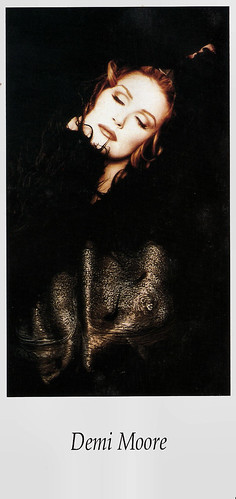
Belgian postcard by MultiChoice Kaleidoscope. Photo: Isopress / Outline / Steven Klein.
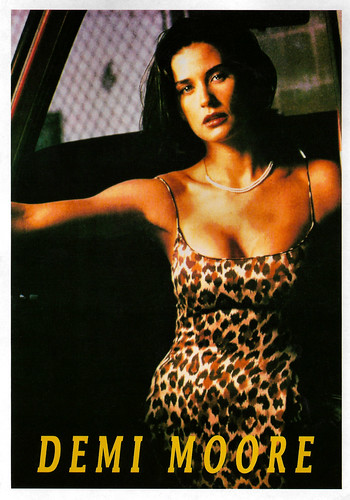
Turkish postcard by Laden, no. 98/191.
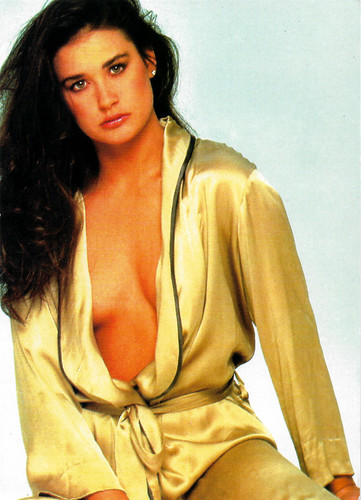
British postcard.

American freecard by Max Racks. Bruce Willis and Demi Moore as Rock Icons on the cover of Spy Magazine, December 1996.
A golden raspberry
Demi Moore did not manage to keep up the success. Striptease (Andrew Bergman, 1996) opened to overwhelmingly negative reviews, with Moore's performance being criticised. The film 'won' six Golden Raspberry Awards, including for Worst Film, Worst Actress and Worst Director. Striptease was a respectable financial success, grossing $113 million worldwide. However, Moore received intense backlash in the media, often being portrayed as greedy and being called "Gimme Moore." Moore also starred in The Juror (Brian Gibson, 1996). The thriller was a box office bomb and was heavily panned by critics.
Her two successes at the time were as the voice of the gipsy woman Esmeralda in Disney's animated film The Hunchback of Notre Dame (Kirk Wise, Gary Trousdale, 1996) and the voice of Dallas Grimes in the animated comedy Beavis and Butt-head Do America (Mike Judge, 1996), alongside her husband Bruce Willis. Then followed her long-cherished project, G.I. Jane (Ridley Scott, 1997), for which the actress even shaved her head. Her performance was largely praised by critics, and budgeted at $50 million, the film was a moderate commercial success, grossing $98.4 million worldwide. Demi Moore took a break in her acting career.
As a producer, she did have a few successes with the three Austin Powers films, including Austin Powers: International Man of Mystery (Jay Roach, 1997). Moore and Bruce Willis separated in 1998 and divorced in 2000. Together they have three children: Rumer Glen Willis (born 1988), Scout LaRue Willis (1991) and Tallulah Belle Willis (1994). In 2003, she began a much-discussed relationship with the 15-year-younger actor Ashton Kutcher, whom she married in 2005. That same year, she returned to the big screen by playing the villain in the sequel Charlie's Angels: Full Throttle (McG, 2005), starring Cameron Diaz, Drew Barrymore and Lucy Liu.
Since 2006, Moore has been the face and muse of cosmetics brand Helena Rubinstein. On-screen, she appeared in the ensemble cast of the acclaimed dramas Bobby (Emilio Estevez, 2006) and Margin Call (J. C. Chandor, 2011) with Kevin Spacey. Moore was expecting a child when she had a late miscarriage. She began drinking again and also abused painkillers. Moore and Kutcher split in 2011, and their divorce was finalised in 2013. After suffering a drug-related seizure in 2012, Moore entered rehab. Incidentally, she appeared in films such as the black comedy Rough Night / Girls' Night Out (Lucia Aniello, 2017) starring Scarlett Johansson. In 2019, Moore released her book 'Inside Out' about her life, which reached the top spot on the New York Times Bestseller list. Since early 2022, Moore has been in a relationship with Swiss celebrity chef Daniel Humm.
In 2024, Demi Moore played socialite Ann Woodward in the TV miniseries Feud: Capote vs. the Swans. Later that year, she made a glorious comeback in the cinema in the British-French Horror film The Substance (Coralie Fargeat, 2024). She played an ageing actress who discovers a medical treatment that will make her appear younger, though at a great cost. The film pokes fun at the American film industry, the ideal of eternal youth, and the cosmetics industry. The actress received widespread acclaim for her performance. Monica Castillo at Roger.Ebert.com: "The Substance works as well as it does because of Moore’s unbridled performance as a woman struggling with self-hatred, society’s treatment of her, and a newfound dependency on a miracle drug. In one particularly heartbreaking scene, Elizabeth stands in front of a mirror, fussing over the final details of her makeup and outfit. Although she looks glamorous as anyone could hope to look, her face betrays a dissatisfied stare as she sees more flaws than beauty before her." Moore was nominated for an Oscar for Best Actress. She won the Golden Globe for Best Actress in a Motion Picture: Musical or Comedy.

European postcard by Moviegoers, no. 0529051999. Demi Moore in The Butcher's Wife (Terry Hughes, 1991).

British postcard, no. C034. Caption: Demi Moore, Swimming Pool.
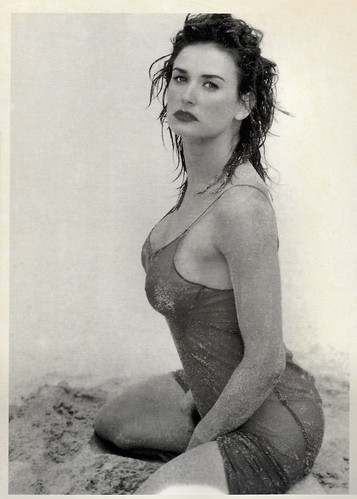
Canadian postcard by Canadian Postcard, no. A-284.

Italian postcard by CIAK. Photo: Dave Stewart / Colorific / G. Neri.
Sources: Roger Ebert (RogerEbert.com), Monica Castillo (RogerEbert.com), Encyclopaedia Britannica, Wikipedia (Dutch, English and German), and IMDb.
No comments:
Post a Comment