
French postcard by F.C. & Cie., no. 251. Photo: Boyer & Bert, Paris. Lucien Muratore in 'Faust'.

French postcard by RA, no. 24. Photo: A. Bert. Lucien Muratore as the title character in Richard Wagner's opera 'Parsifal'.
His voice developed towards the high register
Lucien Muratore was a French singer born in Marseille on 29 August 1876. The son of a Piedmontese immigrant, Muratore began his acting career at a very young age at the Théâtre des Variétés in Marseille.
He was the partner of Réjane and Sarah Bernhardt at the Théâtre de l'Odéon and played 'La Dame de Chez Maxim' at the Théâtre des Nouveautés. He studied music at the conservatory in his hometown and then worked in Paris with Edmond Vergnet, the first Samson at the Paris Opera. Muratore began as a baritone, but his voice developed towards the high register.
He made his debut on 16 December 1902 at the Opéra-Comique in Paris, where he took part in the premiere of Reynaldo Hahn's 'La Carmélite'. In 1904, he sang Werther at La Monnaie in Brussels. In 1905, Muratore made his debut at the Paris Opera. He was quickly given the leading tenor roles, notably in 'Carmen' (Don José), 'Pagliacci' (Canio) and 'Tosca' (Cavaradossi).
He also created the role of Prinzivalle in Henry Février's 'Monna Vanna' in 1909 at the Paris Opera, Bacchus in Camille Erlanger's 'Bacchus triomphant' in Bordeaux in 1909, and Hercules in Camille Saint-Saëns' 'Déjanire' in 1911 at the Monte Carlo Opera. From 1913 onwards, he often stayed in the United States, particularly in Chicago and New York. During the First World War, he campaigned for American intervention in Europe.
Alongside his stage career, he made several films. Between 1914 and 1918, he made four silent films with Italian singer Lina Cavalieri, whom he married in 1913. They separated in 1919, but the divorce was finalised in 1927. These films with Cavalieri and Muratore were Manon Lescaut (Herbert Hall Winslow, 1914), with exteriors filmed in France, the Italian films Sposa nella morte! / The Shadow of Her Past (Emilio Ghione, 1915) and La rosa di Granata / The Rose of Granada (Emilio Ghione, 1916), and the Famous Players production A Woman of Impulse (Edward José, 1918). Apart from a cameo in La Galerie des monstres / Gallery of Monsters (Jaque Catelain, 1924), he didn't act in silent films anymore.

French postcard by F.C. & Cie., no. 183. Photo: G. Ouvières, Paris.

French postcard by S.I.P., 30th series, no. 2. Photo: Reutlinger, Paris. Mailed in 1902. Around 1900, Italian soprano Lina Cavalieri (1874-1944) was considered the most beautiful woman on earth.
The most popular French tenor of his time
When sound film set in, Lucien Muratore returned to the screen in Le chanteur inconnu / The Unknown Singer (Victor Tourjansky, 1931). Muratore plays a singer who has been in Russia and lost his memory, but his wife (Simone Cerdan) still loves him.
Three more films followed. In La voix sans visage / The Faceless Voice (Leo Mittler, 1933), Muratore is a singer accused of murdering his wife's lover and sentenced to ten years' hard labour. His daughter proves his innocence when she discovers the culprit to be his wife (Vera Korène), who wanted to end an embarrassing love affair.
Muratore closed his film career with the films Le chant du destin / The Song of Destiny (Jean-René Legrand, 1935), an alternative-language version of the Austrian film Abenteuer im Lido by Richard Oswald, and the short film Conscience (Robert Boudrioz, 1935). After bidding farewell to the stage in 1931 in 'Pénélope', he gradually devoted himself to teaching singing and directing.
He was mayor of the village of Biot (Alpes-Maritimes) from May 1929 until his resignation in 1934. During his term of office, Lucien Muratore sought and found funding to build a new bridge, better suited to motor traffic, connecting Biot to the town of Antibes. In April 1944, he accepted the position of director of the Opéra-Comique, from which he was relieved on 1 September, a few days after the liberation of Paris.
Lucien Muratore died in Paris's 17th arrondissement on 16 July 1954. He was married first to soprano Marguerite Bériza, and later to soprano Lina Cavalieri. His third wife was Marie Louise Brivaud. The most popular French tenor of his time, he is buried in Saint-Pierre Cemetery in Marseille. On his tomb, sculptor Antoine Sartorio depicted Orpheus and a lyre with the inscription ‘Le chant, don divin’ (Singing, a divine gift).

French leaflet by Pathé Consortium Cinéma. Photo: Production Osso. Lucien Muratore in the sound film Le chanteur inconnu / The Unknown Singer (Victor Tourjansky, 1931) also with Simone Simon.
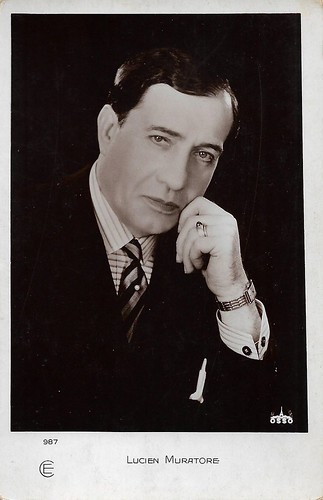
French postcard by Editions Cinémagazine, Paris, no. 987. Photo: Les Films Osso. Lucien Muratore.
Sources: Guy Bellinger (IMDb), Wikipedia (French and English) and IMDb.
No comments:
Post a Comment