
Russian postcard by Ed. Goroyankin, 1909. Photo: K.A. Fischer, Moscow. Vasili Kachalov as Anathema in the prologue of the stage play 'Anathema' by Leonid Andreev, performed in 1909 by the Moscow Art Theatre. Collection: Didier Hanson.

Russian postcard by Ed. Goroyankin, no. 10682, 1909. Photo: K.A. Fischer, Moscow. Vasili Kachalov and Alexander Vishnevsky in the stage play 'Anathema' by Leonid Andreev, performed in 1909 by the Moscow Art Theatre. Collection: Didier Hanson.

Russian postcard by Ed. Goroyankin, 1909. Photo: K.A. Fischer, Moscow. Vasili Kachalov as Anathema in the prologue of the stage play 'Anathema' by Leonid Andreev, performed in 1909 by the Moscow Art Theatre. Collection: Didier Hanson.

Russian postcard by Ed. Goroyankin, 1909. Photo: K.A. Fischer, Moscow. Vasili Kachalov as Anathema in the prologue of the stage play 'Anathema' by Leonid Andreev, performed in 1909 by the Moscow Art Theatre. Collection: Didier Hanson.
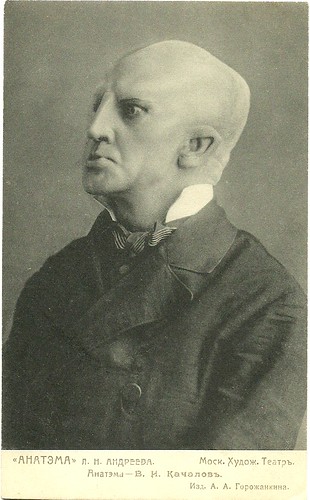
Russian postcard by Ed. Goroyankin, 1909. Photo: K.A. Fischer, Moscow. Vasili Kachalov as Anathema in the prologue of the stage play 'Anathema' by Leonid Andreev, performed in 1909 by the Moscow Art Theatre. Collection: Didier Hanson.
Stanislavski's favourite actress
Playwright Anton Chekhov's legendary collaboration with the Moscow Art Theatre was fruitful for both sides. It resulted in the creation of classic productions of 'The Seagull', 'Uncle Vanya', 'The Three Sisters', and 'The Cherry Orchard'. These four big plays remained in the repertoire of the M.A.T. and countless stage companies ever since. Chekhov was married to the favourite actress of Konstantin Stanislavsky and Vladimir Nemirovich-Danchenko. Olga Leonardovna Knipper-Chekhova (1868-1959) was one of the original 39 founding members of the Moscow Art Theatre in 1898. Nemirovich-Danchenko had been her teacher and lover and had introduced her to Stanislavski. Told in strict confidence, Nemirovich confessed to Knipper that he and Stanislavski were planning the creation of a new theatre company. Nemirovich assured her that she would be invited to join this company. After many weeks, enough capital was finally secured to found the new company. The company gathered in Pushkino, where Stanislavski addressed Knipper and the other members, telling them that he hoped they had all come to dedicate their lives to creating the "first rational, moral, and universally accessible theatre in Russia."
Olga Leonardovna met Anton Chekhov in 1898, when she was given the leading role of Arkadina in his play 'Chaika' (The Seagull) at the MAT. While rehearsing for the play on 9 September, Olga's 30th birthday, she met Russia's most eligible literary bachelor and playwright of 'The Seagull', Anton Chekhov, then 38. Knipper and Chekhov exchanged telegrams and letters for the next few years, while Olga became more familiar with Chekhov's younger sister, Masha. Random letters of teasing and playfulness became letters of love and deep remorse that they lived so far apart from each other. Olga's true colours shone throughout her letters of correspondence. Her ill-moods, volatile tempers, combined with her sporadic high spirits, kept Chekhov on his toes.
Olga brilliantly played Arkadina in 'The Seagull' and also played Elena in the Moscow premiere of 'Uncle Vanya' (1899). In the winter of 1900, Anton Chekhov returned from Yalta and headed to Moscow with a new play that he had written with a 'dear actress' in mind. "What a part I’ve got for you in 'Three Sisters'. Give me ten rubles, and you can have it; otherwise, I’ll give it to another actress," Chekhov wrote to Olga. Many similarities existed between Olga Knipper and the character Chekhov wrote for her in 'Tri sestry' (The Three Sisters), Masha. Knipper was to play the middle of three sisters and one brother. The only married sibling of the foursome and "the most original and talented of the three sisters." To portray a young woman of culture and refinement, who speaks French, German and English, and is a first-class pianist, was no problem for Knipper. She received much praise for her portrayal as Masha in 'The Three Sisters' in 1901.
On 25 May 1901, Anton Chekhov and Olga Knipper eventually married at the Church of the Exaltation of the Cross in Moscow. It was a small wedding about which hardly anyone knew, including Chekhov's mother and sister, and Olga's mother. Many close friends and family were hurt by the secrecy. At the time of the wedding, Anton was already suffering from tuberculosis. In January 1904, Olga starred as Madame Ranevskaya in the premiere of 'Vishnevy sad' (The Cherry Orchard) at the Moscow Art Theatre in 1904, with singer Feodor Chaliapine Sr., writer Maxim Gorky, and composer Sergei Rachmaninoff in attendance. Her marriage ended when Chekhov died of tuberculosis. After Chekhov died in 1904, the MAT experienced a huge changeover. Chekhov had envisioned fellow playwright and friend Maxim Gorki as his successor as the Theatre's leading dramatist, but Nemirovich and Stanislavski's reaction to his play 'Summerfolk' was unenthusiastic, causing Gorki to leave. He took with him Savva Morozov, one of the theatre's main investors at the time.
Now in dire straits, the Moscow Art Theatre decided to accept invitations to go on an international tour in 1906, which started in Berlin and included Dresden, Frankfurt, Prague, and Vienna. The tour was a huge success, gaining the theatre international acclaim. Olga Leonardovna Knipper-Chekhova continued successful work on stage with the Moscow Art Theatre Company for the rest of her life. She did not play many film roles, mostly due to the influence of her teachers, Stanislavsky and Nemirovich-Danchenko. They strongly believed that live stage acting was a superior form of art. For that reason, they discouraged their stage actors of the MAT from working in films.

Russian postcard by Ed. Goroyankin, no. 831, 1909. Konstantin Stanislavski as Rakitin in 'A Month in the Country' (Месяц в деревне, romanised: Mesiats v derevne, 1909) by Ivan Turgenev, at the Moscow Art Theatre (M.A.T.). The Moscow Art Theatre (MAT) production opened on 22 December 1909. It was directed by Konstantin Stanislavski (who alternated the role of Rakitin with Vasili Kachalov) and Ivan Moskvin. Olga Knipper played Natalya, Nikolai Massalitinov was her husband, Islayev, and Maria Samarova was his mother, Anna. Richard Boleslavsky played Belyaev, with Lydia Koreneva as Verochka. The rest of the cast included Elena Muratova as Lizaveta, Nikolai Zvantsev as Schaaf, Ilya Uralov as Bolshintsov, Vladimir Gribunin as Shpigelsky, I. V. Lazarev as Matvei, and Lyubov Dmitrevskaya as Katya. Scenic design was by Mstislav Dobuzhinsky. This was the first production in which Stanislavski made use of his emerging 'system' of acting, much to the general distress of the actors, and Knipper in particular.

Russian postcard by Ed. Goroyankin, no. 831, 1909. Lydia Koreneva as Veroschka and Richard Boleslavsky as Belyaev in 'A Month in the Country' by Ivan Turgenev, first performed by the Moscow Art Theatre in 1909.

Russian postcard by Ed. Goroyankin, no. 831, 1909. Olga Knipper as Natalya and Konstantin Stanislavski as Rakitin in 'A Month in the Country' by Ivan Turgenev, first performed by the Moscow Art Theatre in 1909.

Russian postcard by Ed. Goroyankin, no. 831, 1909. Olga Knipper as Natalya and Konstantin Stanislavski as Rakitin in 'A Month in the Country' by Ivan Turgenev, first performed by the Moscow Art Theatre in 1909.

Russian postcard by Ed. Goroyankin, no. 831, 1909. Olga Knipper as Natalya in 'A Month in the Country' by Ivan Turgenev, first performed by the Moscow Art Theatre in 1909.

Russian postcard by Ed. Goroyankin, no. 831, 1909. Lydia Koreneva as Veroschka in 'A Month in the Country' by Ivan Turgenev, first performed by the Moscow Art Theatre in 1909.

Russian postcard by Ed. Goroyankin, no. 831, 1909. Lyubov Dmitrevskaya as Katya and Nikolai Zvantsev as Schaaf in 'A Month in the Country' by Ivan Turgenev, first performed by the Moscow Art Theatre in 1909.

Russian postcard by Ed. Goroyankin, no. 831, 1909. Vladimir Gribunin as Shpigelsky and Elena Muratova as Lizaveta in 'A Month in the Country' by Ivan Turgenev, first performed by the Moscow Art Theatre in 1909.

Russian postcard by Ed. Goroyankin, no. 831, 1909. Maria Samarova as Anna in 'A Month in the Country' by Ivan Turgenev, first performed by the Moscow Art Theatre in 1909.

Russian postcard by Ed. Goroyankin, no. 831, 1909. Maria Samarova as Anna in 'A Month in the Country' by Ivan Turgenev, first performed by the Moscow Art Theatre in 1909.
A new acting methodology
The first European tour of the Moscow Art Theatre began in February 1906 in Berlin. The MAT played to an audience that included Max Reinhardt, Gerhart Hauptmann, Arthur Schnitzler, and Eleonora Duse. "It's as though we were the revelation," Konstantin Stanislavski wrote of the rapturous acclaim they received. The success of the tour provided financial security for the company, garnered an international reputation for their work, and made a significant impact on European theatre. The tour also provoked a major artistic crisis for Stanislavski that had a significant impact on his future direction. From his attempts to resolve this crisis, his acting system would eventually emerge.
Stanislavski developed his system of acting out of his persistent efforts to remove the blocks that he encountered in his performances, beginning with his crisis in 1906. He produced his early work using an external, director-centred technique that strove for an organic unity of all its elements. In each production, he planned the interpretation of every role, blocking, and the mise en scène in detail in advance. He also introduced into the production process a period of discussion and detailed analysis of the play by the cast. Despite the success that this approach brought, particularly with his Naturalistic stagings of the plays of Anton Chekhov and Maxim Gorky, Stanislavski remained dissatisfied. His struggles with Chekhov's drama, out of which his notion of subtext emerged, and his experiments with Symbolism encouraged a greater attention to 'inner action' and a more intensive investigation of the actor's process. He began to develop the more actor-centred techniques of 'psychological realism', and his focus shifted from his productions to the rehearsal process and pedagogy. He pioneered the use of theatre studios as a laboratory in which to innovate actor training and to experiment with new forms of theatre. Stanislavski organised his techniques into a coherent, systematic methodology, which built on three major strands of influence: (1) the director-centred, unified aesthetic and disciplined, ensemble approach of the Meiningen company; (2) the actor-centred realism of the Maly; and (3) the Naturalistic staging of Antoine and the independent theatre movement.
Stanislavski's production of 'A Month in the Country' (1909) was a watershed in his artistic development. Breaking the MAT's tradition of open rehearsals, he prepared Turgenev's play in private. They began with a discussion of what he would come to call the 'through-line' for the characters: their emotional development and the way they change over the course of the play. This production is the earliest recorded instance of Stanislavski's practice of analysing the action of the script into discrete 'bits'. At this stage in the development of his approach, Stanislavski's technique was to identify the emotional state contained in the psychological experience of the character during each bit and, through the use of the actor's emotional memory, to forge a subjective connection to it. Only after two months of rehearsals were the actors permitted to physicalise the text. Stanislavski insisted that they should play the actions that their discussions around the table had identified. Having realised a particular emotional state in a physical action, he assumed at this point in his experiments that the actor's repetition of that action would evoke the desired emotion. They also explored non-verbal communication, whereby scenes were rehearsed silently with actors interacting 'only with their eyes'. The production's success when it opened in December 1909 seemed to prove the validity of his new methodology.
Another important production was 'Hamlet' (1911–1912). In his treatment of the classics, Stanislavski believed that it was legitimate for actors and directors to ignore the playwright's intentions for a play's staging. He collaborated on 'Hamlet' with the director and designer Edward Gordon Craig, and their production became a landmark of 20th-century theatrical modernism. Stanislavski hoped to prove that his recently developed system for creating internally justified, realistic acting could meet the formal demands of a classic play. Craig envisioned a Symbolist monodrama in which every aspect of production would be subjugated to the protagonist: it would present a dream-like vision as seen through Hamlet's eyes. The production established MAT's reputation and opened new possibilities for the art of the theatre. Late in 1910, Gorky invited Stanislavski to join him in Capri, where they discussed actor training and Stanislavski's emerging 'grammar'. Inspired by a popular theatre performance in Naples that employed the techniques of the commedia dell'arte, Gorky suggested that they form a company, modelled on the medieval strolling players, in which a playwright and a group of young actors would devise new plays together using improvisation. Stanislavski would develop this use of improvisation in his work with his First Studio which he created in September 1912. Its founding members included Yevgeny Vakhtangov, Michael Chekhov, Richard Boleslawski, and Maria Ouspenskaya, all of whom would exert a considerable influence on the subsequent history of theatre.
In 1928, at the MAT's 30th anniversary celebrations, a massive heart attack on-stage put an end to Konstantin Stanislavski's acting career, though he waited until the curtain fell before seeking medical assistance. He continued to direct, teach, and write about acting until his death a few weeks before the publication of the first volume of his life's great work, the acting manual 'An Actor's Work' (1938). He was awarded the Order of the Red Banner of Labour and the Order of Lenin and was the first to be granted the title of People's Artist of the USSR.

Russian postcard by Ed. Goroyankin, no. 11120, 1910. Olga Gzovskaya as Katerina Ivanovna in 'The Brothers Karamazov' by Fyodor Dostoevsky, first performed by the Moscow Art Theatre in 1910.

Russian postcard by Ed. Goroyankin, no. 11120, 1910. Olga Gzovskaya as Katerina Ivanovna in 'The Brothers Karamazov' by Fyodor Dostoevsky, first performed by the Moscow Art Theatre in 1910.

Russian postcard by Ed. Goroyankin, no. 11120, 1910. Leonid Leonidov as Mitya in 'The Brothers Karamazov' by Fyodor Dostoevsky, performed in 1910 by the Moscow Art Theatre.

Russian postcard by Ed. Goroyankin, 1910. Vasili Kachalov as Ivan in 'The Brothers Karamazov' by Fyodor Dostoevsky, performed in 1910 by the Moscow Art Theatre. Collection: Didier Hanson.

Russian postcard by Ed. Goroyankin, 1910. Vasili Kachalov as Glumov in 'Enough Stupidity in Every Wise Man' by Alexander Ostrovski, performed in 1910 by the Moscow Art Theatre.

Russian postcard by Ed. Goroyankin. Vasili Kachalov in the play 'In Life's Clutches' by Knut Hamsun Collection: Didier Hanson.

Russian postcard by Ed. Goroyankin, 1912. Photo: K.A. Fischer, Moscow. Vasili Kachalov as Hamlet in Shakespeare's play 'Hamlet', performed in 1911-1912 by the Moscow Art Theatre, directed by Edward Gordon Craig and Konstantin Stanislavsky.

Russian postcard by Ed. Goroyankin, 1912. Photo: K.A. Fischer, Moscow. Alexander Vishnevsky as the First Actor (The King) in Shakespeare's play 'Hamlet', performed in 1911-1912 by the Moscow Art Theatre, directed by Edward Gordon Craig and Konstantin Stanislavsky.

Russian postcard by Ed. Goroyankin, 1912. Photo: K.A. Fischer, Moscow. Nikolai Massalitinov as Claudius and Olga Knipper as Gertrude in Shakespeare's play 'Hamlet', performed in 1911-1912 by the Moscow Art Theatre, directed by Edward Gordon Craig and Konstantin Stanislavsky.

Russian postcard by Ed. Goroyankin, 1912. Photo: K.A. Fischer, Moscow. Konstantin Khokhlov as Horatio in Shakespeare's play 'Hamlet', performed in 1911-1912 by the Moscow Art Theatre, directed by Edward Gordon Craig and Konstantin Stanislavsky.

Russian postcard by Ed. Goroyankin, 1912. Photo: K.A. Fischer, Moscow. Maria Efremova, Nadezhda Bromley and E.B. Mark, playing three herd girls in 'Peer Gynt', performed by the Moscow Art Theatre in 1912.

Russian postcard by Ed. Goroyankin, 1912. Photo: K.A. Fischer, Moscow. Nikolai Podgorny as Trofimov in 'The Cherry Orchard' by Anton Chekhov, performed by the Moscow Art Theatre in 1912.

Russian postcard by Ed. Goroyankin, 1912. Photo: K.A. Fischer, Moscow. Vasili Kachalov in 'It Tears Where It is Thin' by Ivan Turgenev, performed by the Moscow Art Theatre in 1912.

Russian postcard by Ed. Goroyankin, 1912. Photo: K.A. Fischer, Moscow. Vasili Kachalov in 'The Woes of Wit' or 'Woe from Wit' (Го́ре от ума́, Gore ot uma, 1912) by Alexander Griboyedov, performed by the Moscow Art Theatre in 1912.
Sources: Steve Shelokhonov (IMDb), Wikipedia (English), and Britannica.
No comments:
Post a Comment