
American postcard by Fotofolio, NY, NY, no. P204. Photo: Apeda, N.Y. / Photoworld. Caption: Ethel Barrymore (1879-1959), as the spirit of equity.

American postcard in the O.K. Series by American Post Card Co., New York. Collection: Geoffrey Donaldson Institute.

American postcard by Herman Shumlin / National Theatre, N.Y.C. Ethel Barrymore in 'The Corn is Green' by Emlyn Williams.
Large dark eyes that seemed to look out from her very soul
Ethel Barrymore was born Ethel Mae Blythe in Philadelphia in 1879. She was the second child of the actors Maurice Barrymore (whose real name was Herbert Blythe) and Georgiana Drew. Her father was nearly killed four months before her birth in a famous Old West encounter in Texas while heading a travelling road company. She was named for her father's favourite character — Ethel in William Makepeace Thackeray’s 'The Newcomes'. She was the sister of actors John and Lionel Barrymore, the aunt of actor John Drew Barrymore and actress Diana Barrymore, and the great-aunt of actress Drew Barrymore. She was also a granddaughter of actress and theatre-manager Louisa Lane Drew (Mrs. John Drew), and niece of Broadway matinée idol John Drew Jr and early Vitagraph star Sidney Drew.
She spent her childhood in Philadelphia and attended Roman Catholic schools there. In 1884, the family sailed to England and stayed for two years. Maurice had inherited a substantial amount of money from an aunt and decided to exhibit a play and star in some plays at London's Haymarket Theatre. Ethel recalled being frightened on first meeting Oscar Wilde when handing him some cakes and later being reprimanded by her parents for showing fear of Wilde.
Returning to the U.S. in 1886, her father took her to her first baseball game. She established a lifelong love of baseball and wanted to be a concert pianist. In the summer of 1893, Barrymore was in the company of her mother, Georgie, who had been ailing from tuberculosis and took a curative sabbatical to Santa Barbara, California. Georgie did not recover and died in 1893, a week before her 37th birthday. Essentially, Ethel's and Lionel's childhood ended when Georgie died. They were forced to go to work in their teens without finishing high school. John, a few years younger, stayed with their grandmother.
Barrymore's first appearance on Broadway was in 1895, in a play called 'The Imprudent Young Couple' which starred her uncle John Drew, Jr., and Maude Adams. She appeared with Drew and Adams again in 1896 in 'Rosemary'. William McPeak at IMDb: "Her youthful stage presence was at once a pleasure, a strikingly pretty and winsome face and large dark eyes that seemed to look out from her very soul. Her natural talent and distinctive voice only reinforced the physical presence of someone destined to command any role set before her."
In 1897, Ethel went with William Gillette to London to play Miss Kittridge in Gillette's 'Secret Service'. She was about to return to the States with Gillette's troupe when Henry Irving and Ellen Terry offered her the role of Annette in 'The Bells'. A full London tour was on and, before it was over, Ethel created, on New Year's Day 1898, Euphrosine in 'Peter the Great' at the Lyceum, the play having been written by Irving's son, Laurence Irving. Men everywhere were smitten with Ethel, most notably Winston Churchill, who asked her to marry him. Not wishing to be a politician's wife, she refused. Winston, years later, married Clementine Hozier, a ravishing beauty who looked very much like Ethel. Winston and Ethel remained friends until the end of her life. Their 'romance' was their own little secret until his son let the cat out of the bag 63 years after it happened.

Vintage postcard in the Rotograph Series, no. B 353. Photo: Burr McIntosh, N.Y.

British-American postcard by Bamforth & Co. Publishers, Holmfirth (England) / New York, Series no. 2043.
Outdrawing two of the most prominent actresses of her day
After her season in London, Ethel Barrymore returned to the U.S. Charles Frohman cast her first in 'Catherine' and then as Stella de Grex in 'His Excellency the Governor'. After that, benefactor and friend Frohman finally gave Ethel the role that would make her a star: Madame Trentoni in 'Captain Jinks of the Horse Marines', which opened at the Garrick Theatre in London's West End in 1901. Unbeknownst to Ethel, her father Maurice had witnessed the performance as an audience member and walked up to his daughter, congratulated her and gave her a big hug. It was the first and only time he saw her on stage professionally.
When the tour concluded in Boston in June, she had outdrawn two of the most prominent actresses of her day, Mrs. Patrick Campbell and Minnie Maddern Fiske. Following her triumph in 'Captain Jinks', Ethel gave sterling performances in many top-rate productions. In Thomas Raceward's 'Sunday', she uttered what would be her most famous line, "That's all there is, there isn't any more."
She portrayed Nora in 'A Doll's House' by Henrik Ibsen (1905), and Juliet in 'Romeo and Juliet' by William Shakespeare (1922). Barrymore, along with friend Marie Dressler, was a strong supporter of the Actors' Equity Association and had a high-profile role in the 1919 strike. AEA came into being primarily to allow performers to have a bigger share in the profits of stage productions and to provide benefits to elderly or infirm actors.
This angered many producers and cost Barrymore her friendship with George M. Cohan, an actor, songwriter and producer. Ethel Barrymore's involvement in AEA may have been motivated by the fate of both of her parents, both long-standing actors, her mother, who had needed proper medical care and her father, who required years of institutionalised care.
In 1926, she scored one of her greatest successes as the sophisticated spouse of a philandering husband in W. Somerset Maugham's comedy, 'The Constant Wife'. Maugham counted himself among her admirers, saying that during rehearsals for the play he had "fallen madly in love with her." She starred in 'Rasputin and the Empress' (1932), playing the czarina married to Czar Nicholas. In July 1934, she starred in the play 'Laura Garnett', by Leslie and Sewell Stokes, at Dobbs Ferry, New York.
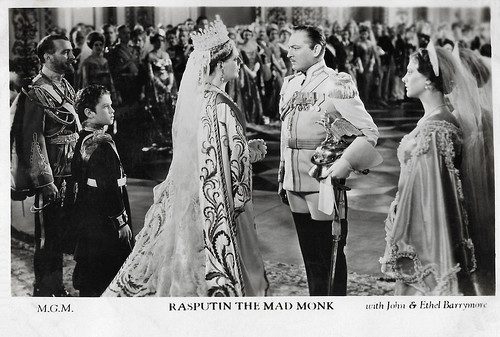
British postcard in The Film Shots Series by Film Weekly. Photo: M.G.M. (Metro-Goldwyn-Mayer). Ralph Morgan, Tad Alexander, Ethel Barrymore and John Barrymore in Rasputin and the Empress (Richard Boleslavsky, 1932).

British postcard in The Film Shots Series by Film Weekly. Photo: M.G.M. (Metro-Goldwyn-Mayer). John Barrymore, Ralph Morgan, Ethel Barrymore and Lionel Barrymore in Rasputin and the Empress (Richard Boleslavsky, 1932).

Dutch postcard for Rembrandt Theater, Utrecht, 1933. Photo: M.G.M. (Metro-Goldwyn-Mayer). John Barrymore, Ethel Barrymore and Lionel Barrymore in Rasputin and the Empress (Richard Boleslavsky, 1932).
Her engaging wit and humanity stood out in even supporting roles
In 1914, Ethel Barrymore appeared in her first feature film, The Nightingale (Augustus Thomas, 1914). Members of her family were already in pictures. Uncle Sidney Drew, his wife Gladys Rankin, and Lionel Barrymore had entered films in 1911, and John Barrymore made his first feature in 1913 after having debuted in Lubin short films in 1912. She made 15 silent pictures between 1914 and 1919, most of them for the Metro Pictures studio. Most of these pictures were made on the East Coast, as her Broadway career and children came first. A few of her silent films have survived: for example, one reel from The Awakening of Helena Richie (John W. Noble, 1916) and The Call of Her People (John W. Noble, 1917).
The only two films that featured all three siblings - Ethel, John, and Lionel - were National Red Cross Pageant (Christy Cabanne, 1917) and Rasputin and the Empress (Richard Boleslawski, 1932). The former film is now considered a lost film. She returned to the stage, where she had her most endearing role in 'The Corn is Green', during a tour that lasted from 1940 to 1942. Barrymore came back to California and won the Academy Award for Best Supporting Actress for her role as the mother of Cary Grant in the film None but the Lonely Heart (Clifford Odets, 1944), but made plain that she was not overly impressed by it.
She appeared in The Spiral Staircase (Robert Siodmak, 1946) and The Paradine Case (Alfred Hitchcock, 1947), in which she was nominated for an Academy Award for Best Supporting Actress. She played the repressed wife of Charles Laughton's character. William McPeak: "Her engaging wit and humanity stood out in even supporting roles, such as, the politically savvy mother of Joseph Cotten in The Farmer's Daughter (H.C. Potter, 1947) and, once again with Cotton, as sympathetic art dealer Miss Spinney, with those eyes, in the haunting screen adaptation of Robert Nathan's novel Portrait of Jennie (William Dieterle, 1948)." Barrymore also appeared as Miss Em opposite Jeanne Crain in the Academy Award-nominated film Pinky (Elia Kazan, 1949), for which she was nominated for Best Supporting Actress.
Her last film appearance was in Johnny Trouble (John H. Auer, 1957) with Stuart Whitman. On the radio, Barrymore starred in the situation comedy Miss Hattie (1944-1945). Barrymore also made several television appearances in the 1950s, including one memorable encounter with comedian Jimmy Durante on NBC's All-Star Revue in 1951. In 1956, she hosted 14 episodes of the TV series Ethel Barrymore Theatre. In 1955, she published her book 'Memories, An Autobiography'. Barrymore died of cardiovascular disease in 1959, at her home in Hollywood, after having lived for many years with a heart condition. She was less than two months shy of her 80th birthday. She was entombed at Calvary Cemetery.
Ethel Barrymore married Russell Griswold Colt in 1909. In 1911, Barrymore took preliminary divorce measures against Colt, much to Colt's surprise, and later recanted by Barrymore as a misunderstanding by the press. At least one source alleged that Colt abused her and that he fathered a child with another woman while married to Barrymore. They divorced in 1923. The couple had three children: Samuel 'Sammy' Colt (1909–1986), a Hollywood agent and occasional actor; actress-singer Ethel Barrymore Colt (1912–1977), who appeared on Broadway in Stephen Sondheim's 'Follies'; and John Drew Colt (1913–1975), who became an actor. Ethel Barrymore never remarried. The Ethel Barrymore Theatre in New York City is named for her. In 1960, Barrymore was posthumously inducted into the Hollywood Walk of Fame with a motion picture star for her contributions to the film industry. Her star is located at 7001 Hollywood Boulevard.

American postcard by Kline Poster Co. Inc., Phila. Image: Metro.

British postcard by Valentine's in the Film Stars and Their Pets series, no. 7113 M. Caption: Ethel Barrymore - A sister of John and Lionel Barrymore, Ethel was born on August 15th 1879. She took to the stage in 1894 and toured Britain with the Lyceum Company. Her latest film is Rasputin, the great Metro-Goldwyn-Mayer production. She is seen here with her two splendid Russian wolfhounds.
Sources: William McPeak (IMDb), Wikipedia and IMDb.
No comments:
Post a Comment