
French photo card by Cinéma Pathé. Photo: Pathé Frères. Scene from L'Exode des fées (Gaston Velle, 1911). Gaston Velle also scripted the film.
The fairies, having enchanted the childhoods of past generations, have turned their backs on today’s youth, positive and sceptical. Paul, who doesn’t believe in fairy tales, tries to destroy the enthusiastic faith of his little sister Jeanne, who loves to read them. The fairies, scorned, leave the earth. They will no longer send children their beautiful dreams of yesteryear, and Paul, plagued by terrible nightmares, recalls those he had spoken ill of. Melusine, Morgane, Urgèle, Viviane, the White Lady, witches, sylphs, and wood spirits return to fill the peaceful nights and joyful evenings of little children with happy dreams.

French photo card by Cinéma Pathé. Photo: Pathé Frères. Scene from the comedy Un tableau de valeur (N.N., 1911).
Tired of waiting for his overdue rent, the landlord Crougnasse threatens to evict his tenant, the painter Brossecroûte. Fortunately for Brossecroûte, one of his friends has a clever idea and shows up, while the painter is away, under the pretext of viewing the studio that has been put up for rent. He pretends to be a wealthy foreign art lover, raves about the artist’s paintings, and offers to buy them for 10,000 francs. The landlord, delighted with the windfall, buys his tenant’s paintings for 2,000 francs. The wealthy buyer takes his leave, and the landlord remains as poor as ever, while our two friends do a little dance in celebration.

French photo card by Cinéma Pathé. Photo: Pathé Frères. Charles Prince in Rigadin veut se faire arrêter (Georges Monca, 1911). Script by Gabriel Timmory.
Rigadin (Charles Prince), looking for a place to stay and a meal on a day when he’s completely broke, tries to get himself arrested. He heads straight to the police station, where he explains his request. There, he’s asked to provide proof of his claim, and since he hasn’t committed any crime, poor Rigadin is given a harsh rebuff. With his stomach growling, the poor wretch swears to get himself arrested at any cost. He enters a restaurant where he is served a hearty meal and turns out his empty pockets when the bill comes. This time, his case is clear; an officer is summoned, and the accused prepares to follow him, when a sympathetic patron intervenes and pays the bill. Rigadin, furious and dejected, tries various schemes without success. In desperation, he goes to sleep in a vacant lot, and he takes pity on a poor stray dog and brings it home. As a reward, he receives a blue banknote. Rigadin, who can’t believe his stroke of luck, no longer thinks of getting arrested and goes to order a suit. But the merchant, suspecting the note’s origin, sends for the police, and this time Rigadin is arrested — a victim of his own good deed, just as fortune was beginning to smile on him.

French photo card by Cinéma Pathé. Photo: Pathé Frères. Charles Prince in Rigadin veut se faire arrêter (Georges Monca, 1911). Script by Gabriel Timmory.

French photo card by Cinéma Pathé. Photo: Pathé Frères. Paul Capellani as the lieutenant, André Hall as the lover, Aimée Tessandier as the mother and Madeleine Barjac as the daughter in Ma fille (Michel Carré, 1911). Carré also scripted the film.
A young woman (Madeleine Barjac) is being courted by an army officer (Paul Capellani). Before taking the courtship any further, her father feels he must warn the officer that the young woman was adopted by them when she was three years old. The officer ignores this. But on the day of the wedding, amidst the happiness of the two fiancés, the girl’s biological mother (Aimée Tessandier) appears and comes to claim her child. She is a poor woman, degraded by poverty and by the degrading influence of a lazy, drunken partner (André Hall). The law is clear. The young girl must leave her adoptive parents and follow her biological mother. Upon arriving at the slum of her new parents, the poor, uprooted girl, subjected to the lechery of the drunkard, cries out for help. Fortunately, her fiancé has followed her through this ordeal. He arrives with officers. The drunkard is taken to the station. The poor mother, mistreated by her lover while trying to defend her child, falls ill and dies in the hospital after entrusting her daughter to her adoptive family and her fiancé. The young girl thus returns to her former situation. The event that had brutally torn her away from her happiness will have been nothing more than a bad dream.

French photo card by Cinéma Pathé. Photo: Pathé Frères. Scene from Le Mémorial de Sainte Hélène ou la captivité de Napoléon (Michel Carré, 1911). Cinematography by Pierre Trimbach. The skinny man on the right must be Georges Tréville as Hudson Lowe.
Exiled to the island of Saint Helena, Napoleon (Laroche), surrounded by generals and loyal friends, lived on the memory of his brilliant epic. But, persecuted by the island’s governor, Sir Hudson Lowe (Georges Tréville), and completely broken in body, mind, and spirit, the great fallen emperor soon succumbed to the island’s deadly climate. This entire drama, with its vivid and accurate portraits and true anecdotes, unfolds before our eyes with gripping interest and remarkable power.

French photo card by Cinéma Pathé. Photo: Pathé Frères. On the foreground right: Georges Tréville as Hudson Lowe, and in the back: Laroche as Napoleon in Le Mémorial de Sainte Hélène ou la captivité de Napoléon (Michel Carré, 1911).

French photo card by Cinéma Pathé. Photo: Pathé Frères. Scene from Le Mémorial de Sainte Hélène ou la captivité de Napoléon (Michel Carré, 1911). Cinematography was by Pierre Trimbach. Cast: Laroche (Napoleon), Georges Tréville (Hudson Lowe), Roger Monteaux (Blackeney), Emile Milo, Herman Grégoire, Sainrat, Mévisto, Dupont-Morgan, Eugénie Nau, Charlotte Barbier, Maria Fromet and Madeleine Fromet.

French photo card by Cinéma Pathé. Photo: Pathé Frères / Le Film Russe. Scene from L'Chaïm (Maurice André Maître, Kaï Hansen, 1911). Cast: Nicolaï Vassiliev (Moische), Mikhaïl Doronine (Matess), Maria Reitzen (Rockelé), Ludmila Sychova (the mother). Cinematography by George Meyer, art direction by Cheslav Sabinsky.
Rockelé (Maria Reitzen) and Chloma are deeply in love with one another and have exchanged vows of love. But Chloma’s wealthy master, Matess (Mikhaïl Doronine), who is also in love with the beautiful Jewish girl, goes to the synagogue on the eve of the Sabbath and asks Reb Moische, Rockelé’s father, for his daughter’s hand in marriage. The father readily agrees, and Rockelé, knowing full well that any resistance would be futile, passively obeys. On the day of the betrothal, following tradition, they drink the l’chaim. All the guests pass the cup of rich wine from hand to hand, from which the betrothed must take a sip if they wish to live happily and long. But the chaim must have betrayed its reputation, for a year after their marriage, misfortune enters Matess’s home with Chloma, who comes to beg the woman he still loves to run away with him. Rockelé hesitates. A little girl has been born of their union. By deserting her home, she knows she will bring misery to Matess, who loves her tenderly and showers her with kindness. But her reason is powerless against the pull of her heart. And so, Rockelé, taking her daughter in her arms, goes to join her lover in the night. Matess, after waking as a happy man, realises the betrayal he has suffered. Desperate over the destruction of his home, he falls from one low point to another, into poverty and drunkenness. One day, Rockelé comes to visit him with her child. He does not recognise them. But after they leave, a letter reveals to him that he has just seen the very people he has been mourning for many years. The unfortunate Matess, now without hope after this encounter, sinks into an even deeper and more desperate state of decline.

French photo card by Cinéma Pathé. Photo: Pathé Frères. Scene from the comedy Express union (N.N., 1911). While in the plot the character is named Gontran, he doesn't look at all like the popular Eclair comedy actor René Grehan, better known as Gontran. Needless to say, the African lady is a male actor, dressed up in blackface.
Aunt Eulalia, finding herself in dire straits, names her nephew Gontran as her sole heir, on the non-negotiable condition that he be married by nightfall. Gontran sets out in search of a fiancée and, after a series of hilarious adventures and setbacks, resigns himself in desperation to marrying a beautiful black woman. He hurries to rush through the wedding and present himself at Aunt Eulalia’s house with his new bride. But the aunt has come back to life, and the unfortunate Gontran, back to square one, is left with his black wife to fend for himself.

French photo card by Cinéma Pathé. Photo: Pathé Frères. Scene from Le rêve d'un joueur / The Dream of a Gambler (N.N., 1911), scripted by Legrand. Actors: Séverin and his company.
The scene takes place during the Directoire period. An elegant man, disguised as Pierrot, goes to his club after formally promising his wife that he will no longer gamble. But as he is an inveterate gambler, he is irresistibly drawn to the roulette wheel. In just a few games, he loses the considerable sum he had brought with him. He returns home, worried, and falls asleep while trying to devise some clever roulette strategies. A terrible nightmare haunts his sleep. He dreams that, overcome by his fatal passion, he steals twenty thousand francs from his wife, which he loses in a few spins of the wheel. Pierrot, in a panic, follows one of the players who has just won a large sum and strangles him. Then he runs away like a madman. But, caught by the police, he will pay for his crime. Punishment looms before him, terrible, in the form of a gallows. But just as the rope tightens cruelly around his neck, our sleeper wakes with a start. It was only a dream, and a salutary one at that.

French photo card by Cinéma Pathé. Photo: Pathé Frères. Scene from Un duel à la mie de pain / A Duel with Breadcrumbs (N.N., 1911).
Threatened with seizure by an inexorable landlord, Dupinceau, with the help of a few merry companions, vows to take a little revenge on his irascible tormentor. Terrible, with the airs of Matamores, our rappers settle down in the café next to Harpagon. One of them picks a fight with him and challenges him to a duel. The unfortunate landlord spends hours in agony before going to the field where the revolver duel takes place. Fortunately, the guns are loaded with breadcrumbs and the miser, unaware of the ruse, believes he has killed his opponent and allows himself to be taken to the police station by one of them, disguised as a policeman. Dupinceau then intervenes and helps his prisoner escape, but not before making him pay a ransom and settle his rent.

French photo card by Cinéma Pathé. Photo: Pathé Frères. Scene from Le grand-père / The Grandfather (Georges Monca, 1911), scripted by Jules Mary and Monca.
A young painter, Marcel Hubert (Roger Monteaux), asked for Suzanne Duroc's (Jeanne Bérangère) hand in marriage. But her father (Charles Mosnier), lacking confidence in the future, ruthlessly rejected this suitor with an uncertain future. Spurred on by love, the young man made progress. After graduating from the École des Beaux-Arts, he renewed his proposal, but with no more success. Suzanne then gave in to her love and, despite her father's wishes, married the man she loved. The years have passed. Suzanne's father, despite his daughter's frequent pleas, has not forgiven him. Now a grandfather, he refuses to see his granddaughter Jeannette (Marie Fromet) and grows old, unhappy and stubborn in his isolation. Then chance brings him into contact with the child. While playing, the little girl runs into his legs and scrapes her knee. Mr Duroc, feeling sorry for her, bandages the wound and the little girl and her grandfather, without knowing each other, part as friends. A few days later, little Jeannette discovers a portrait of her grandfather in a drawer and recognises her new friend. She then forms a grand plan to win over her stubborn grandfather. After an initial failure, the girl takes a bold step. She pretends to be ill in her parents' absence and summons her alarmed grandfather to her bedside. Finally, he agrees to forgive her.

French photo card by Cinéma Pathé. Photo: Pathe Frères / Nizza. Scene from Le chien du chemineau / The Vagrant's Dog (N.N., 1911).
A vagrant, wandering for many days, without work or bread, is rejected by the villagers. At the end of his strength, he lies down to die beside his last friend, an old and faithful sheepdog. The dog, alerted by his instinct, runs to the nearest village and barks to attract the farmers to the place where the starving man is dying. But one of them recognises the dog that, that very morning, had threatened him with his teeth while defending his master. He rouses the villagers against him, and they give him a relentless chase. The wounded dog drags himself back to his master. The villagers, moved by the distress of the creature they have hunted, take him in and comfort him.

French photo card by Cinéma Pathé. Photo: SCAGL / Pathe Frères. Scene from La fille du clown / The Clown's Daughter (Georges Denola, 1911), scripted by Maurice Kéroul. Lucie Pacitti played the daughter while Théodore Thalès played the clown.
An old clown and his daughter, a celebrated ballerina, live happily under the same roof until the dancer, yielding to the entreaties of one of her admirers, leaves her father's house to run away with her seducer. But the old man has discovered her plan. He follows her and catches up with her. She tries to escape him and rolls under the wheels of a car, which crushes her. Years pass; the old clown, retired to the countryside, cannot forget the terrible accident, when he discovers that the young peasant girl who comes every morning to bring him milk bears a striking resemblance to the one he lost. The young girl tries to ease the old clown's pain, and he, confusing the vision of the missing woman with the real presence of the little milkmaid, falls into his final sleep with the comforting feeling of his child's tenderness beside him.

French photo card by Cinéma Pathé. Photo: Pathe Frères. Scene from L'Homme de peine (Michel Carré, 1911). Carré also scripted the film.
A group of Parisians goes on a trip to Corsica, where they enjoy a carefree life. One of them, André Cartier (Dominique-Bernard Deschamps), discovers a pretty girl named Lina (Mme California), the daughter of a woodcutter, in the maquis. He falls in love with her and decides to take her back to Paris with him. Sciavola, the woodcutter (Jean Kemm), discovers his daughter's departure and lets his anger and despair explode. Months pass, bringing weariness on the part of the seducer and soon the end of his whim. Lina, abandoned, gives herself over to a dance from her country in the night restaurant where the break-up has just taken place. This dance wins her the affection of Prince Daniloff (Georges Tréville), who agrees to take her back to Ajaccio to see her country again. However, old Sciavola, aged, worn out and bent over with grief, has had to give up his job. He has become a labourer, working in the very hotel where Lina and her companion are staying. Finding himself in the presence of his guilty daughter, the old man is seized with terrible anger. He brandishes the log he was about to throw into the fire at the unfortunate girl. But just as he is about to strike her, Daniloff intervenes, and Sciavola, overcome with emotion, faints. The great lord, moved by his grief and genuinely enamoured with the young woman, will rehabilitate her by giving her his name.

French photo card by Cinéma Pathé. Photo: Pathe Frères. Scene from Bonaparte et Pichegru (Georges Denola, 1911), scripted by Georges Mitchell. Left, Louis Ravet as Pichegru, in the middle Henri Étiévant as Leblanc.
After his escape from Guiana, where he had been deported for conspiring with Cadoudal against the First Consul, Napoleon Bonaparte (Georges Saillard), Pichegru (Louis Ravet) returns to France and Paris to see his wife, whom he adores, and his child, whose illness he has just learned about. Bonaparte, informed of his return, orders his arrest, but the police are unable to find the fugitive's trail, and Inspector Loupaille reports to the First Consul the failure of his mission. The latter decides that a reward of 100,000 francs will be paid to anyone who hands over the ex-general. Just when the outlaw, after being hunted on all sides, believes himself safe at the home of Citizen Treille, a draper who has offered him hospitality, and he is finally enjoying a moment of rest and happiness among his family, he is betrayed by one of his former officers, Leblanc (Henri Etiévant), Treille's associate. Finding himself face to face with his former brother-in-arms, the valiant companion of his campaigns, tied up like a criminal, Bonaparte has a moment of emotion. But fate has spoken, and it is with anger and contempt that he throws the blood money at the traitor Leblanc.

French photo card by Cinéma Pathé. Photo: Pathe Frères. Scene from Bonaparte et Pichegru (Georges Denola, 1911), scripted by Georges Mitchell. Left, Louis Ravet as the dead Pichegru; next to him, Georges Saillard as Bonaparte.

French photo card by Cinéma Pathé. Photo: Pathe Frères. Scene from Bonaparte et Pichegru (Georges Denola, 1911), scripted by Georges Mitchell. Henri Étiévant as Leblanc, collecting his blood money from Bonaparte (Georges Saillard).
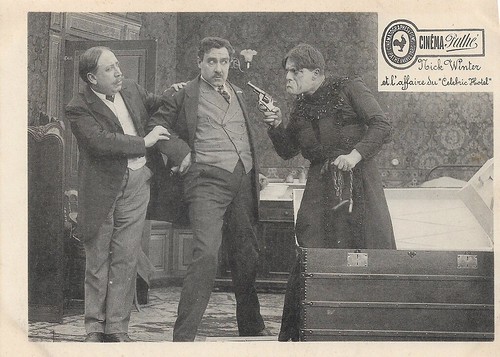
French photo card by Cinéma Pathé. Photo: Pathe Frères. Georges Vinter in Nick Winter et l’affaire du Célébric hôtel (Gérard Bourgeois, 1911). Vinter stands right on this card, Jacques Vandenne as the hotel manager at left, Jacques Normand as the hotel rat in the middle.
Detective Nick Winter (Georges Vinter) has to deal with a notorious hotel rat (Jacques Normand) who remains elusive, despite the many misdeeds that signal his presence. He's staying at the Celebric Hotel and is preparing, with the help of an accomplice, to carry out a successful robbery of an old lady's room, whose purse is stuffed with banknotes. But the tempting bag is a trap for our thieves. The old lady is none other than the astonishing Nick Winter, who triumphs once again in this scene.
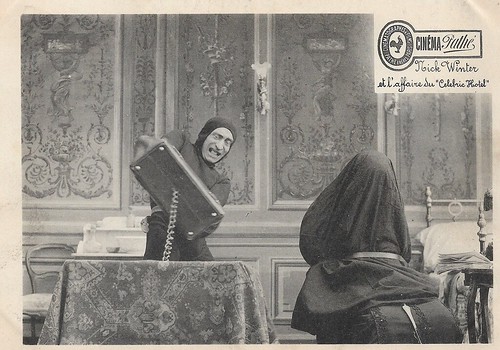
French photo card by Cinéma Pathé. Photo: Pathe Frères. Scene from Nick Winter et l’affaire du Célébric hôtel (Gérard Bourgeois, 1911).
Nick Winter has to deal with a notorious hotel rat who remains elusive, despite the many misdeeds that signal his presence. He's staying at the Celebric Hotel and is preparing, with the help of an accomplice, to carry out a successful robbery of an old lady's room, whose purse is stuffed with banknotes. But the tempting bag is a trap for our thieves. The old lady is none other than the astonishing Nick Winter, who triumphs once again. It is not clear which actor the shouting man on this card is.
Check out more cards from the Pathé album 1911 in our Flickr album.
Source: Fondation Jerome Seydoux-Pathé.
No comments:
Post a Comment