
Belgian collector card by Kwatta. Photo: Metro Goldwyn Mayer.

Dutch postcard by J.S.A. Alice Faye and George Murphy in You’re a Sweetheart (David Butler, 1937). Collection: Marlène Pilaete.

Belgian collector card by Kwatta, Bois-d'Haine, no. C. 219. Photo: M.G.M. George Murphy in Broadway Rhythm (Roy Del Ruth, 1944).
A song-and-dance man in big-budget musicals
George Lloyd Murphy was born in New Haven, Connecticut, in 1902. He was the son of Catholic Irish immigrants. His father was the American track and field trainer and coach Michael Charles 'Mike' Murphy, and his mother was the former Nora Long. George graduated from Yale University and worked to support himself. He first worked as a toolmaker for Ford, later in the mines and as a real estate agent, and finally as a dancer in various discotheques.
In the mid-1920s, George Murphy moved to New York City. There he met his first wife, Juliette Henkel, whom he married in 1926. They had two children, a son, Dennis, and a daughter, Melissa.
He made his Broadway debut as a member of the chorus in 'Good News' (1927) and performed in three other Broadway shows - 'Hold Everything!', 'Of Thee I Sing', and 'Roberta'. After retiring from the stage, Murphy moved with his family to Hollywood, where talking pictures had replaced silent films.
He made his Hollywood debut in Kid Millions (Roy Del Ruth, Willy Pogany, 1934), starring Eddie Cantor. Murphy appeared with Shirley Temple in Little Miss Broadway (Irving Cummings, 1938) and with Judy Garland in Little Nellie Kelly (Norman Taurog, 1940). He became known as a song-and-dance man and appeared in many big-budget musicals, such as Broadway Melody of 1938 (Roy Del Ruth, 1937), Broadway Melody of 1940 (Norman Taurog, 1940), in which he danced with Fred Astaire, and For Me and My Gal (Busby Berkeley, 1942) with Judy Garland.
After switching from the Democratic Party to the Republican Party in 1939, George Murphy became a close political ally of Ronald Reagan, with whom he appeared in This Is the Army (Michael Curtiz, 1943).

Dutch postcard S. & v. H. A. Photo: M.P.E.A. Alice Faye and George Murphy in You're a Sweetheart (David Butler, 1937).

Belgian postcard by L.A.B. (Les Editions d'Art, Bruxelles), no. 1509. Photo: Metro-Goldwyn-Mayer.
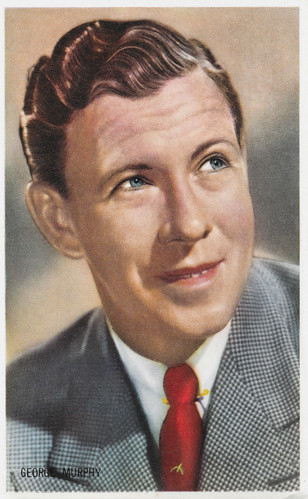
Belgian collector card by Kwatta, Bois-d'Haine, no. C. 318. Photo: M.G.M. George Murphy in Border Incident (Antrhony Mann, 1949).
Say. . . Didn’t you use to be George Murphy?
During World War II, George Murphy primarily appeared in Propaganda films aimed at boosting the morale of US troops. Among these films were The Navy Comes Through (A. Edward Sutherland, 1942), and Bataan (Tay Garnett, 1943) with Robert Taylor.
From 1944 to 1946, Murphy served as president of the Screen Actors Guild. His final film was the Film Noir Walk East on Beacon (Alfred L. Werker, 1952). By then, Murphy had been cast in approximately 50 feature films. Although his work was mostly limited to relatively unknown films, he received an honorary Oscar in 1951 for his contributions to the film industry.
From 1958 to 1961, he served as vice president of the film production company Desilu. In the late 1950s, Murphy became increasingly involved in politics. He served three times - in 1952, 1956, and 1960 - as head of entertainment for the televised inaugurations of Presidents Dwight D. Eisenhower and John F. Kennedy. In the early 1960s, Murphy became chairman of the Republican Party of California and was elected to the U.S. Senate in 1964.
He served a six-year term in the Senate before leaving office in January 1971. His autobiography, 'Say. . . Didn’t You Used to Be George Murphy?' was published in 1970. During his time in office, Murphy was diagnosed with oesophageal cancer, which necessitated surgery to remove his larynx. As a result of the surgery, he had difficulty speaking for the rest of his life.
George Murphy retired from public life, which he shared with his second wife, Bette Blandi, whom he married in 1982. They left California and moved to Palm Beach, where he died of leukaemia in 1992, two months before his 90th birthday.

British postcard in the Picturegoer Series, London, no. 1011a. Photo: Metro-Goldwyn-Mayer.

Dutch postcard by MPEA. Photo: Metro-Goldwyn-Mayer.
Sources: Britannica, Wikipedia (German, French and English) and IMDb.
No comments:
Post a Comment