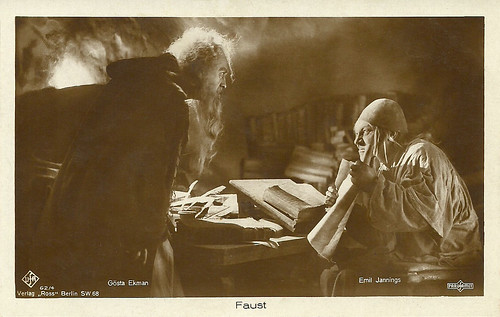
German postcard by Ross Verlag, no. 62/4. Photo: ParUfaMet / Ufa. Gösta Ekman and Emil Jannings in Faust (Friedrich Wilhelm Murnau, 1926). Collection: Didier Hanson.
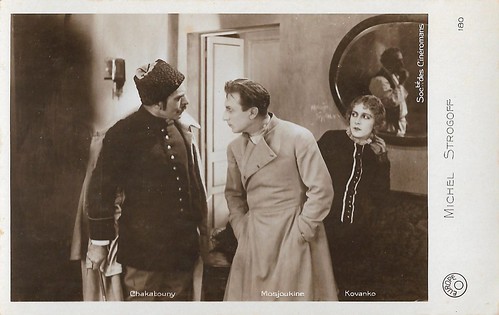
French postcard by Europe, no. 180. Photo: Société des Cinéromans. Ivan Mozzhukhin, Nathalie Kovanko and Acho Chakatouny in Michel Strogoff (Victor Tourjansky, 1926), based on Jules Verne's classic novel.

German postcard by Ross Verlag, no. 4777/1, 1929-1930. Photo: United Artists. Douglas Fairbanks in The Black Pirate (Albert Parker, 1926).

German postcard by Ross Verlag, Berlin, no. 1810/1, 1927-1928. Photo: Fanamet. Adolphe Menjou in The Sorrows of Satan (D.W. Griffith, 1926).
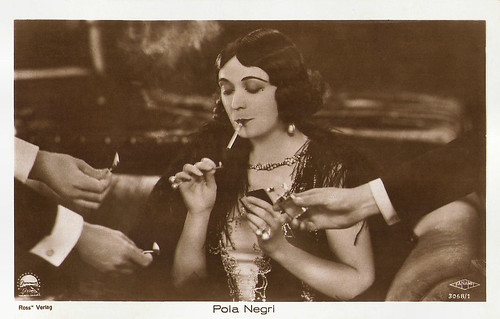
German postcard by Ross Verlag, no. 3068/1, 1928-1929. Photo: Paramount / Fanamet. Pola Negri in Good and Naughty (Malcolm St. Clair, 1926).

German postcard by Ross Verlag, no. 3373/1, 1928-1929. Photo: United Artists. Rudolph Valentino in The Son of the Sheik (George Fitzmaurice, 1926).

German postcard by Ross Verlag, no. 1795/3, 1927-1928. Photo: United Artists. Ronald Colman and Vilma Banky in The Winning of Barbara Worth (Henry King, 1926).

Italian postcard by G.B. Falci Ed. for Unica - Ciocolato Talmone al latte. Photo: Pittaluga Film. Maria Jacobini in Beatrice Cenci (Baldassarre Negroni, 1926).

Italian postcard by Ed. A. Traldi, Milano, no. 818. Photo: Pittaluga Films, Torino. Publicity still for Maciste nella gabbia dei leoni / Maciste in the Lions' Cage (Guido Brignone, 1926).
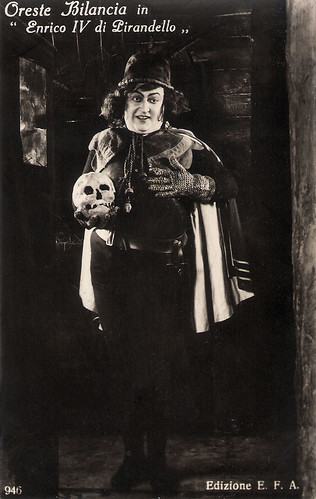
Italian postcard by Edizione A. Traldi, Milano, no. 946. Oreste Bilancia in Die Flucht in die Nacht / The Flight in the Night (Amleto Palermi, 1926), based on the play 'Enrico IV' by Luigi Pirandello.

Italian postcard by Ed. A. Traldi, Milano. Photo: Pittaluga Films, Torino. Publicity still for the Italian silent film Maciste all'inferno / Maciste in Hell (Guido Brignone, 1926), starring Bartolomeo Pagano as Maciste. Caption: The Inhabitants of the Underworld.

Italian postcard. Photo: Pittaluga Film, Turin. Bartolomeo Pagano as Maciste in Maciste contro lo sceicco / Maciste against the Sheik (Mario Camerini, 1926).

German postcard by Ross Verlag, Berlin, no. 1629/1. Photo: Nero-Film, Berlin. Was ist los im Zirkus Beely? / The Phantom of the Circus (Harry Piel, 1927) was Harry Piel's 75th film. It was the first Harry Piel film with a full-grown predator as Piel's companion: the tiger Bylard from the Leipzig Zoo. Mathias Bleckmann, in his 1992 biography of Piel, tells a nice anecdote. To the admiration of the wrangler present, Piel calmly managed to have the animal adapt to the camera. To have the tiger lick his face as the script demanded, he smeared his own mouth with cheese, but he had forgotten that a tiger's tongue might be sharp as a blade - so he ended up a few days in hospital...

Austrian postcard by Iris Verlag, no. 5508. Photo: F.B.O. / Wiener Lichtbilderei. Richard Talmadge in The Night Patrol (Noel M. Smith, 1926).

Soviet postcard: Photo: Vasili Yaroslavtsev in Bukhta smerti / The Bay of Death (Abram Room, 1926).

German postcard. Photo: Deutsch-Nordische Film-Union. La Jana in Die Weisse Geisha / Den hvide Geisha / The White Geisha (Valdemar Andersen, Karl Heiland, 1926). Caption: The white Geisha and the Rikshaman.

German postcard by Taschen, from the book 'Leni Riefenstahl: Five Lives' (2000). Leni Riefenstahl and Luis Trenker in Der heilige Berg / The Holy Mountain (Arnold Fanck, Leni Riefenstahl, 1926). Caption: The Ice Cathedral.

German postcard by Sokal Film, Berlin, for Residenz-Theater. Agnes Esterhazy in Der Student von Prag / The Man Who Cheated Life (Henrik Galeen, 1926).

Danish postcard by Nordisk. Photo: Deutsch Nordische Film Union / Nordisk. Gunnar Tolnaes in Maharadjahens yndlingshustru / The Maharaja's Favourite Wife (A.W. Sandberg, 1926), released in Germany as Die Lieblingsfrau des Maharadscha.

French postcard by Europe, no. 190. Photo: Soc.té des Cinéromans. André Roanne in Mlle. Josette ma femme / Fräulein Josette - Meine Frau / A Marriage of Convenience (Gaston Ravel, 1926).

Italian postcard by G. Vettori, Bologna, no. 3536. Angelo Ferrari and Agnes Esterhazy in Die Flucht in die Nacht / The Flight in the Night (Amleto Palermi, 1926). The Italian title was Enrico IV.

Swedish postcard by Axel Eliassons Konstförlag, no. 467. Photo: SBF / Film AB Nordstjaernan. Thor Christiernsson as Lt. Colonel K.L. Lode in the two-part historical film Fänrik Ståls sägner / The Tales of Ensign Stål (John W. Brunius, 1926). The film is set during the Finnish War between Sweden and Russia in 1808-1909, during the Napoleonic era. The script by Ivar Johansson was based on the epic poem 'The Tales of Ensign Stål' (1848) by nineteenth-century writer Johan Ludvig Runeberg. The film was shot at the Råsunda Studios in Stockholm, and exteriors were shot at Tavastehus, Ritoniemi, Ruovesi and other places. Cinematography was by Hugo Edlund and Karl Andersson, and sets were designed by Vilhelm Bryde. Runeberg's work had already been filmed in 1910 and would be again in 1939.

Danish postcard by Alex Vincents Kunstforlag, no. 2. Photo: Sacha Film / Phoebus Film. Nils Asther and Lily Damita in the Austro-German coproduction Die goldene Schmetterling / The Golden Butterfly (Mihaly Kertesz / Michael Curtiz, 1926).

French postcard by Ed. Expédition Citroën. Still from La croisière noire / The Black Journey (Léon Poirier, 1926). Caption: Indigenous Ubangi dressed for the ritual dance of the Gan'za. Ubangi-Shari was a French colony in Africa, part of French Equatorial Africa. It is now the Central African Republic. The French expedition film La croisière noire / The Black Journey (1926) was one of the publicity missions sponsored by André Citroën, with support from the Société de géographie and the Muséum national d'histoire naturelle, to promote his vehicles. The mission aimed to open a regular motor route in Africa and had political and cultural overtones. Starting at Béchaar, Algeria, on 28 October 1924, the expedition crossed the Sahara Desert and proceeded through Mali, Nigeria, Chad and Ubangi-Shari in French Equatorial Africa (AEF) and the Belgian Congo. The film and photos represent the European colonial gaze of a century ago.

Italian postcard by BFF (Ballerini & Fratini), no. 423. Photo: Metro-Goldwyn, Roma. Antonio Moreno and Alice Terry in Mare Nostrum (Rex Ingram, 1926).

Italian postcard by G.B. Falci Editore, Milano, no. 603. Photo: Metro Goldwyn Films. Marion Davies in Beverly of Graustark (Sidney Franklin, 1926).

Reproduction of film still for Don Juan (Alan Crossland, 1926). Photo: Warner/ Vitaphone. John Barrymore as Don Juan fighting Count Giano Donati (Montague Love), while Cesare Borgia (Warner Oland) and Lucrezia Borgia (Estelle Taylor) look on. Set design by Ben Carré.

German postcard nu Ross Verlag, Berlin, no. 3424/1, 1928-1929. Photo: Metro-Goldwyn-Mayer. Lillian Gish in La Bohème (King Vidor, 1926).

German postcard by Ross Verlag, no 69/1. Photo: Reinhold Schünzel-Film / Ufa. Reinhold Schünzel and Margot Walter in In der Heimat, da gibt's ein Wiedersehn! / We'll Meet Again in the Heimat (Reinhold Schünzel, Leo Mittler, 1926). It meant the screen debut for Margot Walter (1903-1994), later known as Margot Landa when married to actor-director Max Landa.

French postcard by A.N., Paris, no. 331. Photo: Max Munn Autrey / Fox Film. Dolores Del Rio and Edmund Lowe in What Price Glory? (Raoul Walsh, 1926).
No comments:
Post a Comment