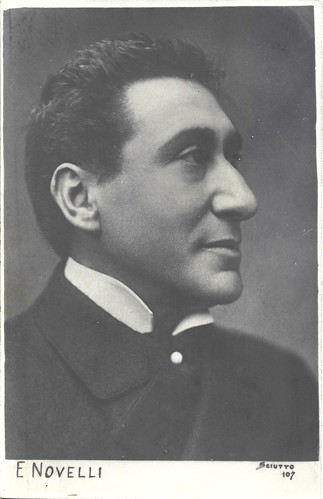
Italian postcard, no. 107. Photo: Sciutto.
Italian actor Ermete Novelli (1851-1919) was a legendary monstre sacré of the theatre. In the 1910s, he appeared in films by Film d'Arte Italiana, Ambrosio and Raggio Film.
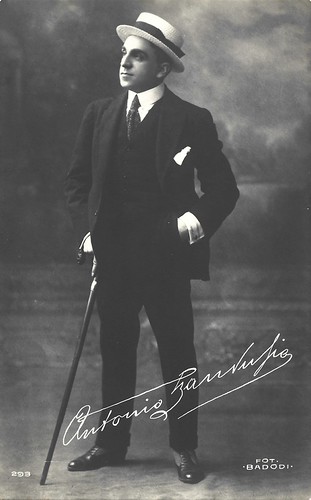
Italian postcard by Ed. Fotocelere, no. 293. Photo: Badodi.
Antonio Gandusio (1873-1951) was an Italian stage and screen actor with a rich career in 1930s and 1940s Italian cinema.
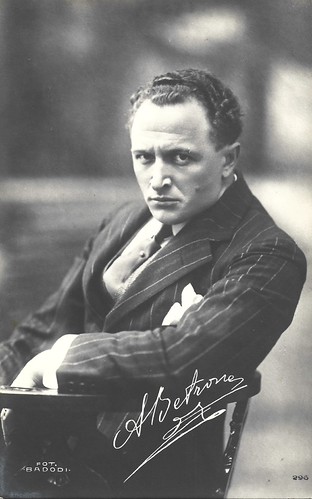
Italian postcard by Ed. Fotocelere, no. 296. Photo: Badodi.
Annibale Betrone (1883-1950) was an Italian film, stage, and radio actor who did some silent films but was rather highly active in Italian sound cinema of the 1930s and 1940s.
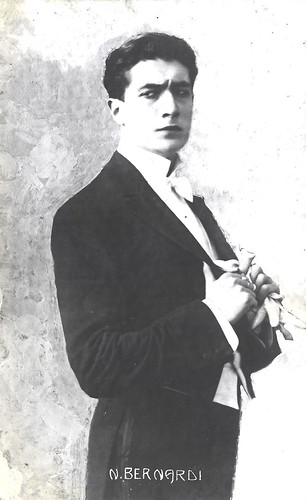
Vintage postcard by K Ltd.
Handsome Nerio Bernardi (1889–1971) was an Italian stage and screen actor and voice actor. In his long career, he acted in some 210 films.
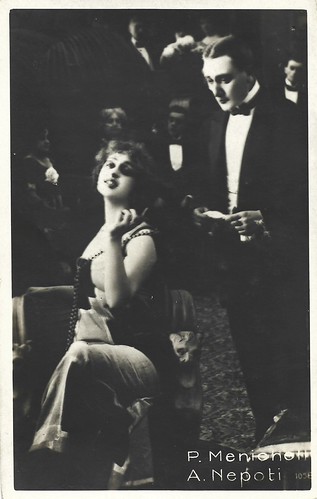
Italian postcard by Ed. Vettori, Bologna, no. 1058. Photo: Itala Film. Pina Menichelli and Alberto Nepoti in Tigre reale (Giovanni Pastrone, 1916).
Fascinating and enigmatic, Pina Menichelli (1890-1984) was the most bizarre Italian diva of the silent era. With her contorted postures and disdainful expression, she impersonated the striking femme fatale.
Celluloid Dreams, Silentscapes
At Le Giornate del Cinema Muto, Ivo Blom (EFSP) co-programmed two slots of mainly French and Italian early silent films dealing with Greco-Roman antiquity. For this occasion, he published at EFSP the posts Ancient Greece in early cinema, and Augusto Mastripietri, about the actor who played Julius Caesar in Bruto / Brutus (1911), one of Enrico Guazzoni's earliest Antiquity films.
On 12 October, Ivo also co-presented with Maria Wyke (UCL) and Bryony Dixon (BFI) the Museum of Dreamworlds website about their research project. It systematically investigates all the silent films in the BFI National Archive that concern ancient Greece or Rome.
In November, a new exhibition opens, inspired by the Museum of Dreamworlds. You can visit the exhibition, 'Celluloid Dreams, Silentscapes', between 20 November and 4 December at University College in London.
The exhibition juxtaposes some of the antiquity films preserved by the BFI with contemporary responses to them. These works are interconnected through their depictions of ancient Greek and Roman architecture, for architecture lies at the heart of these imagined worlds. Monumental temples, ruined cities, and spectacular landscapes became visual stages where historical knowledge intertwined with artistic interpretation.
The exhibition is open from Monday to Friday, 9am-5pm; Saturday and Sunday, 11am-3pm. Address: The UCL Bartlett School of Architecture (Exhibition Space), 22 Gordon St., London WC1H 0QB. Admission is free, and no booking is required. Click here for more information.

Italian postcard by Ed. Traldi, Milano, no. 452. Photographer unknown.
Cecyl Tryan (1897-?) had a prolific career in the Italian silent cinema, from 1913 to the late 1920s. She first starred at Cines, later also at companies like Gladiator Film and Fert.

Italian postcard, no. 2508. Photo: Fox Film Corp., Roma. Sammy Cohen in What Price Glory (Raoul Walsh, 1926). The Italian title was Gloria.

Italian postcard. Foto: Ebang. Mistake alert! The man on the card is not Edmund Lowe but William Haines, and the woman is not Eleanor Boardman but Mary Brian. They acted together in the MGM drama Brown of Harvard (Jack Conway, 1926).
William 'Billy' Haines (1900–1973) was an American film actor and interior designer. By the end of the silent era, he was regularly named as Hollywood's no. 1 male box-office draw.
Mary Brian (1906-2002) was an American actress and film star with dark brown curls and blue/grey eyes, who made the transition from silent films to sound films. She was dubbed 'The Sweetest Girl in Pictures'.
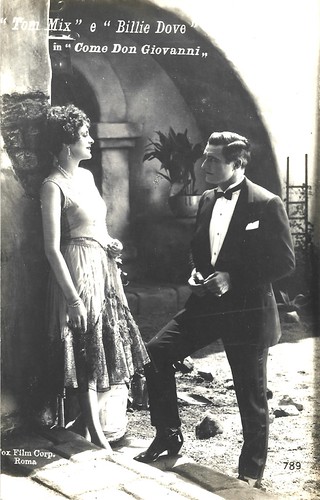
Italian postcard by Ballerini & Fratini, Firenze, no. 789. Photo: Fox Film Corp. Roma. Tom Mix and Billie Dove in the Western The Lucky Horseshoe (John G. Blystone, 1925). The Italian title was Come Don Giovanni (Just like Don Giovanni).
American film actor Tom Mix (1880-1940) starred in many early Westerns between 1909 and 1935. Mix appeared in 291 films, all but nine of which were silent movies. He was Hollywood's first Western megastar and helped to define the genre for all cowboy actors who followed.
Stunningly beautiful and highly photogenic Billie Dove (1903-1997) was one of the most popular Hollywood actresses of the 1920s. She was dubbed 'The American Beauty', after the title of one of her films.
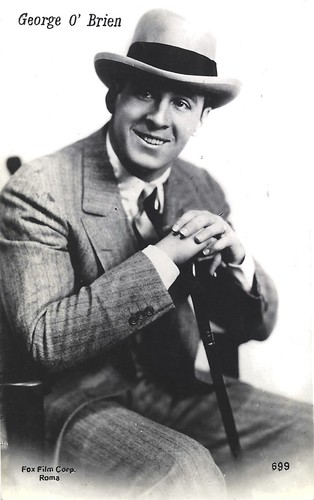
Italian postcard by Ballerini & Fratini, Firenze, no. 699. Photo: Fox Film Corp., Roma.
American actor George O'Brien (1899-1985) was a muscular, barrel-chested, yet sensitively talented leading man in classic silent films, like John Ford's The Iron Horse (1924) and F. W. Murnau's Sunrise (1927). He became a different kind of star as a cowboy in B-Westerns during the sound era.

Italian postcard by Ballerini & Fratini, Firenze, no. 752. Photo: Films Paramount Roma. Ricardo Cortez and Frances Howard in The Swan (Dimitri Buchowetzki, 1925), based on the play by Ferenc Molnar. The Italian release title was Il Cigno.
Suave, dark-haired Ricardo Cortez (1900-1977) was an American screen actor and director who peaked in the 1920s as Paramount's romantic lover opposite the big female stars of the decade, while in the 1930s he rather played tough men such as the first Sam Spade on the screen.

Italian postcard by Ballerini & Fratini, Firenze, no. 754. Photo: Films Paramount, Roma. Adolphe Menjou and Helen Lee Worthing in The Swan (Dimitri Buchowetzki, 1925), based on the play by Ferenc Molnar. The Italian release title was Il Cigno.
Suave and debonair American actor Adolphe Menjou (1890-1963) with his trademark waxy black moustache was one of Hollywood's most distinguished stars and one of America's 'Best Dressed Men'. He started as a matinée idol in silent cinema in classics such as Ernst Lubitsch's The Marriage Circle (1924). His sound films included Morocco (1931) with Marlene Dietrich and Gary Cooper, A Star is Born (1937), and Stanley Kubrick's Paths of Glory (1957) with Kirk Douglas. In 1931, he was nominated for an Oscar for The Front Page (1931).
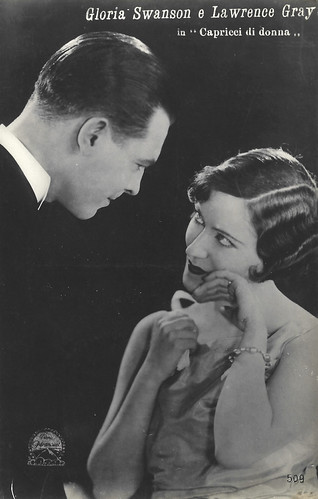
Italian postcard by Ballerini & Fratini, Firenze, no. 509. Photo: Films Paramount. Gloria Swanson and Lawrence Gray in The Untamed Lady (Frank Tuttle, 1926). The Italian release title was Capricci di donna (Female Caprice).
Gloria Swanson (1899-1983) was one of the biggest Hollywood stars of the silent era. She transformed from a typical Mack Sennett comedienne into a lively, provocative, even predatory star in Cecil B. DeMille films. She received Oscar nominations for Sadie Thompson (1928), The Trespasser (1929) and Sunset Blvd. (1950).
Lawrence Gray (1898-1970) was an American film actor of the silent screen. He often partnered with Hollywood's biggest female stars, such as Gloria Swanson (Stage Struck, 1925; The Untamed Lady, 1926), Norma Shearer (After Midnight, 1927), Colleen Moore (Oh, Kay!, 1928), and Marion Davies (The Patsy, 1928).

Italian postcard by Vettori, Bologna, no. 80. Photo: Paramount Pictures.
Wallace Reid (1891–1923) was an American actor in the silent film era, referred to as 'the screen's most perfect lover'. A morphine addiction killed him at the age of only 31.

Italian postcard by Ed. G.B. Falci, Milano, no. 552. Photo: Metro-Goldwyn-Mayer S.A.J.
Aileen Pringle (1895-1989) was an American film actress of the silent screen. She was catapulted into stardom by her appearance in the Goldwyn production Three Weeks (Alan Crossland, 1924) with Conrad Nagel. Aileen's bob in the picture above was called the 'Pringle Shingle'.
Sources: UCL Faculty of Arts & Humanities, Museum of Dream Worlds. With special thanks to Marlene Pilaete for identifying the actress on the 'Eleanor Boardman' card and for additional information on Aileen Pringle.
No comments:
Post a Comment