
Japanese postcard. Minoru Takada (1899-1977).
Minoru Takada was a Japanese actor and film producer in the Taisho and Showa periods. He appeared in over 230 films between 1924 and 1971. His wife was the former actress Mikiko Mitsuki. Takada starred e.g. in Wakasa yo saraba (Shigenori Sakata, 1924), one of his first films, and Yasujirō Ozu's film I Graduated, But.../ Daigaku wa detakeredo (1929).
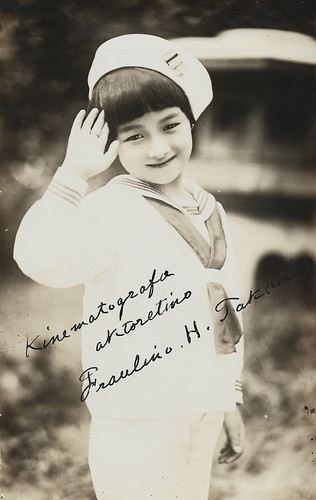
Japanese postcard. Hideo Takamine (1924-2010).
Along with Setsuko Hara and Kinuyo Tanaka, Hideko Takamine remains one of Japan's most admired and prolific film actresses. Born as Hirayama Hideko in Hakodate, Hokkaido in northern Japan in 1924, she became a child actress for Shochiku Studio at age five, appearing in the film Haha. She would go on to work with directors like Kinoshita, Ozu, and arguably most notably Mikio Naruse. Mid-career, she switched to P.C.L. Film Studio (later Toho Studios) and then became independent, yet she would work for notable directors nonetheless. By the time she married director Zenzo Matsuyama in 1955, she had acquired a reputation for depicting feminist roles where women seek their independence or are oppressed. She died in 2010 of lung cancer, but had recorded songs and written biographies before her death. Source: Aghaemi (IMDb).
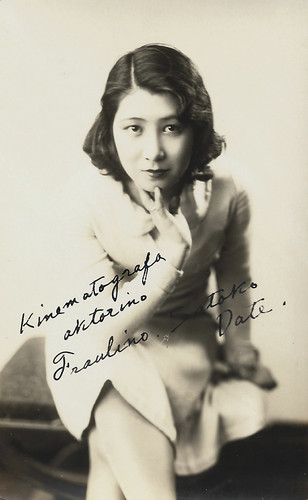
Japanese postcard. Satoko Date (1910-1972).
Japanese actress Satoko Date was born on 11 October 1910 in Yokosuka, Japan, and died on 23 October 1972. She acted in almost 100 films between 1929 and 1952. She started in the silent era in such films as Yasujirō Ozu's Walk Cheerfully (1930), The Revengeful Spirit of Eros (1930), and The Lady and the Beard (1931). Date then played the neighbour's wife in the comedy The Neighbor's Wife and Mine / Madamu to nyōbō (Heinosuke Gosho, 1931), the first feature-length Japanese all-talkie sound film. In the 1930s she acted in films such as Mikio Naruse's Morning's Tree-Lined Street (1936) and The Loves of a Kabuki Actor (Kajirō Yamamoto, 1938). Until 1952, she acted in many supporting parts in Japanese cinema.

Japanese postcard. Shizue Natsukawa (1909-1999).
Shizue Natsakawa was a Japanese actress, born on 9 March 1909, in Tokyo, where she also died on 24 January 1999. Between 1919 and 1984 she acted in over 170 films. working with directors such as Kenji Mizoguchi (Tokyo March, 1929), Shirō Toyoda (Young People, 1937), and Keisuke Kinoshita. In 1927, she joined the Nikkatsu studio, where she gained popularity through films such as Tsubakihime/ A Woman Called Tsubakihime (Minoru Marata, 1927) and Kekkon nijuso: zenpen (Tomotaka Tasaka, 1927-1928). Natsakawa is also known for the trilogy Kono taiyô - Dai sampen (1930), Kono taiyô - dainihen Tamie no maki (1930) and Kono taiyô - Dai ippen (1930), all by Minoru Marata. In 1937 she married Nobuo Iida, and withdrew from acting, but she returned to the screen with Shirō Toyoda's Spring on Leper's Island (1940). After the war, she played many secondary roles in films and on television and continued acting till in her mid-seventies.
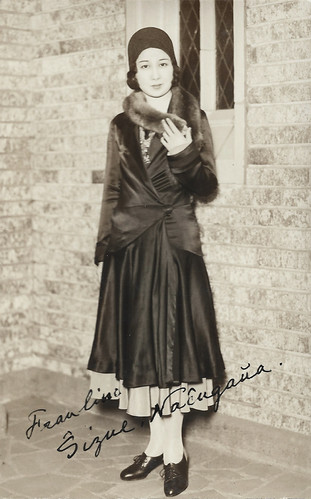
Japanese postcard. Shizue Natsukawa (1909-1999).
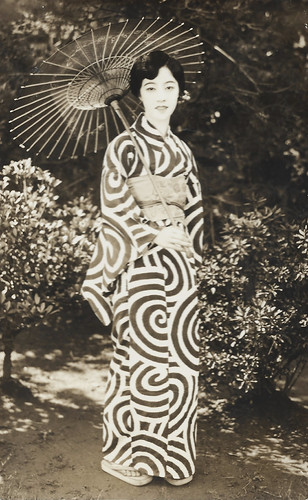
Japanese postcard. Yukiko Tsukuba (1906-1977).
Yukiko Tsukuba was born on 10 June 1906 in Tokyo, Japan, where she died on 8 June 1977. She was a prolific actress, acting in some 60 films between 1924 and 1936. She is known for such films as Renaî kônsen / Crossed Line of Love (Yasujirō Shimazu, 1927), Renbo kouta / Short Song of Love (Hiroshi Shimizu, 1929), Ukikusa-musume tabi fûzoku / Travelling Manners of a Vagrant Girl (Shimizu, 1929), and Nasanu naka / No Blood Relation (Mikio Naruse, 1932).

Japanese postcard. Unknown actress. If you happen to be able to identify this actress or the actress below, we would be very grateful.

Japanese postcard. Unknown Japanese actress dressed as geisha.
No comments:
Post a Comment