
East German postcard by Progress Film-Vertrieb, Berlin, no. 972/78, 1953. Photo: DEFA / Wunsch.

East German postcard by VEB Bild und Heimat Reichenbach i.V., no. 55/64. Photo: DDR Deutscher Fernsehfunk / Winkler. Brigitte Krause in a remarkable and unusual vamp-like pose.

East German postcard by VEB Progress Film-Vertrieb, Berlin, no. 2545, 1966. Photo: DEFA / Pathenheimer. Brigitte Krause in Die Söhne der großen Bärin / The Sons of the Great Bear (Josef Mach, 1966).
Wolfgang Staudte's masterpiece
Brigitte Krause was born in Berlin in 1948. Krause joined the DEFA youth studios, where she trained as a film actress and was engaged as a newcomer in 1950. In 1949, while still a student, the young, fresh-faced girl made her debut in the family epic Die Buntkarierten / Girls in Gingham (Kurt Maetzig, 1949), starring Camilla Spira and Werner Hinz.
She also performed in Wolfgang Staudte's masterpiece Rotation (1949), starring Paul Esser. Rotation tells, in retrospect, the story of a German worker's life between 1920 and 1945 and depicts the true horrors of Nazism. The film won the Golden Leopard at the Locarno International Film Festival.
As part of her training as an actress, she also appeared on stage in Altenburg and Halle. Later, she also performed in theatres in Berlin and Potsdam. After her graduation, Kurt Maetzig gave Krause minor roles as 'natural and simple young girls' in the films Rat der Götter / The Council of the Gods (Kurt Maetzig, 1950) about the I.G. Farben corporation from 1930 to 1948, and the Propaganda film Roman einer Jungen Ehe / Story of a Young Couple (Kurt Maetzig, 1952) that portrays the events in Berlin between 1946 and 1951 from a strict SED perspective.
In Konrad Wolf's debut film, the Heimat comedy Einmal ist keinmal / Once Is Not Enough (1955), she played her first leading role alongside Horst Drinda. The film is considered Wolf's homage to the Soviet musical director Grigory Alexandrov, with whom Wolf had studied at the Gerasimov Institute of Cinematography in Moscow.
Between 1955 and 1964, Krause frequently acted in productions by the 'Stacheltier' group. In total, she appeared in 12 of their satirical short films. The black-and-white shorts were shown before the main feature in East German cinemas. The production group 'Satirische Kurzfilm' (Satirical Short Film) at the DEFA studios produced them.

East German postcard by VEB Volkskunst Reichenbach, i.V., no. G 573, 1956. Photo: Kroiss. Brigitte Krause in Einmal ist keinmal / Once Is Not Enough (Konrad Wolf, 1955).

East German postcard by VEB Volkskunstverlag Reichenbach i.V., no. G 596, 1955. Photo: Radocay, Berlin.

East German postcard by VEB Progress Film-Vertrieb, Berlin, no. 974/101, 1956. Photo: DEFA / Wunsch.
The Russians are coming
From the very beginning of East German television in 1952, Brigitte Krause appeared in DFF's Christmas programme. She later appeared frequently in the station's TV series as an announcer and entertainer. She acted in popular TV shows such as Rentner haben niemals Zeit, Polizeiruf 110 / Police Call 110, and Ferienheim Bergkristall.
She effortlessly transitioned to playing mothers—capable women with their hearts in the right place became her domain. She was also active on East German radio, appearing for many years in the popular series 'Neumann, zweimal klingeln' (Neumann, Ring Twice). In the DEFA comedy Das verhexte Fischerdorf / The Bewitched Fishing Village (Siegfried Hartmann, 1962), she again starred alongside Horst Drinda. From 1965 to 1989, she was an ensemble member of the legendary East Berlin cabaret Distel.
She had a supporting role in the Eastern (DEFA Western) Die Söhne der großen Bärin / The Sons of the Great Bear (Josef Mach, 1966), based on the novel by Liselotte Welskopf-Henrich. This film marked the beginning of Gojko Mitić's career as the 'DEFA's chief Indian' and idol of the East German youth.
Krause had a small part in the interesting film Die Russen kommen / The Russians are Coming (Heiner Carow, 1987), which recounts the final days of World War II from the perspective of a Hitler Youth. The film, produced in 1968, was denied state approval at the time because it focuses not on an anti-fascist hero, but on a fellow traveller as a victim. The film provocatively blurred the lines between guilt and innocence. Only twenty years later were the filmmakers able to painstakingly reconstruct The Russians Are Coming from the few remaining fragments of the original negative and positive prints. In a further restoration project beginning in 2014, experts from the DEFA Foundation discovered numerous previously undiscovered fragments in the working print, which they used to completely reconstruct the film.
Her last screen role was in the first episode of the seven-part television film Johanna (Peter Hagen, 1989). Krause was married to the actor Gerd Biewer, with whom she had a daughter, actress Maxi Biewer, known as the weather presenter for the German television channel RTL. Brigitte Krause died in Berlin on 29 April 2007. She was 78.

East German postcard by VEB Progress Film-Vertrieb, Berlin, no. 1436, 1961. Photo: DEFA / Wenzel.

East German postcard by VEB Progress Film-Vertrieb, Berlin, no. 1722, 1963. Photo: W. Denger.
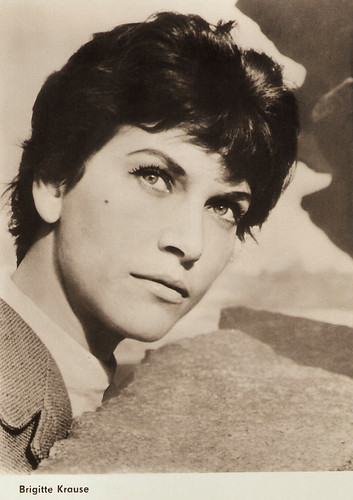
East German postcard by VEB Progress Film-Vertrieb, Berlin, no. 2504, 1965. Photo: Balinski.

East-German postcard by VEB Progress Film-Vertrieb, Berlin, no. 2.546, 1966. Photo: DEFA / Pathenheimer. Hannjo Hasse and Brigitte Krause in Die Söhne der großen Bärin / The Sons of Great Bear (Josef Mach, 1966).
Sources: Peter Warnecke (Filmmuseum Potsdam - German), MDR (German), Wikipedia (German and English) and IMDb.
No comments:
Post a Comment