
British postcard in the Picturegoer Series, London, no. 793. Photo: Universal.

German postcard by Ross Verlag, no. 183/4. Photo: Paramount. Brian Aherne (Richard), Lionel Atwill (Baron von Merzbach) and Marlene Dietrich (Lily) in The Song of Songs (Rouben Mamoulian, 1933). Dietrich is a naive peasant girl who models (naked) for a sculptor and falls in love with him. A rich baron, the sculptor's client, presses the artist to leave the girl to him. The baron turns her into a lady, but, incidentally, into a world-wise woman too.

British postcard in the Filmshots series by Film Weekly. Photo: United Artists. Anna Sten and Lionel Atwill in Nana (Dorothy Arzner, George Fitzmaurice, 1934).
Mad scientists and a sinister, hideously disfigured sculptor
Lionel Alfred William Atwill was born in Croydon in London in 1885. He came from a wealthy, privileged family. His parents, Alfred Atwill and Ada Emily née Dace, encouraged him to study architecture at the prestigious Mercer School in London. The young student felt a keen interest in the stage. In 1904, the 19-year-old Atwill made his stage debut and, to his parents' dismay, abandoned his studies.
He played in plays by Henrik Ibsen and George Bernard Shaw at the Garrick Theatre in London. His aristocratic presence and calm voice allowed him to make a name for himself. In the mid-1910s, wanting to accelerate his career, he left for the United States and performed on Broadway. Handsome and charismatic, he achieved great success and earned an excellent reputation in romantic lover roles alongside the greatest actresses of the time. In 1913, he married Phyllis Relph, who gave birth to a son, John, but they divorced in 1919. John would become an RAF pilot who lost his life in 1941 during the Second World War.
Between 1917 and 1931, Atwill appeared in some 25 plays on Broadway. His charisma and seductive physique helped him enter the world of cinema, where he debuted in 1918 in the silent film Eve's Daughter by James Kirkwood. He also appeared opposite Elsie Ferguson in The Marriage Price (Emile Chautard, 1919). After a few more romantic films, Lionel abandoned the roles of 'jeune premiers' for roles of villains or sinister characters. He had a sonorous voice and dictatorial British accent that served him well for the stage and for sound film. In 1928, he did some Vitaphone short subjects such as The White Faced Fool (Thomas Chalmers, 1928).
Lionel Atwill's first sound feature was the mystery thriller The Silent Witness (R.L. Hough, Marcel Varnel, 1932) with Greta Nissen. He became famous that same year for his title role in Doctor X (Michael Curtiz, 1932), a blend of Crime and Horror film. In Doctor X, the police discover that a killer is using a scalpel that is only used at Doctor Xavier's (Atwill) medical academy. Many Horror films and thrillers followed.
One of his signature roles was that of the mad scientist. In The Vampire Bat? (Frank R. Strayer, 1932), he is Dr. Otto von Niemann, who created a monstrous beast that feeds on blood and uses it to nourish his body. In The Mystery of the Wax Museum (Michael Curtiz, 1933), he is the sinister, hideously disfigured sculptor Ivan Igor. In A. Edward Sutherland's bloody Zoo Murders (1933), he is the evil Gorman, a wealthy zoologist and a very jealous husband. In a deeply disturbing scene, he methodically sews the mouth of a man who has kissed his wife and abandons him to the tigers, then rejoices in his sadism by throwing his wife to the crocodiles. Then he played in The Mask of the Vampire (Tod Browning, 1935) an inspector who investigates a macabre murder in an isolated castle near Prague.
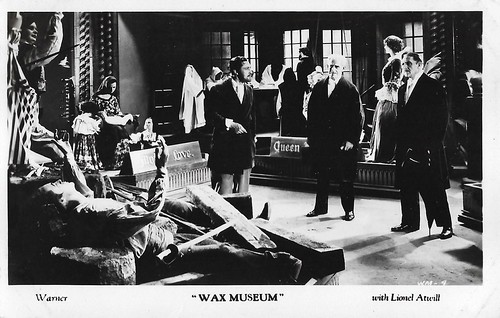
British postcard by Film Weekly, London. Photo: Warner Bros. Lionel Atwill, Holmes Herbert and Claude King in the Horror film Mystery of the Wax Museum (Michael Curtiz, 1933).
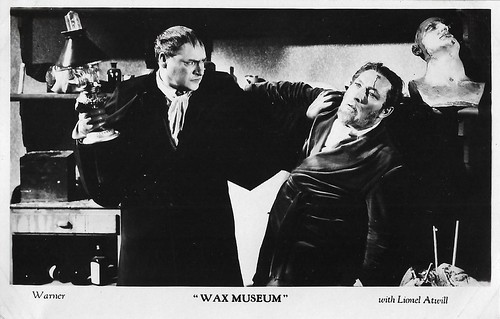
British postcard by Film Weekly, London. Photo: Warner Bros. Lionel Atwill and Edwin Maxwell in Mystery of the Wax Museum (Michael Curtiz, 1933).
A scandalous orgy with minors, naked guests and pornographic films
In a less macabre register, Lionel Atwill played an English officer who once assassinated a man in Ireland for chivalrous reasons in The High Command (Thorold Dickinson, 1936). In the Pirate film Captain Blood (Michael Curtiz, 1935), he played a tyrannical but unforgettable plantation owner alongside Errol Flynn and Olivia de Havilland. Atwill made two melodramas with Marlene Dietrich. In The Song of Songs (Rouben Mamoulian, 1933), he played an ageing baron who falls in love with Dietrich after seeing a statue of her. In The Devil Is a Woman (Josef von Sternberg, 1935), he portrayed police officer Don Pasquale, who is first seduced and then abandoned by Dietrich.
He returned to Horror with The Son of Frankenstein (Rowland V. Lee, 1939) as Police Inspector Krogh with an artificial wooden arm who opposes Boris Karloff, Basil Rathbone and Bela Lugosi. In this role, Atwill showed a generous dose of humour, especially in the scene where he plays darts with Rathbone and sticks the darts in his wooden arm. In the Sherlock Holmes thriller The Hound of the Baskervilles (Sidney Lanfield, 1939), he played Dr. Mortimer. A few years later, he appeared in Sherlock Holmes and The Secret Weapon (Roy William Neill, 1942) as Professor Moriarty, Sherlock Holmes's arch-enemy. Basil Rathbone played Sherlock Holmes in both films, and Nigel Bruce played Dr. Watson. Atwill also appeared several times in the Charlie Chan and Mr. Moto crime series.
Lionel Atwill returned to familiar territory as the evil scientist Dr. Paul Rigas, who wants to create an army of electrobiological zombies in Man-Made Monster (George Waggner, 1941). He acted in The Ghost of Frankenstein (Erle C. Kenton, 1942) with Bela Lugosi and Lon Chaney, Jr. He also played a supporting role as a hammy theatre actor in the classic comedy To Be or Not to Be (Ernst Lubitsch, 1942). At the end of 1941, Atwill's career almost ended.
During the Christmas party, he organised an orgy in his sumptuous home, with minors, naked guests and pornographic films. He was charged, brought before a judge, and found guilty of public indecency in October 1942. William McPeak at IMDb: "Atwill 'lied like a gentleman,' it was said, in the court proceedings to protect the identities of his guests and was convicted of perjury and sentenced to five years' probation.' The scandal made Atwill a pariah in most film studios under the Hays Code that ruled over Hollywood. The crisis also cost him his marriage to his third wife, the socialite Louise Brooks Cromwell, whom he had married in 1930. They separated and then divorced in 1943. Atwill spent weeks looking for roles on Broadway without success and limped back west. He was employed at Poverty Row by Producers Releasing Corporation, a studio that specialised in hiring fallen names cheaply. Jack Backstreet at IMDb: "PRC was a far cry from his glory days at the major studios. Along Gower Gulch, 'features' were usually allotted a five-day shooting schedule and retakes were forbidden."
Atwill was also briefly employed by Universal Pictures. In Frankenstein and the Werewolf (Roy William Neill, 1943), he was the mayor of Vasaria, Frankenstein's native village. Then, Atwill played Police Inspector Arnz in The House of Frankenstein (Erle C. Kenton, 1944), where the mad scientist, Dr. Niemann (Boris Karloff), escapes from the asylum. He also appeared as the villainous scientist Dr. Maldor in the first live-action adaptation of Marvel's Captain America (Elmer Clifton, John English, 1944) with Dick Purcell and Lorna Gray aka Adrian Booth. For his final film appearance in Genius at Work (Leslie Goodwin, 1946), he played a diabolical radio station owner who goes by the name Cobra and has an affinity for bedrooms of torture. In 1944, Lionel married for the fourth time to the writer Mary Paula Pruter. In 1945, their son Tony was born, who became a writer. At that time, the actor was suffering from pneumonia. He knew that he was gravely ill with cancer but refused to give up working. Six months after the birth of his son, Lionel Atwill died of bronchial cancer in 1946 in Pacific Palisades. He was 61. Atwill rests in the columbarium of the Chapel of the Pines Crematorium in California. The serial Lost City of the Jungle (Lewis D. Collins, Ray Taylor, 1946) premiered after his death. Atwill had died before completing his work on the quickie serial, and his remaining scenes were completed using a double.

Vintage postcard. Lionel Atwill in Mystery of the Wax Museum (Michael Curtiz, 1933).
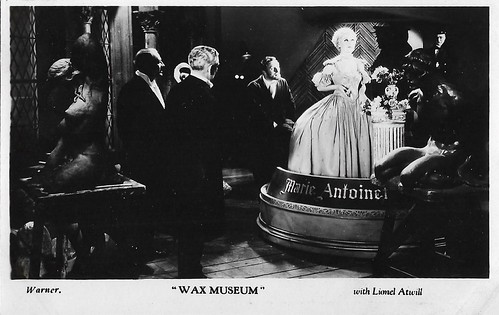
British postcard by Film Weekly, London. Photo: Warner Bros.Lionel Atwill, Fay Wray, Holmes Herbert and Claude King in the Horror film Mystery of the Wax Museum (Michael Curtiz, 1933). Mystery of the Wax Museum was one of the last fiction films using the two-colour Technicolour process. The film would be remade in 1953 as House of Wax.

British postcard in the Filmshots series by Film Weekly. Photo: United Artists. Lionel Atwill, Anna Sten and Richard Bennett in Nana / Lady of the Boulevards (Dorothy Arzner, George Fitzmaurice, 1934).
Sources: William McPeak (IMDb), Gary Richardson (Notre Cinema). James Backstreet (IMDb), Wikipedia (German) and IMDb.
No comments:
Post a Comment