
Latvian postcard. Peteris Lucis and Nina Melbarde in the Latvian film Zvejnieka dels / The Fisherman's Son (Villis Lapenieks, 1940). The film was made in 1939 but premiered on 2 January 1940.

Latvian postcard by Y Upitis, Riga, no. 507. August Mitrevics as Teodors and Olga Lejaskalne as Olga in Zvejnieka dels / The Fisherman's Son (Villis Lapenieks, 1940).

Latvian postcard by EBR, no. 3837. August Mitrevics as Teodors in Zvejnieka dels / The Fisherman's Son (Villis Lapenieks, 1940).
A relic of bourgeois Latvia or fresh as a sea breeze?
In terms of social resonance, the film Zvejnieka dels / The Fisherman's Son (Villis Lapenieks, 1940) has no equal in Latvia. Vilis Jānis Lapenieks' film adaptation of Vilis Lācis’ popular novel was a national blockbuster and created such excitement that at its premiere, the public at Riga's most prestigious cinema, Splendid Palace, broke down the theatre’s doors. In the next two months, around 250,000 people in Latvia watched the film. The film was also screened in Lithuania and Estonia.
After the Second World War, the occupying Soviets hid the film, deeming it a 'relic of bourgeois Latvia'. According to Wikipedia, memories of the film in occupied Latvia were so enduring that, in 1957, the government of the Latvian SSR ordered a new version, Zvejnieka dels / The Fisherman's Son (Varis Krumins, 1957), to replace the ‘bourgeois’ 1940 version. The actors who had played the two comic characters — Jim and Bundža — Harijs Aven and Arnolds Mīlbret in 1940 had to reprise their roles in the new film. When the country regained its independence after the collapse of the Soviet Union in 1991, the original film was re-released in Latvian cinemas. Zvejnieka dels / The Fisherman's Son (Villis Lapenieks, 1940) became for the youth a symbol of free Latvia. Latvia’s first sound feature was, according to Best Baltic, 'slightly naive, fresh as a sea breeze, heartfelt and as real as a child of nature'.
The protagonist of the film is Oskars Klava, who lives in a typical seaside village. He wants to break free of his father’s rule and the old traditions. Oskars dreams of new, large nets, an ice cellar, and the fishermen’s independence from the fish wholesaler. At first, no one wants to believe in Oskars’ plans, except for the happy-go-lucky rascal Fredis. With the help of Fredis, Oskars builds a new fish trap, gaining admiration, even from the old fishermen. Love and deceit also play a role in the story, as do colourful village characters and folk songs. The film's songs have since been absorbed into the national folklore. While the story seems simple, the actors and the beautiful cinematography help flesh it out and transform the film into something bigger than the sum of its parts. In parts it is a doe-eyed melodrama and, in parts, an eye-catching glimpse into a time long past.
Alongside the conflict between the old and the new economic systems, a conflict also arises within the Klava family. Roberts, Oskars’ brother, seduces Zenta, a girl from the fishing village, and then abandons her, causing her to take her own life. Oskars demands that his father throw Roberts out of the house, but old Kļava throws Oskars out instead. Romantic and comic episodes also play an important role in the film: the romantic storyline centres on the love between Oskars and Anita, Bandera’s daughter, whilst the comic elements are characterised by grotesquely portrayed characters: the fishermen Džimis and Bundža, the priest Father Teodors, the marriage-obsessed Kate and others. Andrejs reviews the film at Not Really a Blog: "Even without the historical background, the film stands on its own merits. To the modern eye, it might seem dated and a bit overblown, but taken in the context of the times, it is really a marvel to watch. Full of realistic characters, eye-catching cinematography, and an earnest look at the issues of the time."
Filming in 1939 took place in Lapmežciems, Ragaciems, Plieņciems, Garciems, Buļļu village, Nīca, Pape and Ķekava. The cinematographer was Alfrēds Polis. Oskars was played by Pēteris Lūcis. He remained the embodiment of this character throughout his life. National Theatre actor Kārlis Lagzdiņš played Fredis. The female leads were Kārlis Lagzdiņš's wife, Ņina Melbārde, as Anita and Milda Zīlava as Zenta. Father Kļava was portrayed by Ēvalds Valters, who later played many roles as an elderly man. Towards the end of his life, he became the oldest active actor in Latvia. The film was produced by the Society S.L.M. (Latvijas Republikas Sabiedrisko lietu ministrijas Sabiedriski-kulturālā departamenta Filmu nozare). Director Lapenieks wrote the film script himself and based it on a novel by Vilis Lācis. Lapinieks would eventually have to flee Latvia for the West, where he and his son would go on to respectable Hollywood careers, to escape Soviet persecution. Vilis Lācis became Latvia's Minister of the Interior under the Soviets. Neither lived to see Latvia independent again. Latvijas Filma released Zvejnieka dels / The Fisherman's Son on DVD.
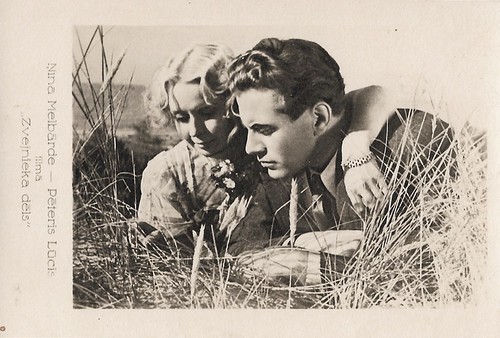
Latvian postcard. Peteris Lucis and Nina Melbarde in Zvejnieka dels/ The Fisherman's Son (Villis Lapenieks, 1940).

Latvian postcard by IRA, Riga, no. 305. Nina Melbarde and Karlis Lagzdins in Zvejnieka dels / The Fisherman's Son (Villis Lapenieks, 1940).

Latvian postcard by IRA, Riga, no. 306. Mila Zilava in Zvejnieka dels / The Fisherman's Son (Villis Lapenieks, 1940).
Splendid Palace
With its neo-baroque facade and neo-Rococo style interior, Cinema Splendid Palace in Riga is a national architectural monument. Splendid Palace hosts Latvian film premieres, national and international film festivals, performances, concerts, and live transmissions of opera and ballet from world-famous opera houses and festivals. Splendid Palace has two screening halls with 749 seats altogether.
Vasilijs Jemeljanovs and Leonids Falsteins founded the Splendid Palace. It was the first free-standing building in Riga intended exclusively for film screening, with a hall for 824 viewers. Architect Fridrihs Karlis Skujins designed the building. On 30 December 1923, the grand opening took place with the American film Under Two Flags (Tod Browning, 1922).
During the silent film period, the cinema had an excellent orchestra, conducted by Oto Karli. In October 1929, a sound film was screened here for the first time in the Baltic States: The Singing Fool (Lloyd Bacon, 1928). Since the 1930s, Splendid Palace has been the main venue of Latvian film premieres. A sensation was the premiere of the first Latvian feature, Zvejnieka dels / The Fisherman's Son (Villis Lapenieks, 1940).
During the USSR, the cinema was renamed 'Riga'. In 1969, the Spartaks cinema was built next to Splendid Palace. Splendid Palace’s current cinema hall is actually the old hall of Spartaks, reconstructed in 1998.
In 2006, the cinema was renovated, and the rococo interior and decorations were carefully reconstructed. In the rear of the hall, rows of two-seater sofas have been added. Since 1994, Splendid Palace has been a member of the European film network 'Europa Cinemas', and since 2007 it's been a member of the international art-house cinema association 'Art Cinema' CICAE. It is the oldest working cinema in the Nordic countries still presenting 35 mm films.
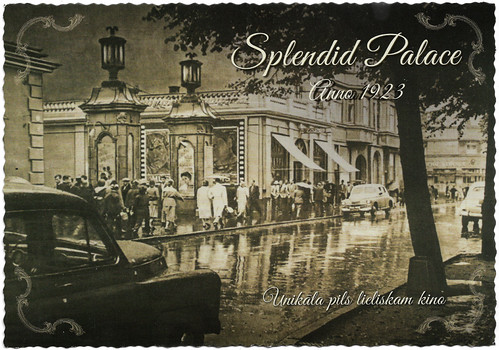
Latvian postcard by Splendid Palace, Latvia. Caption: Splendid Palace, Anno 1923. A unique palace for splendid cinema.

Latvian postcard by Rigas Kino Muzejs / Riga Film Museum. Photo: Laimonis Stipnieks. Caption: Kino Riga (Splendid Palace), 1970s.

Latvian postcard by Splendid Palace, Latvia. Caption: Splendid Palace, A place where cinema is celebrated!

Splendid Palace, Elizabetes iela 61, Riga, LV-1050, Latvia. Photo: Paul van Yperen, 2019.
Sources: Andrejs (Not Really a Blog), Best Baltic, Splendid Palace (Latvian), Wikipedia (Latvian), IMDb, Splendid Palace and the postcards.
No comments:
Post a Comment