Mexican singer and actor Jorge Negrete (1911-1953) was for many years considered the number 1 entertainer in Latin America. More than 50 years after his death, he is still an icon in Mexico, Spain, and Latin America. His rendition of 'México Lindo y Querido' (Beautiful and Beloved México), his country’s unofficial anthem, is an evergreen. Typical is his manly, arrogant yet good-humoured singing and his romantic image, dressed in Charro (cowboy) attire. 'El Charro Cantor' appeared in 44 films.

Spanish postcard, no. 281. Sent by mail in 1950.

Spanish postcard by C.M.B., no. 120. Photo: Procines S.A.

Spanish postcard, no. 24.
Jorge Alberto Negrete Moreno was born in the city of Guanajuato in 1911. His parents were Emilia Moreno Anaya and David Negrete Fernández. He had two brothers and three sisters. Their father was a Mexican Army Colonel who, around 1920, quit his military career and moved with his family to Mexico City. There, he found a job as a math teacher amongst others at the Humboldt German school, thus allowing Jorge and his brother David to study there, learning German.
Because of misbehaviour, his father enrolled the 13-year-old Jorge at the Heroico Colegio Militar (military academy of Mexico), where he learned English, French, and Italian. This was also the place where his fascination for music developed. His military training forged him a gallant presence and a strong-willed character, which would later benefit him in his acting career.
In 1937, Jorge was diagnosed with a hepatic dysfunction (hepatitis C) that did not prevent him from smoking all of his life. At 18, Jorge graduated with the rank of sub-lieutenant from El Colegio Militar. He studied under José Pierson, a prestigious music professor and opera director, who became fascinated by Negrete's singing. Jorge had a fine, wide-ranged baritone voice. Pierson helped him develop his opera talent, and at the age of twenty, Negrete began to sing for Radio XETR. In 1932, he recorded several operas using the stage name Alberto Moreno.
In 1935, he debuted onstage with musical plays in Roberto Soto's company as a stage extra (figurante), working amongst others in 'Calles y más calles' at the Teatro Lírico. In 1936, Jorge Negrete signed with NBC Television for a TV program with Cuban and Mexican musicians. He moved to New York and performed with a friend as The Mexican Caballeros. He also collaborated with band leader Xavier Cugat and earned bookings at Latin clubs. The next year, he made his first film appearance in the Warner Bros. short Cuban Nights.
He returned to Mexico in 1937 to act in his first feature film, La Madrina Del Diablo / The Devil's Godmother (Ramón Peón, 1937), and because of the success of the film, he was able to sign for several more films over the next three years. During the shooting of his next film, La Valentina (Martín de Lucenay, 1938), he met dancer and actress Elisa Christy. They married in 1940 and moved for some time to New York, where Jorge wrote Spanish versions of English songs for Southern Music.

Spanish postcard by Sobe, no. 447. Caption: Sinceramente Jorge Negrete.

Spanish postcard. Sent by mail in 1950.

Spanish postcard by JDP, Valencia, no. 2081.
After working in Havana and Hollywood, Jorge Negrete was called to act in ¡Ay Jalisco, No Te Rajes! / Hey Jalisco, Don’t Back Down! (Joselito Rodríguez, 1941) which made him an international Latin star and helped formulate the Charro film genre. In these 'Comedias Rancheras' (ranch comedies), a folkloric world came alive, often including ancient songs that connected with the audience. During the filming of ¡Ay Jalisco, No Te Rajes!, he met Gloria Marín and fell in love. He separated from Christy, who was pregnant with Negrete's daughter, Diana, born the following year. Negrete and Gloria Marín lived together for 10 years and adopted a girl, Goyita.
He was offered the main role in El Peñón de las Ánimas / The Rock of Souls (Miguel Zacarías, 1943) and wanted Marín to be his co-star. In spite of his protests, newcomer María Félix became his star. She was equally arrogant as himself, so they had frequent quarrels on the set. He had another resounding success with Me he de comer esa tuna / I Have to Eat that Prickly Pear (Miguel Zacarías, 1945). He complemented his film career by singing rancheras with the trio Los Tres Calaveras and touring Latin America, singing at concerts and making personal appearances. Negrete was also one of the founders of the Mexican Actors Association, succeeding Cantinflas as its chairman.
Negrete also starred in such Spanish films as Jalisco canta en Sevilla / Jalisco Sings in Seville (Fernando de Fuentes, 1949) opposite Carmen Sevilla, and Teatro Apolo / Apolo Theatre (Rafael Gil, 1950). In 1952, he and María Félix met again shortly after he had left Gloria Marín. Pride turned to love, and they married that same year. They starred together in El rapto / The rapture (Emilio Fernández, 1954), his final film.
In 1953, when attending a boxing match in Los Angeles, he suffered an acute gastroesophageal haemorrhage, from which he never regained consciousness. These were complications of hepatic cirrhosis, the disease that he had suffered since 1937. According to his wishes, his body was flown back to, and buried in, Mexico City. He was forty-two years old. Negrete was the first to die of the 'Tres Gallos Mexicanos' (Three Mexican Roosters) as he, Pedro Infante and Javier Solís were called. Thousands of fans attended his funeral and followed the hearse to the cemetery, El Panteón Jardín.
On 5 December, the anniversary of his death, fans still pay tribute to 'El Charro Cantor' (the Singing Cowboy) at his tomb, and television stations stage marathons of his films. Jorge Negrete made 44 films. He had a daughter, Diana, and a stepson, actor Enrique Álvarez Félix. Jorge has five grandchildren, Déborah, Diana, Rafael, Liliana and Lorenzo. Rafael and Lorenzo are professional singers and use the Negrete last name for their artistic name.

Spanish postcard by P.M., Bilbao, no. 3018.
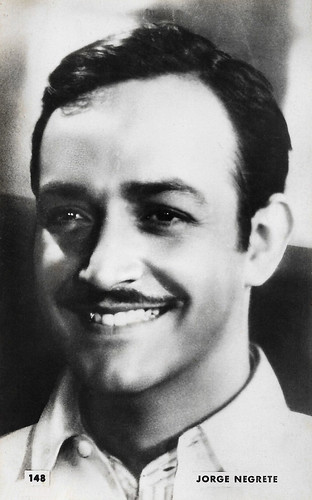
Spanish card, no. 148.

Spanish postcard by Sobes, no. 237.
Sources: Wikipedia and IMDb..
This post was last updated on 13 December 2025.
Spanish postcard, no. 281. Sent by mail in 1950.
Spanish postcard by C.M.B., no. 120. Photo: Procines S.A.
Spanish postcard, no. 24.
The Mexican Caballeros
Jorge Alberto Negrete Moreno was born in the city of Guanajuato in 1911. His parents were Emilia Moreno Anaya and David Negrete Fernández. He had two brothers and three sisters. Their father was a Mexican Army Colonel who, around 1920, quit his military career and moved with his family to Mexico City. There, he found a job as a math teacher amongst others at the Humboldt German school, thus allowing Jorge and his brother David to study there, learning German.
Because of misbehaviour, his father enrolled the 13-year-old Jorge at the Heroico Colegio Militar (military academy of Mexico), where he learned English, French, and Italian. This was also the place where his fascination for music developed. His military training forged him a gallant presence and a strong-willed character, which would later benefit him in his acting career.
In 1937, Jorge was diagnosed with a hepatic dysfunction (hepatitis C) that did not prevent him from smoking all of his life. At 18, Jorge graduated with the rank of sub-lieutenant from El Colegio Militar. He studied under José Pierson, a prestigious music professor and opera director, who became fascinated by Negrete's singing. Jorge had a fine, wide-ranged baritone voice. Pierson helped him develop his opera talent, and at the age of twenty, Negrete began to sing for Radio XETR. In 1932, he recorded several operas using the stage name Alberto Moreno.
In 1935, he debuted onstage with musical plays in Roberto Soto's company as a stage extra (figurante), working amongst others in 'Calles y más calles' at the Teatro Lírico. In 1936, Jorge Negrete signed with NBC Television for a TV program with Cuban and Mexican musicians. He moved to New York and performed with a friend as The Mexican Caballeros. He also collaborated with band leader Xavier Cugat and earned bookings at Latin clubs. The next year, he made his first film appearance in the Warner Bros. short Cuban Nights.
He returned to Mexico in 1937 to act in his first feature film, La Madrina Del Diablo / The Devil's Godmother (Ramón Peón, 1937), and because of the success of the film, he was able to sign for several more films over the next three years. During the shooting of his next film, La Valentina (Martín de Lucenay, 1938), he met dancer and actress Elisa Christy. They married in 1940 and moved for some time to New York, where Jorge wrote Spanish versions of English songs for Southern Music.
Spanish postcard by Sobe, no. 447. Caption: Sinceramente Jorge Negrete.
Spanish postcard. Sent by mail in 1950.
Spanish postcard by JDP, Valencia, no. 2081.
Comedias Rancheras
After working in Havana and Hollywood, Jorge Negrete was called to act in ¡Ay Jalisco, No Te Rajes! / Hey Jalisco, Don’t Back Down! (Joselito Rodríguez, 1941) which made him an international Latin star and helped formulate the Charro film genre. In these 'Comedias Rancheras' (ranch comedies), a folkloric world came alive, often including ancient songs that connected with the audience. During the filming of ¡Ay Jalisco, No Te Rajes!, he met Gloria Marín and fell in love. He separated from Christy, who was pregnant with Negrete's daughter, Diana, born the following year. Negrete and Gloria Marín lived together for 10 years and adopted a girl, Goyita.
He was offered the main role in El Peñón de las Ánimas / The Rock of Souls (Miguel Zacarías, 1943) and wanted Marín to be his co-star. In spite of his protests, newcomer María Félix became his star. She was equally arrogant as himself, so they had frequent quarrels on the set. He had another resounding success with Me he de comer esa tuna / I Have to Eat that Prickly Pear (Miguel Zacarías, 1945). He complemented his film career by singing rancheras with the trio Los Tres Calaveras and touring Latin America, singing at concerts and making personal appearances. Negrete was also one of the founders of the Mexican Actors Association, succeeding Cantinflas as its chairman.
Negrete also starred in such Spanish films as Jalisco canta en Sevilla / Jalisco Sings in Seville (Fernando de Fuentes, 1949) opposite Carmen Sevilla, and Teatro Apolo / Apolo Theatre (Rafael Gil, 1950). In 1952, he and María Félix met again shortly after he had left Gloria Marín. Pride turned to love, and they married that same year. They starred together in El rapto / The rapture (Emilio Fernández, 1954), his final film.
In 1953, when attending a boxing match in Los Angeles, he suffered an acute gastroesophageal haemorrhage, from which he never regained consciousness. These were complications of hepatic cirrhosis, the disease that he had suffered since 1937. According to his wishes, his body was flown back to, and buried in, Mexico City. He was forty-two years old. Negrete was the first to die of the 'Tres Gallos Mexicanos' (Three Mexican Roosters) as he, Pedro Infante and Javier Solís were called. Thousands of fans attended his funeral and followed the hearse to the cemetery, El Panteón Jardín.
On 5 December, the anniversary of his death, fans still pay tribute to 'El Charro Cantor' (the Singing Cowboy) at his tomb, and television stations stage marathons of his films. Jorge Negrete made 44 films. He had a daughter, Diana, and a stepson, actor Enrique Álvarez Félix. Jorge has five grandchildren, Déborah, Diana, Rafael, Liliana and Lorenzo. Rafael and Lorenzo are professional singers and use the Negrete last name for their artistic name.
Spanish postcard by P.M., Bilbao, no. 3018.
Spanish card, no. 148.
Spanish postcard by Sobes, no. 237.
Sources: Wikipedia and IMDb..
This post was last updated on 13 December 2025.
No comments:
Post a Comment