
Spanish postcard, no. 93. Photo: Sam Levin.

French postcard by Editions du Globe, no. 203. Photo: Studio Harcourt.

French postcard by Editions du Globe (E.D.U.G.), Paris, no. 224. Photo: Studio Harcourt.

French postcard by Editions du Globe (E.D.U.G.), Paris, no. 207.

French postcard by Editions du Globe (E.D.U.G.), Paris, no. 220. Photo: Studio Harcourt.

French postcard by Editions du Globe (E.D.U.G.), Paris, no. 683.
Spanish Rhapsody
Carmen Sevilla was born Maria den Carmen Garcia Galisteo in Sevilla, Spain, in 1930. She was the daughter of author José Garcia Padillo. Her brother was the cinematographer José García Galisteo.
At the age of 12, she started her career as a ballerina in the theatrical spectacle, 'Spanish Rhapsody', along with Paquita Rico and Ana Esmeralda, both of whom shared her later success on stage and in films. She also appeared in dance groups with Enrique Castro and Paco Reyes.
Five years later she made her screen debut in La Revoltosa (José Díaz Morales, 1949). She then changed her second name to that of her birthplace. Her next film, the musical comedy Jalisco Canta en Sevilla/Jalisco Sings In Seville (Fernando de Fuentes, 1949), became a huge success.
In the early 1950s, Sevilla became very popular opposite singer-actor Luis Mariano in a series of operetta films. The first was El sueño de Andalucía/Andalousie (Luis Lucia, 1951), filmed in two versions, one in French, the other in Spanish.
Other popular films were Violetas imperiales/Imperial Violets (Richard Pottier, 1952), the French film Don Juan (John Berry, 1956) starring Fernandel, and La venganza/Vengeance (Juan Antonio Bardem, 1958) with Raf Vallone. This Academy Award-nominated drama centred on the problems of the Andalucian farmer.
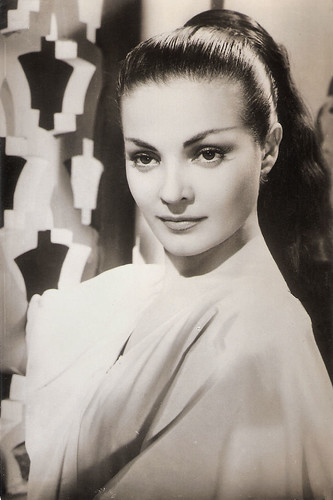
Spanish postcard by Ediciones JRB, no. 147/11.

With Luis Mariano. Dutch postcard. Photo: 20th Century Fox. Publicity still for Andalousie/Andalucia (Robert Vernay, 1951).
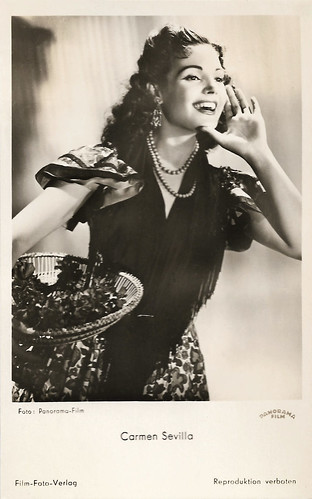
West-German postcard by Ufa/Film-Foto-Verlag, Berlin-Tempelhof, no. FK 519. Photo: Panorama Film. Carmen Sevilla in Violetas imperiales/Imperial Violets (Richard Pottier, 1952).

With Enrique Guitart. Spanish card, no. 1255.

French postcard by Editions P.I., Paris, no. 575, offered by Les Carbones Korès Carboplane. Photo: Paramount Pictures Inc.

Spanish postcard by Archivo Bermejo, no. 6271, 1958. Photo: C.E.A. Films. Carmen Sevilla in Spanish Affair (Luis Marquina, Don Siegel, 1957).
Mary Magdalene
Carmen Sevilla regularly worked with American directors who were working in Spain. She played Mary Magdalene in Nicholas Ray's epic King of Kings (1961), and Octavia in Antony and Cleopatra (1972), directed by Charlton Heston.
During the 1960s and 1970s, she worked in dozens of mediocre comedies but notable were her leads in the interesting horror films El techo de cristal/Glass Ceiling (Eloy de la Iglesia, 1971) and Nadie oyó gritar/No One Heard the Scream (Eloy de la Iglesia, 1973).
In 1978 she retired from show business, but she made a come-back as a television host in the 1990s. She also starred in the Spanish TV comedy series Ada Madrina (Domingo Solano, 1999). It was her last screen appearance.
Sevilla received a Círculo de Escritores Cinematográficos (Cinema Writers Circle) lifetime award in 2004. She was married twice: from 1958 to 1968 to composer and orchestra conductor Augusto Alguero, by whom she had a son, Augusto Jr., and from 1985 till his death in 2000 to Vicente Patuel.
On 26 June 2023, it was made public that Carmen Sevilla was hospitalised in serious condition at the Puerta de Hierro hospital in Madrid, where she died the following day from complications of Alzheimer's. She was 92.
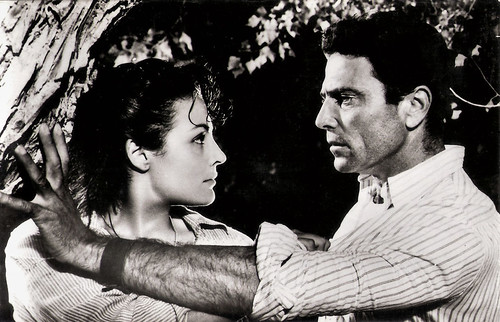
Spanish postcard by Soberanas (SOBE), Barna, no. 266. Photo: Carmen Sevilla and Raf Vallone in La venganza/Vengeance (Juan Antonio Bardem, 1958).

East-German postcard by VEB Progress Film-Vertrieb, Berlin, no. 1311. Photo: Carmen Sevilla and Raf Vallone in La venganza/Vengeance (Juan Antonio Bardem, 1958).

Spanish postcard by Postal Oscarcolor, no. 287.

Spanish postcard, no. 510. Photo of the wedding of Carmen Sevilla on 23 February 1961 in the Basilica del nuestro Senora del Pilar de Zaragoza.

East-German postcard by VEB Progress Film-Vertrieb, Berlin, no. 1312.

Spanish card by A.L.G., Madrid, for Philips.
Carmen Sevilla in a Philips commercial of the 1960s. Source: diaz villanueva (YouTube).
Carmen Sevilla interpretes Carmen de España in La guerrillera de Villa/The Villa guerrilla (Miguel Morayta, 1969). Source: soryeye779 (YouTube).
Sources: Gary Brumburgh (IMDb), Sandra Brennan (AllMovie), Andalucia.com, Wikipedia, and IMDb.
