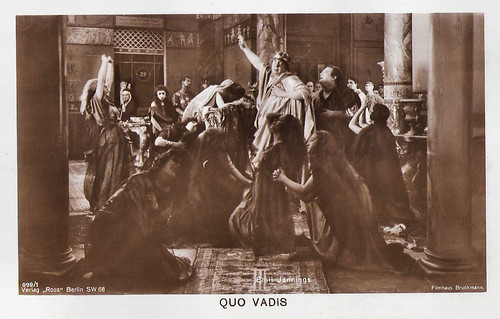
German postcard by Ross Verlag, no. 699/1, 1919-1924. Photo: Filmhaus Bruckmann. Publicity still for Quo vadis? (Georg Jacoby, Gabriellino D'Annunzio, 1924-1925). Here we see Nero (Emil Jannings) going out of his mind when his little son dies.

German postcard by Ross Verlag, Berlin, no. 699/2, 1927-1928. Photo: Filmhaus Bruckmann. Emil Jannings as Nero and Lilian Hall-Davis as Lygia in Quo vadis? (Gabriellino D'Annunzio, Georg Jacoby, 1924). Here we see Nero grabbing Licia, after pretending to save her from the clutches of Vinicius.
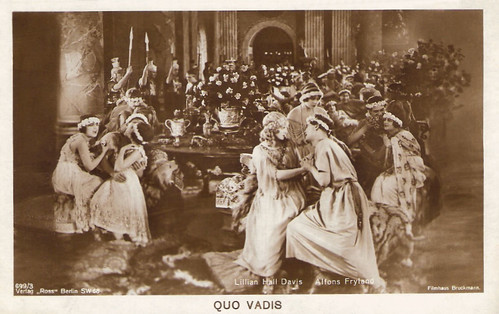
German postcard by Ross Verlag, no. 699/3, 1919-1924. Photo: Filmhaus Bruckmann. Publicity still for Quo vadis? (Georg Jacoby, Gabriellino D'Annunzio, 1924-1925). Here, Marcus Vinicius (Alphons Fryland) tries to seduce the chaste Lygia (Lilian Hall-Davis) during an orgy at Nero's palace.
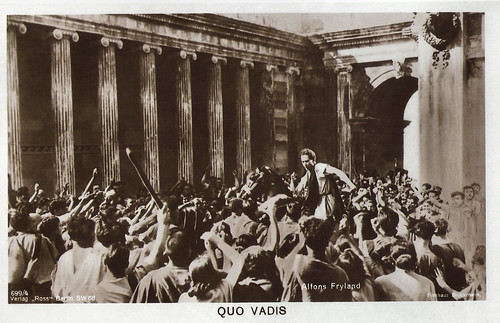
German postcard by Ross Verlag, no. 699/4, 1919-1924. Photo: Filmhaus Bruckmann. Publicity still for Quo vadis? (Gabriellino D'Annunzio, Georg Jacoby, 1925). Marcus Vinicius (Alphons Fryland) leads the populace against Nero.
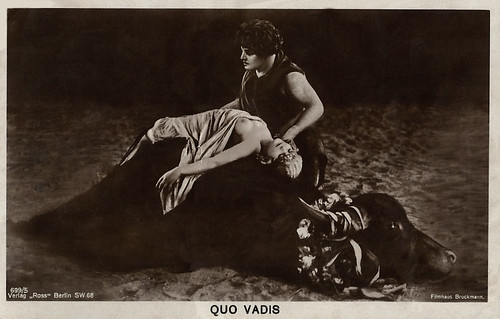
German postcard by Ross Verlag, no. 699/5, 1919-1924. Photo: Filmhaus Bruckmann. Publicity still for Quo vadis? (Georg Jacoby, Gabriellino D'Annunzio, 1924-1925). Here we see Ursus (Bruto Castellani) liberating Lygia (Lilian Hall-Davis) after he has conquered the raging bull. Castellani's face and hair are clearly drawn afterwards. In the film, the nudity is only visible for a fraction of a second.
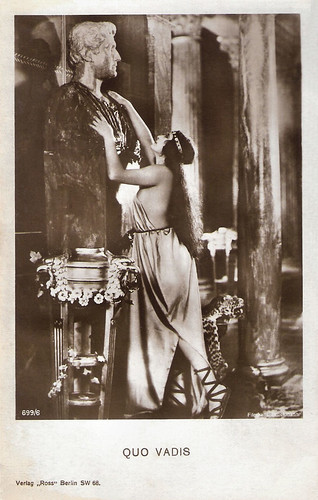
German postcard by Ross Verlag, Berlin, no. 699/6, 1919-1924. Photo: Filmhaus Brückmann. Publicity still for Quo vadis? (Gabriellino D'Annunzio, Georg Jacoby, 1924) with Rina De Liguoro as Eunice, secretly in love with her master Petronius (André Habay).
A huge spectacle
Ten years after the smashing success of director Enrico Guazzoni's colossal epic Quo vadis? (1913), the Unione Cinematografica Italiana (U.C.I.) decided to make a new silent film version.
The Unione Cinematografica Italiana was a Ufa-like or Universal-like merger of many Italian pre-war film companies. Grand old man Arturo Ambrosio was the producer of the third film version, Quo vadis? (1924-1925).
Directors were the German Georg Jacoby and the Italian Gabriellino D' Annunzio, son of Gabriele D'Annunzio, the famous Italian writer and adventurer.
They turned Sienkiewicz's story of Emperor Nero's politically motivated persecution of the early Christians to hush up his own burning of Rome, and of the 'conversion' of an agnostic Roman warrior via the love of a virtuous Christian girl, into a huge spectacle.
Highlights are the 'burning of Rome' scenes and the climactic fights and carnage in the gladiatorial arena. Cinematography was by Giovanni Vitrotti, Alfredo Donelli, and Curt Courant.

Italian postcard by Ed. A. Traldi, Milano, no. 633. Photo: Pinto, Roma. Rina de Liguoro as Eunica in Quo Vadis? (Gabriellino D'Annunzio, Georg Jacoby, 1924).
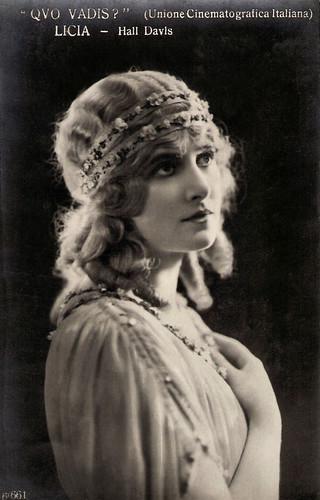
Italian postcard by Ed. A. Traldi, Milano, no. 651. Photo: Lilian Hall-Davis as Licia/Lygia in Quo vadis? (Gabriellino D'Annunzio, Georg Jacoby, 1924-1925).
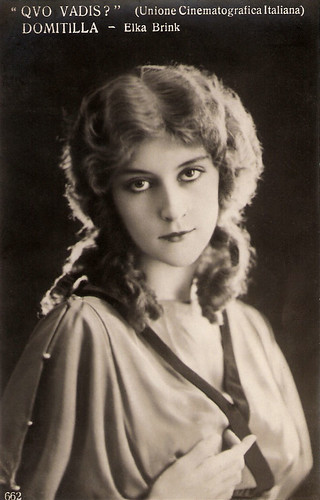
Italian postcard by Ed. A. Traldi, Milano, no. 662. Photo: Elga Brink as Domitilla in Quo vadis? (Gabriellino D'Annunzio, Georg Jacoby, 1924-1925).
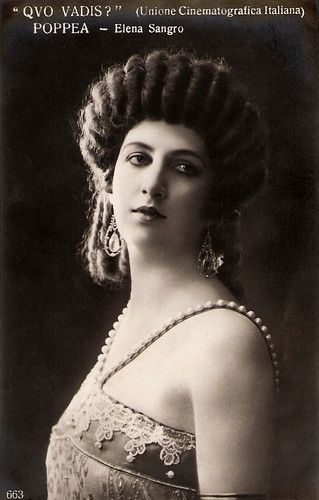
Italian postcard by Ed. A. Traldi, Milano, no. 663. Photo: Elena Sangro as the Empress Poppaea in Quo vadis? (Gabriellino D'Annunzio, Georg Jacoby, 1924-1925).
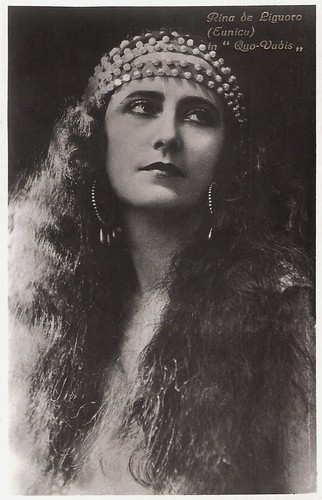
Italian postcard by Ed. G.B. Falci, Milano. Photo: Rina De Liguoro as Eunice in Quo vadis? (Gabriellino D'Annunzio, Georg Jacoby, 1924-1925).
A stellar cast
The historical epic was shot in Rome with a stellar cast of international silent stars. One of the brightest stars of the British silent cinema, Lilian Hall-Davis, and Austrian actor Alphons Fryland played the two young lovers Lygia (Licia in Italian) and Marcus Vinicius.
The German actress Elga Brink appeared as Domitilla. She has a spectacular scene, when, as a Christian martyr, she is first dragged by a chariot through the circus but then manages to climb up the chariot, take the reins and finish the race, to the great joy of the audience. Italian actor André Habay portrayed Marcus' uncle Petronius, Nero's 'arbiter elegantiae', who uses his wit to flatter and mock him at the same time. Italian diva Rina De Liguoro played Petronius' slave Eunice, who later on becomes his mistress and dies with him.
And then there was the famous star of the German silent cinema, Emil Jannings, who was cast as the emperor Nero. Hal Erickson at AllMovie: "Jannings tackles the role of Nero with lusty abandon, making this already larger-than-life historical personality even more so." While in the 1913 version Carlo Cattaneo gave a more naive version of Nero, more the victim of his surroundings, Jannings' Nero is clearly a perverse and sadistic man, who enjoys other people's misery, frightens and plays with his courtiers, and hypocritically offers Licia's his help after Vinicius has been too rough to her, only to reveal later on his own real, lustful intentions. It is also clear that the filmmakers gave Jannings a much bigger part in the film than his predecessor or than in the novel. The publicity highlighted his presence as the star of the film, too.
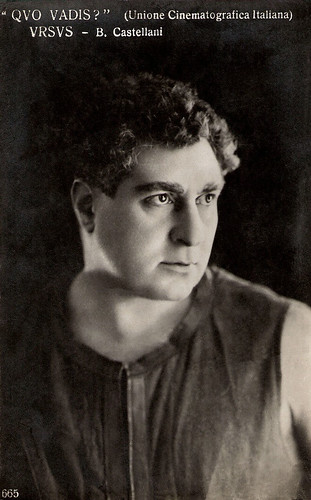
Italian Postcard by Ed. A. Traldi, Milano, no. 665. Photo: Bruto Castellani as Ursus in Quo vadis? (Gabriellino D'Annunzio, Georg Jacoby, 1924-1925).
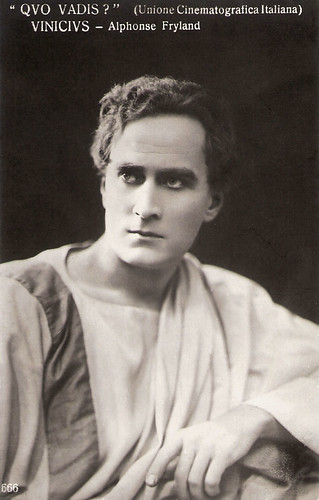
Italian postcard by Ed. Romeo Biagi, Bologna, no. 666. Photo: Unione Cinematografica Italiana. Alphons Fryland as Vinicius in Quo vadis? (Gabriellino D'Annunzio, Georg Jacoby, 1924-1925).
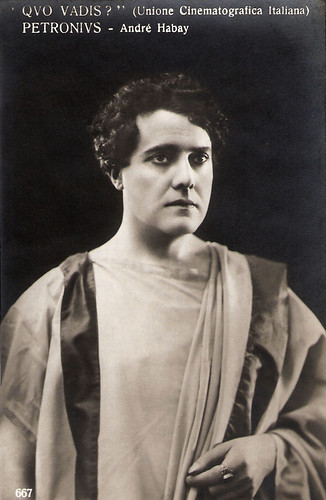
Italian postcard by Ed. A. Traldi, Milano, no. 667. Photo: André Habay as Petronius in Quo vadis? (Gabriellino D'Annunzio, Georg Jacoby, 1924-1925).
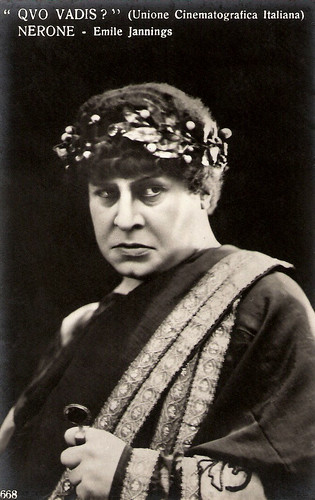
Italian postcard by Ed. A. Traldi, Milano, no. 668. Photo: Unione Cinematografica Italiano. Publicity still of Emil Jannings as Nero in Quo vadis? (Georg Jacoby, Gabriellino D'Annunzio, 1924-1925).
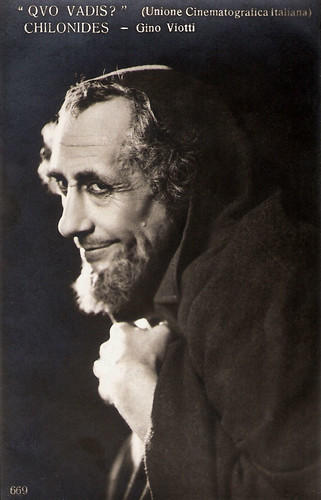
Italian postcard by Ed. A. Traldi, Milano, no. 669. Photo: Gino Viotti as the lecherous and treacherous Greek Chilo Chilonides in Quo vadis? (Gabriellino D'Annunzio, Georg Jacoby, 1924-1925).
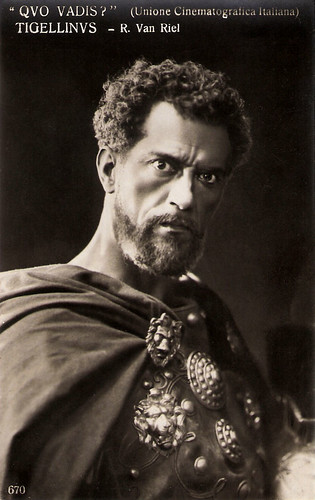
Italian postcard by Ed. A. Traldi, Milano, no. 670. Photo: Raimondo Van Riel as Nero's evil general Tigellinus in Quo vadis? (Gabriellino D'Annunzio, Georg Jacoby, 1924-1925).
Streaks of sadism and nudity
Quo vadis? had its Roman premiere on 16 March 1925. The producer had tried to equal the earlier version of 1913, adding enormous sets, designed by sculptor and architect Armando Brasini, and streaks of sadism & nudity, some already present in the novel, such as the human torches, others added to attract audiences, e.g. a female fed to Nero's lampreys.
The 1925 version didn't have the worldwide success of Enrico Guazzoni's earlier film. For various reasons, people were a bit bored with epic films and the censor had ordered cuts, such as the too-explicit scenes of orgy, violence and blood gulping. The producer almost went bankrupt over the copyright claims he had to pay.
It didn't help that the lion tamer Alfred Schneider was convicted because one of his circus lions had bitten and killed an extra.
Still a fascinating film, especially for the performances of Emil Jannings as the evil emperor Nero, Elena Sangro as the empress Poppaea and Bruto Castellani as the strong man Ursus. Castellani had performed the role before in the 1913 version of Quo vadis?
Hal Erickson at AllMovie: "Although not as much of a cinematic landmark as the 1913 version of Quo Vadis?, this 1924 Italian adaptation of the Henryk Sienkiewicz best-seller was a splendidly lavish production, not to mention a worldwide box-office success."

German postcard by Ross Verlag, Berlin, no. 698/1, 1927-1928. Photo: Filmhaus Bruckmann. Emil Jannings as Nero in Quo vadis? (Gabriellino D'Annunzio, Georg Jacoby, 1924).

German postcard by Ross Verlag, Berlin, no. 698/3, 1927-1928. Photo: Filmhaus Bruckman. Lillian Hall-Davis as Lygia in Quo Vadis? (Gabriellino D'Annunzio, Georg Jacoby, 1924).

German postcard by Ross Verlag, Berlin, no. 698/4, 1927-1928. Photo: Filmhaus Bruckmann. Alphons Fryland as Vinicius in Quo vadis? (Gabriellino D'Annunzio, Georg Jacoby, 1924).

German postcard by Ross Verlag, Berlin, no. 698/5, 1927-1928. Photo: Filmhaus Bruckmann. Elga Brink as Domitilla in Quo vadis? (Gabriellino D'Annunzio, Georg Jacoby, 1924).

German postcard by Ross Verlag, Berlin, no. 698/7, 1927-1928. Photo: Filmhaus Bruckman. Raimondo van Riel as Tigellinus in Quo Vadis? (Gabriellino D'Annunzio, Georg Jacoby, 1924).

German postcard by Ross Verlag, Berlin, no. 698/8, 1927-1928. Photo: Filmhaus Bruckman. Rina De Liguoro as Eunice in Quo vadis? (Gabriellino D'Annunzio, Georg Jacoby, 1924).
Magnificently restored
Hal Erickson mentions at AllMovie that the subsequent Hollywood popularity of Emil Jannings prompted a reissue of Quo vadis? in 1929. Reportedly, a newly recorded musical score was added.
In 1951, Hollywood made a new version with sound and colour, Quo Vadis (Mervyn LeRoy, 1951). The film starred Robert Taylor, Deborah Kerr, Leo Genn, and Peter Ustinov. It was nominated for eight Academy Awards.
Fifty years later, a Polish adaptation by Jerzy Kawalerowicz, Quo Vadis (2001), followed. There was also a 1985 mini-series starring Klaus Maria Brandauer as Nero.
Also in 2001, the Dutch Filmmuseum (now Eye Filmmuseum) in Amsterdam restored the silent 1924 version of Quo vadis?, based on various existing copies. This magnificently restored version had its 're-premiere' at the Bologna film festival Cinema Ritrovato in 2002.
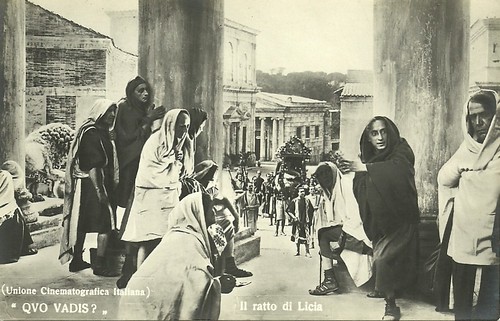
Italian postcard. Photo: UCI (Unione Cinematografica Italiana). Publicity still of the scene of the kidnapping of Lygia in Quo vadis? (Gabriellino D'Annunzio, Georg Jacoby, 1924-1925).
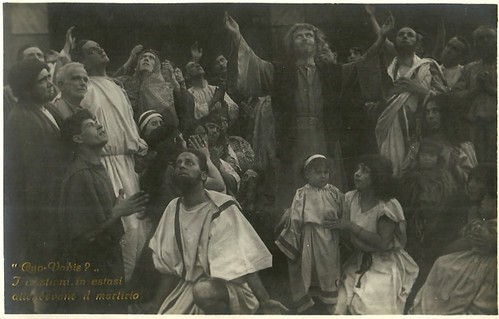
Italian postcard by G.G. Falci, Milano / La Fotominio. Photo: UCI (Unione Cinematografica Italiana). Publicity still for Quo vadis? (Gabriellino D'Annunzio, Georg Jacoby, 1924). Caption: The Christians awaited their martyrdom in ecstasy.
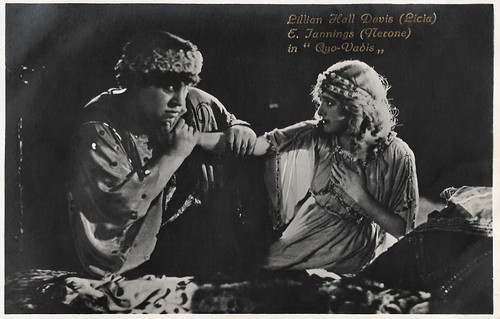
Italian postcard by G.B. Falci, Milano, no. 38. Lilian Hall-Davis as Lygia and Emil Jannings as Nero in Quo Vadis? (Gabriellino D'Annunzio, Georg Jacoby, 1924).
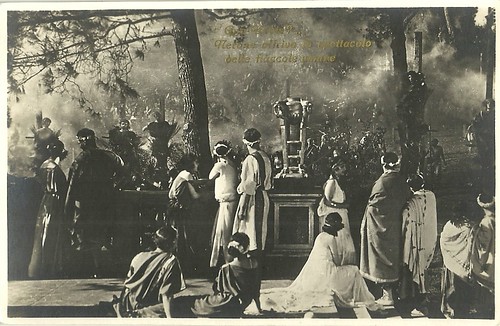
Italian postcard by G.G. Falci, Milano / La Fotominio, no. 156. Photo: UCI (Unione Cinematografica Italiana). Publicity still for Quo vadis? (Gabriellino D'Annunzio, Georg Jacoby, 1924). Caption: Nero offered the spectacle of the human torches.
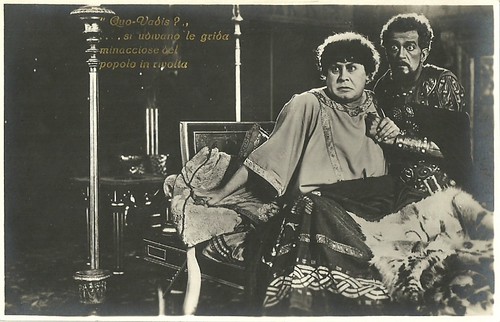
Italian postcard by G.G. Falci, Milano / La Fotominio, no. 159. Photo: UCI (Unione Cinematografica Italiana). Publicity still for Quo vadis? (Gabriellino D'Annunzio, Georg Jacoby, 1924). Caption: They heard the menacing shouts of the revolting mob. Shown are Emil Jannings as Nero and Raimondo Van Riel as Tigellinus. Actually, the scene refers to Nero's nightmare.

Italian postcard by G.B. Falci, Milano in the Fotominio series, no. 159. Gildo Bocci as Vitellius at Nero's orgy in Quo Vadis? (Gabriellino D'Annunzio, Georg Jacoby, 1924).

Italian postcard by G.G. Falci, Milano / La Fotominio, no. 163. Photo: UCI (Unione Cinematografica Italiana). Publicity still for Quo vadis? (Gabriellino D'Annunzio, Georg Jacoby, 1924). Caption: While the Christians were awaiting their turn. In the foreground, Ursus (Bruto Castellani) is guarding Licia (Lilian Hall-Davis). In the background, the light falls on the family of Plautus, Domitilla (Elga Brink) and their son (Marcella Sabatini).
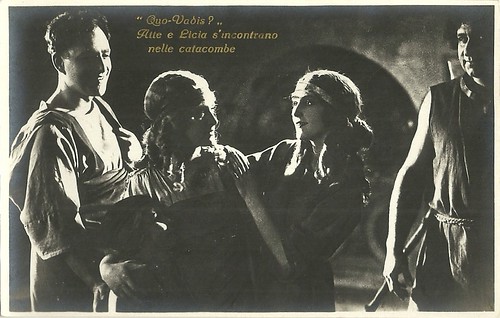
Italian postcard by G.G. Falci, Milano / La Fotominio, no. 165. Photo: UCI (Unione Cinematografica Italiana). Publicity still for Quo vadis? (Gabriellino D'Annunzio, Georg Jacoby, 1924). Caption: Acte and Licia meet again in the catacombs. (But actually, the caption is wrong. Here, Lygia (Lilian Hall-Davis) meets Domitilla (Elga Brink), her husband Plautus (name unknown) and their son. On the right, Ursus (Bruto Castellani).
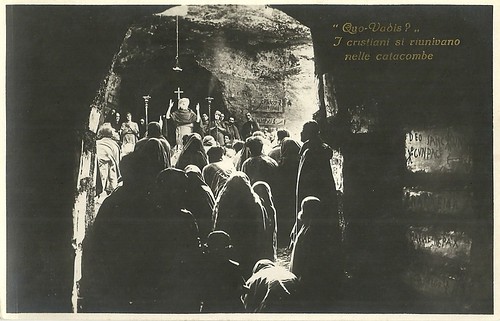
Italian postcard by G.G. Falci, Milano / La Fotominio, no. 168. Photo: UCI (Unione Cinematografica Italiana). Publicity still for Quo vadis? (Gabriellino D'Annunzio, Georg Jacoby, 1924). Caption: The Christians gathered in the catacombs.
Sources: Vittorio Martinelli, Il cinema muto italiano. I film degli anni venti, 1923-1931, Hal Erickson (AllMovie), Marcin Kukuczka (IMDb), Wikipedia and IMDb.
This post at EFSP on Quo vadis? (1924) contains a postcard series published by the Turinese Ed. L'Argentografica.


