Showing posts with label John Gilbert. Show all posts

01 April 2022

John Gilbert

American actor, screenwriter, and director John Gilbert (1899-1936) rose to fame during the silent film era and became a popular leading man known as 'The Great Lover'. With Great Garbo, he began a highly publicised, torrid off-screen affair. The studio publicity department worked overtime to publicise the romance between the two. His career did not survive the arrival of sound film.

John Gilbert in The Merry Widow (1925)
German postcard by Ross Verlag, no. 1319/1, 1927-1928. Photo: Loew Metro Goldwyn. John Gilbert in The Merry Widow (Erich von Stroheim, 1925).
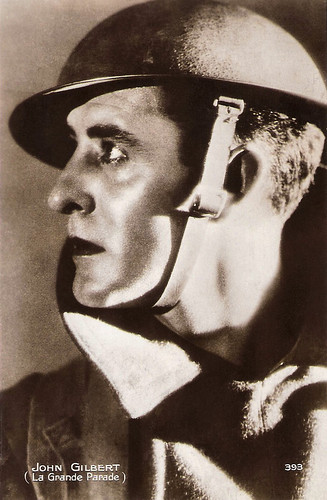
John Gilbert in The Big Parade
French postcard by Editions Cinémagazine, Paris, no. 393. Photo: MGM. Publicity still for The Big Parade (King Vidor, 1925).
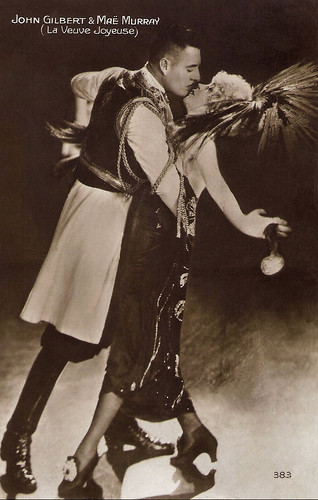
John Gilbert and Mae Murray in The Merry Widow (1925)
French postcard by Cinémagazine-Edition, Paris, no. 383. Photo: Metro-Goldwyn-Film. Publicity still for The Merry Widow (Erich von Stroheim, 1925) with Mae Murray.
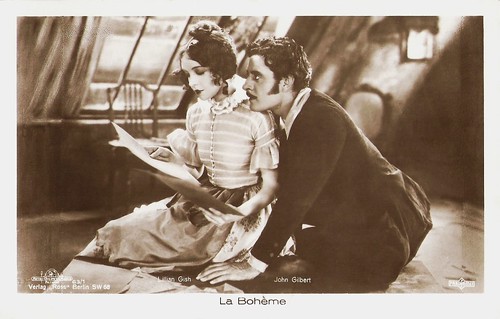
Lillian Gish and John Gilbert in La Bohème (1926)
German postcard by Ross Verlag, no. 63/1. Photo: Metro-Goldwyn-Mayer (MGM) / Parufamet. Publicity still for La Bohème (King Vidor, 1926) with Lillian Gish.

Greta Garbo and John Gilbert in Flesh and the Devil (1926)
German postcard by Ross Verlag, no. 1886/1, 1927-1928. Photo: Clarence Sinclair Bull / Metro-Goldwyn-Mayer. Publicity still for Flesh and the Devil (Clarence Brown, 1926) with Greta Garbo.
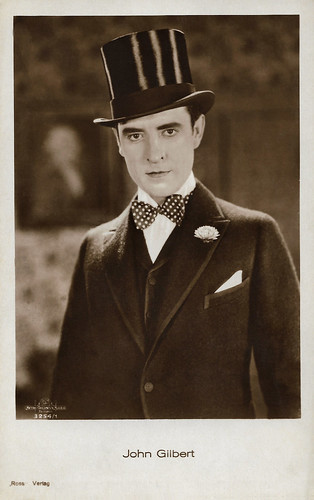
John Gilbert
German postcard by Ross Verlag, no. 3254/1, 1928-1929. Photo: Metro-Goldwyn-Mayer.

Turning from villain to leading man


John Gilbert was born John Cecil Pringle in Logan, Utah, in 1899. His parents, John Pringle (1865–1929) and Ida Apperly Gilbert (1877–1913) were both stock-company actors. His father was a comic with the Pringle Stock Company. John struggled through a childhood of abuse and neglect. His family moved frequently and Gilbert attended several schools throughout the United States. After his family settled in California, he attended Hitchcock Military Academy in San Rafael, California. After he left school Gilbert worked as a rubber goods salesman in San Francisco, then as a stage manager in a stock company in Spokane, Washington in 1915. He lost his job when the company folded. He decided to try acting and got work in films as an extra. Gilbert first appeared in a short directed by Wilfred Lucas, The Mother Instinct (1915). He found work as an extra with the Thomas Ince Studios on films such as the historical war drama The Coward (Reginald Barker, 1915), the drama Aloha Oe (Richard Stanton, Charles Swickard, Gilbert P. Hamilton, 1915), and William S. Hart's Western Hell's Hinges (Charles Swickard, William S. Hart, Clifford Smith, 1916).

Gilbert began to get parts at Kay-Bee Pictures, billed as 'Jack Gilbert' in the Western The Aryan (William S. Hart, Reginald Barker, Clifford Smith, 1916) with William S. Hart, and the war film Shell 43 (Reginald Barker, 1916) with H.B. Warner. He had an early leading part in Kay-Bee's The Apostle of Vengeance (William S. Hart, Clifford Smith, 1916). His first leading role was in Princess of the Dark (Charles Miller, 1917) with Enid Bennett, but the film was not a big success and he went back to supporting roles in The Dark Road (Charles Miller, 1917), Happiness (Reginald Barker, 1917), and the drama The Hater of Men (Charles Miller, 1917). Gilbert did The White Heather (Maurice Tourneur, 1919) for Maurice Tourneur, Widow by Proxy (Walter Edwards, 1919) for Paramount, and Heart o' the Hills (Joseph De Grasse, Sidney Franklin, 1919) for Mary Pickford.

Tourneur signed him to a contract to both write and act in films. Gilbert acted in and co-wrote The White Circle (Maurice Tourneur, 1920), The Great Redeemer (Clarence Brown, Maurice Tourneur, 1921), and Deep Waters (Maurice Tourneur, 1921). As a writer, only he worked on The Bait (Maurice Tourneur, 1921), starring and produced by Hope Hampton. For Hampton, Gilbert wrote and directed, but did not appear in Love's Penalty (1921). In 1921 he signed a three-year contract with Fox Films. His popularity continued to soar and he was turning from villain to leading man. Fox gave Gilbert his first real starring part in Shame (Emmett J. Flynn, 1921). He followed it with leading roles in such films as Arabian Love (Jerome Storm, 1922) with Barbara LaMarr, Monte Cristo (Emmett J. Flynn, 1922) an adaptation of Alexandre Dumas' 'The Count of Monte Cristo', and A California Romance (1922). Many of these films were written by Jules Furthman.

He returned to Tourneur to co-star with Lon Chaney in While Paris Sleeps (Maurice Tourneur, 1923). Back at Fox, Gilbert starred in Truxton King (Jerome Storm, 1923), St. Elmo (Jerome Storm, 1923) with Barbara LaMarr and Bessie Love, and the drama Cameo Kirby (1923), directed by John Ford, co-starring Jean Arthur in her film debut. He appeared in The Wolf Man (Edmund Mortimer, 1923) with Norma Shearer. It was not a horror film, but the story of a man who believes he murdered his fiancee's brother while drunk. In 1924 he signed with MGM which put him into His Hour (King Vidor, 1924), written by Elinor Glyn and co-starring Aileen Pringle. It was a big success. He followed this with such high-profile films as He Who Gets Slapped (Victor Sjöström, 1924) co-starring Lon Chaney and Norma Shearer; and The Merry Widow (Erich von Stroheim, 1925), co-starring Mae Murray. The latter was a huge box-office success.

John Gilbert was once again directed by Vidor in the war epic The Big Parade (King Vidor, 1925), which became the second-highest-grossing silent film and the most profitable film of the silent era. His performance in this film made him a major star. Now at the height of his career, Gilbert rivalled Rudolph Valentino, another silent film-era leading man, as a box office draw. Lillian Gish, who had a new contract with MGM, picked Gilbert to co-star with her in La Bohème (King Vidor, 1926). He then did another film with Vidor, Bardelys the Magnificent (King Vidor, 1926).

John Gilbert in Gleam O'Dawn (1922)
American Arcade card. Photo: Fox. John Gilbert in Gleam O'Dawn (John Francis Dillon, 1922).
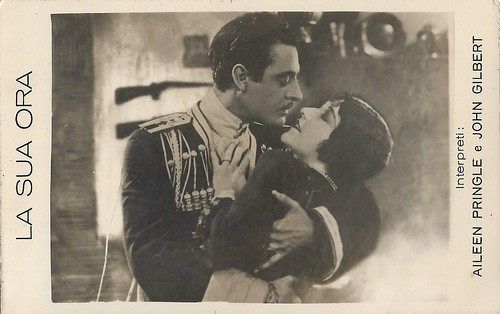
John Gilbert  and Aileen Pringle in His Hour (1924)
Italian postcard. Photo: MGM. John Gilbert and Aileen Pringle in the American silent drama His Hour (King Vidor, 1924).

Renée Adorée and John Gilbert, The Big Parade (1925)
Dutch postcard by M. Bonnist & Zonen, no. 115. Renée Adorée and John Gilbert in The Big Parade (King Vidor, 1925). Collection: Marlene Pilaete.

Mae Murray and John Gilbert in The Merry Widow (1925)
Italian postcard by G.B. Falci, Milano, no. 529. Photo: Metro-Goldwyn Films, Roma. Mae Murray and John Gilbert in The Merry Widow (Erich von Stroheim, 1925). The Italian title was La Vedova Allegra.
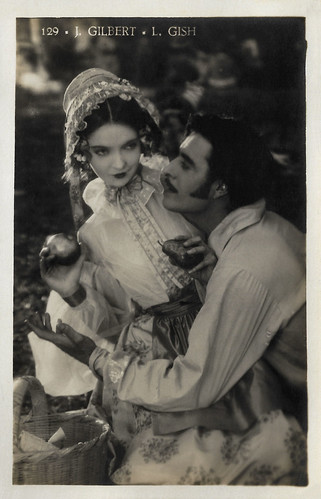
Lilian Gish and John Gilbert in La Bohème (1926)
Italian postcard by Fotocelere, no. 129. Photo: Metro-Goldwyn-Mayer (MGM). Lillian Gish and John Gilbert in La Bohème (King Vidor, 1926).
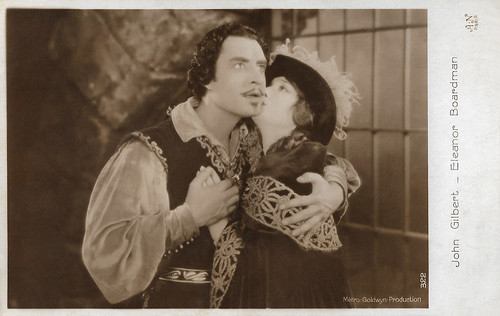
John Gilbert and Eleanor Boardman in Bardelys the Magnificent (1926)
French postcard by A.N., Paris, no. 322. Photo: Metro-Goldwyn-Production. Publicity still for Bardelys the Magnificent (King Vidor, 1926) with Eleonor Boardman.
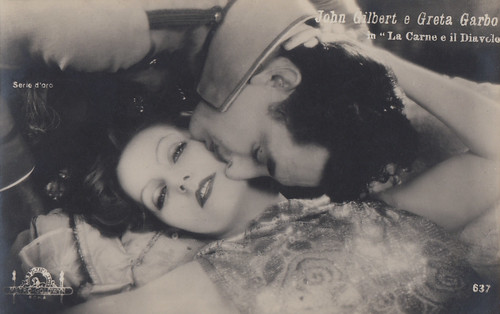
Greta Garbo and John Gilbert in Flesh and the Devil (1926)
Italian postcard in the 'serie d'oro' by Ballerini & Fratini, Firenze, no. 637. Photo: Metro Goldwyn, Roma. Greta Garbo and John Gilbert in Flesh and the Devil (Clarence Brown, 1926). Collection: Marlene Pilaete.

John Gilbert and Greta Garbo in Love (1927)
German postcard by Ross Verlag, no. 3532/3, 1928-1929. Photo: Metro-Goldwyn-Mayer. John Gilbert and Greta Garbo in Love (Edmund Goulding, 1927), based on Lev Tolstoy's 'Anna Karenina'.

John Gilbert in The Cossacks (1928)
German postcard by Ross Verlag, no. 3778/1. Photo: Metro-Goldwyn-Mayer. Publicity still for The Cossacks (George Hill, Clarence Brown, 1928).

Eva von Berne and John Gilbert in The Masks of the Devil (1928)
German postcard by Ross Verlag, no. 4509/1, 1929-1930. Photo: MGM. Eva von Berne and John Gilbert in The Masks of the Devil (Victor Sjöström, 1928).

Dorothy Sebastian and John Gilbert in A Woman of Affairs (1928)
German postcard by Ross Verlag, no. 5362/1, 1930-1931. Photo: Metro-Goldwyn-Mayer. Dorothy Sebastian and John Gilbert in A Woman of Affairs (Clarence Brown, 1928).

A torrid off-screen affair


Then came Greta Garbo. In 1926, John Gilbert made Flesh and the Devil (Clarence Brown, 1926), his first film with Garbo. They soon began a highly publicised, torrid off-screen affair, much to the delight of their fans. The screen chemistry between the two was incredible, and the studio publicity department worked overtime to publicise the romance between the two. The couple starred together again in Love (Edmund Goulding, 1927), and A Woman of Affairs (Clarence Brown, 1928). When it came time to marry, John was reportedly left at the altar. His performances after that were devoid of the sparkle that he once had and he began drinking heavily. Gilbert's popularity began to wane when silent pictures gave way to talkies. Gilbert was often cited as one of the high-profile examples of an actor who was unsuccessful in making the transition to talkies. His decline as a star had far more to do with studio politics and money than with the sound of his screen voice, which was rich and distinctive. Throughout his time at MGM, Gilbert frequently clashed with studio head Louis B. Mayer over creative, social, and financial matters.

Audiences awaited Gilbert's first romantic role on the talking screen. The vehicle was the Ruritanian romance His Glorious Night (1929), directed by Lionel Barrymore. According to reviewers, audiences laughed nervously at Gilbert's performance. The fault was not Gilbert's voice, it was said, but the awkward scenario along with overly ardent love scenes. In one, Gilbert keeps kissing his leading lady, (Catherine Dale Owen), while saying "I love you" over and over again. The scene was parodied in the MGM musical Singin' in the Rain (Stanley Donen, Gene Kelly, 1952) in which a preview of the fictional The Dueling Cavalier flops disastrously.

Garbo tried to restore some of his image when she insisted that he play opposite her in Queen Christina (Rouben Mamoulian, 1933), but by then it was too late. Columbia Pictures gave him what would be his final chance for a comeback in The Captain Hates the Sea (Lewis Milestone, 1934). The film involves a Grand Hotel-style series of intertwining stories involving the passengers on a cruise ship and Gilbert gave a capable performance as a frustrated playwright. But the off-screen cast of heavy drinkers encouraged his alcoholism and the film was his last. By 1934, alcoholism had severely damaged Gilbert's health. He suffered a serious heart attack in December 1935, which left him in poor health. Gilbert suffered a second heart attack at his Bel Air home on 9 January 1936, which was fatal.

Gilbert was married four times. His first marriage was to Olivia Burwell (1918-1921). In February 1921, Gilbert announced his engagement to actress Leatrice Joy. They married in Tijuana in November 1921. As Gilbert had failed to secure a divorce from his first wife and the legality of Gilbert and Joy's Mexican marriage was questionable, the couple separated and had the marriage annulled to avoid a scandal. They remarried in March 1922. The marriage was tumultuous and, in June 1923, Joy filed for legal separation after she claimed that Gilbert slapped her face after a night of heavy drinking. They reconciled several months later. In August 1924, Joy, who was pregnant with the couple's first child, filed for divorce. Joy later said she left Gilbert after discovering he was having an affair with actress Laurette Taylor. Joy also claimed that Gilbert had conducted affairs with Barbara La Marr, Lila Lee, and Bebe Daniels. Gilbert and Joy had a daughter, Leatrice Gilbert (1924-2015). Joy was granted a divorce in May 1925.

In 1929, Gilbert eloped with actress Ina Claire to Las Vegas. They separated in February 1931 and divorced six months later. Gilbert's fourth and final marriage was in August 1932, to actress Virginia Bruce, who had recently co-starred with him on the MGM film Downstairs (Monta Bell, 1932). Bruce retired briefly from acting following the birth of their daughter Susan Ann; however, she resumed her career after their divorce in May 1934.
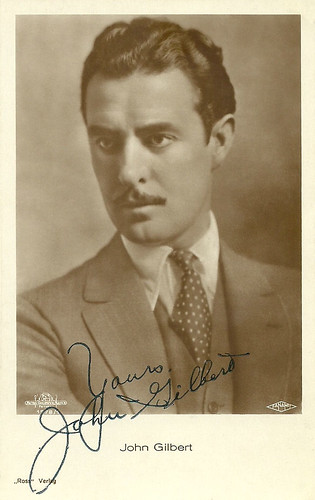
John Gilbert
German postcard by Ross Verlag, no. 1578/1, 1927-1928. Photo: Metro Goldwyn Mayer / FaNaMet. Collection: Didier Hanson.
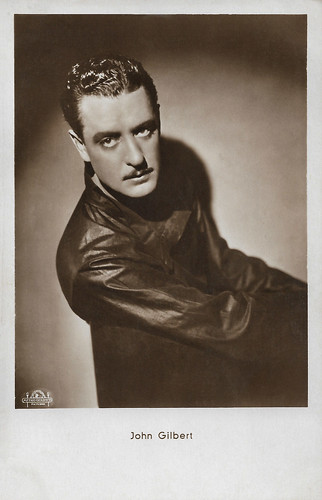
John Gilbert
Austrian postcard by Iris Verlag, no. 6017. Photo: Metro-Goldwyn Pictures.
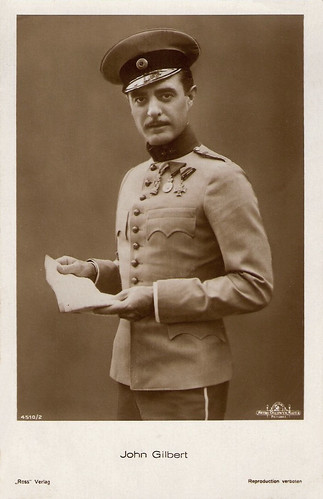
John Gilbert in His Glorious Night (1929)
German postcard by Ross Verlag, no. 4510/2, 1929-1930. Photo: Metro-Goldwyn-Mayer. Publicity still for His Glorious Night (Lionel Barrymore, 1929).
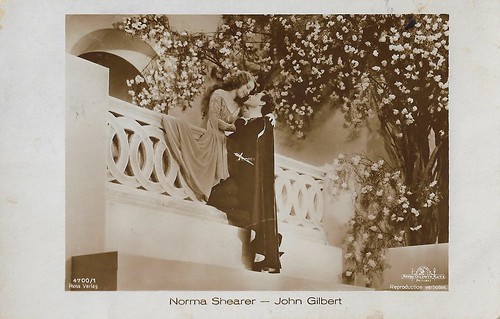
Norma Shearer and John Gilbert in The Hollywood Revue of 1929
German postcard by Ross Verlag, no. 4700/1. Photo: Metro-Goldwyn-Mayer. Norma Shearer as Juliet and John Gilbert as Romeo in the early sound film The Hollywood Revue of 1929 (Charles Reisner, 1929), shot as a series of variety acts. In the film, this sequence was shot in two-color Technicolor.
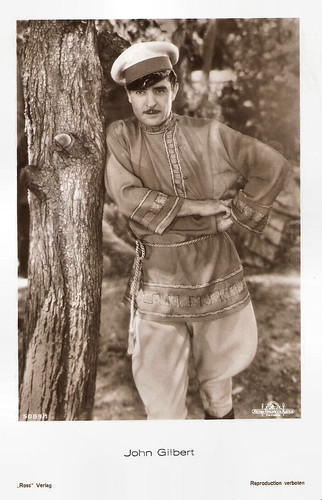
John Gilbert in Redemption (1930)
German postcard by Ross Verlag, no. 5089/1, 1930-1931. Photo: Metro-Goldwyn-Mayer. Publicity still for Redemption (Fred Niblo, 1930).
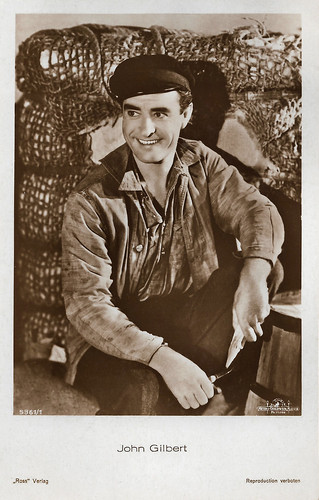
John Gilbert in Way for a Sailor
German postcard by Ross Verlag, no. 5361/1, 1930-1931. Photo: Metro-Goldwyn-Mayer. John Gilbert in the American pre-code sound film Way for a Sailor (Sam Wood, 1930).
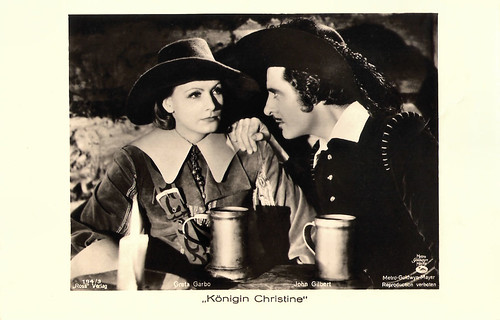
Greta Garbo and John Gilbert, Queen Christina (1933)
German postcard by Ross Verlag, no. 194/3. Photo: MGM. Publicity still for Queen Christina (Rouben Mamoulian, 1933) with Greta Garbo.
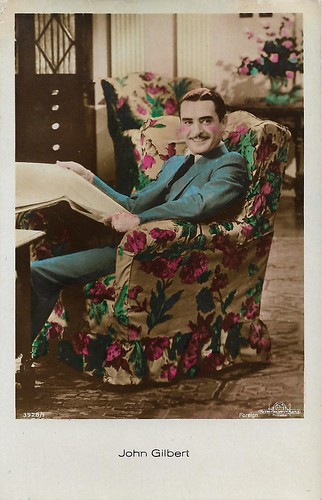
John Gilbert
German postcard by Ross Verlag Foreign, no. 3938/1, 1928-1929. Photo: Metro-Goldwyn-Mayer.
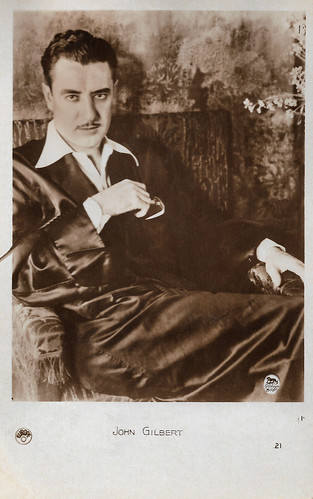
John Gilbert
French postcard by Europe, no. 21. Photo: Metro-Goldwyn-Mayer.

Greta Garbo and John Gilbert in Queen Christina (1933)
German collectors card in the Moderne Schönheitsgalerie by Ross Verlag for Edelzigarette Kurmark, series 2, no. 47 (of 300). Photo: Metro-Goldwyn-Mayer. Greta Garbo and John Gilbert in Queen Christina (Rouben Mamoulian, 1933).

Sources: Tony Fontana (IMDb), Wikipedia, and IMDb.

This post was last updated on 20 May 2024.

11 April 2021

The Merry Widow (1925)

In the silent film The Merry Widow (Erich von Stroheim, 1925), John Gilbert plays a prince, who must woo the now wealthy dancer (Mae Murray) he once abandoned in order to keep her money in the country in order to keep it from crashing economically. The reception for the film was superlative. Critics praised the artistic choices, such as the colours in the wedding sequence at the film’s end. The Merry Widow boasted the largest box office for any Hollywood studio in 1925 and would remain the most successful film both Murray and von Stroheim ever made.

Mae Murray in The Merry Widow (1925)
Italian postcard by Casa Editrice Ballerini & Fratini, Firenze, no. 660. Photo: Metro-Goldwyn, Roma. Mae Murray in The Merry Widow (Erich von Stroheim, 1925).

Mae Murray and John Gilbert in The Merry Widow (1925)
Italian postcard by Casa Editrice Ballerini & Fratini, Firenze, no. 657. Photo: Metro-Goldwyn-Film, Roma. Mae Murray and John Gilbert in The Merry Widow (Erich von Stroheim, 1925).

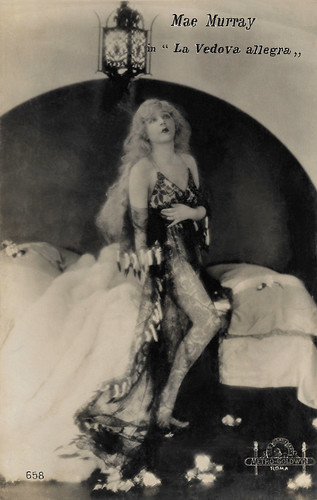
Mae Murray in The Merry Widow (1925)
Italian postcard by Casa Editrice Ballerini & Fratini, Firenze, no. 658. Photo: Metro-Goldwyn, Roma. Mae Murray in The Merry Widow (Erich von Stroheim, 1925).

Mae Murray in
Italian postcard by G.B. Falci, Milano. Photo: MGM. Mae Murray in The Merry Widow (Erich von Stroheim, 1925).

After a couple of shaky weeks at the box-office, it was a major success


The American silent film The Merry Widow (1925) is a romantic drama/black comedy directed and written by Erich von Stroheim. Next to Mae Murray and John Gilbert, the film also stars Roy D'Arcy as Crown Prince Mirko, and Tully Marshall as Baron Sixtus Sadoja. Joan Crawford and Clark Gable both made uncredited appearances as extras in the film before they became famous.

The Merry Widow is based on the 1905 operetta 'Die lustige Witwe' by Austro-Hungarian composer Franz Lehár. The librettists, Viktor Léon and Leo Stein, based the story – concerning a rich widow, and her countrymen's attempt to keep her money in the principality by finding her the right husband – on an 1861 comedy play, 'L'attaché d'ambassade' (The Embassy Attaché) by Henri Meilhac.

Prince Danilo Petrovich falls in love with dancer Sally O'Hara. His uncle, King Nikita I of Monteblanco, forbids the marriage because she is a commoner. Thinking she has been jilted by her prince, Sally marries the old and lecherous Baron Sadoja, whose wealth has kept the kingdom afloat. When he dies suddenly, Sally must be wooed all over again by Danilo.

The operetta has enjoyed extraordinary international success since its 1905 premiere in Vienna and continues to be frequently revived and recorded. Well-known music from the score includes the 'Vilja Song', 'Da geh' ich zu Maxim' (You'll Find Me at Maxim's), and the 'Merry Widow Waltz'.

'Die Lustige Witwe' was first performed at the Theater an der Wien in Vienna on 30 December 1905, with Mizzi Günther as Hanna, Otto Treumann as Danilo, Siegmund Natzler as Baron Zeta and Annie Wünsch as Valencienne. After a couple of shaky weeks at the box-office, it was a major success, receiving good reviews and running for 483 performances.

The piece became an international sensation, and translations were quickly made into various languages: in 1907, Buenos Aires theatres were playing at least five productions, each in a different language. Productions also swiftly followed in Stockholm, Copenhagen, Milan, Moscow, and Madrid, among other places. It was eventually produced in every city with a theatre industry.

Bernard Grün, in his book 'Gold and Silver: The Life and Times of Franz Lehar', estimates that 'The Merry Widow' was performed about half a million times in its first sixty years. Global sheet music sales and recordings totaled tens of millions of dollars. According to theatre writer John Kenrick, no other play or musical up to the 1960s had enjoyed such international commercial success.

John Gilbert in The Merry Widow (1925)
German postcard by Ross Verlag, no. 1319/1, 1927-1928. Photo: Loew Metro Goldwyn. John Gilbert in The Merry Widow (Erich von Stroheim, 1925).

John Gilbert and Mae Murray in The Merry Widow (1925)
Austrian postcard by Iris Verlag, no. 559. Photo: Metro-Goldwyn-Film. John Gilbert and Mae Murray in The Merry Widow (Erich von Stroheim, 1925).

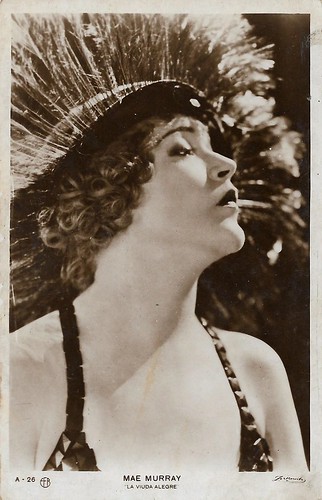
Mae Murray in The Merry Widow
Spanish postcard by EFB (Editorial Fotografica, Barcelona), no. A-26. Photo: Zerkowitz.

Murray's less-than-merry life as a showgirl and desired object of a baron/fetishist


The first film adaptation of 'Die lustige Witwe' was a Hungarian film, A Víg özvegy/The Merry Widow (1918), directed by Mihály Kertész, who became later known in Hollywood as Michael Curtiz and was one of the most prominent directors during Hollywood's Golden Age. Prince Danilo was played by Mihály Várkonyi, who also worked in Hollywood under the name of Victor Varconi.

Erich von Stroheim's 1925 version was the second film adaptation. The Merry Widow (1925) was shot over twelve weeks with a budget of $592,000. Filming was tense as Mae Murray and director von Stroheim did not get on well. After production, Metro-Goldwyn-Mayer decided it could no longer work with the director after he added sexually explicit scenes and changed the operetta's libretto.

Mordaunt Hall in The New York Times: "The Widow is, of course, impersonated by Mae Murray, who demonstrates true acting ability in this effort. Hitherto she was like a top, and one seldom caught much more than a flash of her face. Here she stands still; she wears her costumes with a full realization of their splendor.

Lucia Bozzola ar AllMovie: "Freely adapting Franz Lehar's Viennese operetta, von Stroheim spent a great deal of screen time on Murray's less-than-merry life as a showgirl and desired object of a baron/fetishist, a lecherous prince, and Gilbert's noble Danilo of "Monteblanco." Through lavishly depicted show numbers, orgies, boudoir assignations, and finally Sally's marriage and swift widowhood by the physically impaired baron, von Stroheim turned The Merry Widow into an examination of the decadence beneath the polished surface of the European nobility. Numerous cuts to feet (over the objections of production head Irving Thalberg) particularly reveal the nature of the baron's fetish; MGM cut a few scenes deemed too racy. Danilo and Sally still unite in the famed "Merry Widow Waltz," allowing love to triumph over sordidness and lead to a grand Technicolor finale."

Upon its release, The Merry Widow (1925) was both a critical and box office success. Critics praised Murray's dramatic skills while also noting that von Stroheim had "made an actress out of Miss Murray". The film made a profit of $758,000.

The Merry Widow was adapted for the screen in sound versions in 1934, 1952, 1962, and 1994. While a print of von Stroheim's silent The Merry Widow (1925) still survives, the end sequence shot in two-tone Technicolor is now lost.

John Gilbert and Mae Murray in The Merry Widow (1925)
French postcard by Cinémagazine-Edition, Paris, no. 383. Photo: Metro-Goldwyn-Film. John Gilbert and Mae Murray in The Merry Widow (Erich von Stroheim, 1925).

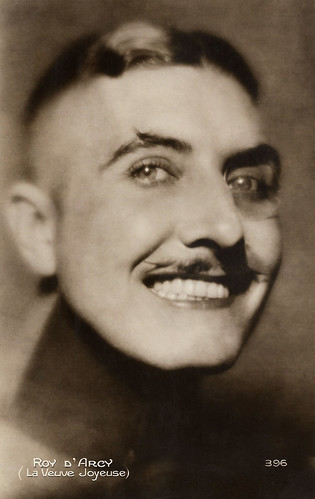
Roy d'Arcy in The Merry Widow (1925)
French postcard by Cinémagazine-Edition, Paris, no. 396. Photo: Roy d'Arcy in The Merry Widow (Erich Von Stroheim, 1925).

John Gilbert in The Merry Widow (1925)
French postcard by Editions Cinémagazine, no. 478. Photo: MGM. John Gilbert as Prince Danilo in The Merry Widow (Erich von Stroheim, 1925).

Mae Murray and John Gilbert in The Merry Widow
French postcard in the Les Vedettes de Cinéma Series, by A.N., Paris, no. 369. Mae Murray [the trema is a mistake] and John Gilbert as the romantic couple Sally O'Hara and Prince Danilo in The Merry Widow (Erich von Stroheim, 1925).

Sources: Lucia Bozzola (AllMovie), Wikipedia and IMDb.

27 December 2018

La Bohème (1926)

In 1925, Lillian Gish moved to Metro-Goldwyn-Mayer after 13 years working with director David Wark Griffith on such classics as The Birth of a Nation (1915), Broken Blossoms (1919), and Orphans of the Storm (1921). Her first MGM picture was La Bohème (King Vidor, 1926). Director Vidor came fresh from his brilliant success with The Big Parade (1925) and took his two leading actors, John Gilbert and Renee Adoree, with him to La Bohème. The story about a group of starving artists in 19th century Paris was not based on Giacomo Puccini's opera but on Henri Murger's novel La Vie de Bohème (Life in the Latin Quarter, 1851). La Bohème (1926) is a classic romantic tragedy, which relates more to fantasy and mythology than to a realistic situation. It is an agonising, bittersweet fairytale.

Lillian Gish and John Gilbert in La Bohème (1926)
Lillian Gish (or Renée Adorée?) and John Gilbert. German postcard by Ross Verlag, no. 63/1. Photo: Metro-Goldwyn-Mayer (MGM) / Parufamet. Publicity still for La Bohème (King Vidor, 1926).

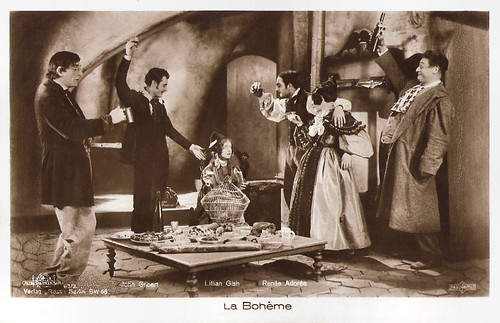
Lillian Gish, John Gilbert and Renée Adorée in La Bohème (1926)
Lillian Gish, John Gilbert and Renée Adorée. German postcard by Ross Verlag, no. 63/2. Photo: Metro-Goldwyn-Mayer (MGM) / Parufamet. Publicity still for La Bohème (King Vidor, 1926).

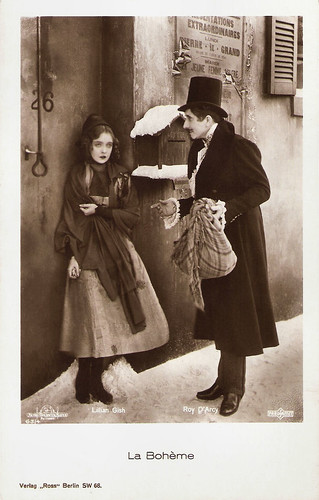
Lillian Gish and Roy D'Arcy in La Bohème (1926)
German postcard by Ross Verlag, no. 63/4. Photo: Metro-Goldwyn-Mayer (MGM) / Parufamet. Publicity still for La Bohème (King Vidor, 1926) with Lillian Gish and Roy D'Arcy.

The rent is due, but the money is not there


The Quartier Latin of Paris, winter 1830. A group of carefree Bohemians try to survive, hoping to one day become famous. Rodolpho (John Gilbert) is a frustrated writer who lives and starves with his room mates, painter Marcel (Gino Corrado), musician Schaunard (George Hassell) and bookish  Colline, played by a young Edward Everett Horton. The rent is due, but the money is not there. An article here, a painting there and a monkey with a cup gives them enough money for the rent, but not for food.

Fortunately, the saucy Musette (Renée Adorée) from downstairs has enough food for everyone including Mimi (Lillian Gish) - the frail and beautiful seamstress from next door. She has been given notice by the landlord, but Rodolpho and his friends rescue her and vow to always share their good fortune with her. Rodolphe and Mimi fall in love and Mimi works endlessly to support Rodolphe who is writing his play with a new found passion. But the rich, idle aristocrat Vicomte Paul (Roy D'Arcy) also has his lusting eye on Mimi and uses her embroidery to get close to her.

Rodolpho does not know that he has been discharged from writing for the magazine Dog and Cat Fanciers. Mimi wants to get his play produced and Vicomte Paul offers to help, but there is a terrible fight when Rodolphe thinks that Mimi is faithless to him with the count. After the fight, he seeks out a doctor as she is sick, but she has left when Rodolphe returns and will stay away until his play is finished.

Rodolphe searches for Mimi for months. Out of his anguish, a new and greater play is born. This turns out to be a hit, but he is miserable without Mimi. Meanwhile, Mimi is toiling in the slums of Paris, but the hard work is too much for the frail woman. She collapses. The doctor tells her coworkers that she will not live out the night. She stumbles out into the street and eventually reaches her old apartment. Rodolphe is ecstatic to see her. Their friends, however, realise her condition. While he goes to fetch her pet bird, she tells Musette she is happy, before dying.

Hal Erickson at AllMovie: "Though John Gilbert hams it up, Lillian Gish's brilliant performance is a model of restraint and subtlety. For her final scene, the actress went to appalling lengths to convincingly simulate death, going without water for three days and training herself to breathe without discernible movement (even when seen today, the effect is startlingly real)."

Steffi van Essen at IMDb: "Gilbert is not nearly as fine an actor as his leading lady, but he is again very much the right type for his part – an idealist with intelligent eyes and a warm smile. Other faces to look out for here are the very entertaining French actress Renée Adorée, and a rare glimpse of a silent-era Edward Everett Horton, although sadly before his comic talent was fully realised."

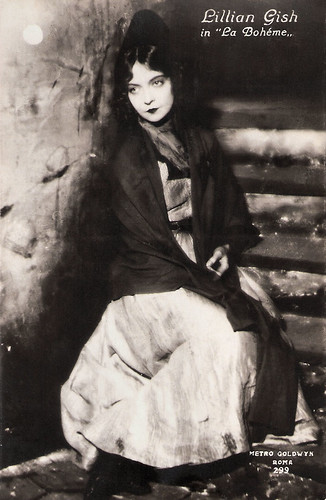
Lillian Gish in La Bohème (1926)
Lillian Gish. Italian postcard by Casa Editrice Ballerini & Fratini, Firenze (B.F.F.), no. 199. Photo: Metro Goldwyn, Roma (MGM). Publicity still for La Bohème (King Vidor, 1926).

Renée Adorée in La Bohème (1926)
Italian postcard by Casa Editrice Ballerini & Fratini, Firenze. Photo: Metro Goldwyn (MGM), Roma, no. 287. Publicity still for La Bohème (King Vidor, 1926). Although the postcard credits Lillian Gish, it's actually co-star Renée Adorée who is portrayed. (Thanks to Marlene Pilaete, for mentioning this).

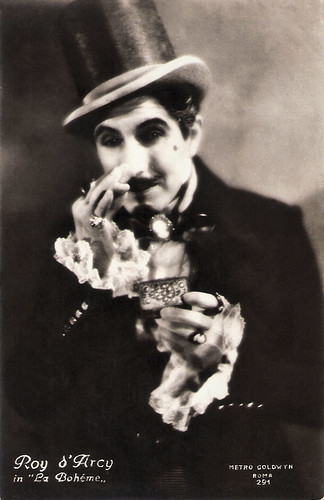
Roy d'Arcy in La Bohème (1926)
Roy D'Arcy. Italian postcard by Casa Editrice Ballerini & Fratini, no. 291. Photo: Metro Goldwyn, Roma (MGM). Publicity still for La Bohème (King Vidor, 1926).

Sources: Hal Erickson (AllMovie),  Steffi van Essen (IMDb), Wikipedia and IMDb.

21 December 2018

The Big Parade (1925)

The melodramatic romance and World War I epic The Big Parade (1925) is one of MGM's all-time biggest hits and one of the classics of the silent film era. John Gilbert plays a young American soldier, who witnesses the horrors of 'the Great War'. Renée Adorée and Karl Dane co-starred and King Vidor was the director.  The film stills were made by Ruth Harriet Louise.

John Gilbert in The Big Parade
John Gilbert. French postcard by Editions Cinémagazine, no. 393. Photo: Ruth Harriet Louise / MGM. Publicity still for The Big Parade (King Vidor, 1925). Ruth Harriet Louise (1903-1940) was the first woman photographer active in Hollywood. She ran Metro-Goldwyn-Mayer's portrait studio from 1925 to 1930. She was the uncredited still photographer for The Big Parade.

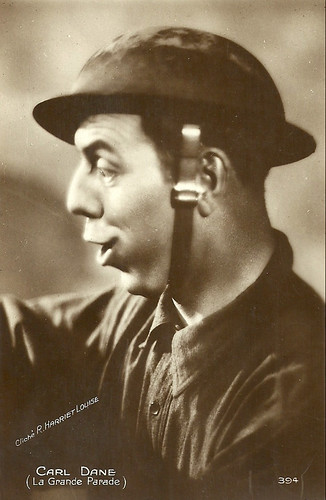
Carl Dane in The Big Parade
Karl Dane. French postcard by Editions Cinémagazine, no. 394. Photo: Ruth Harriet Louise / MGM. Publicity still for The Big Parade (King Vidor, 1925), starring John Gilbert. The French title of the film was La Grande Parade. Karl Dane was sometimes spelled as Carl Dane.

A new kind of realistic war film


After director King Vidor complained to MGM production chief Irving Thalberg that he was tired of shooting pictures that played in theatres for just one week, he told Thalberg about a new kind of realistic war film he had envisioned. Thalberg was enthusiastic about Vidor's vision, and tried to buy the rights to the hit Broadway play What Price Glory? co-written by Maxwell Anderson and World War I Marine veteran Laurence Stallings. Since the rights to the popular anti-war play had already been acquired, Thalberg hired Stallings to come to Hollywood and write a screenplay for the new, realistic war picture that Vidor had dreamed about making. Stallings came up with The Big Parade, an anti-war story that dispensed with traditional concepts of heroism, focusing instead on a love story between a Yank soldier and a French girl.

The Big Parade (1925) takes place from April 1917 to the Spring of 1919. John Gilbert plays Jim, the idle son of a rich businessman, who joins the US Army's Rainbow Division when the U.S.A. enters World War One. He is sent to France, where he becomes friends with two working-class soldiers, Southern construction worker Slim (Karl Dane) and Bronx bartender Bull (Tom O'Brien). He also falls in love with the French girl Mélisande (Renée Adorée), despite not being able to speak each other's language. He has to leave her to move to the frontline. There, he experiences the horrors of trench warfare in a battle that was based on the WWI Battle of Belleau Wood, which raged for most of the month of June 1918. US forces suffered nearly 10,000 casualties, including 1800 killed. Author Laurence Stallings served as a Marine Captain and lost a leg in this battle.

One of the most famous scenes of The Big Parade (1925) is the romantic scene in which Jim (John Gilbert) teaches Melisande (Renée Adorée) to chew gum. The scene was improvised on the spot during filming. Director King Vidor observed a crew member chewing gum and later recalled, "Here was my inspiration. French girls didn't chew or understand gum; American doughboys did...Gilbert's efforts to explain would endear him to her and she would kiss him...[It was] one of the best love scenes I ever directed." Gilbert also claimed that neither he nor Vidor expected Adorée to swallow the gum, which proved to be the scene's comic highlight.

After Vidor completed principal photography, Irving Thalberg took the rough cut and previewed it before live audiences in Colorado. The audiences responded favourably, and Thalberg decided to expand the scope of the picture, as Vidor had created a war picture without many scenes of war. He had Vidor restage the famous marching army column sequence with 3000 extras, 200 trucks, and 100 airplanes. After Vidor moved on to another project, Thalberg had other battle scenes shot by director George W. Hill.

The result was a huge box office hit. The Big Parade (1925) played at New York's Astor Theater for two years and at that one theatre alone grossed $1.5 million during that time - more than three times its production cost of $245,000. Today. it is the highest-grossing silent film of all time, making $22 million during its worldwide release. The Big Parade is one of the first films that neither glorified the war nor ignored its human costs. It heavily influenced many subsequent war films, especially All Quiet on the Western Front (Lewis Milestone, 1930). The film boosted John Gilbert's career and made Renée Adorée a major star, although Adorée would soon be diagnosed with tuberculosis and die only a few years later, 35 years old.

When MGM discovered that a clause in director King Vidor's contract entitled him to 20% of the net profits, studio lawyers called a meeting with him. At the meeting, MGM accountants played up the costs of the picture while downgrading the studio forecast of its potential success. Vidor was persuaded to sell his stake in the film for a small sum. The film ran for 96 weeks at the Astor Theater and grossed $5 million (approximately $50 million in 2003 dollars) domestically by 1930, making it the most profitable release in MGM history at that point. Vidor later said, "I thus spared myself from becoming a millionaire instead of a struggling young director trying to do something interesting and better with a camera."

Renée Adorée in The Big Parade (1925)
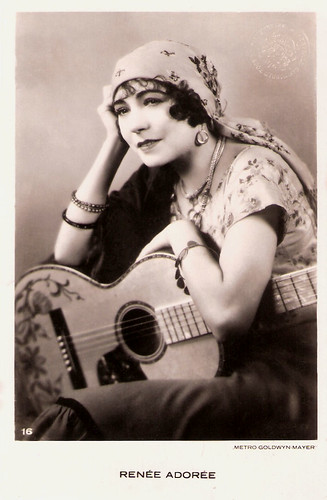
Renée Adorée. Dutch postcard, no. 16. Photo: Ruth Harriet Louise / Metro-Goldwyn-Mayer. Publicity still of The Big Parade (King Vidor, 1925).

Tom O'Brien, John Gilbert, and Karl Dane in The Big Parade
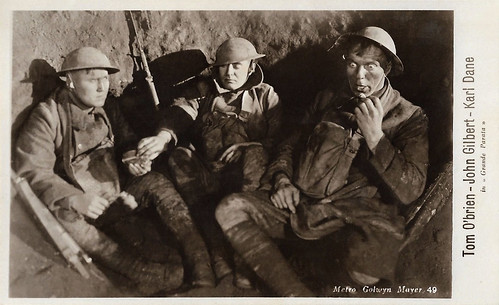
Tom O'Brien, John Gilbert, and Karl Dane. Italian postcard by G.B. Falci, Milano, no. 49. Photo: Ruth Harriet Louise / Metro-Goldwyn-Mayer. Publicity still for The Big Parade (King Vidor, 1925), released in Italy as Grande Parata/La grande parata.

Karl Dane in The Big Parade (1925)
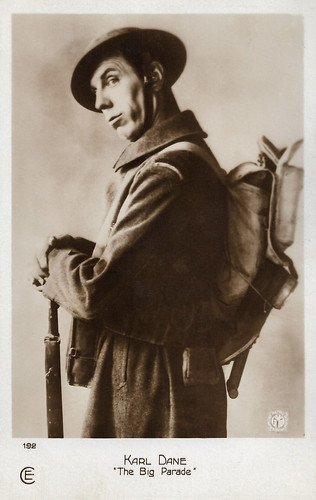
Karl Dane. French postcard by Editions Cinémagazine, no. 192. Photo: Ruth Harriet Louise / Gaumont-Metro-Goldwyn. Publicity still for The Big Parade (King Vidor, 1925).

Sources: Wikipedia and IMDb.