Showing posts with label Ralf Wolter. Show all posts

15 August 2015

Der Schut (1964)

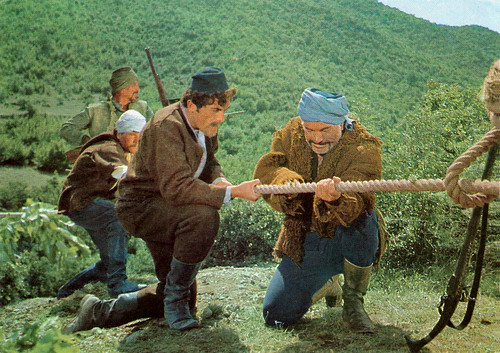
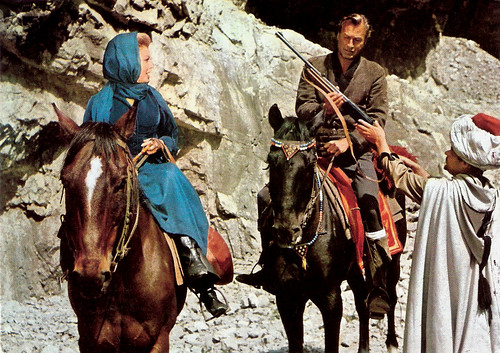
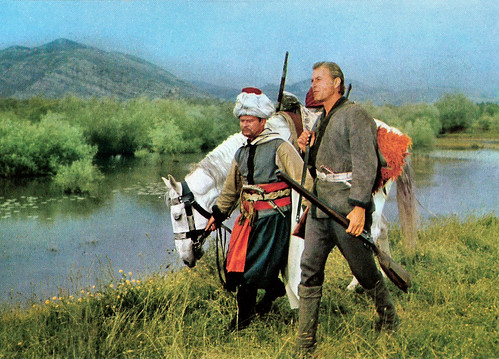
Der Schut/The Yellow One (Robert Siodmak, 1964) is the first film adaptation in the 1960s of the oriental novels by best-selling 19th century German writer Karl May. These adventure novels set in the Orient and Middle East and feature Kara Ben Nemsi who travels throughout the Ottoman empire, alongside his friend and servant Hadschi Halef Omar. In Der Schut, Lex Barker stars as Kara Ben Nemsi and Ralf Wolter plays Halef. German-born Hollywood director Robert Siodmak, famous for the Burt Lancaster classics The Killers (1946) and The Crimson Pirate (1952), directed the picture on location in Yugoslavia.

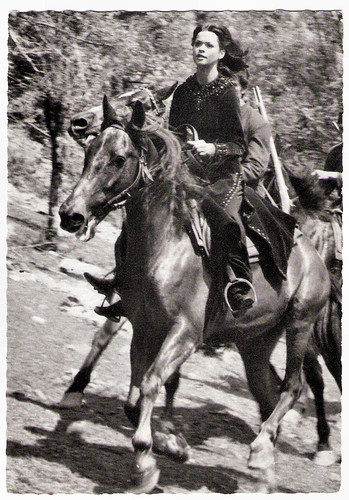
Marie Versini in Der Schut
German postcard by Filmbilder-Vertrieb Ernst Freihoff, Essen, no. 921. Retail price: 10 Pfg. Photo: Gloria / Schnelle. Publicity still for Der Schut/The Shoot (Robert Siodmak, 1964) with Marie Versini as Tschita.

Der Schut  (1964) with Dieter Borsche, Chris Howland and Lex Barker
German postcard by Heinerle Karl-May-Postkarten, no. 2. Photo: CCC / Gloria. Publicity still for Der Schut/The Yellow One (Robert Siodmak, 1964) with Dieter Borsche, Chris Howland and Lex Barker. Caption: "Mister Kara, wie gut, dass ich Euch treffe. Euer Freund Galingré wurde von den Banditen des Schut überfallen und entführt. Ein gewisser Nirwan besuchte mich an Bord meiner Jacht und erzählte mir davon.'- 'Unter diesen Umständen kann ich natürlich nicht mit Euch nach Egypten reisen, Sir David, das werdet Ihr verstehen. Ich werde nach Ostromdscha reiten, wo die Frau meines entführten Freundes lebt... Ich muss den Schut finden!'- " (Mister Kara, so good that I meet you. Your friend Galingré was attacked and kidnapped by bandits of the Yellow One. A certain Nirwan visited me on board of my yacht and told me about it .'- 'In these circumstances, I can not travel with you to Egypt of course, Sir David, which will you understand. I will ride to Strumnitza where my kidnapped friend's wife lives ... I need to find the Yellow One'! -)

Der Schut (1964) with Lex Barker and Ralf Wolter
German postcard by Heinerle Karl-May-Postkarten, no. 7. Photo: CCC / Gloria. Publicity still for Der Schut/The Yellow One (Robert Siodmak, 1964). Caption: "Keine Angst, guter Mann. Wir sind Freunde von Dir. Mein Sihdi, der berühmte Kara ben Nemsi und ich werden alles tun, um diesen Schurken, den Schut, zu fangen." (Do not worry, my good man. We are friends of yours. My Sidi, the famous Kara ben Nemsi and I will do everything possible to catch these rogues, the Schut.)

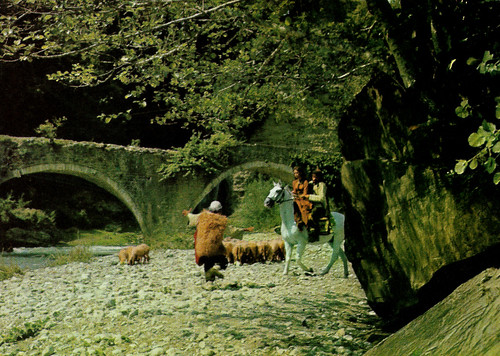
Der Schut (1964) with Renato Baldini
German postcard by Heinerle Karl-May-Postkarten, no. 9. Photo: CCC / Gloria. Publicity still for Der Schut/The Yellow One (Robert Siodmak, 1964) with Renato Baldini. Caption: "'Hier Barud, nimm mein Messer!' - 'Ja, so geht's besser! Sollte jetzt Jemand lust haben, uns zu verfolgen, dann braucht er nur über diese Brücke zu kommen!' - " (Barud, take my knife! '- 'Yes, now it gets better! If someone should like to persecute us, then he just needs to come across the bridge!)

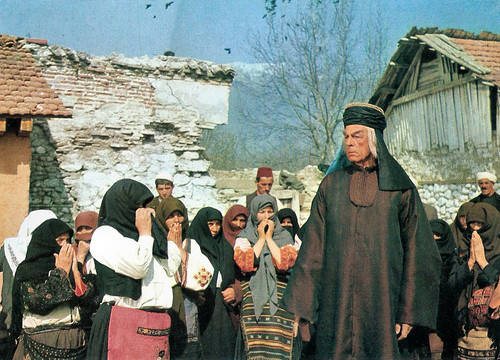
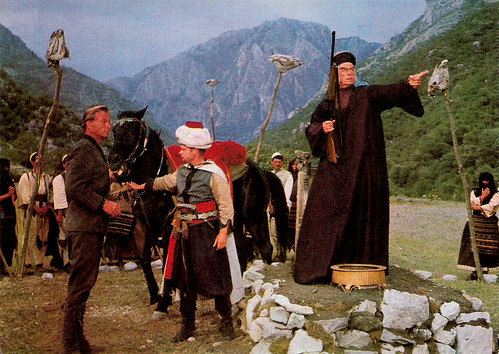
Der Schut (1964) with Friedrich von Ledebur
German postcard by Heinerle Karl-May-Postkarten, no. 13. Photo: CCC / Gloria. Publicity still for Der Schut/The Yellow One (Robert Siodmak, 1964) with Friedrich von Ledebur. Caption: "Ich habe solche Angst vor dem Heiligen Mübarek, er wird zornig sein, weil ich mit euch spreche und seine Raben werden ihn sagen, was ich euch erzählt habe... Dass er die Leute vor euch gewarnt hat...!" (I am so afraid of the Holy Mübarek, he will be angry that I speak to you, and his ravens will tell him what I told you ... That he warned the people for you ...!)

Der Schut (1964) with Lex Barker and Ralf Wolter
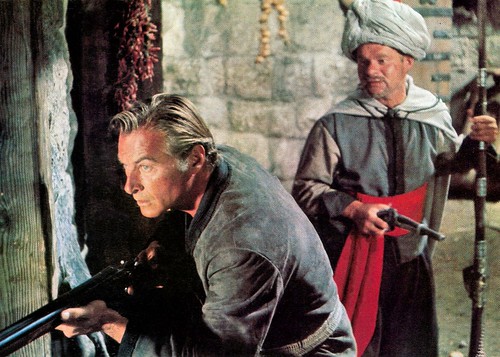
German postcard by Heinerle Karl-May-Postkarten, no. 15. Photo: CCC / Gloria. Publicity still for Der Schut/The Yellow One (Robert Siodmak, 1964). Caption: "Am Abend im Hause Galingré: 'Halef, ich werde dem Mübarek einen Streich spielen. Deshalb musstest du mir Wismut und Quecksilber besorgen. Daraus mache ich Kugeln, die genau aussehen wie Bleikugeln, aber beim Schiessen zerfallen. Nun lade ich das Gewehr immer abwechselnd mit einer Kugel aus Blei und mit einer falschen...'" (In the evening at home Galingré: "Halef, I will play a trick on the Mübarek. Therefore, you had to get me bismuth and mercury. From this I'll make bullets that look like lead bullets, but disintegrate during firing. Now I'll load the gun alternately with a bullet made of lead and a fake one ...")

Der Schut  (1964) with Lex Barker, Ralph Wolter and Friedrich von Ledebur
German postcard by Heinerle Karl-May-Postkarten, no. 16. Photo: CCC / Gloria. Publicity still for Der Schut/The Yellow One (Robert Siodmak, 1964) with Lex Barker, Ralf Wolter and Friedrich von Ledebur. Caption: "Der heilige Mübarek stellt sich seinem Gegner, Kara Ben Nemsi. "Dieser blonde Giaur soll dafür bestraft werden, dass er einen heiligen Raben erschossen hat. Es ist Allahs Wille!" - Ihr lügt, Mübarek. Es ist nicht Allah's sondern dein Wille. Du fürchtest dich von mir, weil ich ein grösserer Zauberer bin als du. Ich will es dir beweisen. Hier ist ein Gewehr, das genauer und besser schiesst als jedes andere. Wenn du mich mit einer einzigen Kugel treffen kannst, dann soll es dir gehören, Mübarek. Halef, zeig ihm das Gewehr und wie man damit feuert." (The Holy Mübarek faces his opponent, Kara Ben Nemsi. "This blonde Giaur will be punished because he shot a sacred raven. It is the will of Allah!" - You lie, Mübarek. It is not God's will but yours. You're afraid of me because I am a greater magician than you. I want to prove it to you. Here is a gun that shoots more accurate and better than any other. If you can meet with a single bullet, then it should belong to you, Mübarek. Halef, show him the rifle and how to fire it.)

Heroic Kara Ben Nemsi


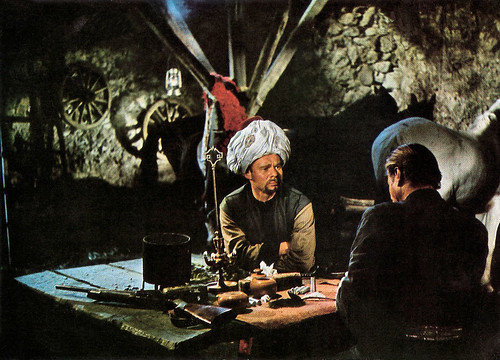
The secretive 'Schut' or 'The Yellow One' (Rik Battaglia) is a bandit king who terrorizes a whole region in the land of the Skipetars - modern Albanians, one of the few Balkan people who adopted the Turkish Muslim faith. He controls the land in the disguise of the wealthy Persian carpet merchant Nirwan.

The Schut holds an English aristocrat and a French merchant for a ransom, then he also abducts the beautiful Tschita (Marie Versini), Kara's friend Omar's fiancée. The corrupt police force does not take any action against him.

Heroic Kara Ben Nemsi (the Turkish-Arabic name means 'black(bearded) German') tries to find the Schut's hiding-place in the mountains and free the prisoners. But the Schut has many rogues and assassins under his command who make this search long and dangerous.

After unmasking the Mübarek, a local phony 'magician', and dealing with some other ruffians and corruption, Kara Ben Nemsi and Lord Lindsay (Dieter Borsche) with his butler Archie (Chris Howland) set out to finish The Schut off.

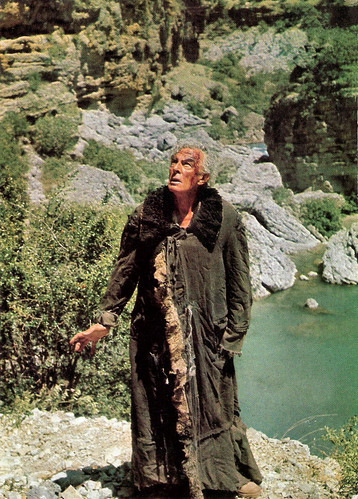
Der Schut (1964) with Friedrich von Ledebur
German postcard by Heinerle Karl-May-Postkarten, no. 17. Photo: CCC / Gloria. Publicity still for Der Schut/The Yellow One (Robert Siodmak, 1964). Caption: "Seht ihr, was hinter der Maske dieses Heiligen steckt? Halif hat ihm den Mantel heruntergerissen und hervor kam das zerfetzte Kleid des angeblich lahmen und taubstummen Bettlers Busra. Er war stets überall und nirgends - trotz seiner kranken Beine. Nicht die Raben haben den Mübarek alles erzählt, sondern er selbst hörte was über ihn gesprochen wurde." (Do you see what's behind the mask of this saint? Halif has torn down his coat and forth came the tattered dress of the supposedly lame and deaf-mute beggar Busra. He was always everywhere and nowhere - despite his ill legs. Not the Ravens have told the Mübarek everything, but he could hear himself what was being said about him.)

Marianne Hold and Lex Barker in Der Schut (1964)
German postcard by Heinerle Karl-May-Postkarten, no. 29. Photo: CCC / Gloria. Publicity still for Der Schut/The Yellow One (Robert Siodmak, 1964) with Marianne Hold and Lex Barker. Caption: "Wie froh bin ich, dass Ihnen nichts passiert ist, Mister Kara. Ich hörte die Schüsse..." - "Wie Sie sehen, ist mit diesem Mübarek alles gut gegangen, Madame Galingré. Fein dass Sie die Pferde mitgebracht haben. Da können Omar, Halef und Ich gleich die Verfolgung des Schut aufnehmen." ("How glad I am that nothing happened to you, Mister Kara (Lex Barker). I heard the shots ...." - "As you can see, everything went well with this Mübarek, Madame Galingré (Marianne Hold). Fine that you brought the horses. Omar, Halef and I can immediately do on with the persecution of The Yellow One.")

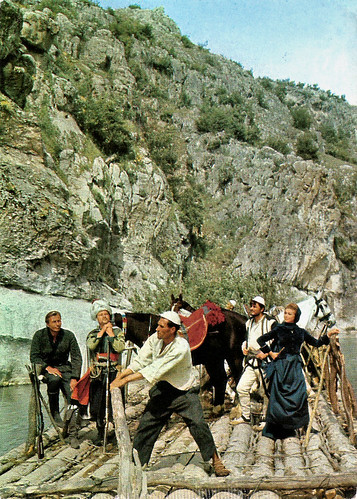
Der Schut (1964) with Lex Barker, Ralf Wolter and Marianne Hold
German postcard by Heinerle Karl-May-Postkarten, no. 31. Photo: CCC / Gloria. Publicity still for Der Schut/The Yellow One (Robert Siodmak, 1964) with Lex Barker, Ralf Wolter and Marianne Hold. Caption: "Das vollbeladene Floss. Ein gutes Angriffsziel für die sich in den Felsen versteckt haltenden Banditen." (The fully loaded raft. A good target for the bandits, who are hiding between the rocks.)

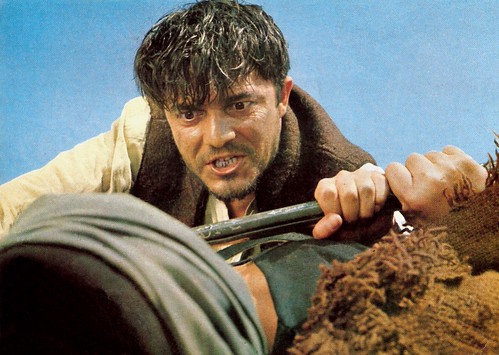
Der Schut (1964) with Dusan Janicijevic
German postcard by Heinerle Karl-May-Postkarten, no. 36. Photo: CCC / Gloria. Publicity still for Der Schut/The Yellow One (Robert Siodmak, 1964) with Dusan Janicijevic. Caption: "Zum letzten Mal! Wo ist meine Braut Tschita? Wohin hast du sie geschleppt?" (For the last time! Where is my bride Tschita? Where did you drag her?)

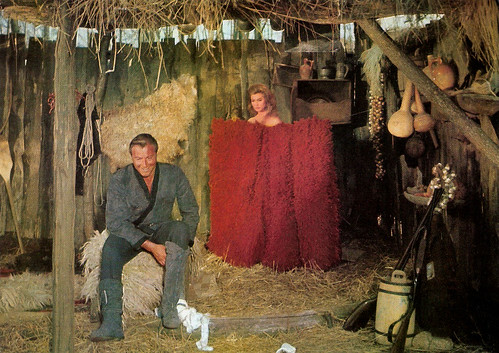
Der Schut (1964) with Lex Barker and Marianne Hold
German postcard by Heinerle Karl-May-Postkarten, no. 37. Photo: CCC / Gloria. Publicity still for Der Schut/The Yellow One (Robert Siodmak, 1964) with Lex Barker and Marianne Hold. Caption: "Damit Madame Galingré sich von den Strapazen des Überfalls erholen kann, wird eine kurze Rast eingelegt. Erst am nächsten Morgen soll die Suche nach dem Schut fortgezetst werden." (A short break is inserted, so Madame Galingré can recover from the rigors of the raid. The next morning the search for the Yellow One will be continued.)

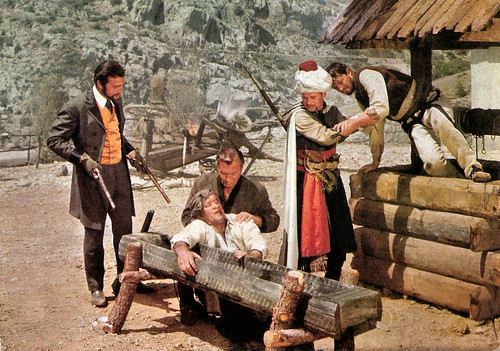
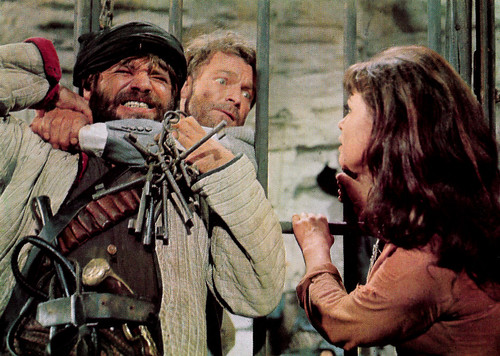
Der Schut (1964) with Ralf Wolter
German postcard by Heinerle Karl-May-Postkarten, no. 39. Photo: CCC / Gloria. Publicity still for Der Schut/The Yellow One (Robert Siodmak, 1964) with Ralf Wolter. Caption: "Man hat Halef in die Schluchthütte gerissen und ihn dort gefesselt. 'Wo halt sich Kara auf? Rede... oder!' - Aber Halef schweigt und widersteht alle Drohungen und Schlägen." (They have pulled Halef into the canyon lodge and tied him up there. 'Where is Kara holding on? Speak... or! '- But Halef remains silent and resists all threats and beatings.)

Karl May's Oriental Cycle


Der Schut was not the first adaptation of the Oriental novels with Kara Ben Nemsi by Karl May. In 1920, May's friends Marie Luise Droop and her husband Adolf Droop among others founded in cooperation with the Karl May Press the production company Ustad-Film.

They produced three silent films: Auf den Trümmern des Paradieses/On the Brink of Paradise (Josef Stein, 1920), Die Todeskarawane/Caravan of Death (Josef Stein, 1920) and Die Teufelsanbeter/The Devil Worshippers (Marie Luise Droop, 1920), all starring Carl de Vogt as Kara Ben Nemsi. These three films are believed to be lost. Due to the low success Ustad-Film went bankrupt in the following year.

The first sound film was Durch die Wüste/Through the Desert (J.A. Hübler-Kahla, 1936). Kara Ben Nemsi was played by Fred Raupach.

The German-Spanish Die Sklavenkarawane/Caravan of Slaves (Georg Marischka, Ramón Torrado, 1958) and its sequel Der Löwe von Babylon/The Lion of Babylon (Johannes Kai, Ramón Torrado, 1959) were the first colour films. In the first film, Kara Ben Nemsi was played by Viktor Staal and in the second by Helmuth Schneider. In both films Halef was played by Georg Thomalla and Sir David Lindsay by Theo Lingen.

Famous is the Karl May film wave from 1962–1968, which was one of the most successful German film series ever. Most of these films were made separately by the two competitors Horst Wendlandt and Artur Brauner.

Most of the 17 films of this series were Westerns starring Pierre Brice as Winnetou, beginning with Der Schatz im Silbersee/The Treasure of the Silver Lake (Harald Reinl, 1962).

Three of the films were based on the Orient cycle. After Der Schut followed Durchs wilde Kurdistan/Wild Kurdistan (Franz Josef Gottlieb, 1965) and Im Reiche des silbernen Löwen/Kingdom of the Silver Lion (Franz Josef Gottlieb, 1965). In all three films Lex Barker starred as Kara Ben Nemsi.

Der Schut (1964) with Lex Barker and Ralf Wolter
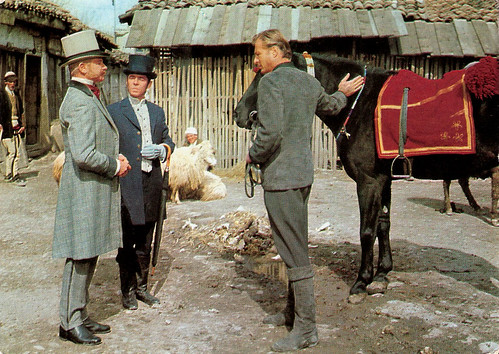
German postcard by Heinerle Karl-May-Postkarten, no. 40. Photo: CCC / Gloria. Publicity still for Der Schut/The Yellow One (Robert Siodmak, 1964) with Lex Barker and Ralf Wolter. Caption: "Kara der seinen treuen Diener plötzlich vermisste, ist seinen Spuren nachgegangen und konnte ihn noch rechtzeitig aus den Klauen der Banditen befreien. Jeder einzelner wird jetzt von Kara mit seinem gefürchteten Bärentöter aufs Korn genommen." (Kara, who suddenly missed his faithful servant, has followed in his footsteps, and could free him in time from the clutches of the bandits. Kara now takes each bandit on the grain with his dreaded bear hunter.)

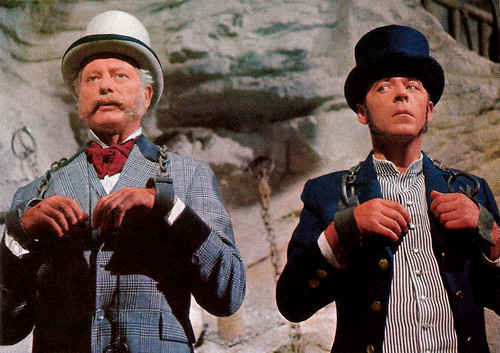
Der Schut, Dieter Borsche, Chris Howland
German postcard by Heinerle Karl-May-Postkarten, no. 43. Photo: CCC / Gloria. Publicity still for Der Schut/The Yellow One (Robert Siodmak, 1964) with Dieter Borsche and Chris Howland. Caption: "'Well, Archibald, was nun?' fragt Sir Lindsay seinen Butler, als sie der Schut unversehends in einer Felsenhöhle, die sich unter seinem Palast befindet, gefangensetzt." ('Archibald now what?', Sir Lindsay (Dieter Borsche) asks his butler (Chris Howland), when The Shoot enexpectedly captures them in a cave, which is located beneath his palace." )

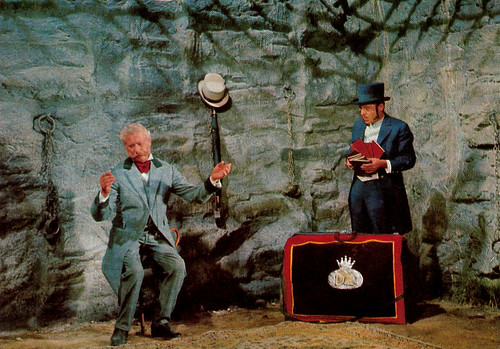
Der Schut  (1964) with Dieter Borsche and Chris Howland
German postcard by Heinerle Karl-May-Postkarten, no. 44. Photo: CCC / Gloria. Publicity still for Der Schut/The Yellow One (Robert Siodmak, 1964) with Dieter Borsche and Chris Howland. Caption: "Der Lord sowie sein Diener lassen sich durch die Situation nicht erschüttern. Archie halt in seinem Wunderkoffer alles bereit, um seinem Lord den Aufenthalt in der Felsenhöhle so angenehm wie möglich zu machen." (The Lord and his servant won't be shaken by the situation. Archie has in his magical suitcase everything ready to make his Lord's stay in the cave as pleasant as possible.)

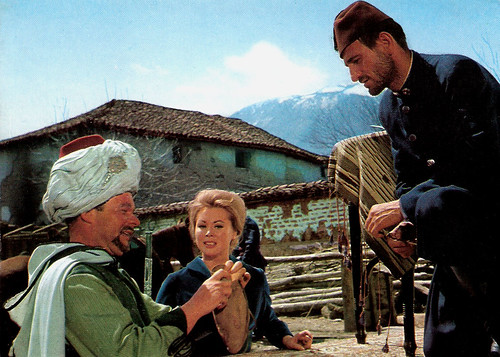
Der Schut (1964) with Ralf Wolter and Marianne Hold
German postcard by Heinerle Karl-May-Postkarten, no. 46. Photo: CCC / Gloria. Publicity still for Der Schut/The Yellow One (Robert Siodmak, 1964) with Ralf Wolter and Marianne Hold. Caption: "Durch eine List gelingt es dem treuen Diener Halef mit Hilfe von türkischen Soldaten seinen geliebten Herrn, Kara Ben Nemsi, aus den Händen des Schut zu befreien, der ihn gefangenhält." (By a ruse and with the help of Turkish soldiers, the faithful servant Halef can free his beloved Lord, Kara Ben Nemsi, from the hands of the Yellow One, who has imprisoned him.)

Lex Barker and Ralf Wolter in Der Schut (1964)
German postcard by Heinerle Karl-May-Postkarten, no. 48. Photo: CCC / Gloria. Publicity still for Der Schut/The Yellow One (Robert Siodmak, 1964). Caption: "Die Abschiedsstunde schlägt. Kara will in seine Heimat zurückkehren. Traurig sagt Halef seinem beliebten Herrn 'Good-bye'. 'Sihdi, wir werden uns wiedersehen, wenn der Sohn von Rih das Licht der Welt erblickt hat!'" (The Farewell Bell Tolls. Kara wants to return to his homeland. Sad Halef says his beloved Lord "Good-bye". "Sidi, we 'll meet again, when the son of Rih has seen the light of day!")

Sources: Wikipedia and IMDb.

29 April 2012

Ralf Wolter

Ralf Wolter (1926) was the ´King of the Supporting Parts´ in countless German comedies, musicals and Euro-Westerns. Unforgettable is his performance as Sam Hawkens, the loyal companion of Winnetou and Old Shatterhand in the classic Karl May Westerns of the 1960’s.

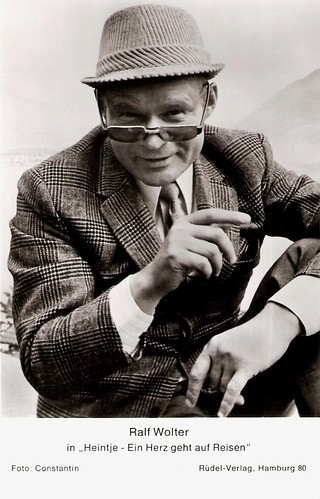
Ralf Wolter
German postcard by Rüdel-Verlag, Hamburg. Photo: Constantin. Publicity still for Heintje - Ein Herz geht auf Reisen/Heintje: A Heart Goes on a Journey (1969, Werner Jacobs).

Goofy Butler
Ralf Wolter was born in 1926 in Berlin as the son of a comedian, acrobat and singer. He studied acting at Der Kreis (Fritz-Kirchhoff-Schule) in his hometown, where he also started his career in several Berlin theatres such as the cabaret Schall und Rauch. Between 1954 and 1958 he was a member of the cabaret Rauchfang. He made his first film appearance in 1951 in the satirical comedy Die Frauen des Herrn S./The Women of Mr. S. (1951, Paul Martin) with Sonja Ziemann and Paul Hörbiger. Soon he got more film offers to show his comical talent in countless comedies and musicals. With his inimitable style he became a darling of the public as the goofy butler, odd fellow or likable bandit, such as in Das Wirtshaus im Spessart/The Spessart Inn (1958, Kurt Hoffmann) with Liselotte Pulver. He appeared in the complete range of funny and indispensable supporting parts, including the policeman, the jockey or the civil servant in light entertainment films like Die Beine von Dolores/The Legs of Dolores (1957, Géza von Cziffra), Wenn die Conny mit dem Peter/When Conny and Peter Do It Together (1958, Fritz Umgelter), and Freddy, die Gitarre und das Meer/Freddy, the Guitar and the Sea (1959, Wolfgang Schleif). His funniest part was a bathroom waiter in Wir Wunderkinder/Aren't We Wonderful? (1958, Kurt Hoffmann) starring Hansjörg Felmy. In 1961 he appeared as a bald soviet agent in the Hollywood comedy One, Two, Three (1961, Billy Wilder) starring James Cagney and Horst Buchholz.

Winnetou I, Ralf Wolter
German postcard, no. E 22. Photo: Constantin. Still from Winnetou I (1963, Harald Reinl). Caption: "The conquering Apaches decide in the powwow to kill the white prisoners. The cranky Sam Hawkens just can't understand, why this is the way he has to go to the happy hunting ground."

Ralf Wolter, Winnetou - 3. Teil
German postcard, no. 8. Photo: Rialto / Constantin. Still for Winnetou - 3. Teil/Desperado Trail (1965, Harald Reinl) with Ralf Wolter.

Trapper Sam Hawkens
Unforgettable is his role as trapper Sam Hawkens, the loyal and sympathetic companion of the heroes in the Karl May films of the 1960’s. The first time Ralf Wolter appeared as this tattered type was in Der Schatz im Silbersee/Treasure of Silver Lake (1962, Harald Reinl). It would be his breakthrough. Soon followed Winnetou I/Apache Gold (1963, Harald Reinl), Old Shatterhand/Shatterhand (1963, Hugo Fregonese), Winnetou - 3. Teil/The Desperado Trail (1965, Harald Reinl), Winnetou und das Halbblut Apanatschi/Half-Breed (1966, Harald Philipp), and Winnetou und Shatterhand im Tal der Toten/Winnetou and Shatterhand in the Valley of Death (1968, Harald Reinl). When producer Artur Brauner needed a Hadschi Halef Omar for his film Der Schut/The Shoot (1964, Robert Siodmak), it was out of the question who should play the always yapping, a bit simple companion of Kara Ben Nemsi (Lex Barker). Wolter continued to yap– and unnerve his master - in the sequels Durchs wilde Kurdistan/Wild Kurdistan (1965, Franz Josef Gottlieb) and Im Reich des silbernen Löwen/Attack of the Kurds (1965, Franz Josef Gottlieb). In the in Mexico situated two-parter Der Schatz der Azteken/The Treasure of the Aztecs (1965, Robert Siodmak) and Die Pyramide des Sonnengottes/Pyramid of the Sun God (1965, Robert Siodmak) he played the cuckoo clock seller Andreas Hasenpfeffer next to Lex Barker. In 1966 he appeared again with Barker in the western Wer kennt Jonny R.?/Who Killed Johnny R.? (1966, José Luis Madrid). He continued appearing in films during the 1970’s, but without the success that he was used to with his Karl May films. His parts in the family films with the Dutch child star Heintje Simons (including Heintje - Ein Herz geht auf Reisen/Heintje: A Heart Goes on a Journey (1969, Werner Jacobs)), the soft-sex Urlaubsreport films (including Urlaubsreport - Worüber Reiseleiter nicht sprechen dürfen/Holidays Report (1971, Ernst Hofbauer) starring Sybil Danning) and five vehicles for Schlager singer Roy Black (including Kinderarzt Dr. Fröhlich/Children’s Doctor Fröhlich (1972, Kurt Nachmann)) were banal and sometimes even too painful to watch. An exception was his leading role in the excellent comedy Was ist denn bloss mit Willi los?/What Is the Matter with Willi? (1970, Werner Jacobs), in which he and Heinz Erhardt played two tax collectors. But more and more the thoroughbred comedian moved over to television. He appeared in TV series like Ein Fall für Titus Bunge/A Case for Titus Bunge (1967), and the Krimis Tatort (1975) and Der Alte/The Old Fox (1977-1978). He returned as Sam Hawkens in the 14-part TV series Winnetou le mescalero/My Friend Winnetou (1980, Marcel Camus). In 1991 he appeared for the last time as Sam Hawkens together with Pierre Brice at the Karl-May-Festspiele in Bad Segeberg. Ralf Wolter made his last film appearance as Professor Boris Smirnoff in Kondom des Grauens/Killer Condom (1996, Martin Walz), based on the comic of Ralf König. In 2003 the then 75-year old actor caused a serious car accident, which killed three people, for which he had to go on probation for ten months. Nowadays Wolter mainly works in the theatre. In 2008 he appeared as the old Harry Frommermann (the founder of the singing group Comedian Harmonists) in the play Jetzt oder nie – Die Comedian Harmonists/Now or Never – The Comedian Harmnonists. Recently, he appeared in two films again. In 2009 he was one of the title figures in the crime comedy Dinosaurier/Dinosaurs (2009, Leander Haußmann) with Eva Maria Hagen and Walter Giller, and in the comedy Bis zum Horizont, dann links!/To the horizon, then left!(2012, Bernd Böhlich) with Robert Stadlober. While I write this, the latter is still in post-production.

Ralf Wolter, Winnetou - 3. Teil
German postcard, no. 20. Photo: Rialto / Constantin. Still for Winnetou - 3. Teil/Desperado Trail (1965, Harald Reinl).

Ralf Wolter, Lex Barker, Winnetou I
German postcard, no. E 5. Photo: Constantin. Still from Winnetou I (1963, Harald Reinl) with Ralf Wolter and Lex Barker as Old Shatterhand.

Sources: Stephanie D'heil (Steffi-line.de), Christoph Stätzler (Lex Barker.net), Wikipedia (German), and IMDb.

18 April 2012

Winnetou – 1. Teil (1963)

Der Schatz im Silbersee/Treasure of Silver Lake (1962, Harald Reinl) was the most successful German film of the 1962/1963 season. Director Harald Reinl and producer Horst Wendlandt then created a series of Euro-westerns, all based on the novels by Karl May. Their next film, Winnetou - 1. Teil/Apache Gold (1963, Harald Reinl) was in fact a prequel to Der Schatz im Silbersee which introduced Apache chief Winnetou and told how he met Old Shatterhand.

Winnetou I, Lex Barker
German postcard, E 9. Photo: Constantin. Still from Winnetou - 1. Teil/Apache Gold (1963) with Lex Barker as Old Shatterhand. Caption: "Old Shatterhand puts a rat in the ammunition and saves himself with a bold leap onto the horse. The remaining car, surrounded by Kiowas, explodes."

Winnetou I, Pierre Brice, Hrvoje Svob
German postcard, no. E 14. Photo: Constantin. Still from Winnetou I/Apache Gold (1963, Harald Reinl) with Pierre Brice as Winnetou and Hrvoje Svob as Klekih-Petra. Caption: "Winnetou, outraged about all the atrocities of the invaders, rides with his white teacher Klekih-Petra to the final negotiations in the camp of the railway workers."

Winnetou I, Lex Barker
German postcard, no. E 23. Photo: Constantin. Still from Winnetou I/Apache Gold (1963, Harald Reinl) with Lex Barker. Caption: "Old Shatterhand has also been sentenced to die at the stake. He regrets emphatically, that he rescued Winnetou from the Kiowas. An ordeal by battle will decide."

Pierre Brice
The stars of Winnetou – 1. Teil were again Lex Barker as Old Shatterhand and Pierre Brice as Winnetou. They both came up with a fine performance and Brice became so popular that he would stay Winnetou throughout his whole life. First he played the native American chief in several film sequels during the 1960's. After the period of the Karl May films was over, Brice continued to perform the role on several stages in Germany and also in TV series. The cast of Winnetou – 1. Teil also included French actress Marie Versini as Winnetou’s sister Nscho-tschi, Mario Adorf as Frederick Santer - the bad guy who shoots Ntscho-tschi, Chris Howland as the comic Lord Tuff-Tuff, Ralf Wolter as Sam Hawkens, Mavid Popovic as Intschu-tschuna - Winnetou's father, and Dunja Rajter as Belle. Christian Wolff was the German voice of Winnetou. Principal shooting took place in national park Paklenica karst river canyon, Yugoslavia now Croatia.

Winnetou I, Chris Howland
German postcard, no. E 21. Photo: Constantin. Still from Winnetou I/Apache Gold (1963, Harald Reinl) with Chris Howland. Caption: "What do you do as a reporter, when you get no Indian in front of your camera? You put on some make up and make a self portrait, here, unfortunately, it failed."

Winnetou I, Ralf Wolter
German postcard, no. E 22. Photo: Constantin. Still from Winnetou I/Apache Gold (1963, Harald Reinl) with Ralf Wolter as Sam Hawkens. Caption: "The conquering Apaches decide in the powwow to kill the white prisoners. The cranky Sam Hawkens just can't understand, why this is the way he has to go to the happy hunting ground."

Karl May
The storyline of every Karl May film is basically the same. The two friends Winnetou and Old Shatterhand try to solve the problems between red and white people and in the end they succeed, of course. According to Karl May's story, first-person narrator Old Shatterhand encounters Winnetou and after initial dramatic events, a true friendship between Old Shatterhand and the Apache arises. On many occasions they give proof of great fighting skill but also of compassion for other human beings. It portrays a belief in an innate ‘goodness’ of mankind. Karl May was with about 200 million copies worldwide one of the best selling German writers of all time. In the books of Karl May Winnetou became the chief of the tribe of the Mescalero Apaches (and of the Apaches in general, with the Navaho included) after his father Intschu-tschuna and his sister Nscho-tschi were slain by the white bandit Santer. He rode a horse called Iltschi (Wind) and had a famous rifle called Silberbüchse (The Silver Gun, a double-barrel rifle whose stock and butt were decorated with silver studs). Old Shatterhand became the blood brother of Winnetou and rode the brother of Iltschi, called Hatatitla (Lightning). Karl May's Winnetou novels symbolize, to some extent, a romantic desire for a simpler life in close contact with nature. In fact, the popularity of the series is due in large part to the ability of the stories to tantalize fantasies many Europeans had and have for this more untamed environment.

Winnetou I, Lex Barker
German postcard, E 24. Photo: Constantin. Still from Winnetou - 1. Teil/Apache Gold (1963) with Lex Barker. Caption: "Haunted by the Apache boats Old Shatterhand must cross a raging river."

Winnetou I, Lex Barker, Mavid Popovic
German postcard, no. E 25. Photo: Constantin. Still from Winnetou I/Apache Gold (1963, Harald Reinl) with Lex Barker and Mavid Popovic. Caption: "In the water there is a bitter fight between Old Shatterhand and Winnetou's father, the chief of the Apaches."

Karl May and the English Speaking World
"A thief, an impostor, a sexual pervert, a grotesque prophet of a sham Messiah!"..."The Third Reich is Karl May's ultimate triumph!" wrote Klaus Mann, son of Thomas Mann in 1940. To which Albert Einstein replied: "...even today he has been dear to me in many a desperate hour." Herman Hesse called his books "indispensable and eternal" and the writer and director Carl Zuckmayer even christened his daughter Winnetou in honor of May's great Apache chief. Yet, the English-speaking world is almost totally ignorant of May and his heroes Winnetou, Old Shatterhand or Kara Ben Nemsi and his Arab friend Hadji Halef Omar who shared many an adventure in what is now called Kurdistan just over a hundred years ago. The reason is simple. Almost none of May's books have ever been translated into English.

Marie Versini, Lex Barker
German postcard, no. E 30. Photo: Constantin. Still from Winnetou I/Apache Gold (1963, Harald Reinl) with Marie Versini. Caption: "Winnetou's sister Nscho-tschi also joins the bond of friendship".

Mario Adorf, Winnetou I
German postcard, no. E 31. Photo: Constantin. Still from Winnetou I/Apache Gold (1963, Harald Reinl) with Mario Adorf as Santer. Caption: "Santer and his gang are still looking for the Apache gold. Unnoticed they follow the course of the Indians to the hiding place of the treasure."

Sources: Wikipedia, Julian Crandall Hollick (Karl May's Imaginary America), and IMDb.