Within the framework of the British research project Museum of Dream Worlds, EFSP collaborator Ivo Blom co-organises two workshops at Il Cinema Ritrovato 2026. Tomorrow, the first workshop will be dedicated to unique prints of silent films on Greco-Roman antiquity in the collection of the British Film Institute. In the 'One Century Ago' section of The Time Machine programme of Il Cinema Ritrovato, the Italian-German silent film Gli ultimi giorni di Pompei / The Last Days of Pompeii (Amleto Palermi, Carmine Gallone, 1926) will be shown today. It was one of the many adaptations of the novel 'The Last Days of Pompeii' (1834) by Edward George Bulwer-Lytton. The stars were the Hungarian actors Victor Varconi and Maria Corda, the Italian actress Rina De Liguoro and the German Bernhard Goetzke. Original release prints of the film were entirely colourised by the Pathechrome stencil colour process.

Italian postcard by C. Chierichetti, Milano, no. 8. Photo: Grandi Films, Roma. Victor Varconi as Glaucus in the Italian epic Gli ultimi giorni di Pompei/The Last Days of Pompeii (Amleto Palermi, Carmine Gallone, 1926).

Italian postcard by C. Chierichetti, Milano. Photo: Grandi Films, Roma. Publicity still for Gli ultimi giorni di Pompei/The Last Days of Pompeii (Amleto Palermi, Carmine Gallone, 1926).
Glaucus (Victor Varconi) training at the gymnasium.

Italian postcard by C. Chierichetti, Milano. Photo: Grandi Films, Roma. Publicity still for Gli ultimi giorni di Pompei (Amleto Palermi, Carmine Gallone, 1926).
Maria Corda as the blind flower girl Nydia.

Italian postcard by C. Chierichetti, Milano. Photo: Grandi Films, Roma. Publicity still for Gli ultimi giorni di Pompei / The Last Days of Pompeii (Amleto Palermi, Carmine Gallone, 1926).
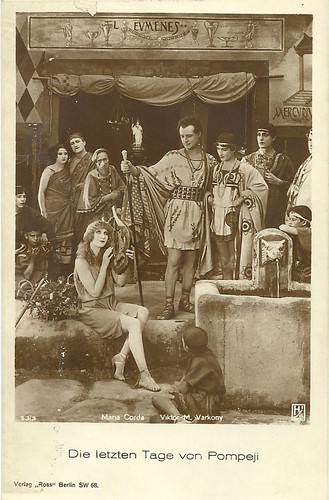
Pompeian street life with the rich Greek Glaucus (Victor Varconi) and his wealthy friends meeting the blind flower girl Nydia (Maria Corda), who also sings and plays the lyre. The bearded man left in the back is Burbo (Carlo Duse), the brutal tavern owner, who owns Nydia as a slave.

Italian postcard by C. Chierichetti, Milano. Photo: Grandi Films, Roma. Publicity still for Gli ultimi giorni di Pompei / The Last Days of Pompeii (Amleto Palermi, Carmine Gallone, 1926).
A Pompeiian street with Burbo's tavern. Sets were by Vittorio Cafiero, costumes by Duilio Cambellotti.

Italian postcard by C. Chierichetti, Milano. Photo: Grandi Films, Roma. Maria Corda as Nydia in Gli ultimi giorni di Pompei (Carmine Gallone, Amleto Palermi, 1926). Caption: The human harmonica (referring to the orgies at Arbaces' house, where women are forced to perform and serve the men).

Italian postcard by C. Chierichetti, Milano. Photo: Grandi Films, Roma. Publicity still for Gli ultimi giorni di Pompei / The Last Days of Pompeii (Amleto Palermi, Carmine Gallone, 1926).
Glaucus (Victor Varconi) has saved Nydia (Maria Corda) from Burbo and taken into his house. Nydia loves Glaucus, but he can only think of Ione.

Italian postcard by C. Chierichetti, Milano. Photo: Grandi Films, Roma. Publicity still for Gli ultimi giorni di Pompei / The Last Days of Pompeii (Amleto Palermi, Carmine Gallone, 1926).
Nydia, in love with Glaucus, thinks she has given Glaucus a love potion, but instead it makes him delirious. It is Arbaces who has concocted this.
The novel and the painting
The novel 'The Last Days of Pompeii' was written by Edward Bulwer-Lytton in 1834. Bulwer-Lytton was inspired by the painting 'The Last Day of Pompeii' by the Russian painter Karl Briullov, which Bulwer-Lytton had seen in Milan.
The novel culminates in the cataclysmic destruction of the city of Pompeii by the eruption of Mount Vesuvius in AD 79. 'The Last Days of Pompeii' became a bestseller, thanks to the eruption of Vesuvius just before its publication.
'The Last Days of Pompeii' uses its characters to contrast the decadent culture of 1st-century Rome with both older cultures and coming trends. The protagonist, Glaucus, a handsome Athenian nobleman and Ione's betrothed, represents the Greeks who have been subordinated by Rome.
His nemesis is Arbaces, a scheming Egyptian sorcerer, a high priest of Isis and the former guardian of Ione and her brother Apaecides. Arbaces represents the still older culture of Egypt. He murders Apaecides and frames Glaucus for the crime. Repeatedly, he attempts to seduce Ione.
Olinthus is the chief representative of the nascent Christian religion, which is presented favourably but not uncritically. The Christian converts Apaecides to Christianity and is sentenced to death for his religion.

German postcard by Ross Verlag, no. 53/1. Photo: Hisa Film-Vertrieb. Publicity still for Gli ultimi giorni di Pompei / The Last Days of Pompeii (Carmine Gallone, Amleto Palermi, 1926). Glaucus (Victor Varconi) and the rich Julia (Lia Maris, not Rina de Liguoro as this card pretends) meet on the streets of Pompeii, so the blind flower girl Nydia (Maria Corda) hears that Glaucus is back in town. Set designer Vittorio Cafiero copied various original artefacts from Pompeii for this film, such as the small burner held up by satyrs in the shop.

German postcard by Ross Verlag, no. 53/2. Photo: Hisa Film-Vertrieb. Publicity still for the Italian silent epic Gli ultimi giorni di Pompei / The Last Days of Pompeii (Carmine Gallone, Amleto Palermi, 1926). Glaucus (Victor Varconi) listens to beautiful and rich Greek Ione (Rina De Liguoro) playing the harp. The statue left was copied from an original Roman one.
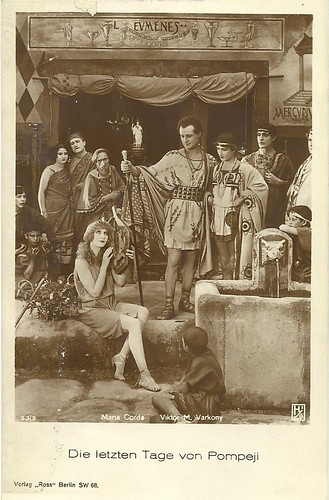
German postcard by Ross Verlag, no. 53/3. Photo: Hisa Film-Vertrieb. Publicity still for Gli ultimi giorni di Pompei / The Last Days of Pompeii (Carmine Gallone, Amleto Palermi, 1926). Collection: Didier Hanson.

German postcard by Ross Verlag, no. 1344/1, 1927-1928. Photo: Hisa Film-Vertrieb. Publicity still for Gli ultimi giorni di Pompei / The Last Days of Pompeii (Carmine Gallone, Amleto Palermi, 1926). Victor Varconi as Glaucus.

German postcard by Ross Verlag, no. 1344/2, 1927-1928. Photo: Hisa Film-Vertrieb. Publicity still for Gli ultimi giorni di Pompei / The Last Days of Pompeii (Carmine Gallone, Amleto Palermi, 1926). Victor Varconi as Glaucus.

German postcard by Verlag Ross, Berlin, no. 1345/1, 1927-1928. Rina De Liguoro as Ione in Gli ultimi giorni di Pompei / The Last Days of Pompeii (Carmine Gallone, Amleto Palermi, 1926), released in Germany as Die letzten Tage von Pompeji.

German postcard by Ross Verlag, no. 1346/1, 1927-1928. Photo: Hisa Film-Vertrieb. Maria Corda as Nydia in Gli ultimi giorni di Pompei (Carmine Gallone, Amleto Palermi, 1926).
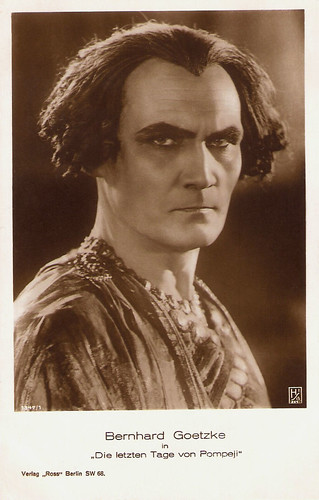
German postcard by Ross Verlag, no. 1347/1, 1927-1928. Photo: Hisa Film-Vertrieb. Publicity still for Gli ultimi giorni di Pompei / The Last Days of Pompeii (Carmine Gallone, Amleto Palermi, 1926). Bernhard Goetzke as the evil Egyptian priest Arbaces.
The star cast
Handsome Victor Varconi (1891–1976) was as Glaucus, the male star of Gli ultimi giorni di Pompei / The Last Days of Pompeii. The Hungarian Varconi, originally Viktor Varkony, was a highly successful matinee idol of the Hungarian-Austrian and German silent cinema in the 1910s and early 1920s. Later, he was the first Hungarian actor to become a Hollywood star until the sound film completely altered the course of his career.
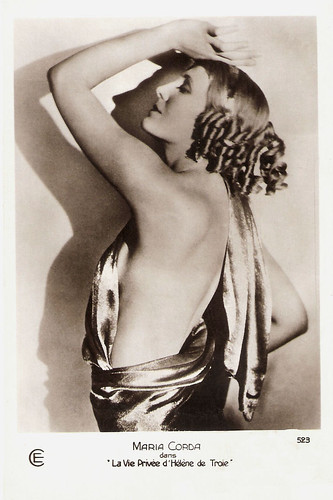
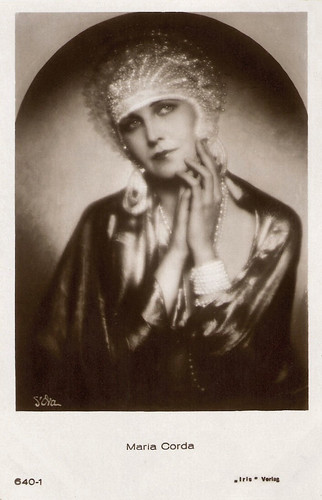
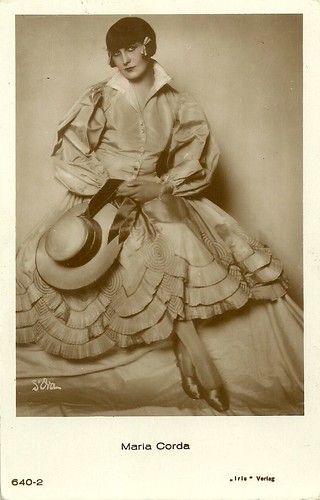
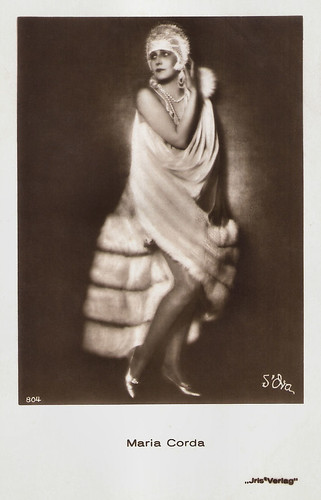
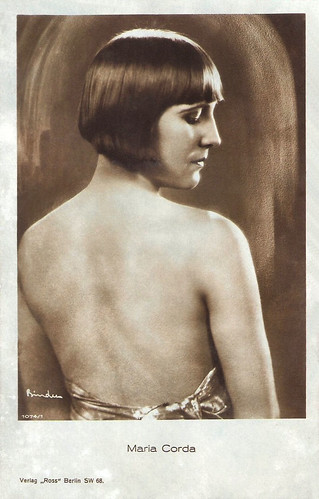
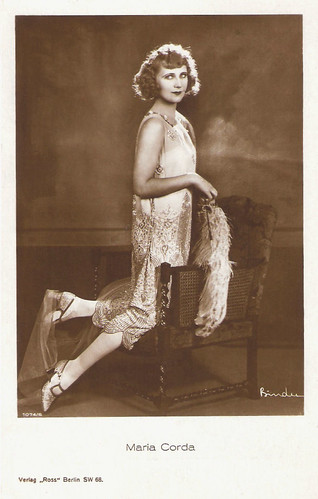
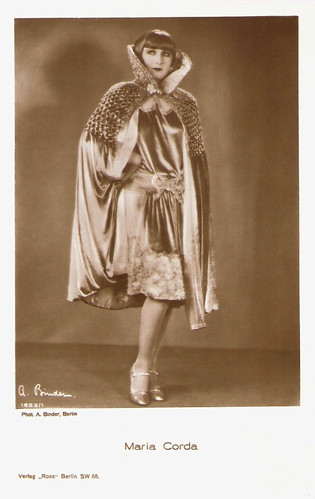
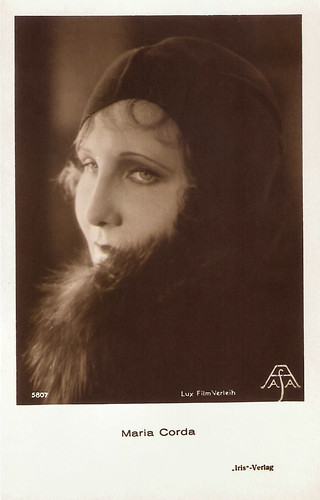
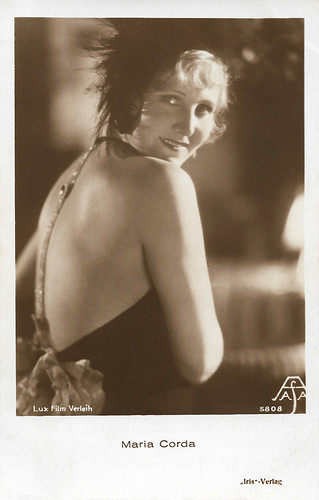
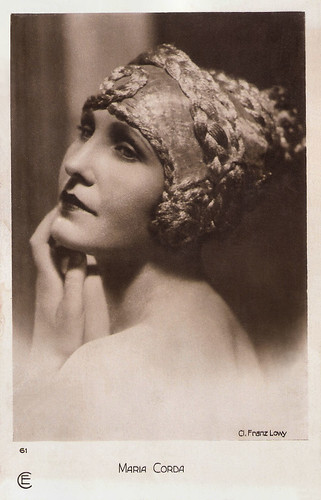
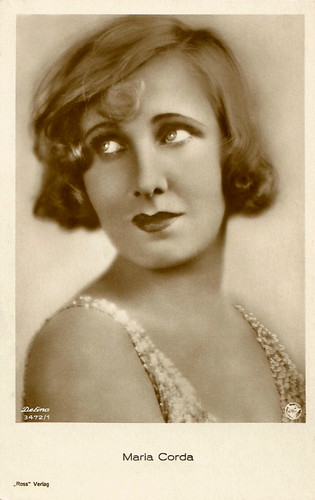
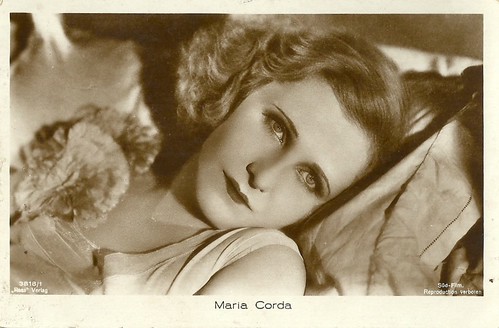
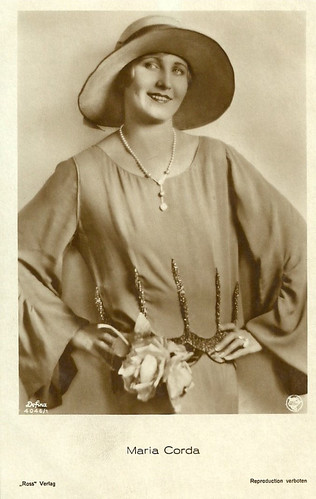
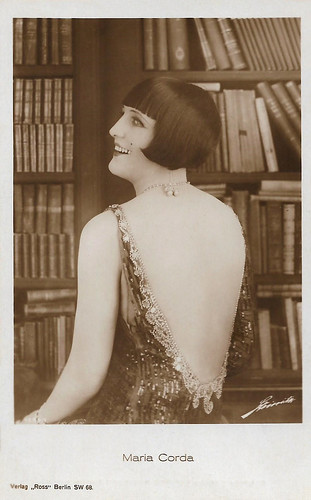
Hungarian Maria Corda (1898-1975) played the slave girl Nydia, who is in love with Glaucus. Corda was an immensely popular star of the silent cinema of Austria and Germany. The pretty, blonde actress was a queen of the popular epic spectacles of the 1920s, which were often directed by her husband, Alexander Korda.
Not pictured on one of the postcards is Rina De Liguoro (1892-1966) as Ione. She was the last diva of the Italian silent cinema of the 1920s. De Liguoro had her breakthrough in 1924 as the sensual, untamed Roman empress Messalina, and the beautiful countess continued her glittering career in such epics as Quo Vadis (1924), Casanova (1927), and Cecil B. DeMille's notorious box office flop Madam Satan (1930).
Emilio Ghione (1879-1930), who played Calenus, was an Italian silent film actor, director and screenwriter. He is best known for writing, directing and starring in the Za La Mort series of adventure films, in which he played a likeable French Apache and 'honest outlaw.'
The evil Egyptian priest Arbaces was played by German film actor Bernhard Goetzke (1884–1964). He was one of the impressive stars of German silent cinema, particularly in the films by Fritz Lang. Goetzke appeared in 130 films between 1917 and 1961.

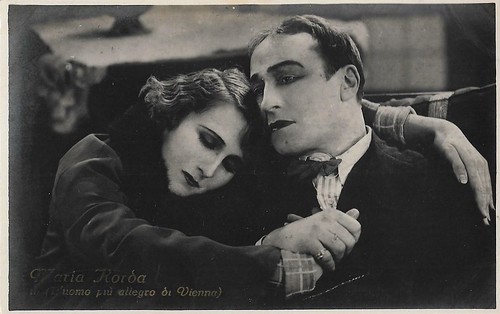
Italian postcard by C. Chierichetti, Milano. Photo: Grandi Films, Roma. Victor Varconi as Glaucus and Maria Corda as Nydia in Gli ultimi giorni di Pompei / The Last Days of Pompeii (Carmine Gallone, Amleto Palermi, 1926).

Italian postcard by C. Chierichetti, Milano. Lia Maris as Julia and Enrica Fantis as Julia's friend in Gli ultimi giorni di Pompei / The Last Days of Pompeii (Carmine Gallone, Amleto Palermi, 1926). Caption: At the Villa on the [river] Sarno.

Italian postcard by C. Chierichetti, Milano. Photo: Grandi Films, Roma. Rina De Liguoro as Ione in Gli ultimi giorni di Pompei (Carmine Gallone, Amleto Palermi, 1926).

Italian postcard by C. Chierichetti, Milano. Photo: Grandi Films, Roma. Gli ultimi giorni di Pompei / The Last Days of Pompeii (Carmine Gallone, Amleto Palermi 1926).
The Forum with the Temple of Jove (Jupiter) in Pompeii.

Italian postcard by C. Chierichetti, Milano. Photo: Grandi Films, Roma. Publicity still for Gli ultimi giorni di Pompei/The Last Days of Pompeii (Amleto Palermi, Carmine Gallone, 1926).
The funeral of Apecides (Vittorio Evangelisti). Apecides, brother of Glaucus' lover Ione and former pupil of the Egyptian high priest of Isis, Arbaces, has converted to Christianity and threatens to unmask Arbaces's frauds. Arbaces stabs him and puts the blame on Glaucus, who was unknowingly drugged by Nydia. The priest in the middle is Calenus (Emilio Ghione), who has seen Arbaces murdering Apecides. Arbaces himself (Bernhard Goetzke) can be seen at the extreme left.

Italian postcard by C. Chierichetti, Milano. Photo: Grandi Films, Roma. Publicity still for Gli ultimi giorni di Pompei/The Last Days of Pompeii (Amleto Palermi, Carmine Gallone, 1926).
At the Via delle Tombe in Pompeii, the funeral service for the murdered Apecides is held. In the centre is the priest Calenus (Emilio Ghione).

Italian postcard by C. Chierichetti, Milano. Photo: Grandi Films, Roma. Publicity still for Gli ultimi giorni di Pompei / The Last Days of Pompeii (Amleto Palermi, Carmine Gallone, 1926).
Calenus (Emilio Ghione) tries to blackmail Arbaces (Bernhard Goetzke). Arbaces leads him to his treasury.

Italian postcard by C. Chierichetti, Milano. Photo: Grandi Films, Roma. Publicity still for Gli ultimi giorni di Pompei / The Last Days of Pompeii (Amleto Palermi, Carmine Gallone, 1926).
Calenus (Emilio Ghione) has been fooled by Arbaces and is locked up in the treasury, which is also a dungeon.
The adaptations
The first theatrical adaptation of 'The Last Days of Pompeii' was Errico Petrella's opera, 'Jone', with a libretto by Giovanni Peruzzini. It premiered at La Scala in 1858. It was successful and remained in the Italian repertoire well into the 20th century. In 1877, an ambitious theatrical adaptation followed, mounted at the Queen's Theatre, Long Acre in London. It featured a staged eruption of Vesuvius, an earthquake and a sybaritic Roman feast – the earth did not quake, the volcano did not erupt, acrobats fell onto the cast below, and the production was an expensive flop.
The first film version was the British short film The Last Days of Pompeii (1900), directed by Walter R. Booth. Eight years later followed Gli ultimi giorni di Pompei / The Last Days of Pompeii (Arturo Ambrosio, Luigi Maggi, 1908). In 1913 followed to more Italian silent film versions, Gli ultimi giorni di Pompei / The Last Days of Pompeii (Mario Caserini, 1913), and Jone ovvero gli ultimi giorni di Pompei / Jone or the Last Days of Pompeii (Giovanni Enrico Vidali, Ubaldo Maria Del Colle, 1913).
The first sound version was the Hollywood production The Last Days of Pompeii (Ernest B. Schoedsack, Merian C. Cooper, 1935), with Preston Foster and Basil Rathbone. It carried a disclaimer that, although the movie used the novel's description of Pompeii, it did not use its plot or characters. The film was a moderate success on its initial release but made an overall loss of $237,000.
After the war followed the French-Italian version Gli ultimi giorni di Pompei / Les Derniers Jours de Pompéi / The Last Days of Pompeii (Marcel L'Herbier, Paolo Moffa, 1950), starring Micheline Presle and Georges Marchal. The amphitheatre scenes were filmed at the Arena di Verona. The next adaptation was another Italian version, Gli ultimi giorni di Pompei / The Last Days of Pompeii (Sergio Leone, 1959), starring Steve Reeves. Mario Bonnard, the original director, fell ill on the first day of shooting, so assistant director Leone and the scriptwriters finished the film. Later followed two TV versions and a German stage musical, Pompeji (2008).
But how was the 1926 version? David Melville reviews at IMDb: "The last of the great silent Italian epics, The Last Days of Pompeii is as lavish as anything produced by Hollywood at that time - only much, much raunchier. During an orgy in the house of the evil priest Arbaces, naked slave girls are served up (literally!) on platters decked with flowers. A nubile mummy rises out of her sarcophagus to do a striptease, and bare-breasted sphinx statues come to life as her chorus line. In the gladiators' tavern, wildly effeminate men (kohl-dark eyelids and lipstick as thick as clotted blood) drool and bat their eyes over so much naked, muscular flesh. All in all, the most satisfyingly decadent Ancient Rome saga until Fellini Satyricon in 1968!"

Italian postcard by C. Chierichetti, Milano. Photo: Grandi Films, Roma. Victor Varconi as Glaucus and Rina De Liguoro as Ione in Gli ultimi giorni di Pompei / The Last Days of Pompeii (Carmine Gallone, Amleto Palermi, 1926).

Italian postcard by C. Chierichetti, Milano. Photo: Grandi Films, Roma. Publicity still for Gli ultimi giorni di Pompei / The Last Days of Pompeii (Amleto Palermi, Carmine Gallone, 1926).
At the basilica (courts of justice). Glaucus (Victor Varconi) is sentenced to die.

Italian postcard. C. Chierichetti, Milano. Grandi Films, Roma. Maria Corda as Nydia in Gli ultimi giorni di Pompei (Carmine Gallone, Amleto Palermi, 1926).

Italian postcard by C. Chierichetti, Milano. Photo: Grandi Films, Roma. Publicity still for Gli ultimi giorni di Pompei / The Last Days of Pompeii (Amleto Palermi, Carmine Gallone, 1926).
Glaucus (Victor Varconi) and the Christian Olintus (Ferruccio Biancini), the man on the right, in the prison of the Christians, waiting for their ordeal in the arena.

Italian postcard by C. Chierichetti, Milano. Photo: Grandi Films, Roma. Publicity still for Gli ultimi giorni di Pompei / The Last Days of Pompeii (Amleto Palermi, Carmine Gallone, 1926).
Glaucus (Victor Varconi) is in prison. The man on the right is the Christian Olintus (Ferruccio Biancini), who had converted Apecides. Olintus will see the eruption and destruction of Pompeii as a punishment from God.

Italian postcard by C. Chierichetti, Milano. Photo: Grandi Films, Roma. Publicity still for Gli ultimi giorni di Pompei / The Last Days of Pompeii (Amleto Palermi, Carmine Gallone, 1926).
Glaucus is sentenced to die in the arena, eaten by lions, when just in time, Glaucus's friends Sallustius, Nydia, Ione and Calenus expose Arbaces as the real murderer, and he threatens to be lynched by the mob. Suddenly, Vesuvius erupts, and the terrorised people flee.

Italian postcard by C. Chierichetti, Milano. Photo: Grandi Films, Roma. Publicity still for Gli ultimi giorni di Pompei / The Last Days of Pompeii (Amleto Palermi, Carmine Gallone, 1926).
The destruction of the house of Glaucus.
Sources: David Melville (IMDb - Page now defunct), Wikipedia and IMDb.