Oscar Sabo (1881-1969) was a celebrated Austrian operetta singer and also a popular silent film actor. When sound film arrived, the already over 50-year-old Sabo suddenly was much in demand as a supporting player.
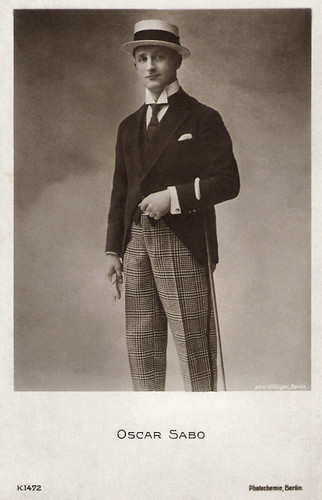
German postcard by Photochemie, no. K. 1472. Photo: Willinger, Berlin.
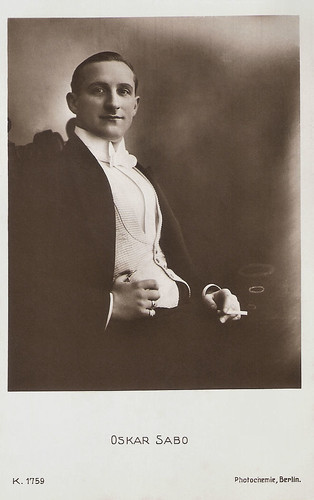
German postcard by Photochemie, no. K. 1759.
Oscar or Oskar Sabo was born in 1881 in Vienna, Austria-Hungary. He trained on the violin at the Stern'schen Konservatorium in Berlin, now the Julius Stern Institute of the Berlin University of the Arts. From 1900 onwards, he appeared as an extra in theatre plays.
When Max Reinhardt discovered him, Sabo received an engagement at the Berliner Theater. He was particularly active in farces and operettas, in which he also performed as a singer.
In 1912, he had great success in two operettas by Walter Kollo, 'Große Rosinen' (Great Raisins) and 'Filmzauber' (Film Magic). With Lisa Weise, he was the first interpreter of Kollo’s popular marching song 'Untern Linden'.
Oscar Sabo made his film debut in one of Austria’s first films, the short silent comedy Die böse Schwiegermutter / The Evil Mother-in-law (Anton Kolm, 1910). His first German film was Kehre zurück! Alles vergeben! / Come back! All forgiven! (Max Mack, 1914). He then played the title role in the comedy Der Barbier von Filmersdorf / The Barber of Filmersdorf (Carl Wilhelm, 1915) with Anna Müller-Lincke.
During the silent film era, the film industry only used Sabo incidentally. In 1922, he played a part in the historical film Der falsche Dimitri / The False Dimitri (Hans Steinhoff, 1922), starring Alfred Abel. Set in early seventeenth-century Russia, it portrays the rise of False Dmitriy I during the Time of Troubles.
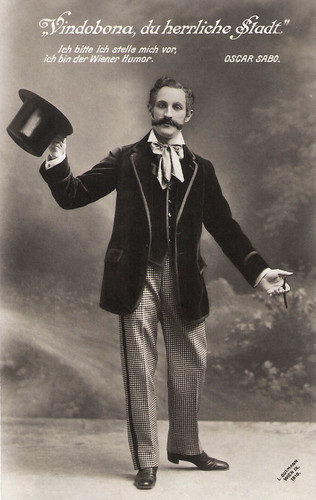
Austrian postcard by Postkartenverlag Brüder Kohn, Wien. Photo: L. Gutmann, Wien, 1910. Caption: "Vindobona, du herrliche Stadt." Ich bitte, ich stelle mich vor, ich bin der Wiener Humor. Oscar Sabo.
Only when sound film arrived, the already over fifty-year-old Oscar Sabo suddenly was much employed as a supporting player. He embodied chauffeurs, policemen, drivers, mailmen, and other subordinate figures, whom he usually depicted with humour.
His films include Der kleine Seitensprung /The Little Escapade (Reinhold Schünzel, 1931) with Renate Müller, Der Läufer von Marathon (Ewald André Dupont, 1933) starring Brigitte Helm, G'schichten aus dem Wienerwald / Tales from Vienna Woods (Georg Jacoby, 1934), and Endstation (E.W. Emo, 1935) starring Paul Hörbiger and Hans Moser.
Sabo continued his career undiminished during wartime and entertained audiences with films like Der Gasmann / The Gas Man (Carl Froelich, 1941) with Heinz Rühmann, Reise in die Vergangenheit/Trip to the Past (Hans H. Zerlett, 1943), Familie Buchholz / The Buchholz Family (Carl Froelich, 1944) and its direct sequel Neigungsehe / Marriage of Affection (Carl Froelich, 1944), both starring Henny Porten.
After the war, Sabo only appeared rarely in the cinema. His films from this period include Wenn Männer schwindeln / When Men Swindle (Carl Boese, 1950) and Madeleine und der Legionär / Escape from Sahara (Wolfgang Staudte, 1958), starring Hildegard Knef.
His son Oscar Sabo jun. (1922-1978) was also an actor. Oscar Sabo died in 1969 in Berlin. Sabo is buried in the Heerstraße cemetery in the Charlottenburg-Wilmersdorf district, as is his son.

German postcard by Photochemie, Berlin, no. 5382. Photo: Willinger. Lisa Weise and Oscar Sabo doing the 'Bärentanz' (Bear Dance), from the Operetta 'Filmzauber' (Film Magic). Caption: I cannot tell you, my child, how much I enjoy this.
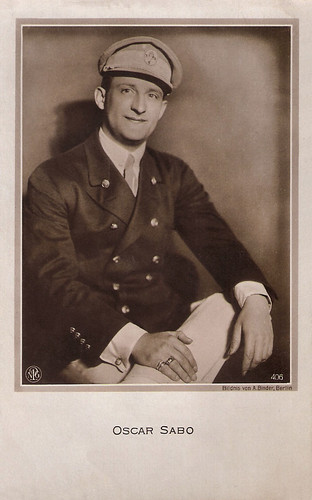
German postcard by NPG, no. 406. Photo: Alex Binder, Berlin.
Sources: Thomas Staedeli (Cyranos), Wikipedia (German and English), and IMDb. This post was last updated on 5 October 2026.
German postcard by Photochemie, no. K. 1472. Photo: Willinger, Berlin.
German postcard by Photochemie, no. K. 1759.
Discovered by Max Reinhardt
Oscar or Oskar Sabo was born in 1881 in Vienna, Austria-Hungary. He trained on the violin at the Stern'schen Konservatorium in Berlin, now the Julius Stern Institute of the Berlin University of the Arts. From 1900 onwards, he appeared as an extra in theatre plays.
When Max Reinhardt discovered him, Sabo received an engagement at the Berliner Theater. He was particularly active in farces and operettas, in which he also performed as a singer.
In 1912, he had great success in two operettas by Walter Kollo, 'Große Rosinen' (Great Raisins) and 'Filmzauber' (Film Magic). With Lisa Weise, he was the first interpreter of Kollo’s popular marching song 'Untern Linden'.
Oscar Sabo made his film debut in one of Austria’s first films, the short silent comedy Die böse Schwiegermutter / The Evil Mother-in-law (Anton Kolm, 1910). His first German film was Kehre zurück! Alles vergeben! / Come back! All forgiven! (Max Mack, 1914). He then played the title role in the comedy Der Barbier von Filmersdorf / The Barber of Filmersdorf (Carl Wilhelm, 1915) with Anna Müller-Lincke.
During the silent film era, the film industry only used Sabo incidentally. In 1922, he played a part in the historical film Der falsche Dimitri / The False Dimitri (Hans Steinhoff, 1922), starring Alfred Abel. Set in early seventeenth-century Russia, it portrays the rise of False Dmitriy I during the Time of Troubles.
Austrian postcard by Postkartenverlag Brüder Kohn, Wien. Photo: L. Gutmann, Wien, 1910. Caption: "Vindobona, du herrliche Stadt." Ich bitte, ich stelle mich vor, ich bin der Wiener Humor. Oscar Sabo.
Much employed as a supporting player
Only when sound film arrived, the already over fifty-year-old Oscar Sabo suddenly was much employed as a supporting player. He embodied chauffeurs, policemen, drivers, mailmen, and other subordinate figures, whom he usually depicted with humour.
His films include Der kleine Seitensprung /The Little Escapade (Reinhold Schünzel, 1931) with Renate Müller, Der Läufer von Marathon (Ewald André Dupont, 1933) starring Brigitte Helm, G'schichten aus dem Wienerwald / Tales from Vienna Woods (Georg Jacoby, 1934), and Endstation (E.W. Emo, 1935) starring Paul Hörbiger and Hans Moser.
Sabo continued his career undiminished during wartime and entertained audiences with films like Der Gasmann / The Gas Man (Carl Froelich, 1941) with Heinz Rühmann, Reise in die Vergangenheit/Trip to the Past (Hans H. Zerlett, 1943), Familie Buchholz / The Buchholz Family (Carl Froelich, 1944) and its direct sequel Neigungsehe / Marriage of Affection (Carl Froelich, 1944), both starring Henny Porten.
After the war, Sabo only appeared rarely in the cinema. His films from this period include Wenn Männer schwindeln / When Men Swindle (Carl Boese, 1950) and Madeleine und der Legionär / Escape from Sahara (Wolfgang Staudte, 1958), starring Hildegard Knef.
His son Oscar Sabo jun. (1922-1978) was also an actor. Oscar Sabo died in 1969 in Berlin. Sabo is buried in the Heerstraße cemetery in the Charlottenburg-Wilmersdorf district, as is his son.
German postcard by Photochemie, Berlin, no. 5382. Photo: Willinger. Lisa Weise and Oscar Sabo doing the 'Bärentanz' (Bear Dance), from the Operetta 'Filmzauber' (Film Magic). Caption: I cannot tell you, my child, how much I enjoy this.
German postcard by NPG, no. 406. Photo: Alex Binder, Berlin.
Sources: Thomas Staedeli (Cyranos), Wikipedia (German and English), and IMDb. This post was last updated on 5 October 2026.
