Ukrainian actress Diana Karenne (18??-1968) was one of the divas of Italian silent cinema. Between 1916 and 1920, Karenne fascinated European audiences with her eccentric dresses and make-up, and with her primadonna behaviour. For a long time, hardly any of her films were available, but in the past few years, several have shown up in the film archives, either as fragments or as full films, and have been shown at festivals like Il Cinema Ritrovato in Bologna, Italy. Russian film historian Tamara Shvediuk recently discovered that Karenne's film career already started before the Revolution in the Russian Empire.

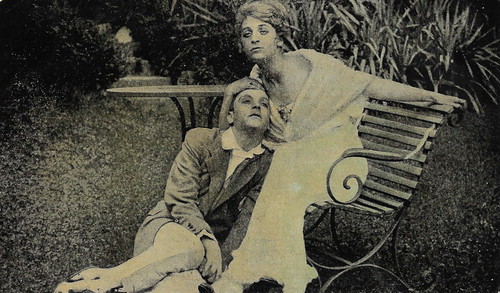
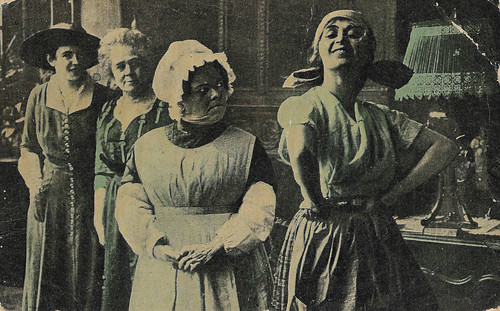
Spanish cromo (collector card) by Chocolate Imperiale, no. 6 of 6. Photo: Sabaudo Film / distr. J. Verdaguer. Diana Karenne in Lea (Diana Karenne, Salvatore Aversano, 1916).

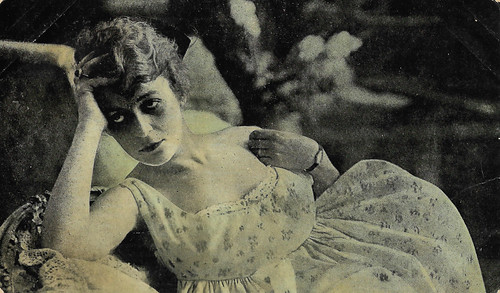
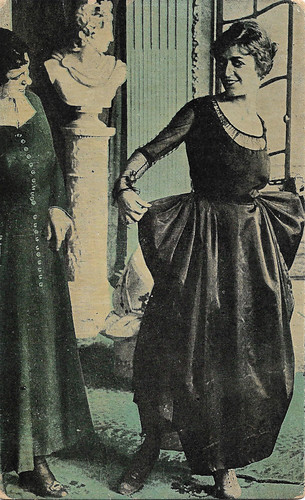
Italian postcard by Soc. A. Bettini, Roma, no. 235. Photo: Riccardo Bettini.
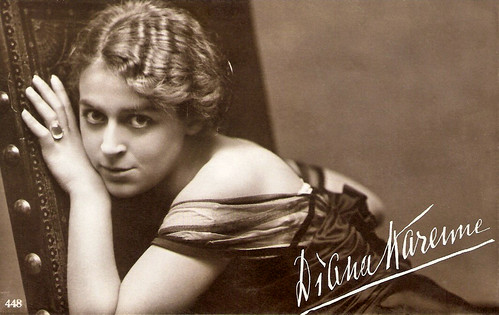
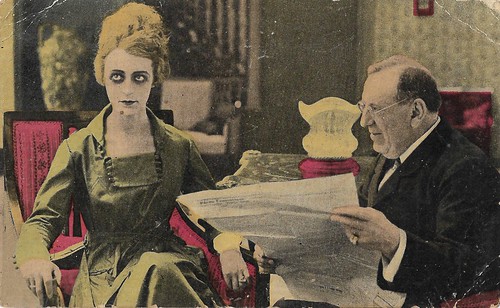
Italian postcard by Ed. A. Traldi, Milano, no. 448.
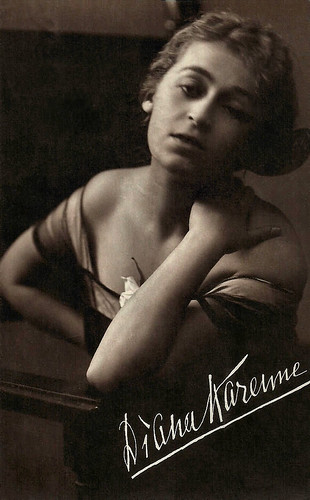
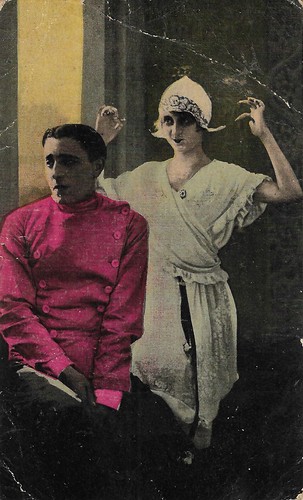
Italian postcard by Fotocelere, Torino.
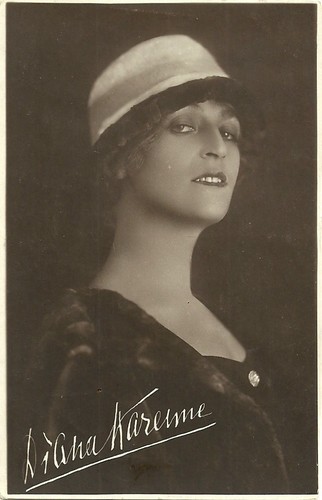
Italian postcard by Fotocelere, Torino.

Austrian postcard by Iris Verlag, no. 928. Photo: Société des Cineromans / Micheluzzi-Verleih / Cine Alliance Film. Diana Karenne in Casanova (Alexandre Volkoff, 1927).

Spanish illustration by Films selectos, Supplemento Artistico. Photo: Films Artistica Barcelonesa. Diana Karenne in Le Collier de la reine/The Queen's Necklace (Tony Lekain, Gaston Ravel, 1929).
In an article in FAScinA 11 (2024), Tamara Shvediuk writes that most of what has been published about Diana Karenne’s life is not true. Karenne’s birth name is unknown. She was most likely born in Kyiv in the Russian Empire (now Ukraine) between 1891 and 1897.
And in 1913, she already performed in Imperial Russia under the name of Dina Karen, in what was her screen debut, Tragedyia dvuch’ sester/The Two Sisters’ Tragedy (?, 1913). Before Shvediuk's rediscovery of this film, it was always thought that she had started her film career in Italy.
Interestingly, Karen also wrote the script of this film. Shvediuk: "This fact alone is extraordinary because female screenwriters in Russian pre-revolutionary cinema were a handful. The film itself would then be shown on the Russian screens for at least the entire first half of 1914.
The film was produced by one of the most important Russian film companies of the pre-revolutionary period, A. Drankov and A. Taldykin, while its director was never mentioned in the press. It is possible that Karenne also directed this film."
Her half-brother was film producer Gregor Rabinovitch, who worked in the German film industry during the 1920s and early 1930s. In 1914 Karen landed in Turin, Italy where she got acquainted with producer Ernesto Maria Pasquali. He launched her as Diana Karenne in Passione tsigana/Gypsy Passion (Ernesto Maria Pasquali, Umberto Paradisi, 1916). Immediately she became a star, and between 1916 and 1922 Karenne played leads in many successful Italian films.
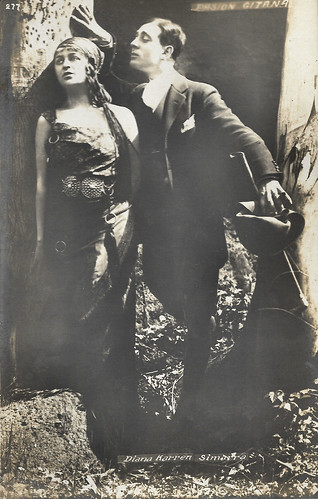
Spanish postcard, no. 277. Diana Karenne and Giovanni Cimara in Passione tsigana/Gypsy Passion (Ernesto Maria Pasquali, 1916). This film was Karenne's debut in Italian silent cinema.

Italian postcard by O.P.E.S. Torino. Diana Karenne in Passione tsigana/Gypsy Passion (Ernesto Maria Pasquali, 1916). Collection: Marlene Pilaete.

Italian postcard, no. 114.
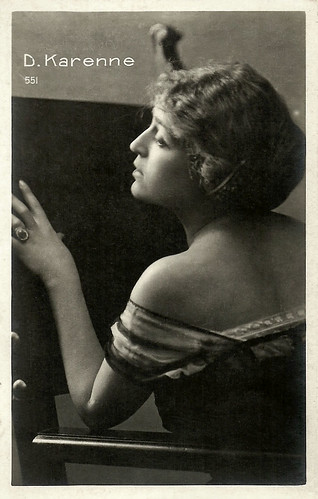
Italian postcard by Vettori, Bologna, no. 551.
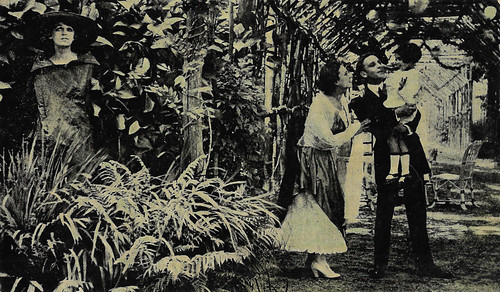
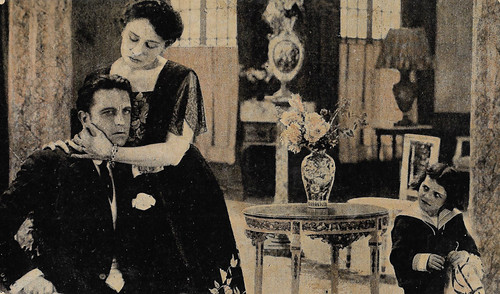
Spanish cromo (collector card) by Chocolate Imperiale, no. 4 of 6. Photo: J. Verdaguer / Sabaudo Film. Diana Karenne (left), Alfonsina Pieri and Umberto Casilini in Lea (Diana Karenne, Salvatore Aversano, 1916).
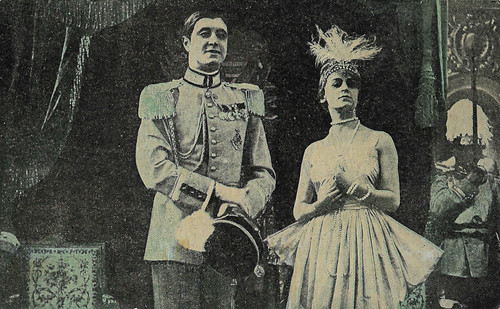
Spanish collector card by Chocolate Imperiale, no. 4 out of 6. Photo: Pasquali / Vay Film / J. Verdaguer / Prod. Armando Vay, Milano. Diana Karenne and Angelo Ferrari in Sofia di Kravonia (Ernesto Maria Pasquali, 1916), based on the book by Anthony Hope.

Spanish collector card (cromo, minicard) by Chocolat Imperiale, Barcelona, card 5 of 6. Photo: J. Verdaguer, Barcelona / David-Karenne Film. Diana Karenne and Alberto Capozzi in the Italian silent film Justice de femme! (Diana Karenne, 1917), based on the novel by Daniel Lesuer.
After films directed by Pasquali such as La contessa Arsenia (1916), Quand l'amour réfleurit (1916), Oltre la vita, oltre la morte (1916), and Sofia di Kravonia (1916), Diana Karenne managed to write and direct her films, and she even designed her film posters.
After Lea (Diana Karenne, Salvatore Aversano, 1916), Il romanzo di Maud/Maud's Romance (1917) was the second film Karenne directed herself. She also played the lead in both films.
Il romanzo di Maud, based on the French novel 'Les demi-vierges' (1895) by Marcel Prévost, tells the tale of the free-spirited Maud de Vouvres. Maud's lover is an opportunistic and dubious gentleman, Giuliano di Suberceaux. When their relationship has an impasse, Maud sees new perspectives in Massimo, a provincial enamoured with her.
Giuliano doesn't give up and forces her to see him in secret. When Maud and Massimo are married, Giuliano tells poor Massimo the truth, but Maud denies all and chases him away. When Giuliano menaces to kill himself, she coldly responds that she doesn't care.
When Massimo forces her to tell, Maud admits her former love but states Massimo is now her only love. Massimo, though, abandons her, unable to forgive her. The film was heavily censored in Italy. After its first release, it always circulated as Les demi-vierges, in particular abroad.
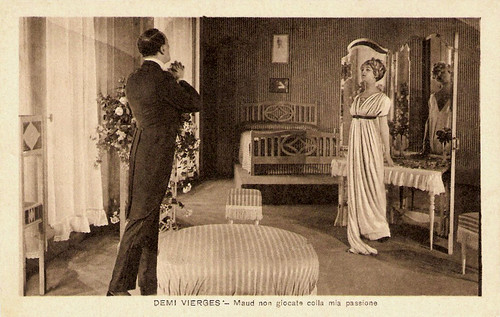
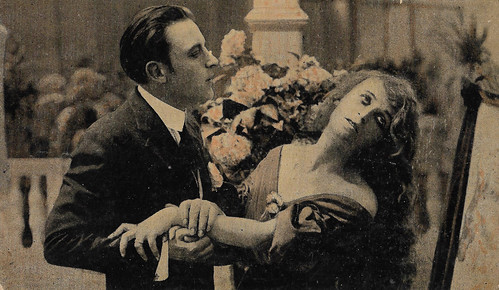
Italian postcard by Film Soc. An. Ambrosio, Torino. "Maud, don't play with my passion", her lover Giuliano implores her in Il romanzo di Maud (1917).
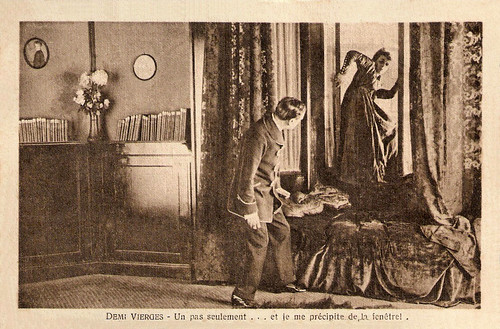
Italian postcard by Film Soc. An. Ambrosio, Torino. "One step further and I throw myself from the window", Maud (Diana Karenne) says in Il romanzo di Maud (1917).

Italian postcard by G.B. Falci, Milano. Diana Karenne in Pierrot/Histoire d'un Pierrot (1917).

Spanish postcard. Diana Karenne in Pierrot/Histoire d'un Pierrot (1917).
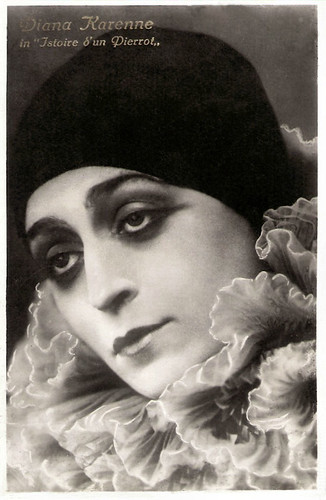
Italian postcard for Pierrot/Histoire d'un Pierrot (1917).

Belgian postcard. Diana Karenne in Redenzione/Maria di Magdala (Carmine Gallone, 1919), presented as Redemption de Marie Madeleine at the cinema Oud-Gend in Ghent, Belgium, between 17 and 23 September 1920. The distributor was the French company Gaumont.

Spanish cromo by Chocolat Imperiale, Barcelona, no. 6 of 6. Photo: Verdaguer / Tiber Film. Diana Karenne in La peccatrice casta (Diana Karenne, Gennaro Righelli, 1919).
After her years at the Pasquali company, Diana Karenne worked at Tiber Film, where she had her own 'Diana Karenne film series' including La peccatrice casta (1918) which she directed herself. In addition, in 1917 the David-Karenne film company was founded. Karenne eventually took over it herself, renaming it Karenne Film.
The film company produced such films as Pierrrot/Histoire d'un Pierrot (1917) and Justice de femme (1917), both directed by herself.
In 1920 Karenne's most successful film was a Medusa production: Maria di Magdala (1919), later renamed Redenzione, and directed by Carmine Gallone. Giulio Antamoro directed Karenne in her last film for Tiber: Zoya (Giulio Antamoro, 1920) with André Habay.
In 1919 Karenne exchanged Tiber Film for Tespi Film, where she did films like Ave Maria (1920). Afterwards, Antamoro directed her at Nova Film in the popular Miss Dorothy (Giulio Antamoro, 1920) with Carmen Boni, and Smarrita (Giulio Antamoro, 1921). All were produced by Karenne Film.
Inspired by the first film superstar Asta Nielsen, Karenne played women who opposed society. Between 1916 and 1920 Karenne fascinated audiences with her eccentric dresses and make-up, and her primadonna behaviour. Critics didn't accept her transgressive characters but the public flocked to see her films.
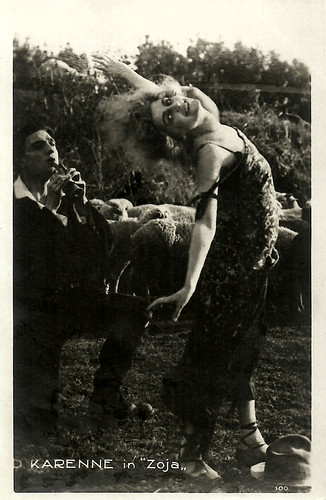
Italian postcard by Vettori, Bologna. Diana Karenne Zoya/Zoja (Giulio Antamoro, 1920), a Tiber Film production. The man left might be Mario Parpagnoli.
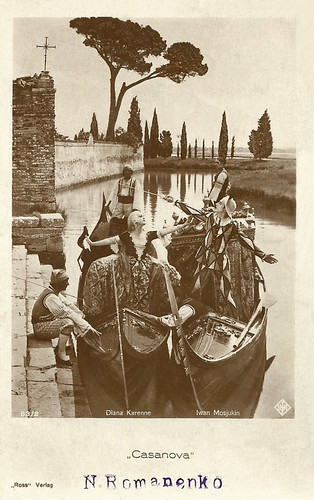
German postcard by Ross Verlag, no. 83/2. Photo: Ufa. Publicity still of Diana Karenne and Ivan Mozzhukhin in Casanova (Alexandre Volkoff, 1927). This scene was shot near the Venice cemetery Isola di San Michele.
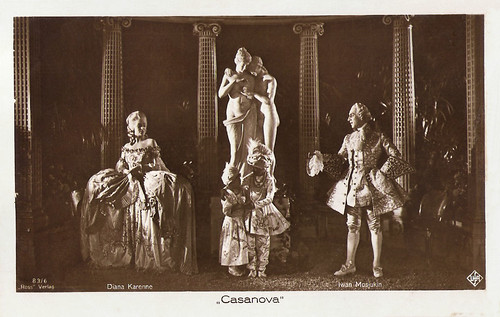
German postcard by Ross Verlag, no. 83/6. Photo: Ufa. Publicity still of Diana Karenne and Ivan Mozzhukhin in Casanova (Alexandre Volkoff, 1927).
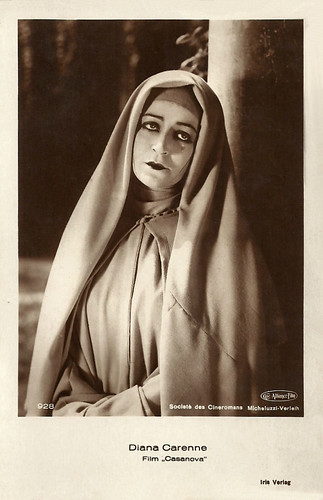
Austrian postcard by Iris Verlag, no. 928. Photo: Société des Cineromans / Micheluzzi-Verleih / Cine Alliance Film. Publicity still for Casanova (Alexandre Volkoff, 1927).
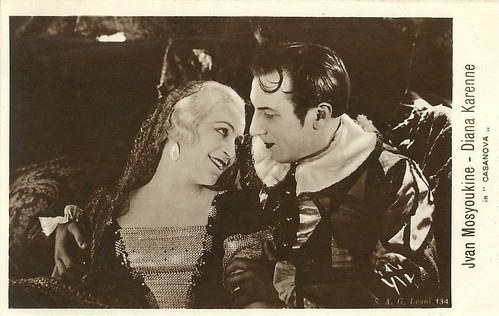
Italian postcard by S.A.G. Leoni, no. 134. Photo: publicity still of Diana Karenne and Ivan Mozzhukhin in Casanova (Alexandre Volkoff, 1927).
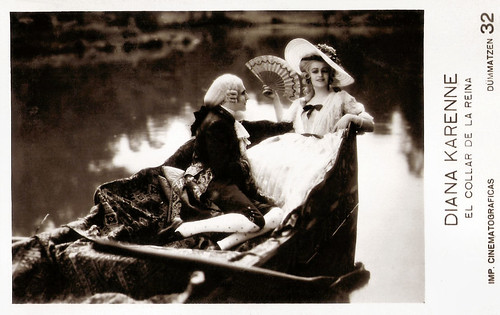
Spanish postcard by PD / Imp. Cinematorgaphicas Dümmatzen, no. 32. Photo: publicity still for Le collier de la Reine/The Queen's Necklace (Tony Lekain, Gaston Ravel, 1929).
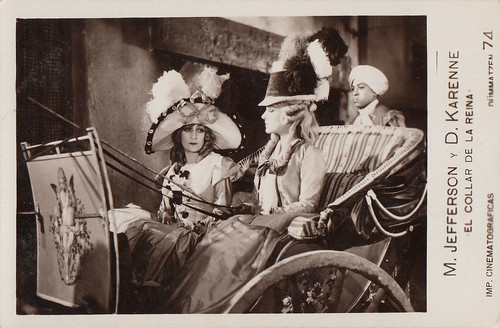
Spanish postcard by Dümmatzen, no. 74. Diana Karenne and Marcelle Jefferson-Cohn (a.k.a. Marcelle Chantal) in Le collier de la reine/The Queen's Necklace (Tony Lekain, Gaston Ravel, 1929). Collection: Marlene Pilaete.
In 1921, when things went bad for the Italian film industry, Diana Karenne moved to Paris and later to Berlin. There she had major roles such as the title role in Marie Antoinette (Rudolf Meinert, 1922), and as one of Casanova's lovers in the visually splendid Casanova (Alexandre Volkoff, 1926) starring Ivan Mozzhukhin.
Other directors of her films were Robert Wiene (Das Spiel mit dem Feuer/Playing With Fire (1921)), Richard Oswald (Die Frau von vierzig Jahren/A Forty Years Old Woman (1925)), Yakov Protazananov (L'ombre de péché/The Shadow of Sin (1923)), and Gaston Ravel (Le collier de la reine/The Queen's Necklace (1929)).
When the sound film arrived, Diana Karenne retired from the film business. She withdrew with her husband to the German city of Aachen, only reappearing once in a bit part in Manon Lescaut (Carmine Gallone, 1940), an Italian production derived from the work of Abbé Prévost, starring Alida Valli and Vittorio de Sica.
Karenne was also a painter, musician and poet. According to film historian Vittorio Martinelli and other sources, Karenne was heavily injured by the Allied bombing of Aachen and she remained in a coma for three months, never regaining consciousness. She died in October 1940. Tamara Shvediuk: "This is not totally false because, in a sense, the actress Diana Karenne disappeared exactly that year. But only some Russian sources shed some light on her private life starting from the 1920s. In that period, she met Russian acmeist poet Nikolay Otzoup and they married at the end of the decade. For a few years, she continued to work in cinema while, simultaneously, compiling a series of critical texts on films which were then published in several Russian-language Parisian newspapers.
However, by the 1930s, she was fully devoted to married life and the work of her husband, who in turn wrote two books where he described and idolized her. One of these, 'Dnevnik v stikhakh' (Diary in verse), was a memoir by Otzoup that is actually a very good resource also for Karenne’s biography." After her husband died in 1958, Diana Karenne edited his papers in two imposing volumes 'Zhizn’ i smert’ (Life and Death). She relapsed into a depression. Diana Karenne outlived her husband for ten years, and died in 1968 in Lausanne, Switzerland, from a heart attack.
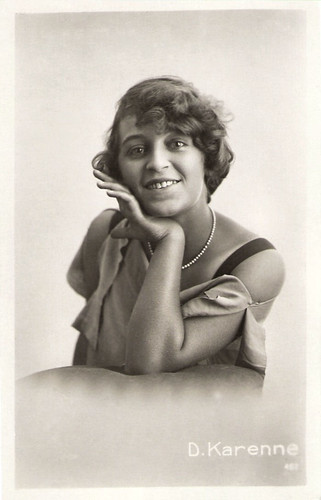
Italian postcard by Photo Vettori, Bologna.
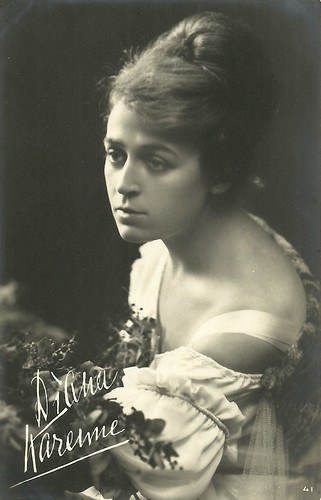
Italian postcard by Fotocelere, Torino, no. 41.
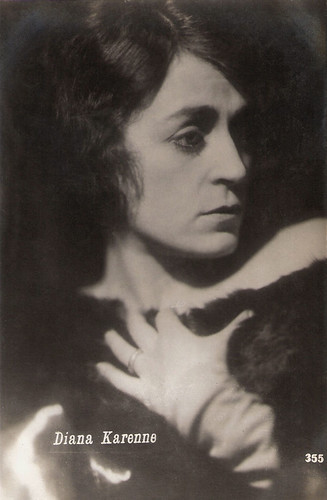
Italian postcard, no. 355.
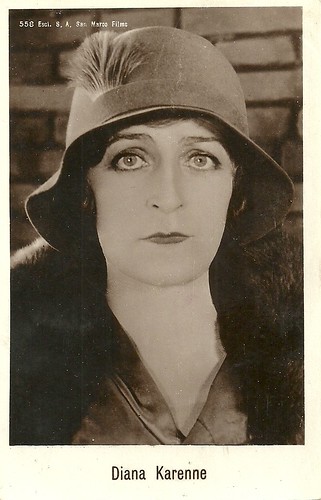
Italian postcard by Esci, S.A., no. 558 Photo: San Marco Films.
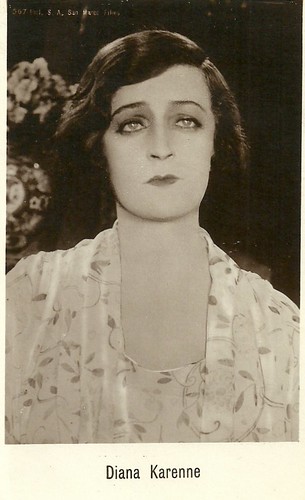
Italian postcard by G.B. Falci, Milano, no. 567. Photo: Distr. SA San Marco Films.
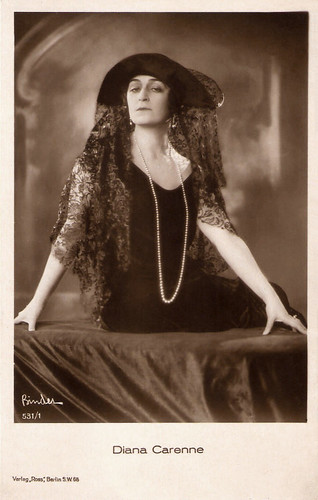
German Postcard by Ross Verlag, Berlin, no. 531/1, 1919-1924. Photo: Alex Binder.
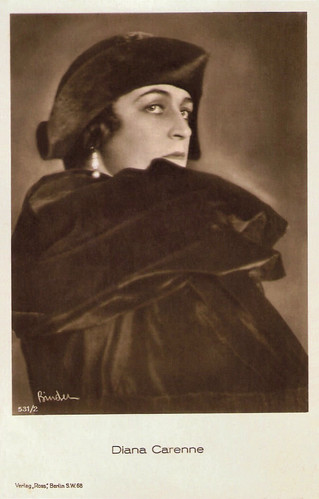
German Postcard by Ross Verlag, Berlin, no. 531/2, 1919-1924. Photo: Alex Binder.
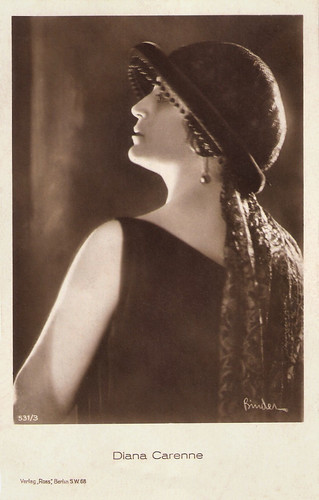
German Postcard by Ross Verlag, Berlin, no. 531/3, 1919-1924. Photo: Alex Binder.
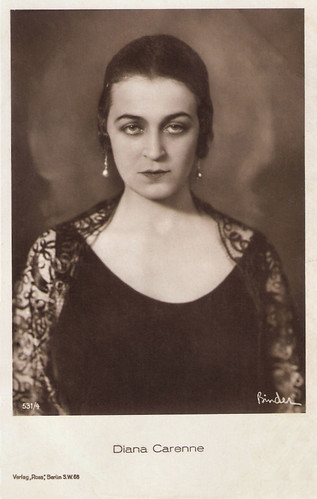
German postcard by Ross Verlag, Berlin, no. 531/4, 1919-1924. Photo: Alex Binder.
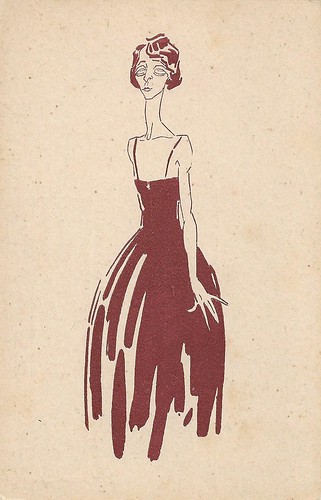
Italian postcard. Caricature by Sandro Properzi for Le Maschere, Rome.
We thank Tamara Shvediuk for sharing her article 'Diana Karenne - A Genuine Tenebrosa in Life and Onscreen' (FAScinA 11, 2024) with us.
Other sources: Marlène Pilaete (CinéArtistes - French), Vittorio Martinelli (Le dive del silenzio), Vittorio Martinelli (Il cinema muto italiano, 1917), Wikipedia (German), and IMDb.
Spanish cromo (collector card) by Chocolate Imperiale, no. 6 of 6. Photo: Sabaudo Film / distr. J. Verdaguer. Diana Karenne in Lea (Diana Karenne, Salvatore Aversano, 1916).
Italian postcard by Soc. A. Bettini, Roma, no. 235. Photo: Riccardo Bettini.
Italian postcard by Ed. A. Traldi, Milano, no. 448.
Italian postcard by Fotocelere, Torino.
Italian postcard by Fotocelere, Torino.
Austrian postcard by Iris Verlag, no. 928. Photo: Société des Cineromans / Micheluzzi-Verleih / Cine Alliance Film. Diana Karenne in Casanova (Alexandre Volkoff, 1927).
Spanish illustration by Films selectos, Supplemento Artistico. Photo: Films Artistica Barcelonesa. Diana Karenne in Le Collier de la reine/The Queen's Necklace (Tony Lekain, Gaston Ravel, 1929).
Gypsy Passion
In an article in FAScinA 11 (2024), Tamara Shvediuk writes that most of what has been published about Diana Karenne’s life is not true. Karenne’s birth name is unknown. She was most likely born in Kyiv in the Russian Empire (now Ukraine) between 1891 and 1897.
And in 1913, she already performed in Imperial Russia under the name of Dina Karen, in what was her screen debut, Tragedyia dvuch’ sester/The Two Sisters’ Tragedy (?, 1913). Before Shvediuk's rediscovery of this film, it was always thought that she had started her film career in Italy.
Interestingly, Karen also wrote the script of this film. Shvediuk: "This fact alone is extraordinary because female screenwriters in Russian pre-revolutionary cinema were a handful. The film itself would then be shown on the Russian screens for at least the entire first half of 1914.
The film was produced by one of the most important Russian film companies of the pre-revolutionary period, A. Drankov and A. Taldykin, while its director was never mentioned in the press. It is possible that Karenne also directed this film."
Her half-brother was film producer Gregor Rabinovitch, who worked in the German film industry during the 1920s and early 1930s. In 1914 Karen landed in Turin, Italy where she got acquainted with producer Ernesto Maria Pasquali. He launched her as Diana Karenne in Passione tsigana/Gypsy Passion (Ernesto Maria Pasquali, Umberto Paradisi, 1916). Immediately she became a star, and between 1916 and 1922 Karenne played leads in many successful Italian films.
Spanish postcard, no. 277. Diana Karenne and Giovanni Cimara in Passione tsigana/Gypsy Passion (Ernesto Maria Pasquali, 1916). This film was Karenne's debut in Italian silent cinema.
Italian postcard by O.P.E.S. Torino. Diana Karenne in Passione tsigana/Gypsy Passion (Ernesto Maria Pasquali, 1916). Collection: Marlene Pilaete.
Italian postcard, no. 114.
Italian postcard by Vettori, Bologna, no. 551.
Spanish cromo (collector card) by Chocolate Imperiale, no. 4 of 6. Photo: J. Verdaguer / Sabaudo Film. Diana Karenne (left), Alfonsina Pieri and Umberto Casilini in Lea (Diana Karenne, Salvatore Aversano, 1916).
Spanish collector card by Chocolate Imperiale, no. 4 out of 6. Photo: Pasquali / Vay Film / J. Verdaguer / Prod. Armando Vay, Milano. Diana Karenne and Angelo Ferrari in Sofia di Kravonia (Ernesto Maria Pasquali, 1916), based on the book by Anthony Hope.
Spanish collector card (cromo, minicard) by Chocolat Imperiale, Barcelona, card 5 of 6. Photo: J. Verdaguer, Barcelona / David-Karenne Film. Diana Karenne and Alberto Capozzi in the Italian silent film Justice de femme! (Diana Karenne, 1917), based on the novel by Daniel Lesuer.
Maud, don't play with my passion
After films directed by Pasquali such as La contessa Arsenia (1916), Quand l'amour réfleurit (1916), Oltre la vita, oltre la morte (1916), and Sofia di Kravonia (1916), Diana Karenne managed to write and direct her films, and she even designed her film posters.
After Lea (Diana Karenne, Salvatore Aversano, 1916), Il romanzo di Maud/Maud's Romance (1917) was the second film Karenne directed herself. She also played the lead in both films.
Il romanzo di Maud, based on the French novel 'Les demi-vierges' (1895) by Marcel Prévost, tells the tale of the free-spirited Maud de Vouvres. Maud's lover is an opportunistic and dubious gentleman, Giuliano di Suberceaux. When their relationship has an impasse, Maud sees new perspectives in Massimo, a provincial enamoured with her.
Giuliano doesn't give up and forces her to see him in secret. When Maud and Massimo are married, Giuliano tells poor Massimo the truth, but Maud denies all and chases him away. When Giuliano menaces to kill himself, she coldly responds that she doesn't care.
When Massimo forces her to tell, Maud admits her former love but states Massimo is now her only love. Massimo, though, abandons her, unable to forgive her. The film was heavily censored in Italy. After its first release, it always circulated as Les demi-vierges, in particular abroad.
Italian postcard by Film Soc. An. Ambrosio, Torino. "Maud, don't play with my passion", her lover Giuliano implores her in Il romanzo di Maud (1917).
Italian postcard by Film Soc. An. Ambrosio, Torino. "One step further and I throw myself from the window", Maud (Diana Karenne) says in Il romanzo di Maud (1917).
Italian postcard by G.B. Falci, Milano. Diana Karenne in Pierrot/Histoire d'un Pierrot (1917).
Spanish postcard. Diana Karenne in Pierrot/Histoire d'un Pierrot (1917).
Italian postcard for Pierrot/Histoire d'un Pierrot (1917).
Belgian postcard. Diana Karenne in Redenzione/Maria di Magdala (Carmine Gallone, 1919), presented as Redemption de Marie Madeleine at the cinema Oud-Gend in Ghent, Belgium, between 17 and 23 September 1920. The distributor was the French company Gaumont.
Spanish cromo by Chocolat Imperiale, Barcelona, no. 6 of 6. Photo: Verdaguer / Tiber Film. Diana Karenne in La peccatrice casta (Diana Karenne, Gennaro Righelli, 1919).
Pierrot
After her years at the Pasquali company, Diana Karenne worked at Tiber Film, where she had her own 'Diana Karenne film series' including La peccatrice casta (1918) which she directed herself. In addition, in 1917 the David-Karenne film company was founded. Karenne eventually took over it herself, renaming it Karenne Film.
The film company produced such films as Pierrrot/Histoire d'un Pierrot (1917) and Justice de femme (1917), both directed by herself.
In 1920 Karenne's most successful film was a Medusa production: Maria di Magdala (1919), later renamed Redenzione, and directed by Carmine Gallone. Giulio Antamoro directed Karenne in her last film for Tiber: Zoya (Giulio Antamoro, 1920) with André Habay.
In 1919 Karenne exchanged Tiber Film for Tespi Film, where she did films like Ave Maria (1920). Afterwards, Antamoro directed her at Nova Film in the popular Miss Dorothy (Giulio Antamoro, 1920) with Carmen Boni, and Smarrita (Giulio Antamoro, 1921). All were produced by Karenne Film.
Inspired by the first film superstar Asta Nielsen, Karenne played women who opposed society. Between 1916 and 1920 Karenne fascinated audiences with her eccentric dresses and make-up, and her primadonna behaviour. Critics didn't accept her transgressive characters but the public flocked to see her films.
Italian postcard by Vettori, Bologna. Diana Karenne Zoya/Zoja (Giulio Antamoro, 1920), a Tiber Film production. The man left might be Mario Parpagnoli.
German postcard by Ross Verlag, no. 83/2. Photo: Ufa. Publicity still of Diana Karenne and Ivan Mozzhukhin in Casanova (Alexandre Volkoff, 1927). This scene was shot near the Venice cemetery Isola di San Michele.
German postcard by Ross Verlag, no. 83/6. Photo: Ufa. Publicity still of Diana Karenne and Ivan Mozzhukhin in Casanova (Alexandre Volkoff, 1927).
Austrian postcard by Iris Verlag, no. 928. Photo: Société des Cineromans / Micheluzzi-Verleih / Cine Alliance Film. Publicity still for Casanova (Alexandre Volkoff, 1927).
Italian postcard by S.A.G. Leoni, no. 134. Photo: publicity still of Diana Karenne and Ivan Mozzhukhin in Casanova (Alexandre Volkoff, 1927).
Spanish postcard by PD / Imp. Cinematorgaphicas Dümmatzen, no. 32. Photo: publicity still for Le collier de la Reine/The Queen's Necklace (Tony Lekain, Gaston Ravel, 1929).
Spanish postcard by Dümmatzen, no. 74. Diana Karenne and Marcelle Jefferson-Cohn (a.k.a. Marcelle Chantal) in Le collier de la reine/The Queen's Necklace (Tony Lekain, Gaston Ravel, 1929). Collection: Marlene Pilaete.
Casanova's major lover
In 1921, when things went bad for the Italian film industry, Diana Karenne moved to Paris and later to Berlin. There she had major roles such as the title role in Marie Antoinette (Rudolf Meinert, 1922), and as one of Casanova's lovers in the visually splendid Casanova (Alexandre Volkoff, 1926) starring Ivan Mozzhukhin.
Other directors of her films were Robert Wiene (Das Spiel mit dem Feuer/Playing With Fire (1921)), Richard Oswald (Die Frau von vierzig Jahren/A Forty Years Old Woman (1925)), Yakov Protazananov (L'ombre de péché/The Shadow of Sin (1923)), and Gaston Ravel (Le collier de la reine/The Queen's Necklace (1929)).
When the sound film arrived, Diana Karenne retired from the film business. She withdrew with her husband to the German city of Aachen, only reappearing once in a bit part in Manon Lescaut (Carmine Gallone, 1940), an Italian production derived from the work of Abbé Prévost, starring Alida Valli and Vittorio de Sica.
Karenne was also a painter, musician and poet. According to film historian Vittorio Martinelli and other sources, Karenne was heavily injured by the Allied bombing of Aachen and she remained in a coma for three months, never regaining consciousness. She died in October 1940. Tamara Shvediuk: "This is not totally false because, in a sense, the actress Diana Karenne disappeared exactly that year. But only some Russian sources shed some light on her private life starting from the 1920s. In that period, she met Russian acmeist poet Nikolay Otzoup and they married at the end of the decade. For a few years, she continued to work in cinema while, simultaneously, compiling a series of critical texts on films which were then published in several Russian-language Parisian newspapers.
However, by the 1930s, she was fully devoted to married life and the work of her husband, who in turn wrote two books where he described and idolized her. One of these, 'Dnevnik v stikhakh' (Diary in verse), was a memoir by Otzoup that is actually a very good resource also for Karenne’s biography." After her husband died in 1958, Diana Karenne edited his papers in two imposing volumes 'Zhizn’ i smert’ (Life and Death). She relapsed into a depression. Diana Karenne outlived her husband for ten years, and died in 1968 in Lausanne, Switzerland, from a heart attack.
Italian postcard by Photo Vettori, Bologna.
Italian postcard by Fotocelere, Torino, no. 41.
Italian postcard, no. 355.
Italian postcard by Esci, S.A., no. 558 Photo: San Marco Films.
Italian postcard by G.B. Falci, Milano, no. 567. Photo: Distr. SA San Marco Films.
German Postcard by Ross Verlag, Berlin, no. 531/1, 1919-1924. Photo: Alex Binder.
German Postcard by Ross Verlag, Berlin, no. 531/2, 1919-1924. Photo: Alex Binder.
German Postcard by Ross Verlag, Berlin, no. 531/3, 1919-1924. Photo: Alex Binder.
German postcard by Ross Verlag, Berlin, no. 531/4, 1919-1924. Photo: Alex Binder.
Italian postcard. Caricature by Sandro Properzi for Le Maschere, Rome.
We thank Tamara Shvediuk for sharing her article 'Diana Karenne - A Genuine Tenebrosa in Life and Onscreen' (FAScinA 11, 2024) with us.
Other sources: Marlène Pilaete (CinéArtistes - French), Vittorio Martinelli (Le dive del silenzio), Vittorio Martinelli (Il cinema muto italiano, 1917), Wikipedia (German), and IMDb.