
German postcard by Verlag Louis Blumenthal, Berlin-W., no. 5001. Photo: Becker & Maass.

German postcard by Ross Verlag, no. 614/5. Photo: Union. Asta Nielsen in Rausch / Intoxication (Ernst Lubitsch, 1919), produced by Paul Otto.

German postcard by Photochemie, Berlin, no. K. 174. Photo: Alex Binder, Berlin.
Gentlemen and unscrupulous seducers
Paul Otto was born in 1878 in Berlin as Paul Otto Schlesinger. Initially, he began an apprenticeship for retail merchant and took acting lessons on the side.
At only 17, he made his stage debut in 1895. After engagements in Halle, Wiesbaden, and Hanover, he came to Berlin in 1906, where he performed on almost all the major stages until his death.
From 1910 onwards, Otto also appeared in films, often directed by Max Mack, Alwin Neuß, and Georg Jacoby. Between 1911 and 1920, he also directed films on several occasions.
One of his first parts was that of the French gentleman thief Arsène Lupin opposite Viggo Larsen as the brilliant English detective Sherlock Holmes in the five-part serial Arsène Lupin contra Sherlock Holmes (Viggo Larsen, 1910). He started at Duskes, where he made such films as Schuldig / Guilty (Paul Otto, 1912). Later, he also directed films at Oliver-Film. His preferred roles as a film actor were those of gentlemen: officers and diplomats, judges, professors, but he also played unscrupulous seducers.
Paul Otto was Asta Nielsen's partner in Die Filmprimadonna (1913) and Vordertreppe – Hintertreppe / Frontstairs and Backstairs (1916), both directed by Urban Gad. Otto played the railway inspector in Lupu Pick's Scherben / Shattered (1921), which is considered to be the earliest example of the Kammerspielfilm. Opposite Henny Porten, he acted in the drama Inge Larsen (Hans Steinhoff, 1923).
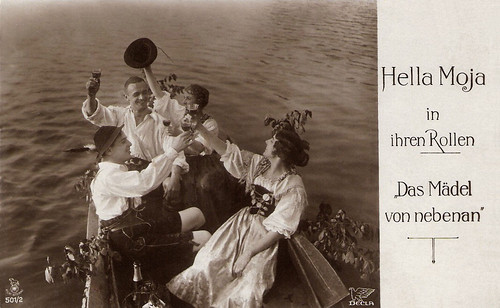
German postcard in the Film Sterne Series by Rotophot, no. 501/2. Photo: Decla. Hella Moja in Das Mädel von nebenan / The Girl Next Door (Otto Rippert, 1917), scripted by Paul Otto.

German postcard by Rotophot in the Film Sterne series, no. 501/3. Photo: Decla. Hella Moja and Theodor Loos (far left) in Die das Glück suchen / Those Searching for Happiness (1917). Odd is that this title does not appear in the databases Filmportal.de and IMDb. Yet, an announcement in Der Kinematograph of 1918 and earlier remarks in Der Lichtbildbühne of 1917 suggest the film did exist. It was directed by Otto Rippert and scripted by Paul Otto. By looking at the serial numbers of the Film-Sterne series, the film must be from 1917. It is not clear when the film when and if the film was released. Other actors mentioned as playing in the film were Hermann Thimig (who might be the doctor-like figure on our other card of the film), Anderly Lebius, and Oto Lins-Morstadt. Cinematography was by Max Fassbender. (With thanks to Jean Ritsema for this information).

German postcard by Rotophot in the Film Sterne series, no. 502/2. Photo: Decla. Alwin Neuss in Die Faust des Schicksals / Fist of Doom (Alwin Neuss, 1917), scripted by Paul Otto.

German postcard in the Film Sterne series by Rotophot, no. 511/3. Photro: Decla. Hella Moja in Die Tochter der Gräfin Stachowska (Otto Rippert, 1917), produced by Erich Pommer and scripted by Paul Otto.

German postcard by Ross Verlag, no. 650/5. Photo: Henny Porten Filmproduktion (HPF). Henny Porten and Paul Otto in Inge Larsen (Hans Steinhoff, 1924).
His Jewish background remained undiscovered at first
Paul Otto also worked as a screenwriter and producer. In the late 1910s, he wrote several scripts for films with Hella Moja. He founded Argus-Film GmbH together with Marcel Boas in June 1918. His most ambitious production was Ernst Lubitsch's adaptation of August Strindberg's Rausch / Intoxication (1919), starring Asta Nielsen. In the film Erdgift / Earth Poison (Paul Otto, 1919), starring Grit Hegesa, and which Otto wrote and directed in 1919, he adapted motifs from Frank Wedekind's drama 'Erdgeist', using expressionist stylistic devices in part.
From 1921, Otto only acted in film and stopped his career as a scriptwriter and director. He became a popular supporting actor throughout the 1920s and acted in such films as Thamar, das Kind der Berge / Thamar, Child of the Mountains (Robert Dinesen, 1924) with Lya de Putti, Frauen, die man oft nicht grüßt / Women You Rarely Greet (Friedrich Zelnik, 1925) with Lya Mara, and Die Frauengasse von Algier / The Bordellos of Algiers (Wolfgang Hoffmann-Harnisch, 1926) with Maria Jacobini. In 1929, Otto was elected to the board of the newly founded Association of Berlin Stage Artists.
After roles in 96 silent films, Paul Otto made an effortless transition to sound film. In the early 1930s, he acted in such films as Yorck / General Yorck (Gustav Ucicky, 1931), Rasputin, Dämon der Frauen / Rasputin, Demon with Women (Adolf Trotz, 1931) with Conrad Veidt, Der Hauptmann von Köpenick / The Captain from Köpenick (Richard Oswald, 1931) starring Max Adalbert and Liebelei / A Love Story (Max Ophüls, 1933).
After the National Socialists came to power in 1933, Paul Otto turned his attention increasingly to theatre work. He continued to appear in numerous films, but always in supporting roles. His Jewish background remained undiscovered at first. In 1937, he was appointed State Actor by Adolf Hitler on account of his stage work at Heinz Hilpert's Deutsches Theater, which was highly regarded by the National Socialists, and in 1942, he took over the management of the stage department of the Reichskulturkammer (Reich Theatre Chamber).
By chance, Paul Otto's Jewish ancestry was discovered in the fall of 1943. Otto didn't see a way out of his situation. To avoid deportation, he and his wife, actress Charlotte Klinder-Otto, took their own lives in their home in Berlin. His grave is located in the Wilmersdorf Cemetery in Berlin. Altogether, he played in 96 silent and 57 sound films.

German postcard by Ross Verlag, no. 3109/1, 1928-1929. Photo: Atelier Rembrandt, Berlin.

German postcard by Ross Verlag, no. 154/2. Photo: FFG. Gitta Alpár and Paul Otto in Die - oder keine / She, or Nobody (Carl Froelich, 1932).

German postcard by Ross Verlag, no. A 2666/1, 1939-1940. Photo: Quick / Tobis.
Sources: Filmportal, Wikipedia (German and English) and IMDb.

No comments:
Post a Comment