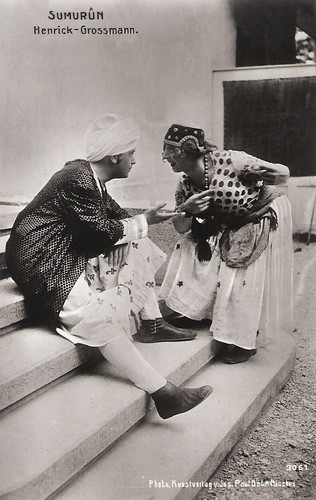
In the late 1910s and the 1920s, Polish film actress Pola Negri (1897-1987) achieved notoriety as a femme fatale in silent films in Poland, Berlin, and Hollywood. Negri was an overnight sensation in Ernst Lubitsch's Madame Dubarry / Passion (1919). Her vamp roles were so popular that she was a direct rival of Theda Bara, and lived in a Hollywood palace, modelled after the White House.
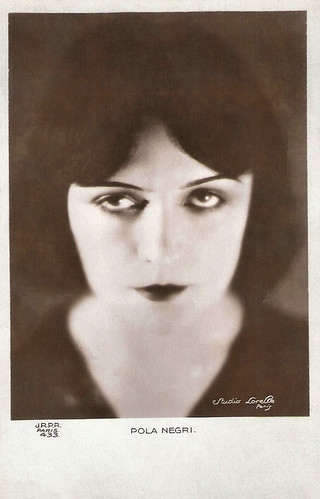
French postcard by J.R.P.R., Paris, no. 433. Photo: Studio Lorelle, Paris.
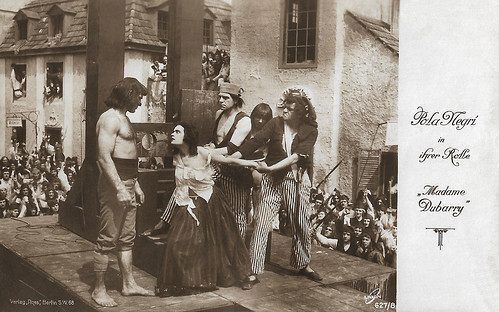
German postcard by Ross Verlag, no. 627/8. Photo: Union. Pola Negri in Madame Dubarry (Ernst Lubitsch, 1918).

German postcard by Photochemie, Berlin, no. K. 2569. Photo: Union. Ernst Wendt, Pola Negri and Arthur Schröder in Mania (Eugen Illés, 1918).
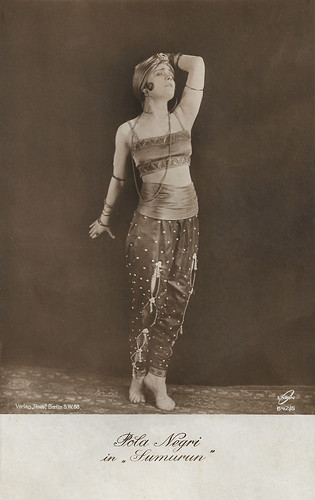
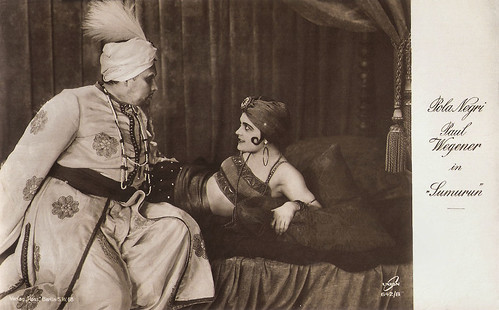
German postcard by Ross Verlag, Berlin, no. 642/5. Photo: Union Film. Pola Negri in Sumurun (Ernst Lubitsch, 1920).
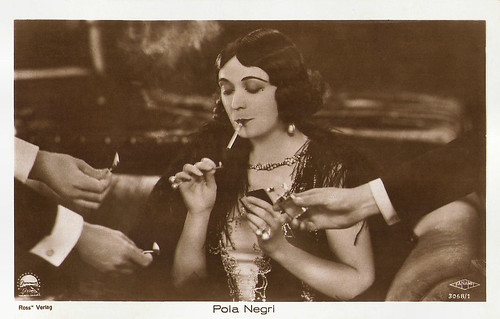
German postcard by Ross Verlag, no. 3068/1, 1928-1929. Photo: Paramount / Fanamet. Pola Negri in Good and Naughty (Malcolm St. Clair, 1926).

German postcard by Ross Verlag, Berlin, no. 72/1. Photo: Parufamet / Paramount. Pola Negri in Hotel Imperial (Mauritz Stiller, 1927).

German postcard by Ross Verlag, Berlin, no. 3814/1, 1928-1929. Photo: Paramount. Pola Negri in Loves of an Actress (Rowland V. Lee, 1928).
Pola Negri was born Barbara Apolonia Chałupiec in Lipno (some sources say Janowa), Russian Empire (present-day Poland), in 1897. Her father, Juraj Chałupiec, was a Slovak immigrant tinsmith. Her mother had to make a living alone after her father was arrested by the Russians and sent to a Siberian prison camp, where he died. In 1902, mother and her only daughter moved to Warsaw, where they lived in poverty. As a teenager, Pola auditioned for the St. Petersburg Imperial Ballet. She was accepted. As a ballerina, she showed great promise until she contracted tuberculosis and was forced to cut short her dance career.
She switched to the Warsaw Imperial Academy of Dramatic Arts and became an actress. Her triumphant debut as Hedwig in Henrik Ibsen's 'The Wild Duck' brought her to the attention of the prestigious and daring Little Theatre of Philharmonic Hall. After a brief stay, Pola moved on to the Rozmaitosci, the national theatre of Poland.
By now, Pola had become a popular and well-known actress in Warsaw, but the outbreak of World War I interrupted her rise and left her and her mother in dire financial straits. By the time the war receded, Pola had signed with the Polish film company Sphinx and debuted as a dancer in Niewolnica zmyslów / Slave of the Senses (Ryszard Ordynski, Jan Pawlowski, 1914).
She appeared in a variety of films, including Żona / The Wife (Aleksander Hertz, 1915), Bestia / Beast (Aleksander Hertz, 1915), and Studenci / Students (Aleksander Hertz, 1916). During that time, she adopted the pseudonym ‘Pola Negri’, after the Italian poetess Ada Negri.
As the situation in Warsaw stabilised, the city's theatres soon became active again, and Pola gained the chance of a lifetime. David Ordynski, a Polish director currently working with Max Reinhardt at his Deutsches Theater in Berlin, returned to Warsaw to stage the Polish premiere of Reinhardt's 'Sumurun'. This is the story of a mulatto dancer bought in the slave market for the Sheik but is loved by his son. She kills the Sheik in self-defence. Pola's success in the role of the slave girl took her to Berlin.

Polish postcard, no. 6011. Photo: Malarski & Tavrell. Pola Negri in 'Sumurun'.

Polish postcard. Photo: Malarski & Tavrell. Photo: Pola Negri in the play 'Sumurun'. Collection: Marlene Pilaete.

German postcard by Ross Verlag, Berlin, no. 234. Photo: Anny Eberth. Pola Negri in her costume of 'Sumurun'.
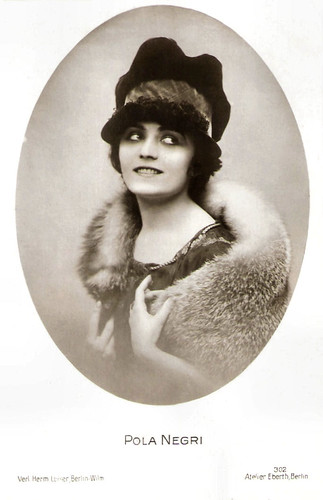
German postcard by Verlag Hermann Leiser, Berlin-Wilm., no. 302. Photo: Atelier Eberth, Berlin.
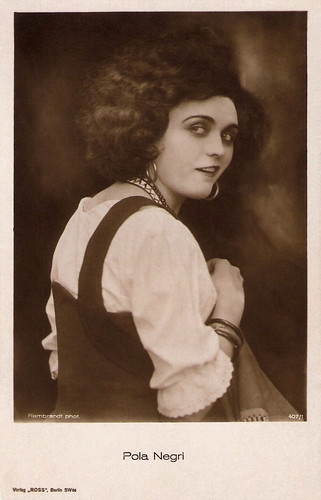
German postcard by Ross Verlag, Berlin, no. 407/1, 1919-1924. Photo: Rembrandt Phot.

German postcard by Ross Verlag, Berlin, no. 407/4, 1919-1924. Photo: Rembrandt Phot. Pola Negri in Mania. Die Geschichte einer Zigarettenarbeiterin/Mania: The Story of a Cigarette Girl (Eugen Illés, 1918).

German postcard by Ross Verlag, Berlin / W.J. Mörling, Berlin, no. 425/2. Photo: Karl Schenker, Berlin.

German postcard by Ross Verlag, Berlin / W.J. Mörling, Berlin, no. 425/3. Photo: Karl Schenker, Berlin.

German postcard by Ross Verlag, Berlin / W.J. Mörling, Berlin, no. 477/1. Photo: Karl Schenker, Berlin. Pola Negri in the final scene of Sappho / Mad Love (Dimitri Buchowetzki, 1921).

German postcard by Ross Verlag, Berlin, no. 488/3. Photo: Ernst Sandau.
In Berlin, Pola Negri found considerable success at the Deutsches Theater. She met German fellow actor-turned-director Ernst Lubitsch, who became famous for the ‘Lubitsch Touch’, the skilful blending of sly wit and innuendo that confounded even the strictest censor in the 1920s.
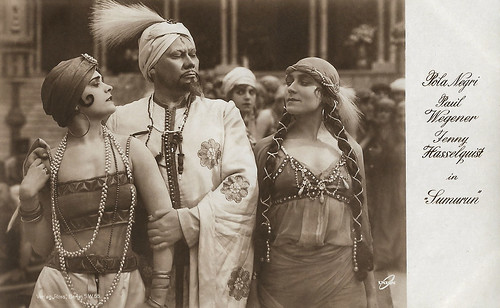
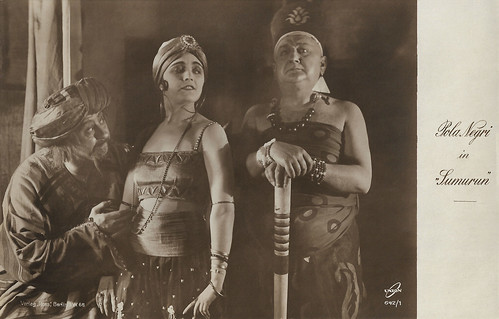
Lubitsch introduced Pola to Paul Davidson, head of Germany's Union Film Alliance, and together they made such films as Die Augen der Mumie Ma / The Eyes of Mummy Ma (Ernst Lubitsch, 1918), Carmen / Gypsy Blood (Ernst Lubitsch, 1918) based on the Georges Bizet opera, a film version of Sumurun / One Arabian Night (Ernst Lubitsch, 1920), and Die Bergkatze / The Wildcat (Ernst Lubitsch, 1921).
The characters that Pola played were strong, earthy, passionate women - full of fire, and her roles to date were of women whose will and ardour were equal to Negri's own.
While Pola also hit it big in such non-Lubitsch films as Arme Violetta / Camille (Paul L. Stein, 1920) and Sappho (Dimitri Buchowetzki, 1921), it was their pairing in the smash hit Madame Dubarry / Passion (Ernst Lubitsch, 1919) that made them an overnight sensation.
Madame Dubarry / Passion was such a success in the USA that by 1922, Negri and Lubitsch both signed contracts with Famous Players and headed for Hollywood.

German collector card by Ross Verlag in the series 'Vom Werden deutscher Filmkunst - Der Stumme Film', picture no. 58, group 40. Photo: Ufa. Emil Jannings and Pola Negri in Die Augen der Mumie Ma / The Eyes of the Mummy (Ernst Lubitsch, 1918).

German postcard by Photochemie, Berlin, no. K. 2765. Photo: Atelier Eberth / Union. Pola Negri in Carmen (Ernst Lubitsch, 1918).

German postcard by Photochemie, Berlin, no. K. 2849. Photo: Union. Pola Negri in Carmen (Ernst Lubitsch, 1918).

German postcard by Ross Verlag, no. 627/1. Photo: Union. Pola Negri in Madame Dubarry (Ernst Lubitsch, 1918).

German postcard by Ross Verlag, Berlin, no. 627/2, 1919-1924. Photo: Union. Pola Negri and Harry Liedtke in Madame Dubarry (Ernst Lubitsch, 1919).

German postcard by Verlag Ross, Berlin, no. 642/1. Photo: Union. Pola Negri in Sumurun (Ernst Lubitsch, 1920).

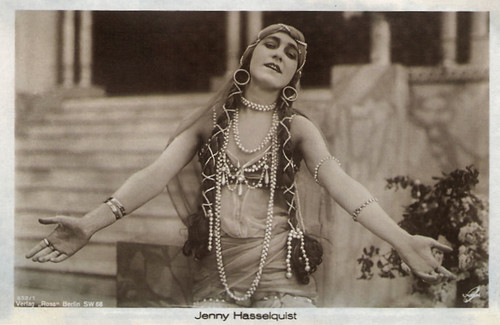
German postcard by Ross Verlag, Berlin. Photo: Union Film. Publicity still for Sumurun (Ernst Lubitsch, 1920) with Pola Negri, Paul Wegener, and Jenny Hasselqvist.
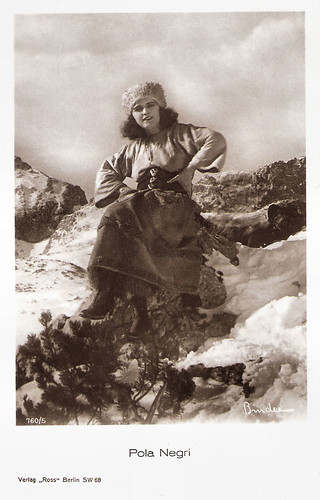
German postcard by Ross Verlag, Berlin, no. 760/5. Photo: Alex Binder. Pola Negri in Die Bergkatze / Wildcat (Ernst Lubitsch, 1921).

German postcard by Ross Verlag, no. 1523/3, 1927-1928. Photo: Parufamet. Pola Negri in Forbidden Paradise (Ernst Lubitsch, 1924).
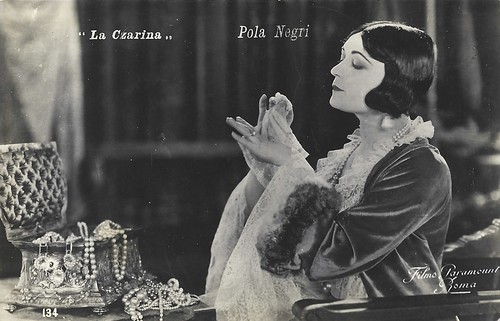
Italian postcard, no. 134. Photo: Films Paramount, Roma. Pola Negri in Forbidden Paradise (Ernst Lubitsch, 1924), launched in Italy as La Czarina.
In 1923, Pola Negri landed the role of Maritana in The Spanish Dancer (Herbert Brenon, 1923) with Antonio Moreno and Wallace Beery. Her exotic style of glamour proved popular with filmgoers. Audiences equally liked her next productions, Bella Donna (George Fitzmaurice, 1923) and The Cheat (George Fitzmaurice, 1923). Negri lived in a palace in Los Angeles, modelled after the White House.
Forbidden Paradise (Ernst Lubitsch, 1924), with Adolphe Menjou and Hotel Imperial (Mauritz Stiller, 1927) were two of her most successful films. However, her vamp style began to go out of vogue, and her popularity quickly began to fade.
Three things conspired to end her career in Hollywood. The display that she put on at the funeral of Rudolph Valentino in 1926 changed the public mood towards her. The Hays Office codes, which would not allow filming the 'scenes of passion' and 'excessive and lustful kissing' that had made her a sex-siren European star. And finally, her thick accent would not play in the sound pictures that were coming into vogue.
In 1928, Negri made her last film for Paramount Pictures entitled The Woman from Moscow (Ludwig Berger, 1928), opposite Norman Kerry. The film was only Negri's second talkie, the first being Loves of an Actress (Rowland V. Lee, 1928) opposite Nils Asther, and Paramount didn’t renew her contract.
Having divorced Eugeniusz Dąbski in 1921, Negri married the self-claimed Georgian prince Serge Mdivani in 1927. In 1929, Negri lost most of her fortune in the Wall Street Crash. The couple divorced, and she left Hollywood for Great Britain to make the drama The Way of Lost Souls / The Woman He Scorned (Paul Czinner, 1929).
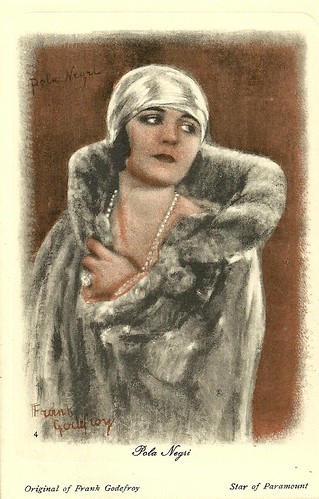
Dutch postcard by J.[Jos] M.H. Nuss, Laren, no. 4. Picture: Frank Godefroy.

Dutch postcard by J.[Jos] M.H. Nuss, Laren, no. 6. Picture: Frank Godefroy. Pola Negri in The Spanish Dancer (1923).

German postcard by Ross Verlag, no. 1093/3, 1927-1928. Photo: Paramount. Herbert Brenon directs Pola Negri in The Spanish Dancer (1923). This silent Paramount production is set in Spain in 1625. It tells of the adventures of Maritana, a Spanish gypsy singer, who is in love with the penniless nobleman and bon vivant Don César de Bazan. The lovers become involved in a court intrigue with the intention of driving the Spanish king and his French wife apart. Maritana's charm and shrewdness save the day.

German postcard by Ross Verlag, Berlin, no. 1093/2. Photo: Paramount. Pola Negri and director Dimitri Buchowetzki on the set of the film Men (1924).
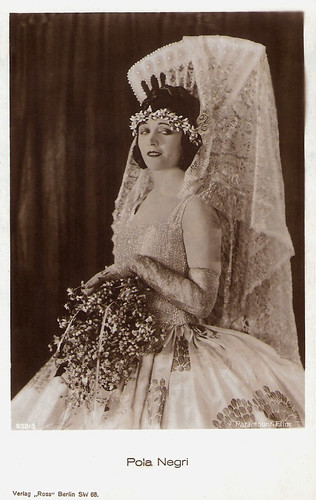
German postcard by Ross Verlag, no. 939/5, 1925-1926. Photo: Paramount-Film. Pola Negri in The Cheat (George Fitzmaurice, 1923).

Italian postcard by Casa Editrice Ballerini & Fratini, Firenze, no. 778. Photo: S.R.I. Films Paramount, Roma. Pola Negri and Noah Beery in Lily of the Dust (Dimitri Buchowetzki, 1924).

Italian postcard by Ed. Ballerini & Fratini, Firenze. Photo: Pola Negri in Good and Naughty (Malcolm St. Clair, 1926).
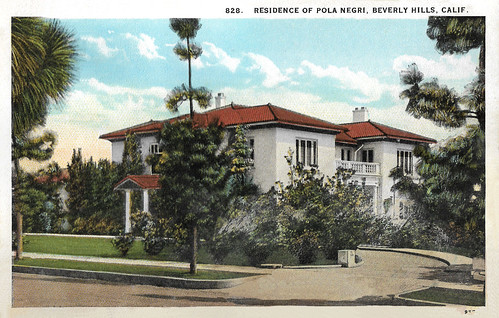
American postcard by Western Publishing & Novelty Co., Los Angeles, Calif, no. 828. Caption: Residence of Pola Negri, Beverly Hills, Calif.
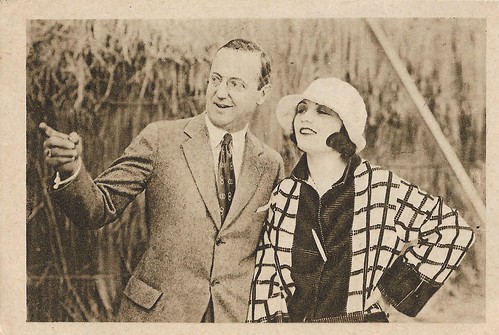
Spanish collectors card by Amatller, Barcelona, in the 'Los artistas cinematograficos en la intimidad' Series, no. A. Photo: Pola Negri and Jesse Lasky.
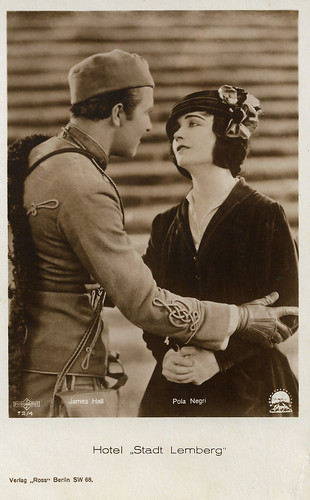
German postcard by Ross Verlag, Berlin, no. 72/4. Photo: ParUfaMet / Paramount. James Hall and Pola Negri in Hotel Imperial (Mauritz Stiller, 1927). The German film title was Hotel "Stadt Lemberg".
After 1930, Pola Negri worked mainly in England and Germany, where she acted in films for the Joseph Goebbels - controlled Ufa. Mazurka (Willi Forst, 1935) gained much popularity in Germany and became one of Adolf Hitler's favourite films.
She fled Germany in 1938 after Nazi officials labelled her as having "part Jewish" ancestry. She moved to France, and then in 1941, she sailed from Portugal to New York and was temporarily detained at Ellis Island. After her release, she eventually returned to Hollywood. She briefly appeared in Hi Diddle Diddle (Andrew L. Stone, 1943), though her career was essentially over.
In 1951, Negri became a naturalised citizen of the United States. Her final film appearance was in the Walt Disney film The Moon-Spinners (James Neilson, 1964), with Hayley Mills. The same year, she received an honorary award from the German film industry for her career.
Negri lived her remaining years in San Antonio, Texas, with her companion, Texan heiress and composer, Margaret West. In 1970, she published her autobiography, 'Memoirs of a Star' (1970). Negri maintained her flamboyant persona to the end of her life and was often compared to the character role she once had turned down: Norma Desmond in Sunset Boulevard (Billy Wilder, 1950).
Pola Negri died in 1987 in San Antonio, USA, at the age of 90. Her death was caused by pneumonia. However, she was also suffering from a brain tumour for which she had refused treatment.

French postcard by A.N., Paris, no. 448. Photo: Paramount. Pola Negri in The Woman from Moscow (Ludwig Berger, 1928).
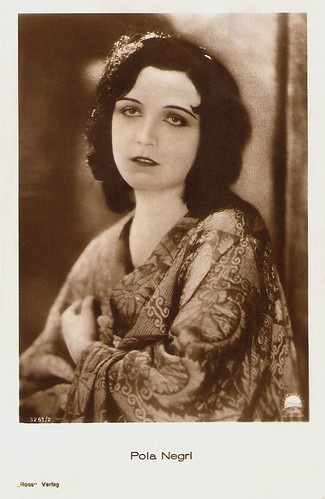
German postcard by Ross Verlag, no. 3261/2, 1928-1929. Photo: Paramount.
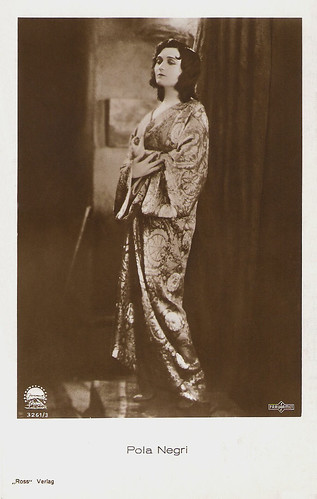
German postcard by Ross Verlag, no. 3261/3, 1928-1929. Photo: Paramount / Parufamet.

German postcard by Ross Verlag, Berlin, no. 3987/2, 1928-1929. Photo: Paramount. Pola Negri in Loves of an Actress (Rowland V. Lee, 1928).
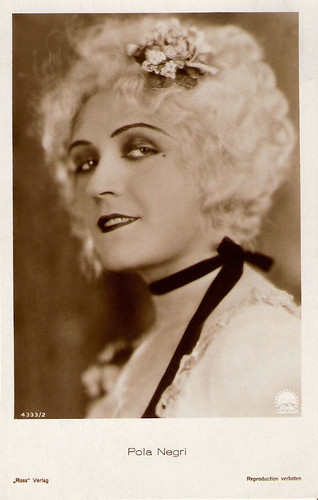
German postcard by Ross Verlag, no. 4333/2, 1929-1930. Photo: Paramount. Photo: Paramount. Pola Negri in Loves of an Actress (Rowland V. Lee, 1928).

German postcard by Ross Verlag, no. 4733/1, 1929-1930. Photo: Paramount. Pola Negri in The Woman from Moscow (Ludwig Berger, 1928).

Belgian postcard issued by the Splendid-Cinéma for the showing of The Way of Los Souls / The Woman He Scorned (in French: Son dernier tango) (Paul Czinner, 1929), produced by Gaumont-British as an early sound film. Some say it was instead a late silent film, so maybe it was shot in both a silent and a sound version.

German postcard by Ross Verlag, no. A 1393/1, 1937-1938. Photo: Atelier Sandau, Berlin. Albrecht Schoenhals and Pola Negri in Mazurka (Willi Forst, 1935).

German postcard by Ross Verlag / Das Programm von Heute für Film und Theater G.m.b.H., Berlin. Photo: Cine-Allianz. Pola Negri in Mazurka (Willi Forst, 1935).

German postcard by Das Programm von Heute, Berlin. Photo: Badal / Terra. Possibly Pola Negri in Der Weg nach Shanghai / Moskou Shanghai (Paul Wegener, 1936).

German postcard by Ross Verlag, no. A 1047/1, 1937-1938. Photo: Euphono-Film / Terra. Pola Negri in Madame Bovary (Gerhard Lamprecht, 1937), based on the novel by Gustave Flaubert.
Scene with Pola Negri in A Woman of the World (Malcolm St. Clair, 1925). Source: Beruozinka (YouTube).
Sources: Glen Pringle and Kally Mavromatis (Silent Star of April - Now defunct), Tony Fontana (IMDb), Denny Jackson (IMDb), David Gasten (Pola Negri Appreciation Site - Now defunct), Wikipedia and IMDb.
French postcard by J.R.P.R., Paris, no. 433. Photo: Studio Lorelle, Paris.
German postcard by Ross Verlag, no. 627/8. Photo: Union. Pola Negri in Madame Dubarry (Ernst Lubitsch, 1918).
German postcard by Photochemie, Berlin, no. K. 2569. Photo: Union. Ernst Wendt, Pola Negri and Arthur Schröder in Mania (Eugen Illés, 1918).
German postcard by Ross Verlag, Berlin, no. 642/5. Photo: Union Film. Pola Negri in Sumurun (Ernst Lubitsch, 1920).
German postcard by Ross Verlag, no. 3068/1, 1928-1929. Photo: Paramount / Fanamet. Pola Negri in Good and Naughty (Malcolm St. Clair, 1926).
German postcard by Ross Verlag, Berlin, no. 72/1. Photo: Parufamet / Paramount. Pola Negri in Hotel Imperial (Mauritz Stiller, 1927).
German postcard by Ross Verlag, Berlin, no. 3814/1, 1928-1929. Photo: Paramount. Pola Negri in Loves of an Actress (Rowland V. Lee, 1928).
Poverty and tuberculosis
Pola Negri was born Barbara Apolonia Chałupiec in Lipno (some sources say Janowa), Russian Empire (present-day Poland), in 1897. Her father, Juraj Chałupiec, was a Slovak immigrant tinsmith. Her mother had to make a living alone after her father was arrested by the Russians and sent to a Siberian prison camp, where he died. In 1902, mother and her only daughter moved to Warsaw, where they lived in poverty. As a teenager, Pola auditioned for the St. Petersburg Imperial Ballet. She was accepted. As a ballerina, she showed great promise until she contracted tuberculosis and was forced to cut short her dance career.
She switched to the Warsaw Imperial Academy of Dramatic Arts and became an actress. Her triumphant debut as Hedwig in Henrik Ibsen's 'The Wild Duck' brought her to the attention of the prestigious and daring Little Theatre of Philharmonic Hall. After a brief stay, Pola moved on to the Rozmaitosci, the national theatre of Poland.
By now, Pola had become a popular and well-known actress in Warsaw, but the outbreak of World War I interrupted her rise and left her and her mother in dire financial straits. By the time the war receded, Pola had signed with the Polish film company Sphinx and debuted as a dancer in Niewolnica zmyslów / Slave of the Senses (Ryszard Ordynski, Jan Pawlowski, 1914).
She appeared in a variety of films, including Żona / The Wife (Aleksander Hertz, 1915), Bestia / Beast (Aleksander Hertz, 1915), and Studenci / Students (Aleksander Hertz, 1916). During that time, she adopted the pseudonym ‘Pola Negri’, after the Italian poetess Ada Negri.
As the situation in Warsaw stabilised, the city's theatres soon became active again, and Pola gained the chance of a lifetime. David Ordynski, a Polish director currently working with Max Reinhardt at his Deutsches Theater in Berlin, returned to Warsaw to stage the Polish premiere of Reinhardt's 'Sumurun'. This is the story of a mulatto dancer bought in the slave market for the Sheik but is loved by his son. She kills the Sheik in self-defence. Pola's success in the role of the slave girl took her to Berlin.
Polish postcard, no. 6011. Photo: Malarski & Tavrell. Pola Negri in 'Sumurun'.
Polish postcard. Photo: Malarski & Tavrell. Photo: Pola Negri in the play 'Sumurun'. Collection: Marlene Pilaete.
German postcard by Ross Verlag, Berlin, no. 234. Photo: Anny Eberth. Pola Negri in her costume of 'Sumurun'.
German postcard by Verlag Hermann Leiser, Berlin-Wilm., no. 302. Photo: Atelier Eberth, Berlin.
German postcard by Ross Verlag, Berlin, no. 407/1, 1919-1924. Photo: Rembrandt Phot.
German postcard by Ross Verlag, Berlin, no. 407/4, 1919-1924. Photo: Rembrandt Phot. Pola Negri in Mania. Die Geschichte einer Zigarettenarbeiterin/Mania: The Story of a Cigarette Girl (Eugen Illés, 1918).
German postcard by Ross Verlag, Berlin / W.J. Mörling, Berlin, no. 425/2. Photo: Karl Schenker, Berlin.
German postcard by Ross Verlag, Berlin / W.J. Mörling, Berlin, no. 425/3. Photo: Karl Schenker, Berlin.
German postcard by Ross Verlag, Berlin / W.J. Mörling, Berlin, no. 477/1. Photo: Karl Schenker, Berlin. Pola Negri in the final scene of Sappho / Mad Love (Dimitri Buchowetzki, 1921).
German postcard by Ross Verlag, Berlin, no. 488/3. Photo: Ernst Sandau.
The Lubitsch touch
In Berlin, Pola Negri found considerable success at the Deutsches Theater. She met German fellow actor-turned-director Ernst Lubitsch, who became famous for the ‘Lubitsch Touch’, the skilful blending of sly wit and innuendo that confounded even the strictest censor in the 1920s.
Lubitsch introduced Pola to Paul Davidson, head of Germany's Union Film Alliance, and together they made such films as Die Augen der Mumie Ma / The Eyes of Mummy Ma (Ernst Lubitsch, 1918), Carmen / Gypsy Blood (Ernst Lubitsch, 1918) based on the Georges Bizet opera, a film version of Sumurun / One Arabian Night (Ernst Lubitsch, 1920), and Die Bergkatze / The Wildcat (Ernst Lubitsch, 1921).
The characters that Pola played were strong, earthy, passionate women - full of fire, and her roles to date were of women whose will and ardour were equal to Negri's own.
While Pola also hit it big in such non-Lubitsch films as Arme Violetta / Camille (Paul L. Stein, 1920) and Sappho (Dimitri Buchowetzki, 1921), it was their pairing in the smash hit Madame Dubarry / Passion (Ernst Lubitsch, 1919) that made them an overnight sensation.
Madame Dubarry / Passion was such a success in the USA that by 1922, Negri and Lubitsch both signed contracts with Famous Players and headed for Hollywood.
German collector card by Ross Verlag in the series 'Vom Werden deutscher Filmkunst - Der Stumme Film', picture no. 58, group 40. Photo: Ufa. Emil Jannings and Pola Negri in Die Augen der Mumie Ma / The Eyes of the Mummy (Ernst Lubitsch, 1918).
German postcard by Photochemie, Berlin, no. K. 2765. Photo: Atelier Eberth / Union. Pola Negri in Carmen (Ernst Lubitsch, 1918).
German postcard by Photochemie, Berlin, no. K. 2849. Photo: Union. Pola Negri in Carmen (Ernst Lubitsch, 1918).
German postcard by Ross Verlag, no. 627/1. Photo: Union. Pola Negri in Madame Dubarry (Ernst Lubitsch, 1918).
German postcard by Ross Verlag, Berlin, no. 627/2, 1919-1924. Photo: Union. Pola Negri and Harry Liedtke in Madame Dubarry (Ernst Lubitsch, 1919).
German postcard by Verlag Ross, Berlin, no. 642/1. Photo: Union. Pola Negri in Sumurun (Ernst Lubitsch, 1920).
German postcard by Ross Verlag, Berlin. Photo: Union Film. Publicity still for Sumurun (Ernst Lubitsch, 1920) with Pola Negri, Paul Wegener, and Jenny Hasselqvist.
German postcard by Ross Verlag, Berlin, no. 760/5. Photo: Alex Binder. Pola Negri in Die Bergkatze / Wildcat (Ernst Lubitsch, 1921).
German postcard by Ross Verlag, no. 1523/3, 1927-1928. Photo: Parufamet. Pola Negri in Forbidden Paradise (Ernst Lubitsch, 1924).
Italian postcard, no. 134. Photo: Films Paramount, Roma. Pola Negri in Forbidden Paradise (Ernst Lubitsch, 1924), launched in Italy as La Czarina.
Excessive and lustful kissing
In 1923, Pola Negri landed the role of Maritana in The Spanish Dancer (Herbert Brenon, 1923) with Antonio Moreno and Wallace Beery. Her exotic style of glamour proved popular with filmgoers. Audiences equally liked her next productions, Bella Donna (George Fitzmaurice, 1923) and The Cheat (George Fitzmaurice, 1923). Negri lived in a palace in Los Angeles, modelled after the White House.
Forbidden Paradise (Ernst Lubitsch, 1924), with Adolphe Menjou and Hotel Imperial (Mauritz Stiller, 1927) were two of her most successful films. However, her vamp style began to go out of vogue, and her popularity quickly began to fade.
Three things conspired to end her career in Hollywood. The display that she put on at the funeral of Rudolph Valentino in 1926 changed the public mood towards her. The Hays Office codes, which would not allow filming the 'scenes of passion' and 'excessive and lustful kissing' that had made her a sex-siren European star. And finally, her thick accent would not play in the sound pictures that were coming into vogue.
In 1928, Negri made her last film for Paramount Pictures entitled The Woman from Moscow (Ludwig Berger, 1928), opposite Norman Kerry. The film was only Negri's second talkie, the first being Loves of an Actress (Rowland V. Lee, 1928) opposite Nils Asther, and Paramount didn’t renew her contract.
Having divorced Eugeniusz Dąbski in 1921, Negri married the self-claimed Georgian prince Serge Mdivani in 1927. In 1929, Negri lost most of her fortune in the Wall Street Crash. The couple divorced, and she left Hollywood for Great Britain to make the drama The Way of Lost Souls / The Woman He Scorned (Paul Czinner, 1929).
Dutch postcard by J.[Jos] M.H. Nuss, Laren, no. 4. Picture: Frank Godefroy.
Dutch postcard by J.[Jos] M.H. Nuss, Laren, no. 6. Picture: Frank Godefroy. Pola Negri in The Spanish Dancer (1923).
German postcard by Ross Verlag, no. 1093/3, 1927-1928. Photo: Paramount. Herbert Brenon directs Pola Negri in The Spanish Dancer (1923). This silent Paramount production is set in Spain in 1625. It tells of the adventures of Maritana, a Spanish gypsy singer, who is in love with the penniless nobleman and bon vivant Don César de Bazan. The lovers become involved in a court intrigue with the intention of driving the Spanish king and his French wife apart. Maritana's charm and shrewdness save the day.
German postcard by Ross Verlag, Berlin, no. 1093/2. Photo: Paramount. Pola Negri and director Dimitri Buchowetzki on the set of the film Men (1924).
German postcard by Ross Verlag, no. 939/5, 1925-1926. Photo: Paramount-Film. Pola Negri in The Cheat (George Fitzmaurice, 1923).
Italian postcard by Casa Editrice Ballerini & Fratini, Firenze, no. 778. Photo: S.R.I. Films Paramount, Roma. Pola Negri and Noah Beery in Lily of the Dust (Dimitri Buchowetzki, 1924).
Italian postcard by Ed. Ballerini & Fratini, Firenze. Photo: Pola Negri in Good and Naughty (Malcolm St. Clair, 1926).
American postcard by Western Publishing & Novelty Co., Los Angeles, Calif, no. 828. Caption: Residence of Pola Negri, Beverly Hills, Calif.
Spanish collectors card by Amatller, Barcelona, in the 'Los artistas cinematograficos en la intimidad' Series, no. A. Photo: Pola Negri and Jesse Lasky.
German postcard by Ross Verlag, Berlin, no. 72/4. Photo: ParUfaMet / Paramount. James Hall and Pola Negri in Hotel Imperial (Mauritz Stiller, 1927). The German film title was Hotel "Stadt Lemberg".
Flamboyant
After 1930, Pola Negri worked mainly in England and Germany, where she acted in films for the Joseph Goebbels - controlled Ufa. Mazurka (Willi Forst, 1935) gained much popularity in Germany and became one of Adolf Hitler's favourite films.
She fled Germany in 1938 after Nazi officials labelled her as having "part Jewish" ancestry. She moved to France, and then in 1941, she sailed from Portugal to New York and was temporarily detained at Ellis Island. After her release, she eventually returned to Hollywood. She briefly appeared in Hi Diddle Diddle (Andrew L. Stone, 1943), though her career was essentially over.
In 1951, Negri became a naturalised citizen of the United States. Her final film appearance was in the Walt Disney film The Moon-Spinners (James Neilson, 1964), with Hayley Mills. The same year, she received an honorary award from the German film industry for her career.
Negri lived her remaining years in San Antonio, Texas, with her companion, Texan heiress and composer, Margaret West. In 1970, she published her autobiography, 'Memoirs of a Star' (1970). Negri maintained her flamboyant persona to the end of her life and was often compared to the character role she once had turned down: Norma Desmond in Sunset Boulevard (Billy Wilder, 1950).
Pola Negri died in 1987 in San Antonio, USA, at the age of 90. Her death was caused by pneumonia. However, she was also suffering from a brain tumour for which she had refused treatment.
French postcard by A.N., Paris, no. 448. Photo: Paramount. Pola Negri in The Woman from Moscow (Ludwig Berger, 1928).
German postcard by Ross Verlag, no. 3261/2, 1928-1929. Photo: Paramount.
German postcard by Ross Verlag, no. 3261/3, 1928-1929. Photo: Paramount / Parufamet.
German postcard by Ross Verlag, Berlin, no. 3987/2, 1928-1929. Photo: Paramount. Pola Negri in Loves of an Actress (Rowland V. Lee, 1928).
German postcard by Ross Verlag, no. 4333/2, 1929-1930. Photo: Paramount. Photo: Paramount. Pola Negri in Loves of an Actress (Rowland V. Lee, 1928).
German postcard by Ross Verlag, no. 4733/1, 1929-1930. Photo: Paramount. Pola Negri in The Woman from Moscow (Ludwig Berger, 1928).
Belgian postcard issued by the Splendid-Cinéma for the showing of The Way of Los Souls / The Woman He Scorned (in French: Son dernier tango) (Paul Czinner, 1929), produced by Gaumont-British as an early sound film. Some say it was instead a late silent film, so maybe it was shot in both a silent and a sound version.
German postcard by Ross Verlag, no. A 1393/1, 1937-1938. Photo: Atelier Sandau, Berlin. Albrecht Schoenhals and Pola Negri in Mazurka (Willi Forst, 1935).
German postcard by Ross Verlag / Das Programm von Heute für Film und Theater G.m.b.H., Berlin. Photo: Cine-Allianz. Pola Negri in Mazurka (Willi Forst, 1935).
German postcard by Das Programm von Heute, Berlin. Photo: Badal / Terra. Possibly Pola Negri in Der Weg nach Shanghai / Moskou Shanghai (Paul Wegener, 1936).
German postcard by Ross Verlag, no. A 1047/1, 1937-1938. Photo: Euphono-Film / Terra. Pola Negri in Madame Bovary (Gerhard Lamprecht, 1937), based on the novel by Gustave Flaubert.
Scene with Pola Negri in A Woman of the World (Malcolm St. Clair, 1925). Source: Beruozinka (YouTube).
Sources: Glen Pringle and Kally Mavromatis (Silent Star of April - Now defunct), Tony Fontana (IMDb), Denny Jackson (IMDb), David Gasten (Pola Negri Appreciation Site - Now defunct), Wikipedia and IMDb.