Little is known about Italian actress Claretta Sabatelli. In 1916, she debuted in Italian silent cinema and appeared in several films around 1920. After one part in a sound film, she disappeared into oblivion.

Italian postcard by G.B. Falci, Milano, no. 367. Photo: Fotominio / Aprutium Film. Publicity for Il voto (Eugenio Fontana, 1921).
Italian actress Claretta or Clarette Sabatelli made her film debut in L'uomo dall'orecchio mozzato / The Man With the Cut-off Ear (Ubaldo Maria Del Colle, 1916), an adaptation of the novel by Edmond. The plot tells about a man who awakens after 100 years.
Her debut was followed by the comedy Battaglia di reginette / Battle of the Starlets (Domenico Gaido, 1917), Lo scandalo della principessa Giorgio / The Scandal of Princess George (Pier Antonio Gariazzo, 1917), starring Neyse Cheyne, whom critics thought was a ravishing beauty but incapable of acting. La calamita / The Magnet (Giuseppe Pinto, 1919) was set and shot in Naples. Neapolitan critic Tito Alacci thought the film was modest but warm and humane.
The first film in which Sabatelli had the female lead was the Vay Film production Il frantoio / The Crusher (Giuseppe Zaccaria, 1919), about a poor washing girl who starts working in an office and falls in love with an engineer. A trust forces him, through speculation, to fire his staff and flee to the US, where he works in a mine. His adversary, the head of the enemy trust, has lost his daughter, and of course it is the girl, the washing girl. In the end, the girl finds her father and her future husband. The title refers to a rock breaker, used in mines, similar to the plot's splitting of souls.
Italian postcard by G.B. Falci, Milano, no. 367. Photo: Fotominio / Aprutium Film. Publicity for Il voto (Eugenio Fontana, 1921).
A young scoundrel climbing over fences
Italian actress Claretta or Clarette Sabatelli made her film debut in L'uomo dall'orecchio mozzato / The Man With the Cut-off Ear (Ubaldo Maria Del Colle, 1916), an adaptation of the novel by Edmond. The plot tells about a man who awakens after 100 years.
Her debut was followed by the comedy Battaglia di reginette / Battle of the Starlets (Domenico Gaido, 1917), Lo scandalo della principessa Giorgio / The Scandal of Princess George (Pier Antonio Gariazzo, 1917), starring Neyse Cheyne, whom critics thought was a ravishing beauty but incapable of acting. La calamita / The Magnet (Giuseppe Pinto, 1919) was set and shot in Naples. Neapolitan critic Tito Alacci thought the film was modest but warm and humane.
The first film in which Sabatelli had the female lead was the Vay Film production Il frantoio / The Crusher (Giuseppe Zaccaria, 1919), about a poor washing girl who starts working in an office and falls in love with an engineer. A trust forces him, through speculation, to fire his staff and flee to the US, where he works in a mine. His adversary, the head of the enemy trust, has lost his daughter, and of course it is the girl, the washing girl. In the end, the girl finds her father and her future husband. The title refers to a rock breaker, used in mines, similar to the plot's splitting of souls.
Next at Vay Film, Claretta Sabatelli starred in L'ombra della morte / The Shadow of Death (Attilio d'Anversa, 1919), scripted by Per Antonio Gariazzo. The press praised Sabatelli, who played a young scoundrel climbing over fences and walking over roofs, but thought the plot was old-fashioned.
Sabatelli played Guendalina in Tutto il mondo è teatro / All the World is a Stage (Pier Antonio Gariazzo, 1919), scripted by Lucio D'Ambra and loosely based on William Shakespeare. The plot is about two marionettes who, after adventures in the real world, decide their wooden existence is better. After a supporting part in La Sacra Bibbia / The Holy Bible (Pier Antonio Gariazzo, 1920), a costly flop according to the press, and a last film at Vay, the negligible I millepiedi / The Milipedes (Attilio d'Anversa, 1920), Sabatelli shifted to the Roman company Rinascimento Film.

Italian postcard by G.B. Falci, Milano, no. 367. Photo: Fotominio / Aprutium Film. Claretta Sabatelli in Il voto (Eugenio Fontana, 1921).

Italian postcard by G.B. Falci, Milano, no. 367. Photo: Fotominio / Aprutium Film. Publicity still for Il voto (Eugenio Fontana, 1921).
Exquisite expressions of deep-felt grief and despair
For Rinascimento Film, Claretta Sabatelli first had a supporting part in La naufraga della vita / Life's Shipwrecked (Eugenio Perego, 1920), with Olga and Desdemona Mazza. Then she played the female lead in Il dramma dell'amore / The Drama of Love (Amleto Palermi, 1920), opposite the monstre sacré of the Italian stage, Giovanni Grasso. The press considered the plot old hat, but praised Grasso and Sabatella. She played a poor, seduced young girl. Aurelio Spada wrote in the Neapolitan magazine Film: "She presents the character with spontaneity and efficacy, assuming exquisite expressions of deep-felt grief and despair."
In 1921, Sabatelli acted with the famous Vaudeville performer Anna Fougez and Gustavo Serena in Fiore selvaggio / Wild Flower (Gustavo Serena, 1921), about a goatkeeper (Fougez) who becomes a grande cocotte in town and eventually returns to her roots.
She then appeared in Il voto / The Vow (Eugenio Fontana, 1921). In the Abruzzi mountains, a fatal woman is not loved by her brutal husband, so she starts an affair with another man, but this is discovered, and the lover is killed. Years later, the victim's son returns from Rome to his hometown, and he looks so much like his father that the woman falls in love with him too. Then one day it is revealed that she is his mother. To atone, he seeks penitence by going as a pilgrim to a sanctuary, where the pilgrims, on their knees, strike the sins from them. But also the woman comes to redeem her sins. Together they choose death. The press criticised Ettore Moschino's script as too artificial. They praised Eugenio Fontana's direction for the pictorial qualities of his images. They were also favourable about the performances of Amleto Novelli and Claretta Sabatelli. "She is really becoming an excellent actress", a critic wrote. The film was shot at the Majella in the Abruzzi, and at the Abruzzean coastline. Il voto premiered in April 1921 at the Corso Cinema Teatro in Rome.
After an interval of some years, Sabatelli tried her luck in comedy in 1924 in Donne, parrucchieri, cani, amori / Women, Hairdressers, Dogs, Loves (Renato Testard, Corradi, 1924), in which the lead Renato Malvasi played an imitation of Larry Semon, known in Italy as Ridolini. The film spoofed the American comedy The Hottentot (Del Andrews, James W. Horne, 1922). Sabatelli had a supporting role in I volti dell'amore / The Faces of Love (Carmine Gallone, 1924), a star vehicle for Soava Gallone, based on 'Adrienne Lecouvreur'.
In 1926, Sabatelli played Countess Lilla in Garibaldi e i suoi tempi / Garibaldi and His Times (Silvio Laurenti Rosa, 1926), starring Enrico Benvenuto, and scripted by Umberto Paradisi. Sabatelli also performed on stage. In 1925 she mime-danced, e.g. at the Teatro degli Independenti. After a last part in the sound film L'amore si fa così / This Is the Way How to Love (Carlo Ludovico Bragaglia, 1939), Claretta Sabatelli quit film acting. Nothing was heard from her since.
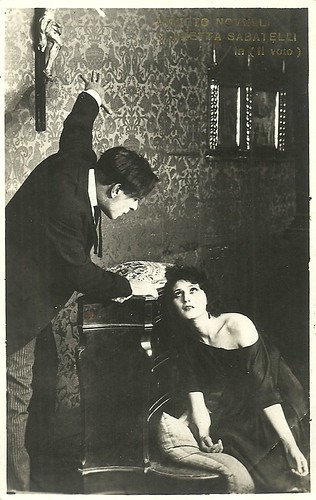
Italian postcard by G.B. Falci, Milano. Photo: Fotominio / Aprutium Film. Claretta Sabatelli and Amleto Novelli in Il voto (Eugenio Fontana, 1921).

Italian postcard by G.B. Falci, Milano. Photo: Fotominio / Aprutium Film. Claretta Sabatelli and Amleto Novelli in Il voto (Eugenio Fontana, 1921).
Source: Sempre in penombra (Italian - Now defunct), Vittorio Martinelli (Il cinema muto italiano - Italian), and IMDb. This post was last updated on 3 October 2026.
