Coquettish and captivating Marie Glory (1905-2009) made more than 50 films during the course of nearly four decades, from 1924 to 1960. For a long time, she was the longest living star of the silent era, but in 2009 she died at the age of 103.

French card by Massilia.
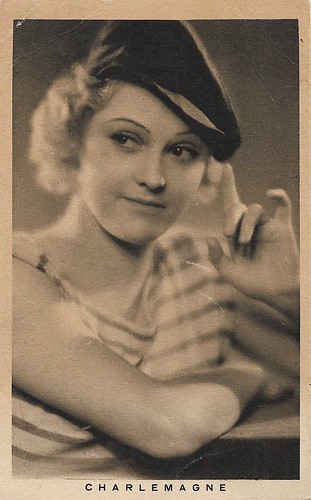
French postcard by Rasiogravure A. Breger Frères, Paris for Victor-Hugo Théâtre Pathé Natan. Photo: Marie Glory in Charlemagne (Pierre Colombier, 1933). Publicity for the film's release at the Pathé Natan cinema in Lyon on 22 December 1933.
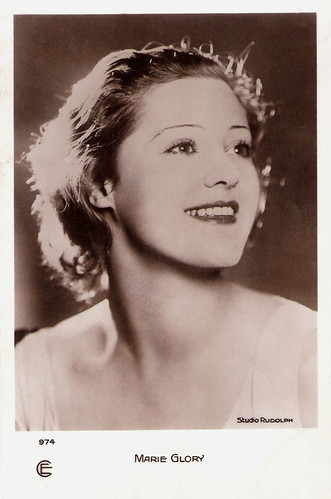
French postcard by Editions et Publications cinématographiques, no. 974. Photo: Studio Rudolph.

French postcard by Cinémagazine-Edition, no. 644. Photo: Studio Lorelle.
Marie Glory was born Raymonde Louise Marcelly Toully in Mortagne-au-Perche, Normandy, in 1905. Her father was a hairdresser, her mother a painter. When she was still an infant, the family moved to Rouen, where she studied at the Lycée Jeanne d'Arc. Aged 18, and chaperoned by her mother, she moved to Paris, where she enrolled in dance classes.
It was in the French capital that she entered the first of many beauty contests, winning second place and her first professional job, working as an advertiser's model posing for postcards and posters. She made her film debut in 1924 with a small role in Le Miracle des Loups/The Miracle of the Wolves (Raymond Bernard, 1924), a historical adventure set in the court of Louis XI. In this film she appeared under the stage name Arlette Genny, which she used until 1927.
She had her real breakthrough under the name Marie Glory in the late silent film classic L'Argent/Jazz Bank (Marcel L'Herbier, 1928) opposite Brigitte Helm. Glory played Line, the wife of aviator Hamelin (Henry Victor) who is manipulated by business tycoon Saccard (Pierre Alcover) to fly to Guyana and drill for oil there. Saccard tries to seduce Line while Hamelin is away, but she sees through his scheming and accuses him of fraud. The three hours plus French-German co-production was based on Emile Zola's classical homonymous novel but temporally transposed to the 1920s instead of the 1860s.
With her porcelain features and cloud of hair, Glory went on to captivate audiences in a string of silent films. She starred with Jean Angelo, Lil Dagover and Gaston Modot in the Franco-German coproduction Monte Cristo/The Count of Monte Christo (Henri Fescourt, 1929).
In the German production Vater und Sohn/Father and Son (Geza von Bolvary, 1929), she starred opposite Harry Liedtke. Glory's first sound film was Le Roi de Paris/The King of Paris (Leo Mittler, 1930), with exiled Serbian matinee idol Iván Petrovich.
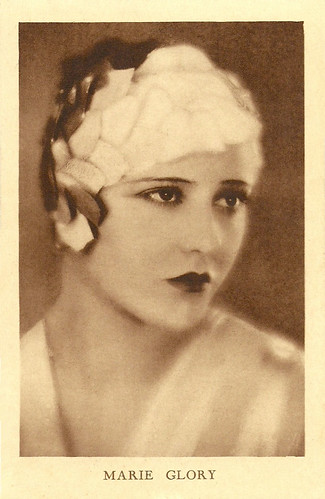
French card. Collection: Didier Hanson.
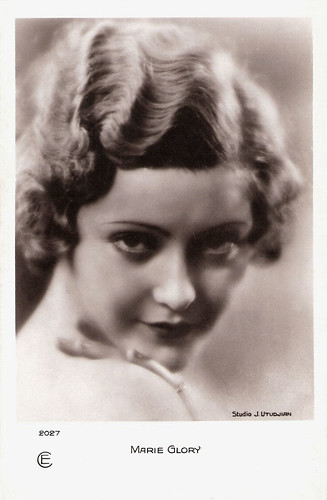
French postcard by Editions Cinémagazine, no. 2027. Photo: Studio J. Utudjian.
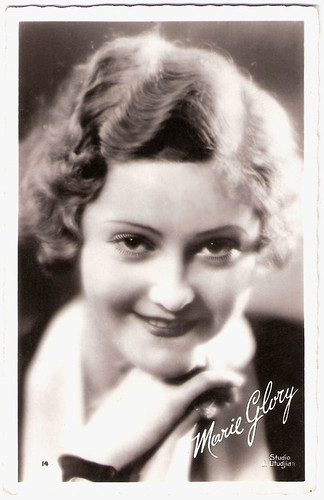
French postcard by Editions et Publications cinématographiques, no. 14. Photo: Studio J. Utudjian.
In the 1930s, Marie Glory played many leading roles in films like the war drama Les deux mondes/Two Worlds (Ewald André Dupont, 1930) with Henri Garat, Dactylo (Wilhelm Thiele, 1931) with Jean Murat and Madame ne veut pas d'enfants/No Children Wanted (Hanns Steinhoff, Constantin Landau, 1933).
She also starred in Le paquebot Tenacity/S.S. Tenacity (Julien Duvivier, 1934) opposite Albert Préjean, and the comedy Les amants terribles/The Terrible Lovers (Marc Allégret, 1936), an adaptation of Noël Coward's Private Lives.
In the circus drama Les gens du voyage/People Who Travel (Jacques Feyder, 1938), Marie Glory co-starred with Françoise Rosay.
She was already acquainted with Italian directors when working in France. From the late 1930s on, Glory played in several Italian films: Napoli che non muore/Naples That Never Dies (Amleto Palermi, 1939) with Fosco Giacchetti, Terra di fuoco/Land of Fire (Giorgio Ferroni, Marcel L'Herbier, 1939) with the great lyric tenor Tito Schipa, and Una moglie in pericolo/A Wife in Danger (Max Neufeld, 1939), which would turn out to be her last leading film part.
When war broke out in 1939, Marie Glory was shooting The Last Refuge, written by the screenwriter Jacques Constant, whom she later married. She was advised to leave Nazi occupied Paris, and the film was abandoned and never finished.
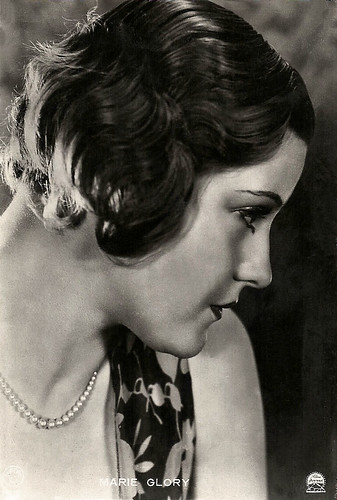
French postcard. Photo: Paramount.
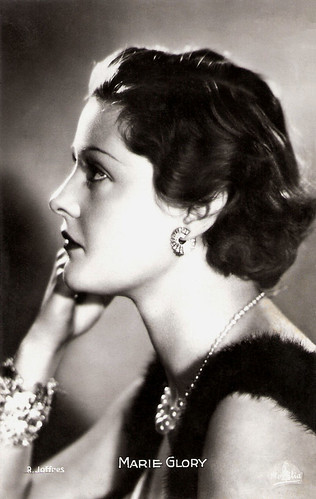
French card by Massilia. Photo: R. Joffres.
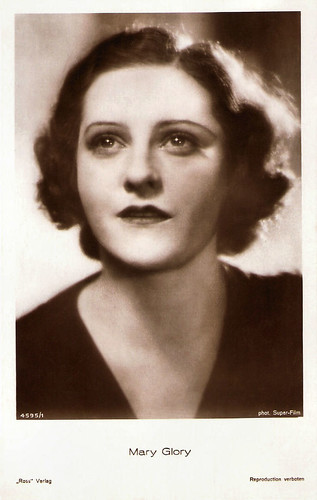
German postcard by Ross Verlag, no. 4595/1, 1929-1930. Photo: Super-Film.
Two years later, Marie Glory escaped with Constant to Spain via Biarritz, and then over the Portuguese border. She crossed the Atlantic to Buenos Aires and became active in relief and charitable work on behalf of children in occupied France. In 1942 she moved to Algeria and then Martinique, where she worked in propaganda radio. She was one of the few actresses to work under the aegis of the Free French Forces of General de Gaulle.
Following the armistice, Glory returned to France. She was decorated by the Allies, but was unable to regain her former status in the French film industry. In the 1950s she was seen in minor roles in French and Italian films. She played Antonella Lualdi‘s mother in Adorables créatures/Adorable Creatures (Christian-Jaque, 1952).
She played Brigitte Bardot‘s mother-in-law in Et Dieu… créa la femme/…And God Created Woman (Roger Vadim, 1955), and a café customer in Pierre Chenal‘s Raffles sur la ville/Sinners of Paris (1958) with Charles Vanel.
She stopped as a film actress in 1960 and as a television actress in 1964. In 1967 she returned to Paris, where she opened and managed her own beauty salon. She retired in 1973 and settled in Cannes in the south of France.
Glory was one of the actresses interviewed by Kevin Brownlow for his memorable TV series on the silent European cinema, Cinema Europe: The Other Hollywood (1996). In 2006, she was a guest of honour at the Cannes Film Festival‘s special screening of the restored Monte Cristo. In 2009, Marie Glory passed away in her house in Cannes, two months shy of her 104th birthday.
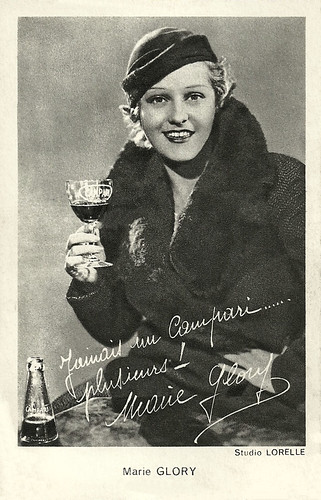
French postcard for Campari. Photo: Studio Lorelle. Caption: 'J'aimais un Campari... plusieurs!'
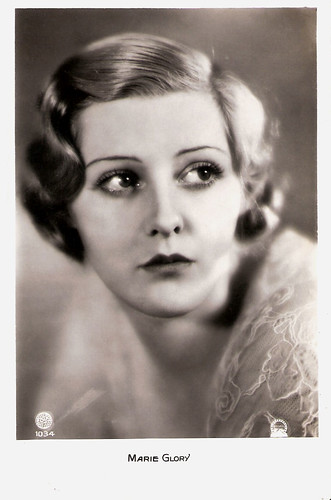
French postcard by E.D.U.G., no. 1034. Photo: Paramount.

French postcard by O.P., Paris, no. 50. Photo: Studio Piaz.

French postcard by Rasiogravure A. Breger Frères, Paris for Victor-Hugo Théâtre Pathé Natan. Photo: Raimu and Marie Glory in Charlemagne (Pierre Colombier, 1933).
Sources: Andre Soares (Alt Film Guide), Yvan Foucart (Les Gens du Cinema - French), Telegraph, The Times, The Bioscope, Wikipedia and IMDb.

French postcard by A.N., Paris, no. 744. Photo: Films Paramount.
This post was last updated on 5 June 2024.
French card by Massilia.
French postcard by Rasiogravure A. Breger Frères, Paris for Victor-Hugo Théâtre Pathé Natan. Photo: Marie Glory in Charlemagne (Pierre Colombier, 1933). Publicity for the film's release at the Pathé Natan cinema in Lyon on 22 December 1933.
French postcard by Editions et Publications cinématographiques, no. 974. Photo: Studio Rudolph.
French postcard by Cinémagazine-Edition, no. 644. Photo: Studio Lorelle.
Jazz Bank
Marie Glory was born Raymonde Louise Marcelly Toully in Mortagne-au-Perche, Normandy, in 1905. Her father was a hairdresser, her mother a painter. When she was still an infant, the family moved to Rouen, where she studied at the Lycée Jeanne d'Arc. Aged 18, and chaperoned by her mother, she moved to Paris, where she enrolled in dance classes.
It was in the French capital that she entered the first of many beauty contests, winning second place and her first professional job, working as an advertiser's model posing for postcards and posters. She made her film debut in 1924 with a small role in Le Miracle des Loups/The Miracle of the Wolves (Raymond Bernard, 1924), a historical adventure set in the court of Louis XI. In this film she appeared under the stage name Arlette Genny, which she used until 1927.
She had her real breakthrough under the name Marie Glory in the late silent film classic L'Argent/Jazz Bank (Marcel L'Herbier, 1928) opposite Brigitte Helm. Glory played Line, the wife of aviator Hamelin (Henry Victor) who is manipulated by business tycoon Saccard (Pierre Alcover) to fly to Guyana and drill for oil there. Saccard tries to seduce Line while Hamelin is away, but she sees through his scheming and accuses him of fraud. The three hours plus French-German co-production was based on Emile Zola's classical homonymous novel but temporally transposed to the 1920s instead of the 1860s.
With her porcelain features and cloud of hair, Glory went on to captivate audiences in a string of silent films. She starred with Jean Angelo, Lil Dagover and Gaston Modot in the Franco-German coproduction Monte Cristo/The Count of Monte Christo (Henri Fescourt, 1929).
In the German production Vater und Sohn/Father and Son (Geza von Bolvary, 1929), she starred opposite Harry Liedtke. Glory's first sound film was Le Roi de Paris/The King of Paris (Leo Mittler, 1930), with exiled Serbian matinee idol Iván Petrovich.
French card. Collection: Didier Hanson.
French postcard by Editions Cinémagazine, no. 2027. Photo: Studio J. Utudjian.
French postcard by Editions et Publications cinématographiques, no. 14. Photo: Studio J. Utudjian.
The Last Refuge
In the 1930s, Marie Glory played many leading roles in films like the war drama Les deux mondes/Two Worlds (Ewald André Dupont, 1930) with Henri Garat, Dactylo (Wilhelm Thiele, 1931) with Jean Murat and Madame ne veut pas d'enfants/No Children Wanted (Hanns Steinhoff, Constantin Landau, 1933).
She also starred in Le paquebot Tenacity/S.S. Tenacity (Julien Duvivier, 1934) opposite Albert Préjean, and the comedy Les amants terribles/The Terrible Lovers (Marc Allégret, 1936), an adaptation of Noël Coward's Private Lives.
In the circus drama Les gens du voyage/People Who Travel (Jacques Feyder, 1938), Marie Glory co-starred with Françoise Rosay.
She was already acquainted with Italian directors when working in France. From the late 1930s on, Glory played in several Italian films: Napoli che non muore/Naples That Never Dies (Amleto Palermi, 1939) with Fosco Giacchetti, Terra di fuoco/Land of Fire (Giorgio Ferroni, Marcel L'Herbier, 1939) with the great lyric tenor Tito Schipa, and Una moglie in pericolo/A Wife in Danger (Max Neufeld, 1939), which would turn out to be her last leading film part.
When war broke out in 1939, Marie Glory was shooting The Last Refuge, written by the screenwriter Jacques Constant, whom she later married. She was advised to leave Nazi occupied Paris, and the film was abandoned and never finished.
French postcard. Photo: Paramount.
French card by Massilia. Photo: R. Joffres.
German postcard by Ross Verlag, no. 4595/1, 1929-1930. Photo: Super-Film.
Cinema Europe
Two years later, Marie Glory escaped with Constant to Spain via Biarritz, and then over the Portuguese border. She crossed the Atlantic to Buenos Aires and became active in relief and charitable work on behalf of children in occupied France. In 1942 she moved to Algeria and then Martinique, where she worked in propaganda radio. She was one of the few actresses to work under the aegis of the Free French Forces of General de Gaulle.
Following the armistice, Glory returned to France. She was decorated by the Allies, but was unable to regain her former status in the French film industry. In the 1950s she was seen in minor roles in French and Italian films. She played Antonella Lualdi‘s mother in Adorables créatures/Adorable Creatures (Christian-Jaque, 1952).
She played Brigitte Bardot‘s mother-in-law in Et Dieu… créa la femme/…And God Created Woman (Roger Vadim, 1955), and a café customer in Pierre Chenal‘s Raffles sur la ville/Sinners of Paris (1958) with Charles Vanel.
She stopped as a film actress in 1960 and as a television actress in 1964. In 1967 she returned to Paris, where she opened and managed her own beauty salon. She retired in 1973 and settled in Cannes in the south of France.
Glory was one of the actresses interviewed by Kevin Brownlow for his memorable TV series on the silent European cinema, Cinema Europe: The Other Hollywood (1996). In 2006, she was a guest of honour at the Cannes Film Festival‘s special screening of the restored Monte Cristo. In 2009, Marie Glory passed away in her house in Cannes, two months shy of her 104th birthday.
French postcard for Campari. Photo: Studio Lorelle. Caption: 'J'aimais un Campari... plusieurs!'
French postcard by E.D.U.G., no. 1034. Photo: Paramount.
French postcard by O.P., Paris, no. 50. Photo: Studio Piaz.
French postcard by Rasiogravure A. Breger Frères, Paris for Victor-Hugo Théâtre Pathé Natan. Photo: Raimu and Marie Glory in Charlemagne (Pierre Colombier, 1933).
Sources: Andre Soares (Alt Film Guide), Yvan Foucart (Les Gens du Cinema - French), Telegraph, The Times, The Bioscope, Wikipedia and IMDb.
French postcard by A.N., Paris, no. 744. Photo: Films Paramount.
This post was last updated on 5 June 2024.


