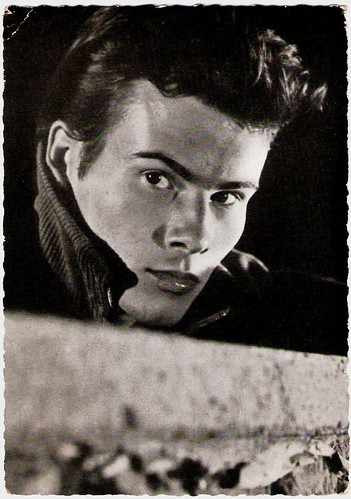
German actor Christian Doermer (1935-2022) appeared in 83 films and television shows. His breakthrough was as Horst Buchholz’s brother in the successful teen drama Die Halbstarken/Teenage Wolfpack (1956).

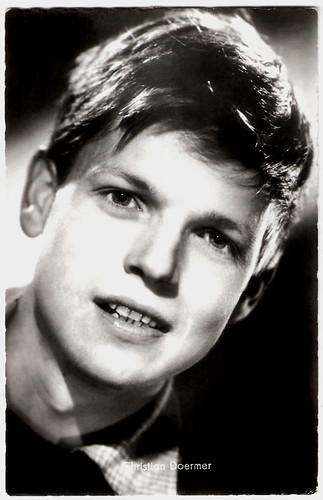
German postcard by WS-Druck, Wanne-Eickel, no. 298. Photo: H.D. / Bavaria / Schorcht.
Christian-Michael Doermer was born in Rostock, Germany in 1935. He was the son of Dr. Hartmut Doermer and the actress Ruth von Zerboni. He studied sociology and economics in Frankfurt and Marburg. His mother led the acting school Zerboni in Munich and through her interference, he made his acting debut in Geliebtes Fräulein Doktor/Beloved Miss Doctor (Hans H. König, 1954) with Edith Mill.
In 1956 he made his stage debut at the Deutschen Schauspielhaus in Hamburg. His first bigger film role was in the crime film Viele kamen vorbei/Many Passed By (Peter Pewas, 1956). Then he had his breakthrough in the classic Die Halbstarken/Teenage Wolfpack (Georg Tressler, 1956) as the ambivalent younger brother of Horst Buchholz.
Volker Scheunert at IMDb: “There was hardly a realistic view of (West-)German society during the years of the ‘Economic Miracle’. Young author Will Tremper did not like that sentimental stuff. Obviously influenced by Hollywood teen dramas he and director Georg Tressler in 1956 realized Germany's first look at juvenile delinquency, a film that is now regarded as a classic of German post-war cinema. This one is hard, raw and realistic, omitting any false sentimentality or romanticism.”
In 1957, Doermer appeared in the German war film Der Stern von Afrika/The Star of Africa (Alfred Weidenmann, 1957) portraying the combat career of Luftwaffe World War II fighter pilot Hans-Joachim Marseille (Joachim Hansen). Marseille was killed in a plane crash after over 150 kills in North Africa. The film was very successful at the German box office, although the critics predominantly gave it a fair rating.
He appeared in another teen drama Die Frühreifen/The Precocious (Josef von Báky, 1957) with Heidi Brühl and Christian Wolff, but mostly played supporting parts in such comedies as Ohne Mutter geht es nicht/Without Mother It Does Not Work (Erik Ode, 1958) with Ewald Balser and Adelheid Seeck.
German postcard by Kolibri-Verlag, Minden-Westf., no. 140.

German postcard by Kolibri-Verlag, Minden-Westf., no. 388. Photo: A. Grimm / CCC / Bavaria. Publicity still for Ohne Mutter geht es nicht/Without Mother It Does Not Work (Erik Ode, 1958).
Christian Doermer reunited with Will Tremper for the thriller Flucht nach Berlin/Escape to Berlin (Will Tremper, 1961). He played a disappointed young SED official who settled in West Berlin with his girlfriend (Susanne Korda). For this role, he won a Filmband im Gold award as Best Young Actor.
On TV he could be seen in the very popular crime series Das Halstuch/The Scarf (Hans Quest, 1962) based on a Francis Durbridge novel and starring Heinz Drache. Doermer then played the lead role in Das Brot der frühen Jahre/The Bread of Those Early Years (Herbert Vesely, 1962), based on the novel by Heinrich Böll. It was entered into the 1962 Cannes Film Festival.
That year, he also appeared in L'amour à vingt ans/Love at Twenty (1962) a French-produced omnibus project of Pierre Roustang, consisting of five segments directed by five directors from five different countries. He appeared in the charming, but somewhat sentimental German episode directed by Marcel Ophüls about an unwed mother (Barbara Frey) who contrives to trap the father of her baby.
As the only actor, he signed the Oberhausen Manifesto, a declaration by a group of 26 young German filmmakers at the International Short Film Festival Oberhausen in 1962. The manifesto was a call to arms to establish a ‘new German feature film’ and among the signatories were the directors Alexander Kluge and Edgar Reitz.
The signatories to the manifesto became known as the Oberhausen Group and are seen as important forerunners of the New German Cinema that began later in the decade. The Oberhausen Group were awarded the Deutscher Filmpreis in 1982. In 1963 Doermer founded his own film company Cine Dokument Film. In the following decades, he developed several films for which he was the writer, producer, director and actor.

German postcard by Rüdel-Verlag, Hamburg-Bergedorf, no. 2178. Photo: Bavaria / Vogelmann.

German postcard by WS-Druck, Wanne-Eickel, no. 349. Photo: A. Grimm / CCC / Bavaria / Filmpress. Publicity still for Ohne Mutter geht es nicht/Without Mother It Does Not Work (Erik Ode, 1958).
Christian Doermer starred in the drama Schonzeit für Füchse/No Shooting Time for Foxes (Peter Schamoni, 1966), which won the Special Jury Prize at the 16th Berlin International Film Festival. That year, he could also be seen in a supporting part in the thriller Die Rechnung – eiskalt serviert/Tip Not Included (Helmut Ashley, 1966). It was the third film in the Jerry Cotton series with George Nader as the G-man. Doermer also made some films in Great Britain. In the action-thriller The Syndicate (1968), he is among a group of prospectors who plan to mine a Kenyan savannah for its rich, and as yet untapped uranium. The group slowly deteriorates under the threat of double-cross and jealousy.
He had a big part in the drama Joanna (Michael Sarne, 1968). He played an aspiring painter/art teacher, who has a fling with the title figure, Joanna (Geneviève Waïte), a provincial girl studying art in London. The film was listed to compete in Cannes, but the festival was cancelled due to the events of May 1968. Doermer also appeared as a German soldier in Sir Richard Attenborough’s film musical Oh! What a Lovely War (1969), tells the story of WWI through its popular songs.
In the early 1970s, Doermer stopped acting and focused himself on his production company. As a writer, producer and director, he made several TV documentaries about India, Africa and Asia. After his complex feature film about General Paul von Lettow-Vorbeck, Lettow-Vorbeck: Der deutsch-ostafrikanische Imperativ/Lettow-Vorbeck: The German-East Africa Imperative (Christian Doermer, 1984) became a flop, Doermer turned to acting again.
He mostly worked for television, such as in Väter und Söhne - Eine deutsche Tragödie/Fathers and Sons (Bernhard Sinkel, 1986) with Julie Christie. In 1989 he founded with Hans Clarin, Günther Maria Halmer, and the actresses Mona Freiberg and Cornelia Froboess, the production company Ensemble am Chiemsee that works primarily for private television and local media.
Later acting work included parts in the TV films Wambo (Jo Baier, 2000), about the murder of Bavarian actor Walter Sedlmayer, and Stauffenberg (Jo Baier, 2004) about the unsuccessful Valkyrie Operation against Adolf Hitler in 1944 by General Stauffenberg (Sebastian Koch). He finally was seen in Gierig/Greedy (Ralf Huettner, 2011), an episode of the TV series Kommissarin Lucas. Christian Doermer died in 2022 in Nußdorf am Inn, Bavaria, aged 87. Since 1961, he was married to Lore Schmidt-Polex and they had three children.
Trailer for Schonzeit für Füchse/No Shooting Time for Foxes (Peter Schamoni, 1966). Source: alleskino (YouTube).
Sources: Volker Scheunert (IMDb), Stephanie d’Heil (Steffi-Line.de), Cinedokumentfilm.de (German - now defunct), Filmportal.de (German), Wikipedia (German and English) and IMDb.
This post was last updated on 14 January 2024.
German postcard by WS-Druck, Wanne-Eickel, no. 298. Photo: H.D. / Bavaria / Schorcht.
Germany's first look at juvenile delinquency
Christian-Michael Doermer was born in Rostock, Germany in 1935. He was the son of Dr. Hartmut Doermer and the actress Ruth von Zerboni. He studied sociology and economics in Frankfurt and Marburg. His mother led the acting school Zerboni in Munich and through her interference, he made his acting debut in Geliebtes Fräulein Doktor/Beloved Miss Doctor (Hans H. König, 1954) with Edith Mill.
In 1956 he made his stage debut at the Deutschen Schauspielhaus in Hamburg. His first bigger film role was in the crime film Viele kamen vorbei/Many Passed By (Peter Pewas, 1956). Then he had his breakthrough in the classic Die Halbstarken/Teenage Wolfpack (Georg Tressler, 1956) as the ambivalent younger brother of Horst Buchholz.
Volker Scheunert at IMDb: “There was hardly a realistic view of (West-)German society during the years of the ‘Economic Miracle’. Young author Will Tremper did not like that sentimental stuff. Obviously influenced by Hollywood teen dramas he and director Georg Tressler in 1956 realized Germany's first look at juvenile delinquency, a film that is now regarded as a classic of German post-war cinema. This one is hard, raw and realistic, omitting any false sentimentality or romanticism.”
In 1957, Doermer appeared in the German war film Der Stern von Afrika/The Star of Africa (Alfred Weidenmann, 1957) portraying the combat career of Luftwaffe World War II fighter pilot Hans-Joachim Marseille (Joachim Hansen). Marseille was killed in a plane crash after over 150 kills in North Africa. The film was very successful at the German box office, although the critics predominantly gave it a fair rating.
He appeared in another teen drama Die Frühreifen/The Precocious (Josef von Báky, 1957) with Heidi Brühl and Christian Wolff, but mostly played supporting parts in such comedies as Ohne Mutter geht es nicht/Without Mother It Does Not Work (Erik Ode, 1958) with Ewald Balser and Adelheid Seeck.
German postcard by Kolibri-Verlag, Minden-Westf., no. 140.
German postcard by Kolibri-Verlag, Minden-Westf., no. 388. Photo: A. Grimm / CCC / Bavaria. Publicity still for Ohne Mutter geht es nicht/Without Mother It Does Not Work (Erik Ode, 1958).
A declaration by 26 young German filmmakers
Christian Doermer reunited with Will Tremper for the thriller Flucht nach Berlin/Escape to Berlin (Will Tremper, 1961). He played a disappointed young SED official who settled in West Berlin with his girlfriend (Susanne Korda). For this role, he won a Filmband im Gold award as Best Young Actor.
On TV he could be seen in the very popular crime series Das Halstuch/The Scarf (Hans Quest, 1962) based on a Francis Durbridge novel and starring Heinz Drache. Doermer then played the lead role in Das Brot der frühen Jahre/The Bread of Those Early Years (Herbert Vesely, 1962), based on the novel by Heinrich Böll. It was entered into the 1962 Cannes Film Festival.
That year, he also appeared in L'amour à vingt ans/Love at Twenty (1962) a French-produced omnibus project of Pierre Roustang, consisting of five segments directed by five directors from five different countries. He appeared in the charming, but somewhat sentimental German episode directed by Marcel Ophüls about an unwed mother (Barbara Frey) who contrives to trap the father of her baby.
As the only actor, he signed the Oberhausen Manifesto, a declaration by a group of 26 young German filmmakers at the International Short Film Festival Oberhausen in 1962. The manifesto was a call to arms to establish a ‘new German feature film’ and among the signatories were the directors Alexander Kluge and Edgar Reitz.
The signatories to the manifesto became known as the Oberhausen Group and are seen as important forerunners of the New German Cinema that began later in the decade. The Oberhausen Group were awarded the Deutscher Filmpreis in 1982. In 1963 Doermer founded his own film company Cine Dokument Film. In the following decades, he developed several films for which he was the writer, producer, director and actor.
German postcard by Rüdel-Verlag, Hamburg-Bergedorf, no. 2178. Photo: Bavaria / Vogelmann.
German postcard by WS-Druck, Wanne-Eickel, no. 349. Photo: A. Grimm / CCC / Bavaria / Filmpress. Publicity still for Ohne Mutter geht es nicht/Without Mother It Does Not Work (Erik Ode, 1958).
G-man Jerry Cotton
Christian Doermer starred in the drama Schonzeit für Füchse/No Shooting Time for Foxes (Peter Schamoni, 1966), which won the Special Jury Prize at the 16th Berlin International Film Festival. That year, he could also be seen in a supporting part in the thriller Die Rechnung – eiskalt serviert/Tip Not Included (Helmut Ashley, 1966). It was the third film in the Jerry Cotton series with George Nader as the G-man. Doermer also made some films in Great Britain. In the action-thriller The Syndicate (1968), he is among a group of prospectors who plan to mine a Kenyan savannah for its rich, and as yet untapped uranium. The group slowly deteriorates under the threat of double-cross and jealousy.
He had a big part in the drama Joanna (Michael Sarne, 1968). He played an aspiring painter/art teacher, who has a fling with the title figure, Joanna (Geneviève Waïte), a provincial girl studying art in London. The film was listed to compete in Cannes, but the festival was cancelled due to the events of May 1968. Doermer also appeared as a German soldier in Sir Richard Attenborough’s film musical Oh! What a Lovely War (1969), tells the story of WWI through its popular songs.
In the early 1970s, Doermer stopped acting and focused himself on his production company. As a writer, producer and director, he made several TV documentaries about India, Africa and Asia. After his complex feature film about General Paul von Lettow-Vorbeck, Lettow-Vorbeck: Der deutsch-ostafrikanische Imperativ/Lettow-Vorbeck: The German-East Africa Imperative (Christian Doermer, 1984) became a flop, Doermer turned to acting again.
He mostly worked for television, such as in Väter und Söhne - Eine deutsche Tragödie/Fathers and Sons (Bernhard Sinkel, 1986) with Julie Christie. In 1989 he founded with Hans Clarin, Günther Maria Halmer, and the actresses Mona Freiberg and Cornelia Froboess, the production company Ensemble am Chiemsee that works primarily for private television and local media.
Later acting work included parts in the TV films Wambo (Jo Baier, 2000), about the murder of Bavarian actor Walter Sedlmayer, and Stauffenberg (Jo Baier, 2004) about the unsuccessful Valkyrie Operation against Adolf Hitler in 1944 by General Stauffenberg (Sebastian Koch). He finally was seen in Gierig/Greedy (Ralf Huettner, 2011), an episode of the TV series Kommissarin Lucas. Christian Doermer died in 2022 in Nußdorf am Inn, Bavaria, aged 87. Since 1961, he was married to Lore Schmidt-Polex and they had three children.
Trailer for Schonzeit für Füchse/No Shooting Time for Foxes (Peter Schamoni, 1966). Source: alleskino (YouTube).
Sources: Volker Scheunert (IMDb), Stephanie d’Heil (Steffi-Line.de), Cinedokumentfilm.de (German - now defunct), Filmportal.de (German), Wikipedia (German and English) and IMDb.
This post was last updated on 14 January 2024.