Saucer-eyed, long-legged Jessie Matthews (1907-1981) was a gamine, graceful dancer, with a sweet, pure-toned singing voice, and waif-like sex appeal. She embodied 1930s style. For most of the decade, she was the most popular musical star in England and ranked on a par with Fred Astaire, Ruby Keeler, and Ginger Rogers. She was a favourite of Irving Berlin and Richard Rodgers, and Lorenz Hart, all of whom gave her some of their very best work. Her personal life was blighted by relationship breakdowns and her struggles against ill-health and insecurity.

British postcard in the Film-Kurier series, London, no. 138a. Sent by mail in Great Britain in 1937. Photo: Gaumont British.

British collectors card by De Reszke Cigarettes, no. 9. Photo: Gaumont-British.
Jessie Margaret Matthews was born in Soho, London, in 1907, in relative poverty. She was the seventh of sixteen children (of whom eleven survived) of a fruit-and-vegetable seller. Matthews enjoyed dancing from an early age, and elocution lessons created her distinctive ‘plummy’ accent.
Aged 12, she debuted on stage as a child dancer in 'Bluebell in Fairyland' (1919) by Seymour Hicks, at the Metropolitan Music Hall in London. She made her West End debut at 16 in Irving Berlin's Music Box Revue.
Her first film appearance was in the silent film The Beloved Vagabond (Fred LeRoy Granville, 1923). More fleeting dancing roles in silent films followed. Matthews was in the chorus of 'Charlot Review' (1926) in London, and went with the show to New York, where she was also understudy to the star, Gertrude Lawrence. When Lawrence fell ill, Matthews took over the role and was given great reviews.
Matthews was acclaimed in the United Kingdom as a dancer and as the first performer of numerous popular songs of the 1920s and 1930s, including 'A Room with a View' and 'London Calling!' by Noël Coward and 'Let's Do It, Let's Fall in Love' by Cole Porter. In London, she was in 'Ever Green' (1930), a musical by Rodgers and Hart that was partly inspired by the life of music hall star Marie Lloyd.
At its time, 'Ever Green was the most expensive musical ever mounted on a London stage. It featured the hit song 'Dancing on the Ceiling'. Matthews co-starred with Sonnie Hale (then husband of Evelyn Laye), which led to a scandalous divorce action, with Matthews cited as the ‘other woman’. The scandal should have kept Matthews off the screen but the talkies needed musical stars and Matthews clicked big-time in films like Out of the Blue (Gene Gerrard, J.O.C. Orton, 1931), There Goes the Bride (Albert de Courville, 1932) opposite Owen Nares, and The Man from Toronto (Sinclair Hill, 1933).
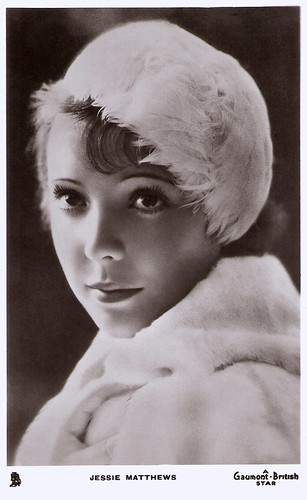
British postcard by Raphael Tuck & Sons in the Real Photograph series, no. 66-S. Photo: Gaumont-British.

Vintage postcard.
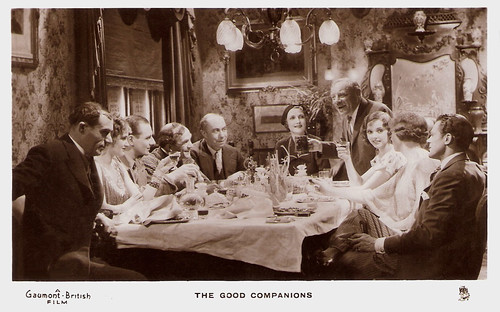
British postcard by Raphael Tuck & Sons in the Real Photograph Series, no. 27-B. Photo: Gaumont-British. Publicity still for The Good Companions (Victor Saville, 1933) with a.o. John Gielgud (third from left), A.W. Baskcomb (fifth from left) and Jessie Matthews (third from right).
Jessie Matthews’ fame reached its initial height with her breakthrough performance in the film of J.B. Priestley's novel, The Good Companions (1933). As Susie Dean, she danced with airy grace and fluidity in this classic film by Victor Saville, who would be her most sympathetic director.
The film is about three musicians, including John Gielgud in his first film and Edmund Gwenn, joining together to save a failing concert party, the Dinky Doos.
At IMDb, Bensonj reviews: “Jessie Matthews' ability and magnetism are so evident there's just no question that when the right person finally sees her perform, her star quality will be instantly recognised. This was never more true than in The Good Companions, where Matthews' vitality, youth, sex appeal and talent absolutely light up the film!
Like every aspect of this film, the romance between Gielgud and Matthews is remarkable to behold. She's so strong-willed, so incandescent, Gielgud seems almost afraid to burn his fingers, yet dares to hold his own. As with only the finest fairy tale fantasies, this is absolutely grounded in the real world, filled with sharp, rich characterisations and the details of its time and place.”
She then appeared in Friday the Thirteenth (Victor Saville, 1933) opposite Sonnie Hale, and the flop Waltzes from Vienna (Alfred Hitchcock, 1934) about the lives of Johann Strauss the elder (Edmund Gwenn) and younger (Esmond Knight).
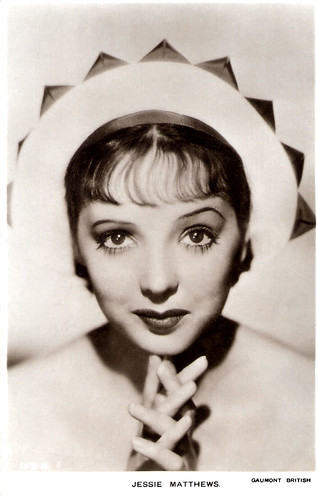
British postcard, no. 159b. Photo: Gaumont British.
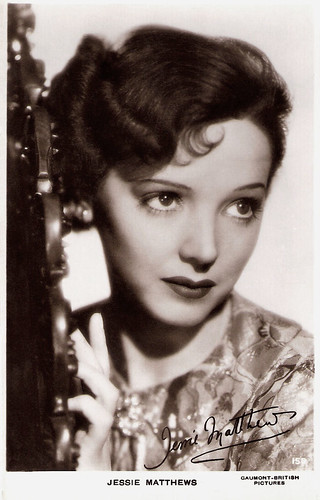
British postcard by Real Photograph, no. 159. Photo: Gaumont-British Pictures.
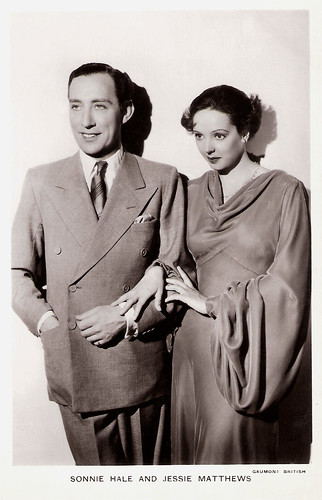
British postcard in the Film Partners series, London, no. P 196. Photo: Gaumont British. With Sonnie Hale.
That same year, Jessie Matthews’ biggest film triumph followed: the film version of Evergreen (Victor Saville, 1934) with Sonnie Hale and Betty Balfour. At IMDb, bbrntwist reviews: “This is an utterly charming and delightful film, derived from the London production of a Rodgers and Hart musical. (...) Matthews is a sheer delight, reminding me of Joan Collins, Julie Andrews, Jane Wyatt and Jennifer Jones, all rolled into one.”
The film opened in the USA at Radio City Music Hall, New York, and Matthews was labelled ‘The Dancing Divinity’, although attempts to co-star her and Fred Astaire in a film never materialised. Her British studio (Gaumont British) was reluctant to let go of its biggest name, which resulted in offers for her to work in Hollywood being repeatedly rejected.
Evergreen (1934) featured the newly composed song 'Over My Shoulder', which would become Matthews' personal theme song, later giving its title to her 1974 autobiography and to a 21st-century musical stage show of her life. Next came the gender-swapping musical comedy First A Girl (Victor Saville, 1935). It was later remade as Victor, Victoria (Blake Edwards, 1982) starring Julie Andrews. Like all of Matthews' major 1930s films, it was produced by Gaumont British, which surrounded her with the best available talent.
Other, weaker films were directed by Sonnie Hale, including Head over Heels (Sonnie Hale, 1937) with Louis Borel, and Sailing Along (Sonnie Hale, 1938) with Roland Young. In Climbing High (Carol Reed, 1938), Matthews costarred with Michael Redgrave. During the shooting, Matthews and Carol Reed had a brief affair.
Her only US film role was a cameo in the all-star fundraiser Forever and a Day (René Clair, 1943). Roger Phillip Mellor writes in the Encyclopedia of British Cinema: “For most of the 1930s, Matthews was the most popular female film star in England: the image of her in Sailing Along (Sonnie Hale, 1938), in a white evening gown, with a gentleman's black top hat and walking cane, performing 'Souvenir of Love' in Lime Grove's art deco luxury sets, indelibly incarnates 1930s style.”

British postcard in the Picturegoer series, London, no. 711a. Photo: Gaumont British.

British postcard by Real Photogravure. Photo: Gaumont British.
Jessie Matthews’ distinctive warbling voice and round cheeks made her a familiar and much-loved personality to British theatre and film audiences at the beginning of World War II, but her popularity waned in the 1940s after several years' absence from the screen followed by an unsatisfactory thriller, Candles at Nine (John Harlow, 1944). Post-war audiences associated her with a world of hectic pre-war luxury that was now seen as obsolete in austerity-era Britain. After a few false starts as a straight actress, she played Tom Thumb's mother in the children's film Tom Thumb (George Pal, 1958).
During the 1960s, she found new fame when she took over the leading role of Mary Dale in the hugely popular BBC radio show, 'The Dales', formerly 'Mrs Dale's Diary' The title character was a nice middle-class doctor's wife, Mary, and her husband Jim, who lived at Virginia Lodge in the Middlesex suburb of Parkwood Hill. Live theatre and variety shows remained the mainstay of Matthews' work through the 1950s and 1960s, with successful tours of Australia and South Africa interspersed with periods of less glamorous but welcome work in British provincial theatre and pantomimes.
Matthews was awarded an OBE in 1970 and became a stalwart nostalgia feature of TV variety shows such as The Night Of A Thousand Stars and The Good Old Days. She returned to the stage in 1973 in an acclaimed performance in Charles Kingsley's The Water Babies. Her television appearances also included one-off guest roles in the popular BBC series Angels (1976) and an episode of the ITV mystery anthology Tales of the Unexpected (1980). She was perfectly cast as Aunt Bessie in the mini-series Edward and Mrs. Simpson (Waris Hussein, 1978) starring Edward Fox. The following year, she took her one-woman stage show to Los Angeles and won the United States Drama Logue Award 1979 for the year's best performance in concert. Her last film role was in the Horror comedy The Hound of the Baskervilles (Paul Morrissey, 1978) starring Peter Cook and Dudley Moore.
Jessie Matthews was married three times. In 1926, she married actor Henry Lytton, Jr. They divorced in 1929. The second marriage was to Sonnie Hale (1931-1944); the third to a military officer, Lt. Brian Lewis (1945-1959). All of her marriages ended in divorce and were marred by affairs and a series of unsuccessful pregnancies. With Hale, she had one adopted daughter, Catherine Hale-Monro. Jessie Matthews had suffered from periods of ill health throughout her life and eventually died of cancer in 1981 in Eastcote, England. She was 74.
At British Pictures, David Absalom remembers: “Her films were fluff, but unlike her musical-comedy rivals (Gracie Fields and George Formby), she had grace and glamour. Her costumes were carefully designed to show off as much of her body as the censor would allow, and her dancing can best be described as a high-class bump and grind act. No other star had that fluidity of movement and that joie de vivre.”
Scene from The Good Companions (1933) with John Gielgud, Max Miller and Jessie Matthews. Source: Art Deco Chap (YouTube).
Jessie Matthews sings Over My Shoulder in Evergreen (1934). Source: Other-Pete (YouTube).
Scene from Gangway (1937). Source: Guggle 86 (YouTube).
Trailer Tom Thumb (1958). Source: Rotten Tomatoes Classic Trailers (YouTube).
Sources: Roger Phillip Mellor (Encyclopedia of British Cinema), David Absalom (British Pictures), Bruce Eder (AllMovie - Page now defunct), Michael Thornton (Daily Mail), Pete Lambert (IMDb), Wikipedia, and IMDb.
This post was last updated on 14 June 2025.
British postcard in the Film-Kurier series, London, no. 138a. Sent by mail in Great Britain in 1937. Photo: Gaumont British.
British collectors card by De Reszke Cigarettes, no. 9. Photo: Gaumont-British.
Dancing on the ceiling
Jessie Margaret Matthews was born in Soho, London, in 1907, in relative poverty. She was the seventh of sixteen children (of whom eleven survived) of a fruit-and-vegetable seller. Matthews enjoyed dancing from an early age, and elocution lessons created her distinctive ‘plummy’ accent.
Aged 12, she debuted on stage as a child dancer in 'Bluebell in Fairyland' (1919) by Seymour Hicks, at the Metropolitan Music Hall in London. She made her West End debut at 16 in Irving Berlin's Music Box Revue.
Her first film appearance was in the silent film The Beloved Vagabond (Fred LeRoy Granville, 1923). More fleeting dancing roles in silent films followed. Matthews was in the chorus of 'Charlot Review' (1926) in London, and went with the show to New York, where she was also understudy to the star, Gertrude Lawrence. When Lawrence fell ill, Matthews took over the role and was given great reviews.
Matthews was acclaimed in the United Kingdom as a dancer and as the first performer of numerous popular songs of the 1920s and 1930s, including 'A Room with a View' and 'London Calling!' by Noël Coward and 'Let's Do It, Let's Fall in Love' by Cole Porter. In London, she was in 'Ever Green' (1930), a musical by Rodgers and Hart that was partly inspired by the life of music hall star Marie Lloyd.
At its time, 'Ever Green was the most expensive musical ever mounted on a London stage. It featured the hit song 'Dancing on the Ceiling'. Matthews co-starred with Sonnie Hale (then husband of Evelyn Laye), which led to a scandalous divorce action, with Matthews cited as the ‘other woman’. The scandal should have kept Matthews off the screen but the talkies needed musical stars and Matthews clicked big-time in films like Out of the Blue (Gene Gerrard, J.O.C. Orton, 1931), There Goes the Bride (Albert de Courville, 1932) opposite Owen Nares, and The Man from Toronto (Sinclair Hill, 1933).
British postcard by Raphael Tuck & Sons in the Real Photograph series, no. 66-S. Photo: Gaumont-British.
Vintage postcard.
British postcard by Raphael Tuck & Sons in the Real Photograph Series, no. 27-B. Photo: Gaumont-British. Publicity still for The Good Companions (Victor Saville, 1933) with a.o. John Gielgud (third from left), A.W. Baskcomb (fifth from left) and Jessie Matthews (third from right).
Dancing with airy grace and fluidity
Jessie Matthews’ fame reached its initial height with her breakthrough performance in the film of J.B. Priestley's novel, The Good Companions (1933). As Susie Dean, she danced with airy grace and fluidity in this classic film by Victor Saville, who would be her most sympathetic director.
The film is about three musicians, including John Gielgud in his first film and Edmund Gwenn, joining together to save a failing concert party, the Dinky Doos.
At IMDb, Bensonj reviews: “Jessie Matthews' ability and magnetism are so evident there's just no question that when the right person finally sees her perform, her star quality will be instantly recognised. This was never more true than in The Good Companions, where Matthews' vitality, youth, sex appeal and talent absolutely light up the film!
Like every aspect of this film, the romance between Gielgud and Matthews is remarkable to behold. She's so strong-willed, so incandescent, Gielgud seems almost afraid to burn his fingers, yet dares to hold his own. As with only the finest fairy tale fantasies, this is absolutely grounded in the real world, filled with sharp, rich characterisations and the details of its time and place.”
She then appeared in Friday the Thirteenth (Victor Saville, 1933) opposite Sonnie Hale, and the flop Waltzes from Vienna (Alfred Hitchcock, 1934) about the lives of Johann Strauss the elder (Edmund Gwenn) and younger (Esmond Knight).
British postcard, no. 159b. Photo: Gaumont British.
British postcard by Real Photograph, no. 159. Photo: Gaumont-British Pictures.
British postcard in the Film Partners series, London, no. P 196. Photo: Gaumont British. With Sonnie Hale.
Gender-swapping musical comedy
That same year, Jessie Matthews’ biggest film triumph followed: the film version of Evergreen (Victor Saville, 1934) with Sonnie Hale and Betty Balfour. At IMDb, bbrntwist reviews: “This is an utterly charming and delightful film, derived from the London production of a Rodgers and Hart musical. (...) Matthews is a sheer delight, reminding me of Joan Collins, Julie Andrews, Jane Wyatt and Jennifer Jones, all rolled into one.”
The film opened in the USA at Radio City Music Hall, New York, and Matthews was labelled ‘The Dancing Divinity’, although attempts to co-star her and Fred Astaire in a film never materialised. Her British studio (Gaumont British) was reluctant to let go of its biggest name, which resulted in offers for her to work in Hollywood being repeatedly rejected.
Evergreen (1934) featured the newly composed song 'Over My Shoulder', which would become Matthews' personal theme song, later giving its title to her 1974 autobiography and to a 21st-century musical stage show of her life. Next came the gender-swapping musical comedy First A Girl (Victor Saville, 1935). It was later remade as Victor, Victoria (Blake Edwards, 1982) starring Julie Andrews. Like all of Matthews' major 1930s films, it was produced by Gaumont British, which surrounded her with the best available talent.
Other, weaker films were directed by Sonnie Hale, including Head over Heels (Sonnie Hale, 1937) with Louis Borel, and Sailing Along (Sonnie Hale, 1938) with Roland Young. In Climbing High (Carol Reed, 1938), Matthews costarred with Michael Redgrave. During the shooting, Matthews and Carol Reed had a brief affair.
Her only US film role was a cameo in the all-star fundraiser Forever and a Day (René Clair, 1943). Roger Phillip Mellor writes in the Encyclopedia of British Cinema: “For most of the 1930s, Matthews was the most popular female film star in England: the image of her in Sailing Along (Sonnie Hale, 1938), in a white evening gown, with a gentleman's black top hat and walking cane, performing 'Souvenir of Love' in Lime Grove's art deco luxury sets, indelibly incarnates 1930s style.”
British postcard in the Picturegoer series, London, no. 711a. Photo: Gaumont British.
British postcard by Real Photogravure. Photo: Gaumont British.
Nice middle-class doctor's wife
Jessie Matthews’ distinctive warbling voice and round cheeks made her a familiar and much-loved personality to British theatre and film audiences at the beginning of World War II, but her popularity waned in the 1940s after several years' absence from the screen followed by an unsatisfactory thriller, Candles at Nine (John Harlow, 1944). Post-war audiences associated her with a world of hectic pre-war luxury that was now seen as obsolete in austerity-era Britain. After a few false starts as a straight actress, she played Tom Thumb's mother in the children's film Tom Thumb (George Pal, 1958).
During the 1960s, she found new fame when she took over the leading role of Mary Dale in the hugely popular BBC radio show, 'The Dales', formerly 'Mrs Dale's Diary' The title character was a nice middle-class doctor's wife, Mary, and her husband Jim, who lived at Virginia Lodge in the Middlesex suburb of Parkwood Hill. Live theatre and variety shows remained the mainstay of Matthews' work through the 1950s and 1960s, with successful tours of Australia and South Africa interspersed with periods of less glamorous but welcome work in British provincial theatre and pantomimes.
Matthews was awarded an OBE in 1970 and became a stalwart nostalgia feature of TV variety shows such as The Night Of A Thousand Stars and The Good Old Days. She returned to the stage in 1973 in an acclaimed performance in Charles Kingsley's The Water Babies. Her television appearances also included one-off guest roles in the popular BBC series Angels (1976) and an episode of the ITV mystery anthology Tales of the Unexpected (1980). She was perfectly cast as Aunt Bessie in the mini-series Edward and Mrs. Simpson (Waris Hussein, 1978) starring Edward Fox. The following year, she took her one-woman stage show to Los Angeles and won the United States Drama Logue Award 1979 for the year's best performance in concert. Her last film role was in the Horror comedy The Hound of the Baskervilles (Paul Morrissey, 1978) starring Peter Cook and Dudley Moore.
Jessie Matthews was married three times. In 1926, she married actor Henry Lytton, Jr. They divorced in 1929. The second marriage was to Sonnie Hale (1931-1944); the third to a military officer, Lt. Brian Lewis (1945-1959). All of her marriages ended in divorce and were marred by affairs and a series of unsuccessful pregnancies. With Hale, she had one adopted daughter, Catherine Hale-Monro. Jessie Matthews had suffered from periods of ill health throughout her life and eventually died of cancer in 1981 in Eastcote, England. She was 74.
At British Pictures, David Absalom remembers: “Her films were fluff, but unlike her musical-comedy rivals (Gracie Fields and George Formby), she had grace and glamour. Her costumes were carefully designed to show off as much of her body as the censor would allow, and her dancing can best be described as a high-class bump and grind act. No other star had that fluidity of movement and that joie de vivre.”
Scene from The Good Companions (1933) with John Gielgud, Max Miller and Jessie Matthews. Source: Art Deco Chap (YouTube).
Jessie Matthews sings Over My Shoulder in Evergreen (1934). Source: Other-Pete (YouTube).
Scene from Gangway (1937). Source: Guggle 86 (YouTube).
Trailer Tom Thumb (1958). Source: Rotten Tomatoes Classic Trailers (YouTube).
Sources: Roger Phillip Mellor (Encyclopedia of British Cinema), David Absalom (British Pictures), Bruce Eder (AllMovie - Page now defunct), Michael Thornton (Daily Mail), Pete Lambert (IMDb), Wikipedia, and IMDb.
This post was last updated on 14 June 2025.