Showing posts with label René Cresté. Show all posts

07 June 2014

René Cresté

René Cresté (1881-1922) was a French stage and film actor and director of the silent film era. He is best remembered as the amazingly cool title character in the crime-adventure serial Judex (1917-1918), directed by Louis Feuillade. Judex was the first superhero of the cinema.

René Cresté, Edouard Mathé
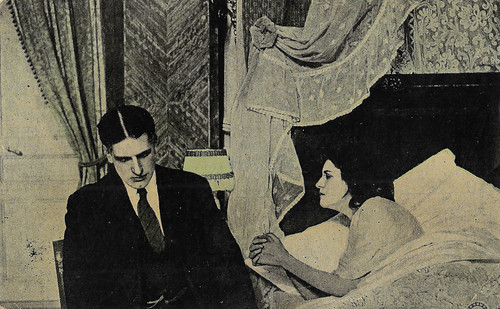
French postcard by Coquemer Gravures, Paris. Photo: Gaumont. Still for La nouvelle mission de Judex (Louis Feuillade, 1917-1918).

Louis Feuillade


René Cresté was born in Paris, France, in 1881.

He began his acting career on the stages of Paris as a jeune premier in plays such as Claudine à Paris (Claudine in Paris) by and with Colette, Ruy Blas by Victor Hugo, and Adrienne Lecouvreur by Eugene Scribe. In 1913, Alphonse Séché engaged him for his Nouveau Théâtre d’Art to play leading roles in several plays.

Cresté was also signed to a contract to the Gaumont Film Company in 1908. Little is known of these first film appearances as they are considered lost. For Pathé he appeared in La chatte métamorphosée en femme/The cat transformed in a woman (Michel Carré, 1910) with Carlos Avril.

In 1912 he began appearing in a series of mystery shorts directed by Léonce Perret for Gaumont. These films included La bonne hôtesse/The good hostess (Léonce Perret, 1912) with Suzanne Grandais, Le mariage de Suzie/Suzie’s Wedding (Léonce Perret, 1912) with Suzanne Grandais, and Par l’amour/By Love (Léonce Perret, 1913) with Jean Aymé.

At the onset of the First World War, Cresté enlisted in the French army and actively participated in the fighting. Injured and demobilized, he resumed his acting career at Gaumont studios by the end of 1915 and appeared in Son or/His Gold (Louis Feuillade, 1915) with Yvette Andréyor, Dernier amour/Last love (Léonce Perret, 1916) with Valentine Petit, and Le roi de la montagne/The King of the Mountain (Léonce Perret, 1916) with Fabienne Fabrèges.

In 1917 he played in several films for Louis Feuillade, including Le passé de Monique/Monique (Louis Feuillade, 1917) with Edouard Mathé, Mon Oncle/My Uncle (Louis Feuillade, 1917) with Musidora, and Les petites marionnettes/The small puppets (Louis Feuillade, 1917) again opposite Edouard Mathé.
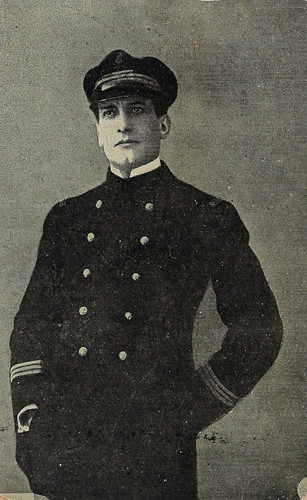
René Cresté
French postcard in the series Les Vedettes de l'Ecran by Editions Film, no. 112. Collection: Performing Arts / Manuel Palormina Ajona.

Le Panthéon du cinéma


René Cresté was then cast for his greatest role – Judex, a positive hero who steals to help the poor. The character's arch-nemesis is the callous banker Favraux, who had carelessly driven thousands of people into bankruptcy.

In 1916, Feuillade and writer Arthur Bernède had begun to develop a surrealistic character called 'Jacques de Tremeuse' (aka Judex) - a mysterious avenger who sports a signature long dark cloak, a wide-brimmed black hat, and a fatalistic air.

Judex (which means Justice) appears and disappears like a ghost, and would appear to have mild hypnotic powers. He is a master of disguise, and an excellent fighter. He commands the loyalty of an organization composed of circus folks and redeemed apaches. Finally, he flies a plane and has a secret lair, where he interrogates his prisoners through a ‘television’ screen - everything Judex writes on the screen on his desk appears on a similar screen on the wall of his victim's cell.

The serial began production in 1917 and was released the same year in its first instalment to critical and public praise. Jefferey M. Anderson at Combustible Celluloid calls Judex an ‘unalloyed masterwork’: “establishing Feuillade as one of history's greatest directors. He had an uncanny knack for finding shocking beauty in simple images, such as a gate or a wall or an antique car driving down the road”.

The character of Judex is widely recognized as one of cinema's first superheroes. René Cresté, who was already popular among female audiences, now became an immensely popular film star.

Judex also starred Musidora as villainess Diana Monti, Édouard Mathé, Gaston Michel, the young René Poyen, and Yvette Andréyor.

Simultaneously with the release of the serial, a novelization, signed by both Feuillade and Bernède, was released, first as a serial in Le Petit Parisien, then in a collected edition by Tallandier.

The following year a sequel was made, La nouvelle mission de Judex/The New Mission of Judex (Louis Feuillade, 1917), which landed Cresté definitively in ‘le Panthéon du cinéma’, as Philippe Pelletier writes so beautifully at Ciné Artistes.
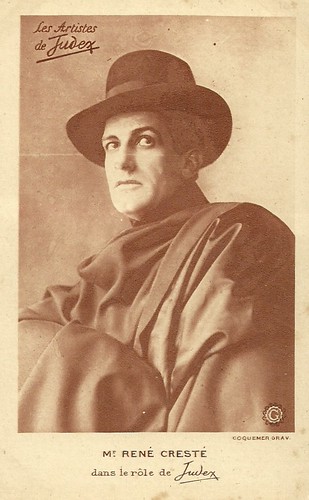
René Cresté in La nouvelle mission de Judex
French postcard by Coquemer Gravures. Photo: Gaumont. Still for La nouvelle mission de Judex (1917-1918).
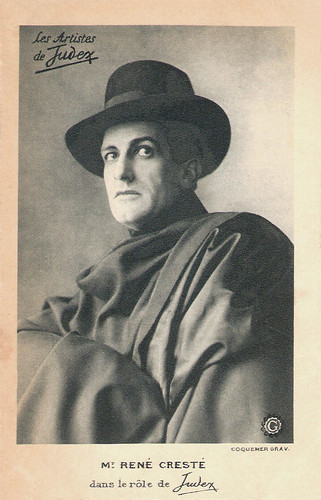
René Cresté as Judex
French postcard by Coquemer Gravures. Photo: Gaumont. Still for La nouvelle mission de Judex (1917-1918).

Eyes Without a Face


Following the success of Judex, René Cresté appeared in the serials Tih Minh (Louis Feuillade, 1918), and Vendémiaire (Louis Feuillade, 1918) with Édouard Mathé and Mary Harald. Both were less successful than Judex.

He also appeared in the films L’homme sans visage/Eyes Without a Face (Louis Feuillade, 1919) with Gina Manès, L’engrenage/The gearing (Louis Feuillade, 1919) with Geneviève Félix, and L’énigme/Enigma (Louis Feuillade, 1919) with Fernand Herrmann.

Then Cresté founded his own film production company, Films-René-Cresté, for which he produced and directed Le château du silence/The Silent Castle (René Cresté, 1919) and L’aventure de René/René’s Adventure (René Cresté, 1921).

His last film was Un coup de tête/A Whim (René Cresté, 1922). All his productions were ultimately unsuccessful.

Disappointed and ruined he decided to take the management of an Parisian Cinema, the Cocorico. He also played Judex again at the stage of the Gaîté-Rochechouart.

In 1922, René Cresté died of tuberculosis in Paris, aged 40. To support the financial needs of his widow and infirmed daughter, a charity gala was organized by friends of the Cresté family with the help of the Surrealist artists in February 1929. Three months following the event, his only daughter Renée died.

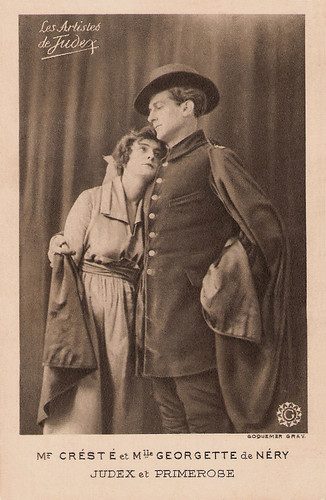
René Cresté & Georgette de Néry in La nouvelle mission de Judex
French postcard by Coquemer Gravures. Photo: Production Gaumont. Still for the sequel La nouvelle mission de Judex (1917-1918) with Georgette de Néry.
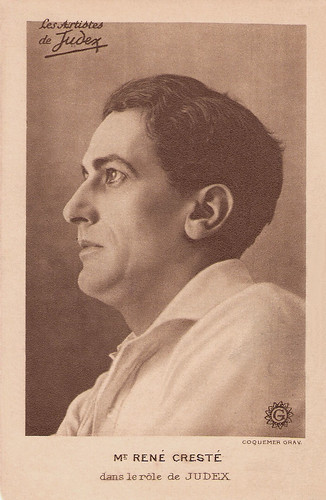
René Cresté in La nouvelle mission de Judex
French postcard. Production Gaumont. Coquemer Gravures. Still for La nouvelle mission de Judex (1917-1918).

Sources: Jeffrey M. Anderson (Combustible Celluloid), Philippe Pelletier (CinéArtistes), French Wold Newton Universe, Wikipedia and IMDb.

04 January 2014

La nouvelle mission de Judex (1917-1918)

During the last three months, we presented you a film special each Saturday. Today, the last of the series, La nouvelle mission de Judex/The New Mission of Judex (1917-1918), a French, silent crime serial directed by Louis Feuillade and produced by Gaumont. The title character, Judex (René Cresté), is a positive and cool superhero who steals to help the poor

René Cresté in La nouvelle mission de Judex
René Cresté. French postcard by Coquemer Gravures, Paris. Photo: Gaumont. Still for La nouvelle mission de Judex (Louis Feuillade, 1917-1918).

Edouard Mathé
Édouard Mathé. French postcard by Coquemer Gravures, Paris. Photo: Gaumont. Still for La nouvelle mission de Judex (Louis Feuillade, 1917-1918).

René Cresté & Georgette de Néry in La nouvelle mission de Judex
René Cresté & Georgette de Néry. French postcard by Coquemer Gravures, Paris. Photo: Gaumont. Still for La nouvelle mission de Judex (Louis Feuillade, 1917-1918).

The First Superhero of the Cinema


Judex was the first superhero of the cinema. The caped crusader was introduced in the crime-adventure Judex (1917), a French silent serial in twelve parts directed by Louis Feuillade.

In 1916, Feuillade and writer Arthur Bernède had begun to develop a surrealistic character called 'Jacques de Tremeuse' (aka Judex) - a mysterious avenger who sports a signature long dark cloak, a wide-brimmed black hat, and a fatalistic air.

Judex (which translates as Justice) appears and disappears like a ghost, and seems to have hypnotic powers. He is a master of disguise, and an excellent fighter. He commands the loyalty of an organization composed of circus folks and redeemed apaches.

Finally, he flies a plane and has a secret lair, where he interrogates his prisoners through a ‘television’ screen - everything Judex writes on the screen on his desk appears on a similar screen on the wall of his victim's cell.

The character's arch-nemesis is the callous banker Favraux, who has carelessly driven thousands of people into bankruptcy.

René Cresté in La nouvelle mission de Judex
René Cresté. French postcard by Coquemer Gravures, Paris. Photo: Gaumont. Still for La nouvelle mission de Judex (Louis Feuillade, 1917-1918).

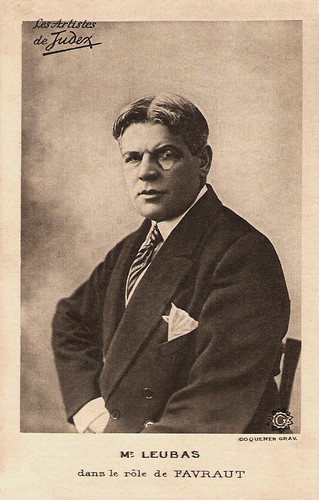
Louis Leubas in La nouvelle mission de Judex
Louis Leubas. French postcard by Coquemer Gravures, Paris. Photo: Gaumont. Still for La nouvelle mission de Judex (Louis Feuillade, 1917-1918).

Marcel Levesque in La nouvelle mission de Judex
Marcel Lévesque. French postcard by Coquemer Gravures, Paris. Photo: Gerschel / Gaumont. Still for La nouvelle mission de Judex (Louis Feuillade, 1917-1918).

Olinda Mano in La nouvelle mission de Judex
Olinda Mano. French postcard by Coquemer Gravures, Paris. Photo: Gaumont. Still for La nouvelle mission de Judex (Louis Feuillade, 1917-1918).

Amazingly Cool


Judex began production in 1917 and the 12-part serial was released the same year in its first instalment to critical and public praise.

Jeffrey M. Anderson at Combustible Celluloid calls Judex  an ‘unalloyed masterwork’,  “establishing Feuillade as one of history's greatest directors. He had an uncanny knack for finding shocking beauty in simple images, such as a gate or a wall or an antique car driving down the road”.

Louis Feuillade had already made two popular earlier serials, Fantômas (1913) and Les Vampires (1915) which were popular with audiences, but drew criticism for glorifying criminals.

The amazingly cool and positive Judex was played by René Cresté, a French stage and film actor and director of the silent film era.

Cresté, who was already popular among female audiences, now became an immensely popular film star.

Judex also starred Musidora as villainess and Favraux' mistress Diana Monti, Édouard Mathé as Jacques' brother Roger, Louis Leubas as the banker Favraux, Marcel Lévesque as the amateur detective Cocantin, Gaston Michel as Kerjean, Jean Devalde as his criminal son Morales, Yvette Andréyor as Jacqueline, the daughter of Favraux; the little girl (!) Olinda Mano as her little son Jean, and in a small part the young René Poyen.

Yvette Andreyor
Yvette Andréyor. French postcard by Coquemer Gravures, Paris. Photo: Gerschel / Gaumont. Still for La nouvelle mission de Judex (Louis Feuillade, 1917-1918).

Georgette de Néry(s) in La nouvelle mission de Judex
Georgette de Néry. French postcard by Coquemer Gravures, Paris. Photo: Gerschel / Gaumont. Still for La nouvelle mission de Judex (Louis Feuillade, 1917-1918).

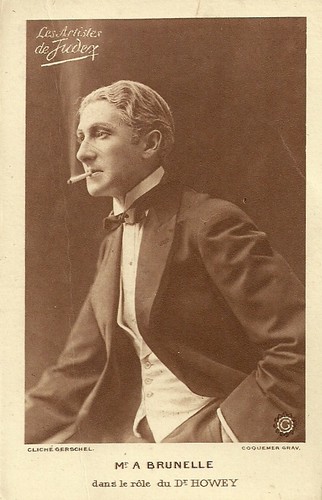
Andrew Brunelle in La nouvelle mission de Judex
Andrew Brunelle. French postcard by Coquemer Gravures, Paris. Photo: Gerschel / Gaumont. Still for La nouvelle mission de Judex (Louis Feuillade, 1917-1918).

Juana Borguèse in La nouvelle mission de Judex
Juana Borguèse. French postcard by Coquemer Gravures, Paris. Photo: Félix / Gaumont. Still for La nouvelle mission de Judex (Louis Feuillade, 1917-1918).

The New Mission of Judex


Simultaneously with the release of Judex in the cinemas, a novelization of the film serial, signed by both Feuillade and Bernède, was released, first as a serial in Le Petit Parisien, then in a collected edition by Tallandier.

The following year a sequel was made, La nouvelle mission de Judex/The New Mission of Judex (1917-1918, Louis Feuillade).

Most characters from Judex returned: Judex (René Cresté), Jacqueline (Yvette Andréyor), her father Favraux (Louis Leubas), clumsy Cocantin (Marcel Lévesque), little Jean (Olinda Mano) and Roger (Édouard Mathé).

Jacques/ Judex has married Jacqueline, so he has become a father to her son Jean. Jacques' brother Roger loves a neighbour girl Primerose (Georgette de Néry), whose father is the inventor Milton (Emile Keppens).

Their happiness is threatened by the dangerous gang La rafle aux secrets (the raiders of the secrets), who avid to steal and resell important technological inventions. The evil Dr. Howey (Andrew Brunelle) and his accomplice, the dangerous Baronne d'Apremont (Juana Borguèse), both have the capacities to hypnotise the innocent Jacqueline and Primerose, and make them do things against their will. Jacqueline threatens to poison her already ill son, while Primerose steals her father's invention and kidnaps little Jean.

The Baronne and her female aid Gaby (Cyprian Gilles) hold Jean, but they are captured and imprisoned by Judex and Cocantin. Gaby repents but the Baronne escapes. Dr. Hewey and the Baronne die when their boat explodes, accidentally caused by Cocantin.

In the end Primerose is cured and marries Roger. Remarkable is that the theft of the invention seems an excuse to display the hysterical crises and hypnotised states of the women, while the Baronne and Gaby seem to be very close to another and the previous strict boundaries between good woman/bad woman in Judex are blurred.

The sequel landed René Cresté definitively in ‘le Panthéon du cinéma’, as Philippe Pelletier writes so beautifully at CinéArtistes. The film studio, Gaumont, created this beautiful series of Les Artistes de Judex postcards, published by Coquemer Gravures in  Paris, to advertise the new series.

A remake was made in 1934 under the same title, directed by Maurice Champreux, and starring René Ferté as Judex.

Another remake was done in 1963 by director Georges Franju under the same title. The story was shortened and simplified but remained true to the original. American magician Channing Pollock was cast as the mysterious hero.

René Cresté
René Cresté. French postcard by Coquemer Gravures, Paris. Photo: Gaumont. Still for La nouvelle mission de Judex (Louis Feuillade, 1917-1918).

Edouard Mathé in La nouvelle mission de Judex
Édouard Mathé. French postcard by Coquemer Gravures, Paris. Photo: Gaumont. Still for La nouvelle mission de Judex (Louis Feuillade, 1917-1918).

Louis Leubas in La nouvelle mission de Judex
Louis Leubas. French postcard by Coquemer Gravures, Paris. Photo: Gaumont. Still for La nouvelle mission de Judex (Louis Feuillade, 1917-1918).

Marcel Levesque in La nouvelle mission de Judex
Marcel Lévesque. French postcard by Coquemer Gravures, Paris. Photo: Gerschel / Gaumont. Still for La nouvelle mission de Judex (Louis Feuillade, 1917-1918).

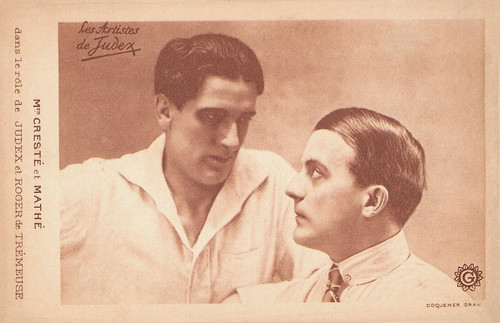
René Cresté, Edouard Mathé
René Cresté and Edouard Mathé. French postcard by Coquemer Gravures, Paris. Photo: Gerschel / Gaumont. Still for La nouvelle mission de Judex (Louis Feuillade, 1917-1918).

Next Saturday we start a new series on photographers for star postcards.

Sources: Jeffrey M. Anderson (Combustible Celluloid), Philippe Pelletier (CinéArtistes) (French),  Wikipedia and IMDb.