On the night of 30 November, British entertainer Chris Howland (1928-2013) died. He played the comic sidekick in Winnetou I and other Karl May films. After the war, Howland became Germany’s first deejay, but he was also a popular Schlager singer, TV host, and actor in some 30 films. Howland was 85.

German postcard by Filmbilder-Vertrieb Ernst Freihoff, Essen, no. 516. Retail price: 10 Pfg. Photo: Electrola / A. Grimm / Zeyss / Union.

German postcard by Filmbilder-Vertrieb Ernst Freihoff, Essen, no. 134. Retail price: 10 Pfg. Photo: Allianz Film.

German promotion card by Columbia / Electrola, no. DrW 3281 a. Photo: Neumann, Mannheim.
John Christopher Howland was born in London in 1928, and he grew up in Southern England. He was trained to work as a beekeeper. His father was an editor at the BBC. After WW II Chris worked for the radio station of the BFN (British Forces Network, now BFBS). In this function, he went to Hamburg in 1946 and became the main presenter and head of the music department of the BFN.
In 1952 he started as a diskjockey for the German radio station NWDR, where he presented the show Rhythmus der Welt, about novelties and trends in the international music scene. With his British accent and his creaky voice, he soon became a darling of the radio audiences. He gave himself the nickname Mr. Heinrich Pumpernickel. Meanwhile, he also had a successful recording career. His first hit single was 'Japanisches Abschiedslied' (1953), the German version of 'Japanese Farewell'by Kay Cee Jones. His biggest hits would be 'Fraulein' (Miss, 1958), 'Das hab ich in Paris gelernt' (That’s What I Learned in Paris, 1959), and 'Hämmerchen-Polka' (Little Hammer Polka, 1961), which stayed for 24 weeks in the German Top 5.
Howland also appeared in entertainment films like Ball der Nationen/Ball of the Nations (Karl Ritter, 1954) starring Zsa Zsa Gabor, Der Major und die Stiere/The Major and the Bulls (Eduard von Borsody, 1955), the Heimatfilm Verlobung am Wolfgangsee/Engagement at Wolfgangsee (Helmut Weiss, 1956) with Ingrid Andree, Witwer mit fünf Töchtern/Widower with 5 Daughters (Erich Engels, 1957), and Tausend Sterne leuchten/A Thousand Stars Aglitter (Harald Philipp, 1959) with ski champion Toni Sailer.
In 1959 he returned to Great Britain to present the talkshow People and Places. In 1961 he went again to Germany, where he became the host of the enormously successful TV shows Musik aus Studio B and Vorsicht Kamera, a Candid Camera show.
His films in the early 1960s included the Edgar Wallace Krimi Das Geheimnis der schwarzen Koffer/The Secret of the Black Suitcase (Werner Klingler, 1962) with Senta Berger, Der schwarze Panther von Ratana/The Black Panther of Ratana (Jürgen Roland, 1963) with Marianne Koch, Die weiße Spinne/The White Spider (Harald Reinl, 1963) with Joachim Fuchsberger, and another Edgar Wallace adaptation, Der Henker von London/The Mad Executioners (Edwin Zbonek, 1963) with Hansjörg Felmy.

Vintage postcard. Photo: Electrola.
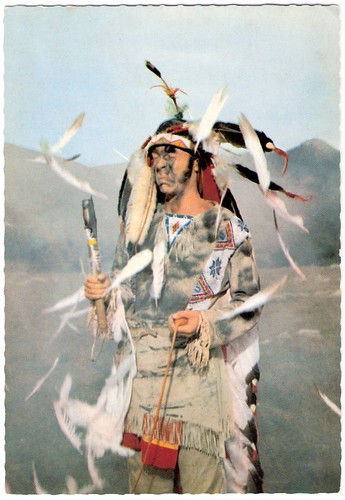
German postcard, no. E 21. Photo: Constantin. Still from Winnetou I (Harald Reinl, 1963) with Chris Howland. Translation caption: "What do you do as a reporter, when you get no Indian in front of your camera? You put on some make-up and make a self-portrait, here, unfortunately, it failed."

German postcard by Heinerle Karl-May-Postkarten, no. 43. Photo: CCC / Gloria. Publicity still for Der Schut/The Shoot (Robert Siodmak, 1964). Caption: "'Archibald now what?', Sir Lindsay (Dieter Borsche) asks his butler (Chris Howland), when The Shoot enexpectedly captures them in a cave, which is located beneath his palace."
Another highlight in the career of Chris Howland was his appearance in five film adaptations of the Karl May novels. His part as Lord Tuff-Tuff in Winnetou I/Apache Gold (Harald Reinl, 1963) was just a comic intermezzo, but for his performance as the butler Archie in his second Karl May film, Der Schut/The Shoot (Robert Siodmak, 1964), he received the second highest salary (after Lex Barker) of the cast.
He played this role again in Durchs wilde Kurdistan/Wild Kurdistan (Franz Josef Gottlieb, 1965) and in the sequel Im Reiche des silbernen Löwen/Attack of the Kurds (Franz Josef Gottlieb, 1965). That same year he appeared for the last time in a Karl May film, Das Vermächtnis des Inka/Legacy of the Incas (Georg Marischka, 1965), as the Indian Don Parmesan.
In 1970 Howard left Germany again, now to run his hotel Villa Columbus in Mallorca, where he also helped to found the first German-language radio station. In 1975 he returned again to Germany to present radio and TV shows. His autobiography 'Happy Days?' was released in 1997.
In 2002 Chris Howland was awarded the Scharlih, the oldest Karl May prize, to honour his appearances in the Winnetou films. He married four times and has three children. In the last years, he lived with his wife Monica Howland-Vervloet in Rösrath near Köln (Cologne) and appeared incidentally on TV to be a guest in talk shows or to perform one of his evergreens.
Twice a month he presented his radio show Spielereien mit Schallplatten (Dalliances With Records) on WDR 4. In 2007 Chris Howland returned for the last time on the screen in the Edgar Wallace parody Neues vom Wixxer/News from the Wixxer (Cyrill Boss, Philipp Stennert, 2007). Typically he played the butler.

German postcard, no. E 11. Photo: Constantin. Chris Howland in Winnetou - 1. Teil/Apache Gold (Harald Reinl, 1963). Caption: One looks scornfully at the i
ncoming Cook agent, whose innocuous endeavour is to photograph Indians in full war coats.

German promotion card by Ingrid Orgel, Frankfurt/M.
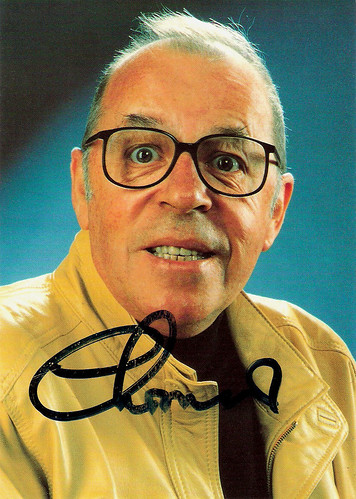
German postcard by Westdeutschen Rundfunk (WDR), Köln. Photo: Harald Kratzer / WDR.
Sources: Stephanie D'heil (Steffi-line.de - German), t-online.de (German - page now defunct), Wikipedia (German), Chris Howland.de (now defunct), and IMDb.
This post was last updated on 24 October 2024.
German postcard by Filmbilder-Vertrieb Ernst Freihoff, Essen, no. 516. Retail price: 10 Pfg. Photo: Electrola / A. Grimm / Zeyss / Union.
German postcard by Filmbilder-Vertrieb Ernst Freihoff, Essen, no. 134. Retail price: 10 Pfg. Photo: Allianz Film.
German promotion card by Columbia / Electrola, no. DrW 3281 a. Photo: Neumann, Mannheim.
Novelties and trends
John Christopher Howland was born in London in 1928, and he grew up in Southern England. He was trained to work as a beekeeper. His father was an editor at the BBC. After WW II Chris worked for the radio station of the BFN (British Forces Network, now BFBS). In this function, he went to Hamburg in 1946 and became the main presenter and head of the music department of the BFN.
In 1952 he started as a diskjockey for the German radio station NWDR, where he presented the show Rhythmus der Welt, about novelties and trends in the international music scene. With his British accent and his creaky voice, he soon became a darling of the radio audiences. He gave himself the nickname Mr. Heinrich Pumpernickel. Meanwhile, he also had a successful recording career. His first hit single was 'Japanisches Abschiedslied' (1953), the German version of 'Japanese Farewell'by Kay Cee Jones. His biggest hits would be 'Fraulein' (Miss, 1958), 'Das hab ich in Paris gelernt' (That’s What I Learned in Paris, 1959), and 'Hämmerchen-Polka' (Little Hammer Polka, 1961), which stayed for 24 weeks in the German Top 5.
Howland also appeared in entertainment films like Ball der Nationen/Ball of the Nations (Karl Ritter, 1954) starring Zsa Zsa Gabor, Der Major und die Stiere/The Major and the Bulls (Eduard von Borsody, 1955), the Heimatfilm Verlobung am Wolfgangsee/Engagement at Wolfgangsee (Helmut Weiss, 1956) with Ingrid Andree, Witwer mit fünf Töchtern/Widower with 5 Daughters (Erich Engels, 1957), and Tausend Sterne leuchten/A Thousand Stars Aglitter (Harald Philipp, 1959) with ski champion Toni Sailer.
In 1959 he returned to Great Britain to present the talkshow People and Places. In 1961 he went again to Germany, where he became the host of the enormously successful TV shows Musik aus Studio B and Vorsicht Kamera, a Candid Camera show.
His films in the early 1960s included the Edgar Wallace Krimi Das Geheimnis der schwarzen Koffer/The Secret of the Black Suitcase (Werner Klingler, 1962) with Senta Berger, Der schwarze Panther von Ratana/The Black Panther of Ratana (Jürgen Roland, 1963) with Marianne Koch, Die weiße Spinne/The White Spider (Harald Reinl, 1963) with Joachim Fuchsberger, and another Edgar Wallace adaptation, Der Henker von London/The Mad Executioners (Edwin Zbonek, 1963) with Hansjörg Felmy.
Vintage postcard. Photo: Electrola.
German postcard, no. E 21. Photo: Constantin. Still from Winnetou I (Harald Reinl, 1963) with Chris Howland. Translation caption: "What do you do as a reporter, when you get no Indian in front of your camera? You put on some make-up and make a self-portrait, here, unfortunately, it failed."
German postcard by Heinerle Karl-May-Postkarten, no. 43. Photo: CCC / Gloria. Publicity still for Der Schut/The Shoot (Robert Siodmak, 1964). Caption: "'Archibald now what?', Sir Lindsay (Dieter Borsche) asks his butler (Chris Howland), when The Shoot enexpectedly captures them in a cave, which is located beneath his palace."
Lord Tuff-Tuff
Another highlight in the career of Chris Howland was his appearance in five film adaptations of the Karl May novels. His part as Lord Tuff-Tuff in Winnetou I/Apache Gold (Harald Reinl, 1963) was just a comic intermezzo, but for his performance as the butler Archie in his second Karl May film, Der Schut/The Shoot (Robert Siodmak, 1964), he received the second highest salary (after Lex Barker) of the cast.
He played this role again in Durchs wilde Kurdistan/Wild Kurdistan (Franz Josef Gottlieb, 1965) and in the sequel Im Reiche des silbernen Löwen/Attack of the Kurds (Franz Josef Gottlieb, 1965). That same year he appeared for the last time in a Karl May film, Das Vermächtnis des Inka/Legacy of the Incas (Georg Marischka, 1965), as the Indian Don Parmesan.
In 1970 Howard left Germany again, now to run his hotel Villa Columbus in Mallorca, where he also helped to found the first German-language radio station. In 1975 he returned again to Germany to present radio and TV shows. His autobiography 'Happy Days?' was released in 1997.
In 2002 Chris Howland was awarded the Scharlih, the oldest Karl May prize, to honour his appearances in the Winnetou films. He married four times and has three children. In the last years, he lived with his wife Monica Howland-Vervloet in Rösrath near Köln (Cologne) and appeared incidentally on TV to be a guest in talk shows or to perform one of his evergreens.
Twice a month he presented his radio show Spielereien mit Schallplatten (Dalliances With Records) on WDR 4. In 2007 Chris Howland returned for the last time on the screen in the Edgar Wallace parody Neues vom Wixxer/News from the Wixxer (Cyrill Boss, Philipp Stennert, 2007). Typically he played the butler.
German postcard, no. E 11. Photo: Constantin. Chris Howland in Winnetou - 1. Teil/Apache Gold (Harald Reinl, 1963). Caption: One looks scornfully at the i
ncoming Cook agent, whose innocuous endeavour is to photograph Indians in full war coats.
German promotion card by Ingrid Orgel, Frankfurt/M.
German postcard by Westdeutschen Rundfunk (WDR), Köln. Photo: Harald Kratzer / WDR.
Sources: Stephanie D'heil (Steffi-line.de - German), t-online.de (German - page now defunct), Wikipedia (German), Chris Howland.de (now defunct), and IMDb.
This post was last updated on 24 October 2024.
