Maxime Desjardins (1861-1936) was a French stage and screen actor, who peaked in the French silent cinema of the 1920s. From 1912 Desjardins acted in cinema, first in short films at Pathé Frères and at Eclair, later in feature films by such acclaimed directors as Abel Gance, Julien Duvivier and Henri Diamant-Berger. He was a member of the Comédie-Française.

French postcard by Cinémagazine, no. 68. Photo: Pathé Consortium. Maxime Desjardins as the English king Charles I in Vingt ans après/The Return of the Musketeers (Henri Diamant-Berger, 1922).
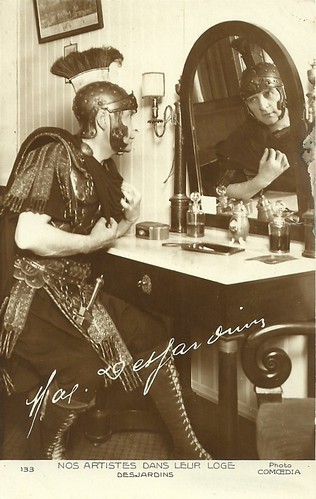
French postcard in the Nos artistes dans leur loge series, no. 133. Photo: Comoedia.
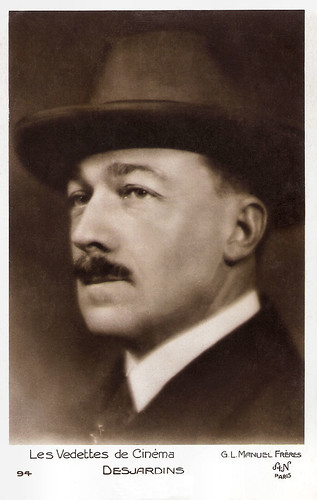
French postcard in the Les Vedettes de Cinéma series by A.N., Paris, no. 94. Photo: G.L. Manuel Frères.
Maxime Desjardins was born in 1861 in Auxerre (Burgundy), France. He started his stage acting career in Paris around 1890 at the Théâtre de l'Ambigu-Comique, shifting around 1895 to the Théâtre de la Porte-Saint-Martin, and around 1902 to the Théâtre Sarah-Bernhardt. Between 1906 and 1917 he was a regular actor at the Théâtre de l'Odéon, where he often played under the direction of André Antoine.
From 1912 Maxime Desjardins acted in cinema, first in short films at Pathé Frères and at Eclair. For Pathé he appeared in Patrie (Albert Capellani, 1914) after the drama of Victorien Sardou, starring Henry Krauss and Paul Capellani, and for Eclair in L'aiglon/The Eaglet (Emile Chautard, 1913). The latter is an adaptation of the play 'L'Aiglon' by Edmond Rostand, which portrays the life of Napoleon II with Emile Chautard as Napoleon Bonaparte.
In 1916 Desjardins acted in four films at Pathé, including Coeur de Française (Gaston Leprieur, 1916), a propagandist spy drama in which he had the male lead as inventor Aubry opposite Andrée Pascal as his wife. All the actors in the film were acclaimed stage actors, such as Albert Dieudonné.
Desjardins' film career really set off after the First World War. He was Maria Lazare in Abel Gance's J'accuse (1919) with Séverin-Mars and Romuald Joubé. He played Tréville in the silent adventure serial Les trois mousquetaires/The Three Musketeer (Henri Diamant-Berger, 1921) with Aimé Simon-Girard, and Commander Doguereau and General petit in the historical film L'agonie des aigles/The Agony of the Eagles (Dominique Bernard-Deschamps, Julien Duvivier, 1922) with Gaby Morlay and Séverin-Mars.
In 1922, he also appeared as the count Marnay in Mimi-Trottin (Henri Andréani, 1922) with Louise Lagarange in the title role, the protagonist François Roquevillard in Les Roquevillard (Julien Duvivier, 1922), the Grandduke in the serial Les mystères de Paris/The Mysteries of Paris (Charles Burguet, 1922) based on the novel 'The Mysteries of Paris' by Eugène Sue, and as King Charles I in the serial Vingt ans après (Henri Diamant-Berger 1922), the sequel to Les trois mousquetaires.

French postcard. Photo: Paul Boyer. Maxime Desjardins in Théodora (Victorien Sardou, 1884), performed in 1902 at the Théâtre Sarah-Bernhardt. Caption: M. Déjardin [sic] in the part of Justinian.

French postcard. Photo: Paul Boyer. Sarah Bernhardt in Théodora (Victorien Sardou, 1884), performed in 1902 at the Théâtre Sarah-Bernhardt. Caption: Emperor Justinian has the Empress (Sarah Bernhardt) strangled. This is the final scene of the play. The emperor was played by Maxime Desjardins, while on the right on the sofa, we see the dead Andreas, played by Pierre Magnier. The man left of the emperor may be Édouard Céalis, who played General Belisarius.
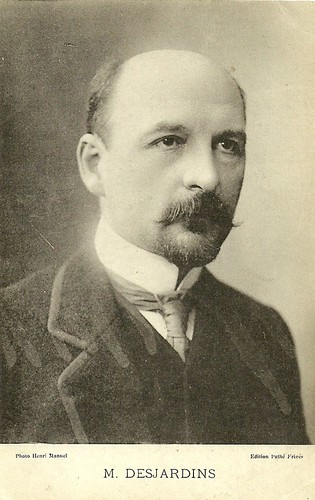
French postcard by Edition Pathé Frères. Photo: Henri Manuel.
In 1924, Maxim Desjardins was the Abbot D'Areynes in La mendiante de Sainte-Sulpice (Charles Burguet, 1924), starring Gaby Morlay and Charles Vanel, and he played Pierre Millot in the murder mystery La double existence de Lord Samsey (Maurice Kéroul, Georges Monca, 1924), starring Geneviève Félix.
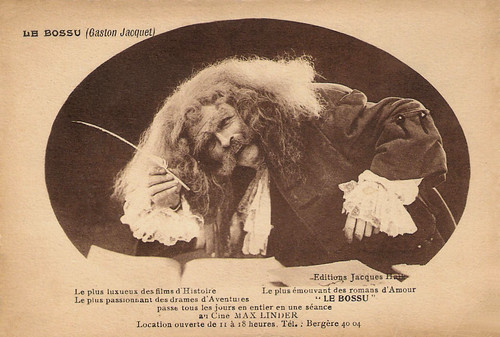
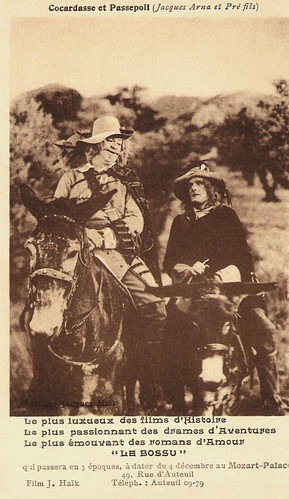
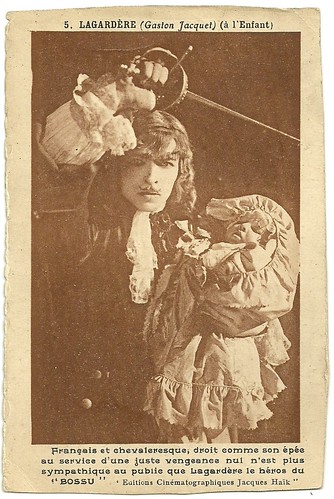
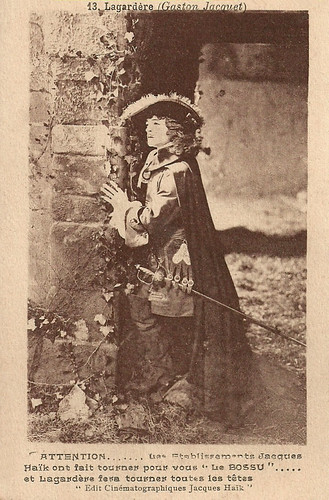
In 1925 he was baron D'anvilliers in Nantas (Donatien, 1925), avoiding the suicide of the main character (Donatien) by offering him to marry the baron's daughter Flavie (Lucienne Legrand) who expects an illegitimate child. Afterwards, Desjardins was the Regent in the historical adventure film Le bossu/The Hunchback (Jean Kemm, 1925), starring Gaston Jacquet, and Jean Sérès in Le coeur des gueux (Alfred Machin, Henri Wulschleger, 1925), starring Ginette Maddie.
In 1926-1927 Desjardins acted again under the direction of Donatien in Simone (1926) based on a play by Eugène Brieux, and Florine, la fleur du Valois (1927). His last silent film was La grande épreuve (1928), directed by André Dugès-Delzescauts and Alexandre Ryder.
Desjardins did make the passage to sound cinema in Marcel L'Herbier's Le mystère de la chambre jaune/The Mystery of the Yellow Room (1930), starring Roland Toutain and Huguette Duflos, and the French version of E.A. Dupont's Atlantic, called Atlantis (1930), co-directed by Jean Kemm. He actually had one of the leads in this film based on the Titanic disaster, which co-starred Alice Field and Constant Rémy.
However, Desjardins's sound film career was brief. His last role was in the Agatha Christie adaptation Le coffret de laque/The Lacquered Box (1932), starring Danielle Darrieux, and based on Christie's play 'Black Coffee'. From 1921 to 1930 Desjardins was also 'sociétaire' at the Comédie-Française, playing in the classic repertory of plays by Molière and Shakespeare, but also more recent authors such as Mérimée and Maeterlinck. Maxime Desjardins died in 1936 in Vence, Alpes-Maritimes, France.
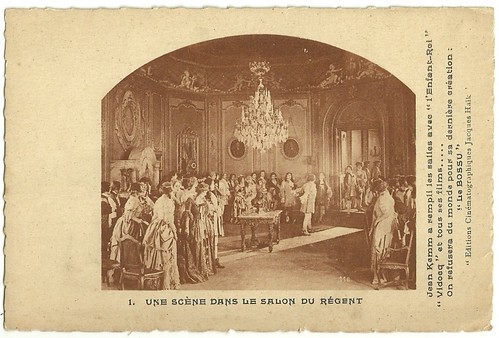
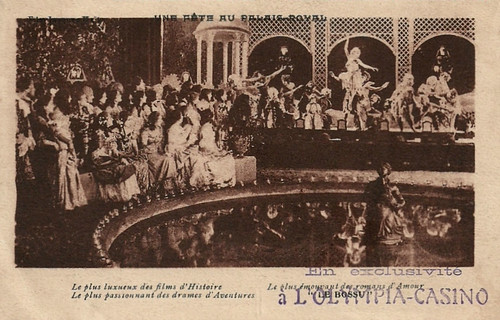
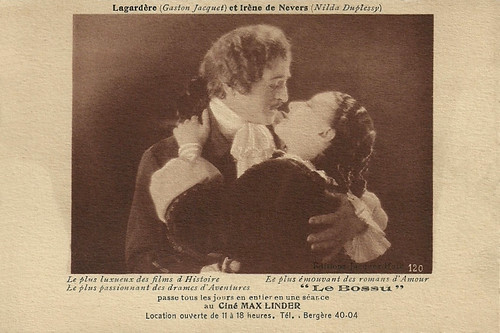
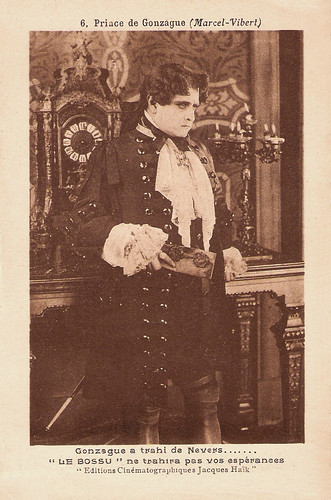
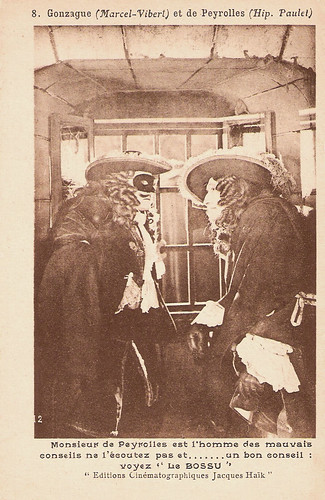
French postcard by Editions Cinématographiques Jacques Haïk, no. 1. Caption: Scene in the Salon of the Regent. Maxime Desjardins as The Regent in Le Bossu ou le Petit Parisien (Jean Kemm, 1925). The story deals with Chevalier Lagardère (Gaston Jacquet), who wants to avenge the death of his friend, killed by the Prince of Gonzaga many years ago. The film was based on the homonymous novel by Paul Féval, who was co-scenarist for the film as well. Jealous of the other man's riches, Gonzaga (Marcel Vibert) kills Nevers (Jean Lorette) in a treacherous duel and marries his widow, Aurore (Claude France). But Lagardère steals Irène, the child of Nevers and Aurore. Several years after, he returns pretending to be the hunchback of the Rue Quincampoix. He unmasks Gonzaga and holds Irène's (Nilde Duplessy) hand in return. Le Bossu was probably the first production of cinema owner Jacques Haïk, who would become an active French film producer and film distributor in the early sound era.
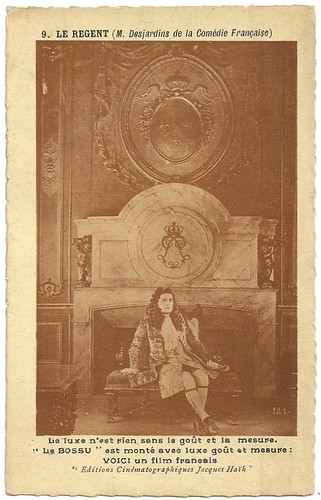
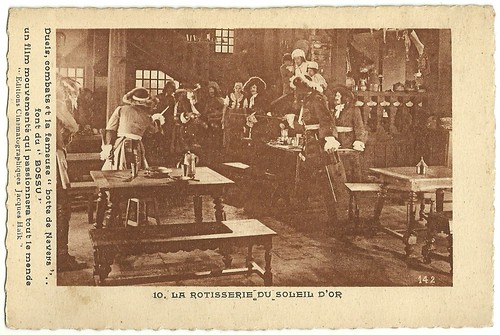
French postcard by Editions Cinématographiques Jacques Haïk, no. 9. Publicity still for Le Bossu ou le Petit Parisien (Jean Kemm, 1925) with Maxime Desjardins as Le Régent. Caption: "Le luxe n'est rien sans le goût et la mesure. 'Le Bossu' est monté avec goût et la mesure: voici un film Français." (Luxury is nothing without taste and measure. 'The Bossu' is mounted with taste and measurement: here is a French film.)
Sources: Wikipedia (French and English), and IMDb.
This post was last updated on 30 December 2023.
French postcard by Cinémagazine, no. 68. Photo: Pathé Consortium. Maxime Desjardins as the English king Charles I in Vingt ans après/The Return of the Musketeers (Henri Diamant-Berger, 1922).
French postcard in the Nos artistes dans leur loge series, no. 133. Photo: Comoedia.
French postcard in the Les Vedettes de Cinéma series by A.N., Paris, no. 94. Photo: G.L. Manuel Frères.
The Three Musketeers
Maxime Desjardins was born in 1861 in Auxerre (Burgundy), France. He started his stage acting career in Paris around 1890 at the Théâtre de l'Ambigu-Comique, shifting around 1895 to the Théâtre de la Porte-Saint-Martin, and around 1902 to the Théâtre Sarah-Bernhardt. Between 1906 and 1917 he was a regular actor at the Théâtre de l'Odéon, where he often played under the direction of André Antoine.
From 1912 Maxime Desjardins acted in cinema, first in short films at Pathé Frères and at Eclair. For Pathé he appeared in Patrie (Albert Capellani, 1914) after the drama of Victorien Sardou, starring Henry Krauss and Paul Capellani, and for Eclair in L'aiglon/The Eaglet (Emile Chautard, 1913). The latter is an adaptation of the play 'L'Aiglon' by Edmond Rostand, which portrays the life of Napoleon II with Emile Chautard as Napoleon Bonaparte.
In 1916 Desjardins acted in four films at Pathé, including Coeur de Française (Gaston Leprieur, 1916), a propagandist spy drama in which he had the male lead as inventor Aubry opposite Andrée Pascal as his wife. All the actors in the film were acclaimed stage actors, such as Albert Dieudonné.
Desjardins' film career really set off after the First World War. He was Maria Lazare in Abel Gance's J'accuse (1919) with Séverin-Mars and Romuald Joubé. He played Tréville in the silent adventure serial Les trois mousquetaires/The Three Musketeer (Henri Diamant-Berger, 1921) with Aimé Simon-Girard, and Commander Doguereau and General petit in the historical film L'agonie des aigles/The Agony of the Eagles (Dominique Bernard-Deschamps, Julien Duvivier, 1922) with Gaby Morlay and Séverin-Mars.
In 1922, he also appeared as the count Marnay in Mimi-Trottin (Henri Andréani, 1922) with Louise Lagarange in the title role, the protagonist François Roquevillard in Les Roquevillard (Julien Duvivier, 1922), the Grandduke in the serial Les mystères de Paris/The Mysteries of Paris (Charles Burguet, 1922) based on the novel 'The Mysteries of Paris' by Eugène Sue, and as King Charles I in the serial Vingt ans après (Henri Diamant-Berger 1922), the sequel to Les trois mousquetaires.
French postcard. Photo: Paul Boyer. Maxime Desjardins in Théodora (Victorien Sardou, 1884), performed in 1902 at the Théâtre Sarah-Bernhardt. Caption: M. Déjardin [sic] in the part of Justinian.
French postcard. Photo: Paul Boyer. Sarah Bernhardt in Théodora (Victorien Sardou, 1884), performed in 1902 at the Théâtre Sarah-Bernhardt. Caption: Emperor Justinian has the Empress (Sarah Bernhardt) strangled. This is the final scene of the play. The emperor was played by Maxime Desjardins, while on the right on the sofa, we see the dead Andreas, played by Pierre Magnier. The man left of the emperor may be Édouard Céalis, who played General Belisarius.
French postcard by Edition Pathé Frères. Photo: Henri Manuel.
The Titanic disaster
In 1924, Maxim Desjardins was the Abbot D'Areynes in La mendiante de Sainte-Sulpice (Charles Burguet, 1924), starring Gaby Morlay and Charles Vanel, and he played Pierre Millot in the murder mystery La double existence de Lord Samsey (Maurice Kéroul, Georges Monca, 1924), starring Geneviève Félix.
In 1925 he was baron D'anvilliers in Nantas (Donatien, 1925), avoiding the suicide of the main character (Donatien) by offering him to marry the baron's daughter Flavie (Lucienne Legrand) who expects an illegitimate child. Afterwards, Desjardins was the Regent in the historical adventure film Le bossu/The Hunchback (Jean Kemm, 1925), starring Gaston Jacquet, and Jean Sérès in Le coeur des gueux (Alfred Machin, Henri Wulschleger, 1925), starring Ginette Maddie.
In 1926-1927 Desjardins acted again under the direction of Donatien in Simone (1926) based on a play by Eugène Brieux, and Florine, la fleur du Valois (1927). His last silent film was La grande épreuve (1928), directed by André Dugès-Delzescauts and Alexandre Ryder.
Desjardins did make the passage to sound cinema in Marcel L'Herbier's Le mystère de la chambre jaune/The Mystery of the Yellow Room (1930), starring Roland Toutain and Huguette Duflos, and the French version of E.A. Dupont's Atlantic, called Atlantis (1930), co-directed by Jean Kemm. He actually had one of the leads in this film based on the Titanic disaster, which co-starred Alice Field and Constant Rémy.
However, Desjardins's sound film career was brief. His last role was in the Agatha Christie adaptation Le coffret de laque/The Lacquered Box (1932), starring Danielle Darrieux, and based on Christie's play 'Black Coffee'. From 1921 to 1930 Desjardins was also 'sociétaire' at the Comédie-Française, playing in the classic repertory of plays by Molière and Shakespeare, but also more recent authors such as Mérimée and Maeterlinck. Maxime Desjardins died in 1936 in Vence, Alpes-Maritimes, France.
French postcard by Editions Cinématographiques Jacques Haïk, no. 1. Caption: Scene in the Salon of the Regent. Maxime Desjardins as The Regent in Le Bossu ou le Petit Parisien (Jean Kemm, 1925). The story deals with Chevalier Lagardère (Gaston Jacquet), who wants to avenge the death of his friend, killed by the Prince of Gonzaga many years ago. The film was based on the homonymous novel by Paul Féval, who was co-scenarist for the film as well. Jealous of the other man's riches, Gonzaga (Marcel Vibert) kills Nevers (Jean Lorette) in a treacherous duel and marries his widow, Aurore (Claude France). But Lagardère steals Irène, the child of Nevers and Aurore. Several years after, he returns pretending to be the hunchback of the Rue Quincampoix. He unmasks Gonzaga and holds Irène's (Nilde Duplessy) hand in return. Le Bossu was probably the first production of cinema owner Jacques Haïk, who would become an active French film producer and film distributor in the early sound era.
French postcard by Editions Cinématographiques Jacques Haïk, no. 9. Publicity still for Le Bossu ou le Petit Parisien (Jean Kemm, 1925) with Maxime Desjardins as Le Régent. Caption: "Le luxe n'est rien sans le goût et la mesure. 'Le Bossu' est monté avec goût et la mesure: voici un film Français." (Luxury is nothing without taste and measure. 'The Bossu' is mounted with taste and measurement: here is a French film.)
Sources: Wikipedia (French and English), and IMDb.
This post was last updated on 30 December 2023.