Legendary Italian actor Bartolomeo Pagano (1878-1947) was the original Maciste who debuted in the silent classic Cabiria (1914). His name is forever attached to the character of the strong man, which he played in 25 films.
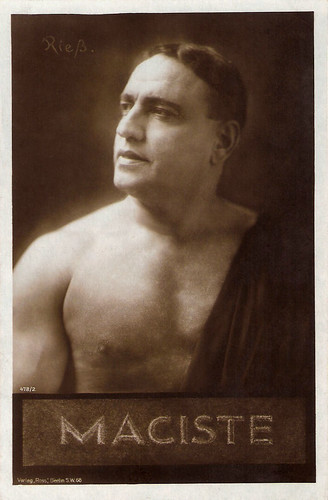
German postcard by Ross Verlag, Berlin, no. 478/2, 1919-1924. Photo: Riess.
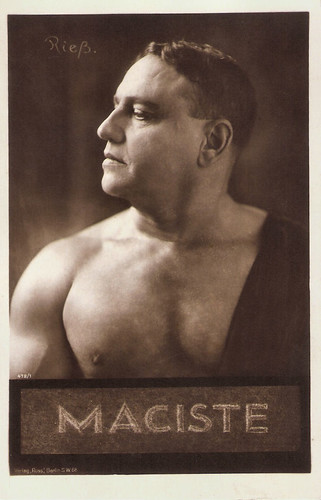
German postcard by Ross Verlag, Berlin, no. 478/1, 1919-1924. Photo: Riess.
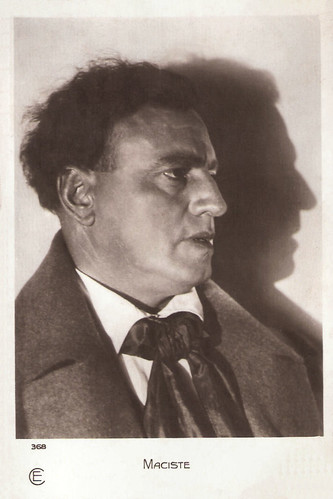
French postcard by Cinémagazine-Edition, no. 368. Bartolomeo Pagano aka Maciste in Maciste all'inferno / Maciste in Hell (Guido Brignone, 1926).
Bartolomeo Pagano was born in the Sant’Ilario quarter of Genoa in 1878. He was the son of a Neapolitan father. As an adult, he worked as a dockhand in the port of Genoa, in the nearby quarter of Nervi. Different versions circulate about his discovery for the cinema. In 1913, film director and producer Giovanni Pastrone, manager of the Itala company of Turin, released a call for the interpreter of the character of the Nubian slave Maciste (a character created together by author Gabriele D’Annunzio) for Pastrone’s super-production Cabiria (Giovanni Pastrone, 1914) starring diva Italia Almirante-Manzini. Out of 50 candidates from all over Italy, Pastrone selected Pagano.
According to another version, it was actor Domenico Gambino who noticed Pagano and signalled him to Pastrone, who, impressed by his muscular physique, hired him for his epic film. Overnight, the film made Pagano an international success because of his muscles and his image as a courageous, humorous and no-nonsensical defender of the weak. In Cabiria, he uses his power to rescue a Roman girl from the hands of the Carthaginian priests who want to offer her to Moloch.
Pastrone immediately saw opportunities with his new star and launched a series of vehicles for his character, starting with a film simply called Maciste (Luigi Romano Borgnetto, Vincenzo Denizot, 1915). Deliberately, Maciste’s part in Cabiria, the splendour of the Itala studio, and Maciste’s work there were shown to impress audiences and tie them to the previous box office hit. Of course, the plot deals with a damsel in distress, whom Maciste saves with his muscles and his wit.
During the First World War, Pastrone used Maciste for war propaganda in Maciste alpino / The Warrior (Giovanni Pastrone, 1916), in which Maciste fiercely opposes the Austrian soldiers when he and his colleagues are captured during a film shoot on location. The success of the film made Pastrone exploit Maciste in all kinds of situations and genres, but mostly in the adventure and crime genre: Maciste medium (Vincenzo Denizot, 1918), Maciste atleta /Maciste Athlete (Vincenzo Denizot, Giovanni Pastrone, 1918), Maciste poliziotto (Roberto Roberti, 1918), Maciste innamorato / Maciste in Love (Luigi Romano Borgnetto, 1919), La trilogia di Maciste / The Maciste Trilogy (Carlo Campogalliani, 1920), Maciste salvato dalle acque / Maciste Saved From the Waters (Luigi Romano Borgnetto, 1921), and Maciste in vacanza / Maciste On Holiday (Luigi Romano Borgnetto, 1921).
In all these films, he performed Maciste in 'blackface', which he continued to do in all 25 films in which he played Maciste. By now, Pastrone did not direct the films anymore but left this task to skilled directors like Luigi Romano Borgnetto. While not all of these were good productions, La Trilogia di Maciste (1920) by Carlo Campogalliani was one of the better Maciste films.
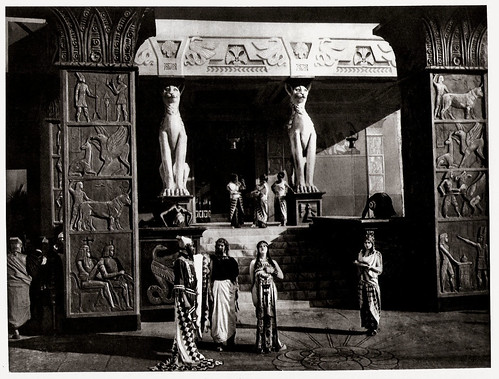
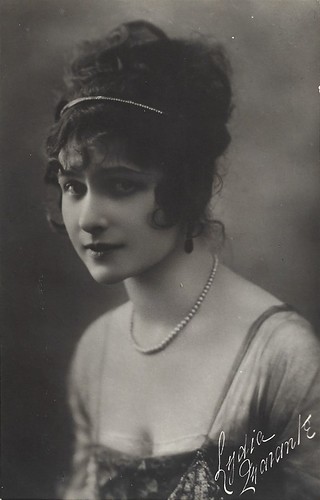
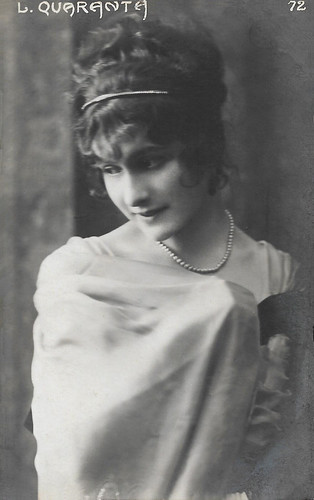
Publicity still of the Italian silent film classic Cabiria (Giovanni Pastrone, 1914), with Alex Bernard, Edoardo Davesnes, Italia Almirante-Manzini and Lydia Quaranta.

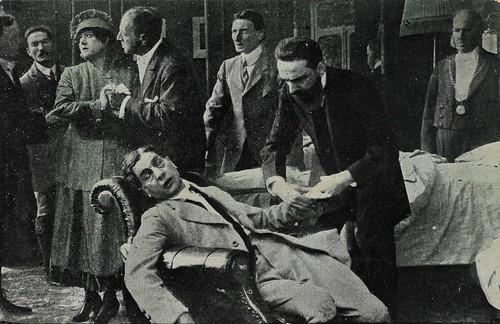
Spanish collector card by Chocolate Amatller, Barcelona, no. 10 (of 12). Photo: Itala Film. Bartolomeo Pagano as Maciste in Cabiria (Giovanni Pastrone, 1914). Here, Maciste strangles the highpriest Karthalo (Dante Testa), but Cabiria holds him back.
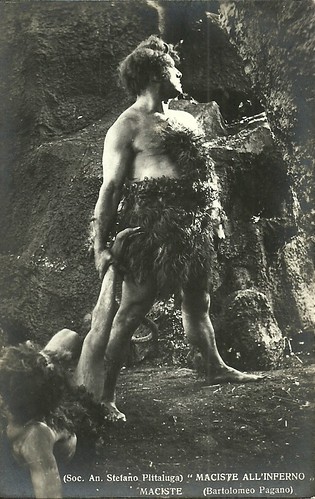
Italian postcard by Ed. A. Traldi, Milano. Photo: Dist. Società Anonima Stefano Pittaluga. Bartolomeo Pagano as Maciste in Maciste all'inferno / Maciste in Hell (Guido Brignone, 1926).
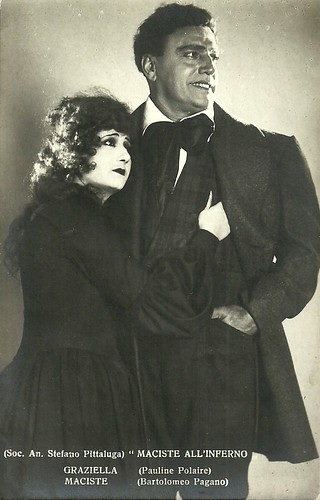
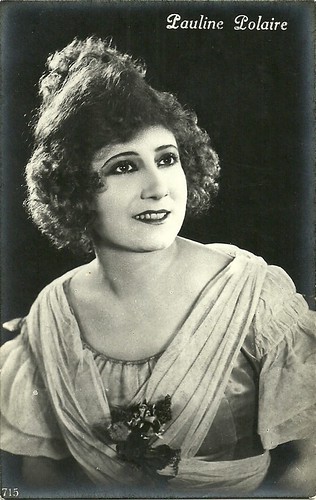
Italian postcard by Ed. A. Traldi, Milano. Photo: Pittaluga Films, Torino. Bartolomeo Pagano as Maciste and Pauline Polaire as Graziella in Maciste all'inferno / Maciste in Hell (Guido Brignone, 1926).
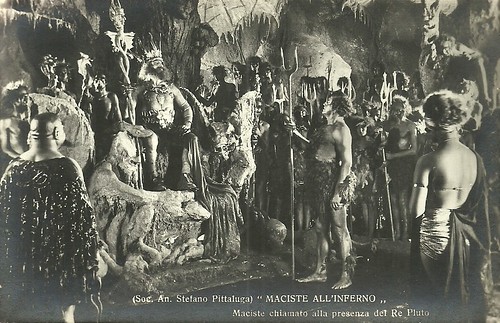
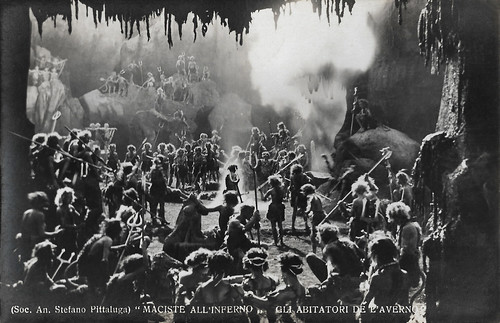
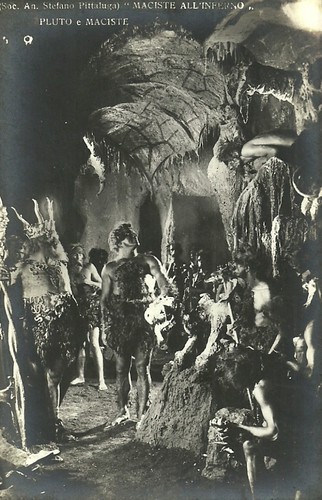
Italian postcard by Ed. A. Traldi, Milano. Photo: Pittaluga Films, Torino. Publicity still for Maciste all'inferno / Maciste in Hell (Guido Brignone 1926). Caption: Maciste (Bartolomeo Pagano) called before King Pluto (Umberto Guarracino). On the right, on the back, Pluto's daughter Luciferina (Lucia Zanussi) is standing. The bold guy on the left must be Gerione (Mario Saio).
While Bartolomeo Pagano’s precursor, Bruto Castellani, the strong man Ursus in Quo vadis (Enrico Guazzoni, 1913), had no followers, Pagano’s Maciste did.
In Italy, the 'strong men' or 'forzuti' genre in film sprang up, creating space for characters such as Ausonia, Galaor, Ajax, and Sansone, and attracting competing strong men and physical culture champions such as Giovanni Raicevich.
But Pagano’s Maciste was also simply pirated abroad, such as by the French actor Michel Bonnet with his character Magiste, and there was another rip-off in Mexico.
French critic Louis Delluc called him the 'Guitry of biceps', while newcomers Ultus (Aurele Sydney) and Douglas Fairbanks were launched as the British and the American Maciste.
In the late 1910s and early 1920s, Maciste’s popularity was at its peak in Austria and Germany, despite the preceding anti-Austrian Maciste alpino / The Warrior (1916). At home in Italy, Maciste’s image of Superman coincided with the new fascist ideology. In the 1920s Pagano was one of the best-paid actors of his time, sometimes gaining 600.000 lire a year.
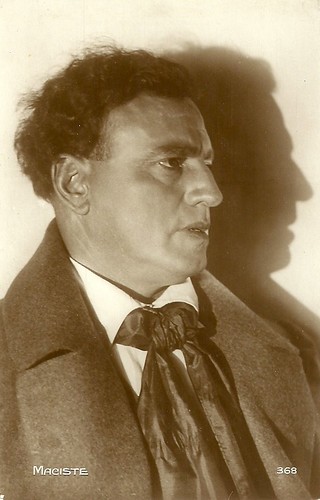
French postcard by Editions Cinémagazine, no. 368. Bartolomeo Pagano aka Maciste in Maciste all'inferno / Maciste in Hell (Guido Brignone, 1926).

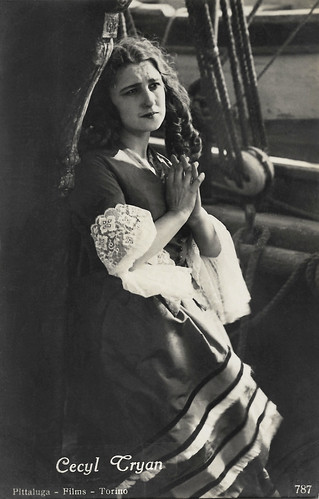
Italian postcard. Photo: Pittaluga Films, Torino (Turin). Publicity still for the Italian silent film Maciste contro lo sceicco / Maciste Against the Sheik (Mario Camerini, 1926). Maciste (Bartolomeo Pagano) hoists the sails, while the evil captain (Alex Bernard) looks on.

Italian postcard. Bartolomeo Pagano aka Maciste in Maciste contro lo sceicco / Maciste Against the Sheik (Mario Camerini, 1926), produced by Pittaluga Film, Turin.
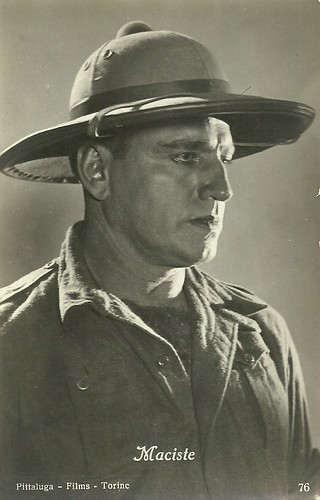
Italian postcard by Ed. A. Traldi, Milano, no. 76. Photo: Pittaluga Films, Torino. Bartolomeo Pagano aka Maciste in Maciste nella gabbia dei leoni / Maciste in the Lion's Cage (Guido Brignone, 1926).
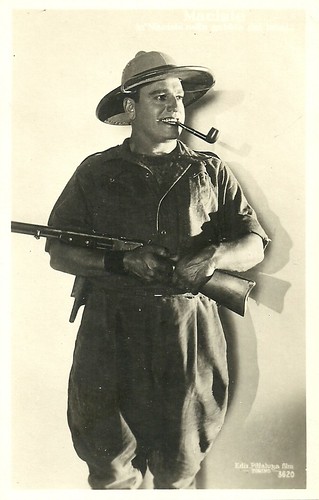
Italian postcard. Bartolomeo Pagano aka Maciste in Maciste nella gabbia dei leoni / Maciste in the Lion's Cage (Guido Brignone, 1926), produced by Pittaluga Film, Turin.
Bartolomeo Pagano continued to star in the Maciste films until the early 1920s, when, not so much because of the collapse of the Italian film production but rather because of a fabulous contract, Pagano went to Berlin, the mecca of the European film industry. Here he stayed between 1921 and 1923, but according to the film press, he wasn’t as successful there, playing in Maciste und die Javanerin / Maciste and the Javanese (Uwe Jenss Kraft, 1921) with Carola Toelle, Maciste und die Tochter des Silberkönig / Maciste and the Daughter of the Silver King (Luigi Romano Borgnetto, 1921) opposite Helena Makowska, Maciste und der Sträfling Nr. 51 / Maciste and the Convict No. 51 (Luigi Romano Borgnetto, 1921), and Maciste und die Chinesische Truhe / Maciste and the Chinese chest (Carl Boese, 1923).
Dissatisfied, Pagano returned to Italy, where producer Stefano Pittaluga immediately put him on a transatlantic for the film Maciste e il nipote d’America / Maciste and the Grandson of America (Eleuterio Rodolfi, 1924), which included scenes shot in New York. Among the less convincing titles is Maciste imperatore / Maciste Emperor (Guido Brignone, 1924).
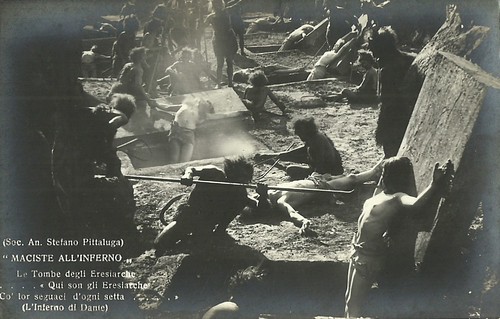
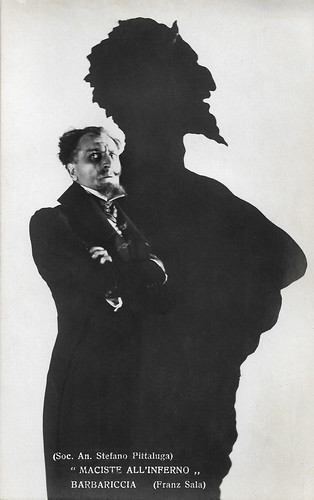
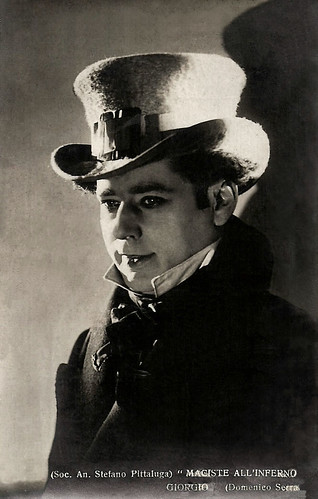
The same year Brignone directed Pagano in Maciste all’Inferno / Maciste in Hell (1926), a witty and artful pastiche on Dante, Gustave Doré, Georges Méliès, Expressionism and medieval illustrations. It also contains ingenious special effects by ‘magician’ Segundo de Chomon. When entering Hades, Maciste is being seduced by Proserpina, played by Italian diva Elena Sagro, and he turns into a hairy devil himself. The film was dear to Federico Fellini because of its weird, fairy-tale-like atmosphere; the film supposedly inspired him to become a film director.
Bored with his Maciste films, Pagano asked and got different roles: Il vetturale del Moncenisio / The Coachman of the Mont Cenis (Baldassarre Negroni, 1927) with Rina De Liguoro, Giuditta e Oloferne / Judith and Holofernes (Baldassarre Negroni, 1928) starring Jia Ruskaja, and his last part (a secondary one by now) in L’ultimo Zar / The last Tsar (Baldassarre Negroni, 1928). The actor retired from films in 1926 to marry Camilla Balduzzi, and he raised a family in his Villa Maciste in Sant’Ilario Ligure near Genoa. Diabetes destroyed his forces, and typhoid reduced his weight in drastic ways, while arthritis even obliged him to spend his last years in a wheelchair. The outside world didn’t know.
Bartolomeo Pagano died of a heart attack in San Ilario Ligure in 1947. According to Italian film historian Vittorio Martinelli, Pagano was never a real actor, but rather the lively personification of a character from popular literature. His character’s name remains a synonym for power and courage. After Pagano's death, the character of Maciste was played by several other actors. In 1960-1965, Maciste was revived in the Sword and Sandal films with Mark Forrest, Gordon Scott, Ed Fury and other bodybuilders, while in the early 1970s cult director Jesus Franco made two low-budget Maciste films for French producers.

Italian postcard by G.B. Falci, Milano (Milan), no. 3. Photo: Production Pittaluga Film, Torino (Turin). Bartolomeo Pagano in Giuditta e Oloferne / Judith and Hollophernes (Baldassarre Negroni, 1929). The man on the right may be Franz Sala.

Italian postcard by G.B. Falci, Milano (Milan), no. 7. Photo: Production Pittaluga Film, Torino (Turin). Bartolomeo Pagano and Jia Ruskaja in Giuditta e Oloferne / Judith and Hollophernes (Baldassarre Negroni, 1929).

Italian postcard by S.A. Stefano Pittaluga, no. 35-439. Photo: Pittaluga. Bartolomeo Pagano and Amilcare Taglienti in Gli ultimi zar / The Last Czar (Baldassarre Negroni, 1928).
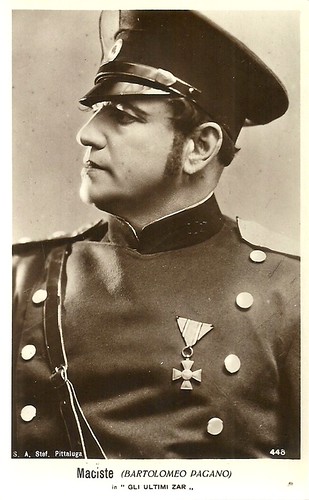
Italian postcard by S.A. Stefano Pittaluga, no. 35-448. Photo: Pittaluga. Bartolomeo Pagano in Gli ultimi zar / The Last Czar (Baldassarre Negroni, 1928).
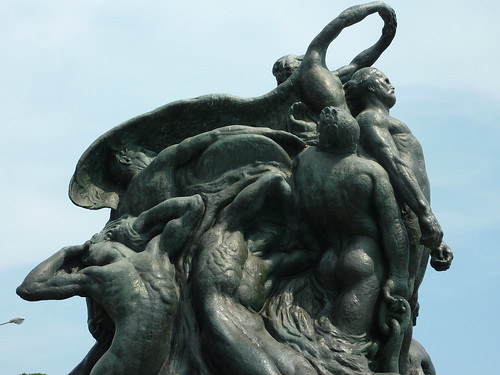
Monumento Quarto dei Mille (1915) by Eugenio Baroni. Near the site of this statue, Giuseppe Garibaldi took off to liberate Sicily from the Bourbon regime in 1860, together with his Thousand volunteers. In 1915, the monument was inaugurated with a speech by Gabriele D'Annunzio. Apparently, the former Genovese dock worker Bartolomeo Pagano, who had become a major film star as Maciste in Giovanni Pastrone's Cabiria (1914), had modelled for the statue of Garibaldi. So when the statue was revealed, audiences whispered that Garibaldi looked a lot like Maciste, their local hero who had become an international star. Quarto or Quarto del mare used to be a separate community, but later on became part of the city of Genoa.
Sources: Vittorio Martinelli (Maciste & Co. I giganti buoni del cinema italiano), Jim Beaver (IMDb), Wikipedia (Italian and English), and IMDb.
This post was last updated on 27 January 2026.
German postcard by Ross Verlag, Berlin, no. 478/2, 1919-1924. Photo: Riess.
German postcard by Ross Verlag, Berlin, no. 478/1, 1919-1924. Photo: Riess.
French postcard by Cinémagazine-Edition, no. 368. Bartolomeo Pagano aka Maciste in Maciste all'inferno / Maciste in Hell (Guido Brignone, 1926).
In blackface
Bartolomeo Pagano was born in the Sant’Ilario quarter of Genoa in 1878. He was the son of a Neapolitan father. As an adult, he worked as a dockhand in the port of Genoa, in the nearby quarter of Nervi. Different versions circulate about his discovery for the cinema. In 1913, film director and producer Giovanni Pastrone, manager of the Itala company of Turin, released a call for the interpreter of the character of the Nubian slave Maciste (a character created together by author Gabriele D’Annunzio) for Pastrone’s super-production Cabiria (Giovanni Pastrone, 1914) starring diva Italia Almirante-Manzini. Out of 50 candidates from all over Italy, Pastrone selected Pagano.
According to another version, it was actor Domenico Gambino who noticed Pagano and signalled him to Pastrone, who, impressed by his muscular physique, hired him for his epic film. Overnight, the film made Pagano an international success because of his muscles and his image as a courageous, humorous and no-nonsensical defender of the weak. In Cabiria, he uses his power to rescue a Roman girl from the hands of the Carthaginian priests who want to offer her to Moloch.
Pastrone immediately saw opportunities with his new star and launched a series of vehicles for his character, starting with a film simply called Maciste (Luigi Romano Borgnetto, Vincenzo Denizot, 1915). Deliberately, Maciste’s part in Cabiria, the splendour of the Itala studio, and Maciste’s work there were shown to impress audiences and tie them to the previous box office hit. Of course, the plot deals with a damsel in distress, whom Maciste saves with his muscles and his wit.
During the First World War, Pastrone used Maciste for war propaganda in Maciste alpino / The Warrior (Giovanni Pastrone, 1916), in which Maciste fiercely opposes the Austrian soldiers when he and his colleagues are captured during a film shoot on location. The success of the film made Pastrone exploit Maciste in all kinds of situations and genres, but mostly in the adventure and crime genre: Maciste medium (Vincenzo Denizot, 1918), Maciste atleta /Maciste Athlete (Vincenzo Denizot, Giovanni Pastrone, 1918), Maciste poliziotto (Roberto Roberti, 1918), Maciste innamorato / Maciste in Love (Luigi Romano Borgnetto, 1919), La trilogia di Maciste / The Maciste Trilogy (Carlo Campogalliani, 1920), Maciste salvato dalle acque / Maciste Saved From the Waters (Luigi Romano Borgnetto, 1921), and Maciste in vacanza / Maciste On Holiday (Luigi Romano Borgnetto, 1921).
In all these films, he performed Maciste in 'blackface', which he continued to do in all 25 films in which he played Maciste. By now, Pastrone did not direct the films anymore but left this task to skilled directors like Luigi Romano Borgnetto. While not all of these were good productions, La Trilogia di Maciste (1920) by Carlo Campogalliani was one of the better Maciste films.
Publicity still of the Italian silent film classic Cabiria (Giovanni Pastrone, 1914), with Alex Bernard, Edoardo Davesnes, Italia Almirante-Manzini and Lydia Quaranta.
Spanish collector card by Chocolate Amatller, Barcelona, no. 10 (of 12). Photo: Itala Film. Bartolomeo Pagano as Maciste in Cabiria (Giovanni Pastrone, 1914). Here, Maciste strangles the highpriest Karthalo (Dante Testa), but Cabiria holds him back.
Italian postcard by Ed. A. Traldi, Milano. Photo: Dist. Società Anonima Stefano Pittaluga. Bartolomeo Pagano as Maciste in Maciste all'inferno / Maciste in Hell (Guido Brignone, 1926).
Italian postcard by Ed. A. Traldi, Milano. Photo: Pittaluga Films, Torino. Bartolomeo Pagano as Maciste and Pauline Polaire as Graziella in Maciste all'inferno / Maciste in Hell (Guido Brignone, 1926).
Italian postcard by Ed. A. Traldi, Milano. Photo: Pittaluga Films, Torino. Publicity still for Maciste all'inferno / Maciste in Hell (Guido Brignone 1926). Caption: Maciste (Bartolomeo Pagano) called before King Pluto (Umberto Guarracino). On the right, on the back, Pluto's daughter Luciferina (Lucia Zanussi) is standing. The bold guy on the left must be Gerione (Mario Saio).
Strong men or forzuti
While Bartolomeo Pagano’s precursor, Bruto Castellani, the strong man Ursus in Quo vadis (Enrico Guazzoni, 1913), had no followers, Pagano’s Maciste did.
In Italy, the 'strong men' or 'forzuti' genre in film sprang up, creating space for characters such as Ausonia, Galaor, Ajax, and Sansone, and attracting competing strong men and physical culture champions such as Giovanni Raicevich.
But Pagano’s Maciste was also simply pirated abroad, such as by the French actor Michel Bonnet with his character Magiste, and there was another rip-off in Mexico.
French critic Louis Delluc called him the 'Guitry of biceps', while newcomers Ultus (Aurele Sydney) and Douglas Fairbanks were launched as the British and the American Maciste.
In the late 1910s and early 1920s, Maciste’s popularity was at its peak in Austria and Germany, despite the preceding anti-Austrian Maciste alpino / The Warrior (1916). At home in Italy, Maciste’s image of Superman coincided with the new fascist ideology. In the 1920s Pagano was one of the best-paid actors of his time, sometimes gaining 600.000 lire a year.
French postcard by Editions Cinémagazine, no. 368. Bartolomeo Pagano aka Maciste in Maciste all'inferno / Maciste in Hell (Guido Brignone, 1926).
Italian postcard. Photo: Pittaluga Films, Torino (Turin). Publicity still for the Italian silent film Maciste contro lo sceicco / Maciste Against the Sheik (Mario Camerini, 1926). Maciste (Bartolomeo Pagano) hoists the sails, while the evil captain (Alex Bernard) looks on.
Italian postcard. Bartolomeo Pagano aka Maciste in Maciste contro lo sceicco / Maciste Against the Sheik (Mario Camerini, 1926), produced by Pittaluga Film, Turin.
Italian postcard by Ed. A. Traldi, Milano, no. 76. Photo: Pittaluga Films, Torino. Bartolomeo Pagano aka Maciste in Maciste nella gabbia dei leoni / Maciste in the Lion's Cage (Guido Brignone, 1926).
Italian postcard. Bartolomeo Pagano aka Maciste in Maciste nella gabbia dei leoni / Maciste in the Lion's Cage (Guido Brignone, 1926), produced by Pittaluga Film, Turin.
Inspiring Federico Fellini
Bartolomeo Pagano continued to star in the Maciste films until the early 1920s, when, not so much because of the collapse of the Italian film production but rather because of a fabulous contract, Pagano went to Berlin, the mecca of the European film industry. Here he stayed between 1921 and 1923, but according to the film press, he wasn’t as successful there, playing in Maciste und die Javanerin / Maciste and the Javanese (Uwe Jenss Kraft, 1921) with Carola Toelle, Maciste und die Tochter des Silberkönig / Maciste and the Daughter of the Silver King (Luigi Romano Borgnetto, 1921) opposite Helena Makowska, Maciste und der Sträfling Nr. 51 / Maciste and the Convict No. 51 (Luigi Romano Borgnetto, 1921), and Maciste und die Chinesische Truhe / Maciste and the Chinese chest (Carl Boese, 1923).
Dissatisfied, Pagano returned to Italy, where producer Stefano Pittaluga immediately put him on a transatlantic for the film Maciste e il nipote d’America / Maciste and the Grandson of America (Eleuterio Rodolfi, 1924), which included scenes shot in New York. Among the less convincing titles is Maciste imperatore / Maciste Emperor (Guido Brignone, 1924).
The same year Brignone directed Pagano in Maciste all’Inferno / Maciste in Hell (1926), a witty and artful pastiche on Dante, Gustave Doré, Georges Méliès, Expressionism and medieval illustrations. It also contains ingenious special effects by ‘magician’ Segundo de Chomon. When entering Hades, Maciste is being seduced by Proserpina, played by Italian diva Elena Sagro, and he turns into a hairy devil himself. The film was dear to Federico Fellini because of its weird, fairy-tale-like atmosphere; the film supposedly inspired him to become a film director.
Bored with his Maciste films, Pagano asked and got different roles: Il vetturale del Moncenisio / The Coachman of the Mont Cenis (Baldassarre Negroni, 1927) with Rina De Liguoro, Giuditta e Oloferne / Judith and Holofernes (Baldassarre Negroni, 1928) starring Jia Ruskaja, and his last part (a secondary one by now) in L’ultimo Zar / The last Tsar (Baldassarre Negroni, 1928). The actor retired from films in 1926 to marry Camilla Balduzzi, and he raised a family in his Villa Maciste in Sant’Ilario Ligure near Genoa. Diabetes destroyed his forces, and typhoid reduced his weight in drastic ways, while arthritis even obliged him to spend his last years in a wheelchair. The outside world didn’t know.
Bartolomeo Pagano died of a heart attack in San Ilario Ligure in 1947. According to Italian film historian Vittorio Martinelli, Pagano was never a real actor, but rather the lively personification of a character from popular literature. His character’s name remains a synonym for power and courage. After Pagano's death, the character of Maciste was played by several other actors. In 1960-1965, Maciste was revived in the Sword and Sandal films with Mark Forrest, Gordon Scott, Ed Fury and other bodybuilders, while in the early 1970s cult director Jesus Franco made two low-budget Maciste films for French producers.
Italian postcard by G.B. Falci, Milano (Milan), no. 3. Photo: Production Pittaluga Film, Torino (Turin). Bartolomeo Pagano in Giuditta e Oloferne / Judith and Hollophernes (Baldassarre Negroni, 1929). The man on the right may be Franz Sala.
Italian postcard by G.B. Falci, Milano (Milan), no. 7. Photo: Production Pittaluga Film, Torino (Turin). Bartolomeo Pagano and Jia Ruskaja in Giuditta e Oloferne / Judith and Hollophernes (Baldassarre Negroni, 1929).
Italian postcard by S.A. Stefano Pittaluga, no. 35-439. Photo: Pittaluga. Bartolomeo Pagano and Amilcare Taglienti in Gli ultimi zar / The Last Czar (Baldassarre Negroni, 1928).
Italian postcard by S.A. Stefano Pittaluga, no. 35-448. Photo: Pittaluga. Bartolomeo Pagano in Gli ultimi zar / The Last Czar (Baldassarre Negroni, 1928).
Monumento Quarto dei Mille (1915) by Eugenio Baroni. Near the site of this statue, Giuseppe Garibaldi took off to liberate Sicily from the Bourbon regime in 1860, together with his Thousand volunteers. In 1915, the monument was inaugurated with a speech by Gabriele D'Annunzio. Apparently, the former Genovese dock worker Bartolomeo Pagano, who had become a major film star as Maciste in Giovanni Pastrone's Cabiria (1914), had modelled for the statue of Garibaldi. So when the statue was revealed, audiences whispered that Garibaldi looked a lot like Maciste, their local hero who had become an international star. Quarto or Quarto del mare used to be a separate community, but later on became part of the city of Genoa.
Sources: Vittorio Martinelli (Maciste & Co. I giganti buoni del cinema italiano), Jim Beaver (IMDb), Wikipedia (Italian and English), and IMDb.
This post was last updated on 27 January 2026.