Elegant German actress Claire Rommer (1904-1996) appeared in about 50 German film productions during the 1920s and the early 1930s. Her successful career was suddenly ended by the Nazis.

Austrian postcard by Iris Verlag, no. 566. Photo: Verleih E. Weil & Co.

Austrian postcard by Iris Verlag, no. 672. Photo: Allianz-Film / Domo-Strauß-Film GmbH. Walter Rilla and Claire Rommer in the Austrian-German silent operetta film Hoheit tanzt Walzer / Her Highness Dances the Waltz (Fritz Freisler, 1926). The operetta film is based on the 1912 operetta 'Hoheit tanzt Walzer' by Leo Ascher (music) and Alfred Grünwald (libretto). Domo-Strauß-Film was the German distributor. The film was a huge critical and commercial success and a breakthrough for Rilla.

German postcard by Ross Verlag, no. 1446/2, 1927-1928. Photo: Walther Lichtenstein, Berlin-Charlottenburg / Domo-Strauß-Film. Claire Rommer as Fräulein Rittmeister Julie in Die dritte Eskadron / The Third Squadron (Carl Wilhelm, 1926).

German postcard by Ross Verlag, no. 1845/1, 1927-1928. Photo: Alex Binder.
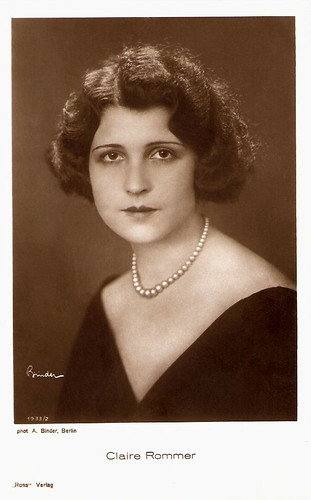
German postcard by Ross Verlag, no. 1933/2, 1927-1928. Photo: Alex Binder.
Claire Rommer was born as Klara Romberger in Berlin, Germany, in 1904. Although her parents sent her to a boarding school, she defied the opposition of her family and attended the famous Max-Reinhardt-Schule in Berlin. At almost 17, she debuted as a temporary assistant at the Neues Volkstheater (New People's Theatre) and the Volksbühne (People's Stage).
As a soubrette, she later appeared repeatedly in operettas and comedies on the Berlin stage, especially at the Lustspielhaus (Comedy House). In the season of 1925-1926, she was committed to the Vereinigten Bühnen (United Stages).
However, she became best known as a film actress. She appeared as a lover or a salon lady in dozens of silent films of the 1920s. Rommer made her film debut in Wem nie durch Liebe Leid geschah / Those Who Never Suffered From Love (Heinz Schall, 1922) starring Johannes Riemann.
With a light touch, she then played leading and supporting roles in such films as Menschen und Masken / People and Masks (Harry Piel, 1923), Die eiserne Braut / The Iron Bride (Carl Boese, 1925) opposite Otto Gebühr, and Qualen der Nacht / Torments of the Night (Kurt Bernhardt aka Curtis Bernhardt, 1926) with Ernö (Ernst) Verebes.
Her other silent films included Herkules Maier (Alexander Esway, 1927) and Kinderseelen klagen euch an / Children’s Souls Accuse You (Kurt Bernhardt, 1927) with Carla Bartheel.

German postcard by Ross Verlag, no. 947/2, 1925-1926. Photo: Alex Binder.

Austrian postcard by Iris Verlag, no. 738. Photo: Treuhand-Film / Mondial A.G. / National. Publicity still for Die eiserne Braut / The Iron Bride (Carl Boese, 1925) with Otto Gebühr.

German postcard by Ross Verlag, no. 1959/1, 1927-1928. Photo: Emelka, München / Süd Film. Fritz Kampers and Claire Rommer in Frühere Verhältnisse / Former Conditions (Arthur Bergen, 1927).

German postcard by Ross Verlag, no. 1286/1, 1927-1928.

German postcard by Ross Verlag, no. 1361/1, 1927-1928. Photo: Alwin Steinitz.
When sound film was introduced, Claire Rommer also did vocal numbers. She played successfully in the films Aschermittwoch / Ash Wednesday (Johannes Meyer, 1930), and Der Walzerkönig / The Waltz King (Manfred Noa, 1930) opposite Hans Stüwe.
In the following years, she appeared in Weimar films such as Es geht um alles / It’s About Everything (Max Nosseck, 1932) with Luciano Albertini and Tausend für eine Nacht / A Thousand for One Night (Max Mack, 1933).
In 1934 she appeared on stage in the Revue 'Scala – etwas verrückt' (Scala - A Little Crazy) in Berlin at the Scala Theatre, when her film and stage career suddenly ended because of the seizure of power by the Nazis.
In 1927 she married the Jewish entrepreneur Adolf Strenger. In July 1938, she was excluded from any activity in the German film industry because she was probably not Aryan either. In 1940, she emigrated with her husband from France via Lisbon to the USA.
There she divorced Strenger and married a multi-millionaire from the meat industry. She never appeared in a film again. Claire Rommer died of pneumonia in 1996, at the Chelsea and Westminster Hospital in London.

German postcard by Ross Verlag, no. 4016/2, 1929-1930. Photo: Alex Binder, Berlin.

German postcard by Ross Verlag, no. 4383/1, 1929-1930. Photo: Atelier Bieber.

German postcard by Ross Verlag, no. 6687/1, 1931-1932. Photo: Atelier Schneider.

German postcard by Ross Verlag, no. 6788/1, 1931-1932. Photo: Atelier Schneider, Berlin.
Source: Thomas Staedeli (Cyranos), Wikipedia (German) and IMDb.
This post was last updated on 15 September 2026.
Austrian postcard by Iris Verlag, no. 566. Photo: Verleih E. Weil & Co.
Austrian postcard by Iris Verlag, no. 672. Photo: Allianz-Film / Domo-Strauß-Film GmbH. Walter Rilla and Claire Rommer in the Austrian-German silent operetta film Hoheit tanzt Walzer / Her Highness Dances the Waltz (Fritz Freisler, 1926). The operetta film is based on the 1912 operetta 'Hoheit tanzt Walzer' by Leo Ascher (music) and Alfred Grünwald (libretto). Domo-Strauß-Film was the German distributor. The film was a huge critical and commercial success and a breakthrough for Rilla.
German postcard by Ross Verlag, no. 1446/2, 1927-1928. Photo: Walther Lichtenstein, Berlin-Charlottenburg / Domo-Strauß-Film. Claire Rommer as Fräulein Rittmeister Julie in Die dritte Eskadron / The Third Squadron (Carl Wilhelm, 1926).
German postcard by Ross Verlag, no. 1845/1, 1927-1928. Photo: Alex Binder.
German postcard by Ross Verlag, no. 1933/2, 1927-1928. Photo: Alex Binder.
Soubrette
Claire Rommer was born as Klara Romberger in Berlin, Germany, in 1904. Although her parents sent her to a boarding school, she defied the opposition of her family and attended the famous Max-Reinhardt-Schule in Berlin. At almost 17, she debuted as a temporary assistant at the Neues Volkstheater (New People's Theatre) and the Volksbühne (People's Stage).
As a soubrette, she later appeared repeatedly in operettas and comedies on the Berlin stage, especially at the Lustspielhaus (Comedy House). In the season of 1925-1926, she was committed to the Vereinigten Bühnen (United Stages).
However, she became best known as a film actress. She appeared as a lover or a salon lady in dozens of silent films of the 1920s. Rommer made her film debut in Wem nie durch Liebe Leid geschah / Those Who Never Suffered From Love (Heinz Schall, 1922) starring Johannes Riemann.
With a light touch, she then played leading and supporting roles in such films as Menschen und Masken / People and Masks (Harry Piel, 1923), Die eiserne Braut / The Iron Bride (Carl Boese, 1925) opposite Otto Gebühr, and Qualen der Nacht / Torments of the Night (Kurt Bernhardt aka Curtis Bernhardt, 1926) with Ernö (Ernst) Verebes.
Her other silent films included Herkules Maier (Alexander Esway, 1927) and Kinderseelen klagen euch an / Children’s Souls Accuse You (Kurt Bernhardt, 1927) with Carla Bartheel.
German postcard by Ross Verlag, no. 947/2, 1925-1926. Photo: Alex Binder.
Austrian postcard by Iris Verlag, no. 738. Photo: Treuhand-Film / Mondial A.G. / National. Publicity still for Die eiserne Braut / The Iron Bride (Carl Boese, 1925) with Otto Gebühr.
German postcard by Ross Verlag, no. 1959/1, 1927-1928. Photo: Emelka, München / Süd Film. Fritz Kampers and Claire Rommer in Frühere Verhältnisse / Former Conditions (Arthur Bergen, 1927).
German postcard by Ross Verlag, no. 1286/1, 1927-1928.
German postcard by Ross Verlag, no. 1361/1, 1927-1928. Photo: Alwin Steinitz.
Millionaire from the meat industry
When sound film was introduced, Claire Rommer also did vocal numbers. She played successfully in the films Aschermittwoch / Ash Wednesday (Johannes Meyer, 1930), and Der Walzerkönig / The Waltz King (Manfred Noa, 1930) opposite Hans Stüwe.
In the following years, she appeared in Weimar films such as Es geht um alles / It’s About Everything (Max Nosseck, 1932) with Luciano Albertini and Tausend für eine Nacht / A Thousand for One Night (Max Mack, 1933).
In 1934 she appeared on stage in the Revue 'Scala – etwas verrückt' (Scala - A Little Crazy) in Berlin at the Scala Theatre, when her film and stage career suddenly ended because of the seizure of power by the Nazis.
In 1927 she married the Jewish entrepreneur Adolf Strenger. In July 1938, she was excluded from any activity in the German film industry because she was probably not Aryan either. In 1940, she emigrated with her husband from France via Lisbon to the USA.
There she divorced Strenger and married a multi-millionaire from the meat industry. She never appeared in a film again. Claire Rommer died of pneumonia in 1996, at the Chelsea and Westminster Hospital in London.
German postcard by Ross Verlag, no. 4016/2, 1929-1930. Photo: Alex Binder, Berlin.
German postcard by Ross Verlag, no. 4383/1, 1929-1930. Photo: Atelier Bieber.
German postcard by Ross Verlag, no. 6687/1, 1931-1932. Photo: Atelier Schneider.
German postcard by Ross Verlag, no. 6788/1, 1931-1932. Photo: Atelier Schneider, Berlin.
Source: Thomas Staedeli (Cyranos), Wikipedia (German) and IMDb.
This post was last updated on 15 September 2026.
