Spanish diva Raquel Meller (1888-1962) was already a highly popular singer before debuting as a film actress in 1919. She performed not only in Spain but also in France and the USA.
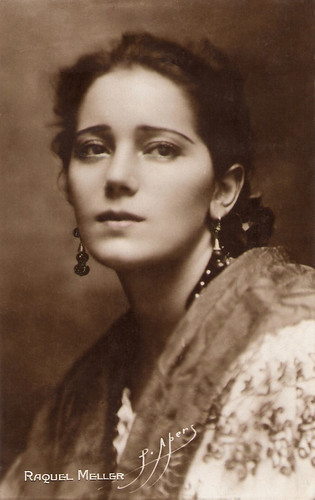
French postcard by Editions Cinémagazine. Photo: P. Apers.
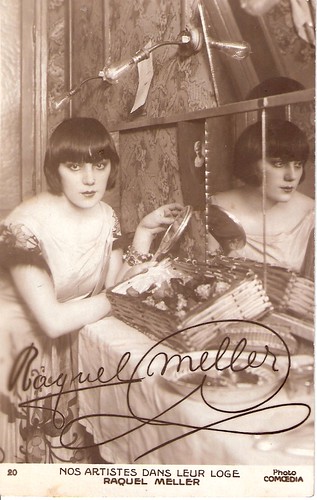
French postcard by Ed. Art de Comoedia, quotidien des théâtres. Concessionnaire: Editions Lafayette, Paris, no. 20.

French postcard by Editions Filma, no. 151. Photo: P. Apers.

French postcard by Editions P-C, Paris, no. 21. Raquel Meller sang the slow-fox 'Adieu, mon rêve' (Farewell, my dream). Text by Géo Koger and music by Vincent Scotto. Copyright: Editions Salabert, Paris, 1932.
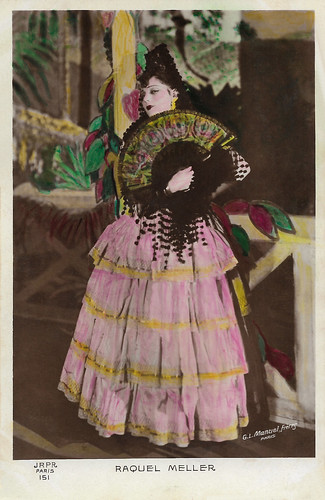
French postcard by J.R.P.R., Paris, no. 151. Photo: G.L. Manuel Frères, Paris.
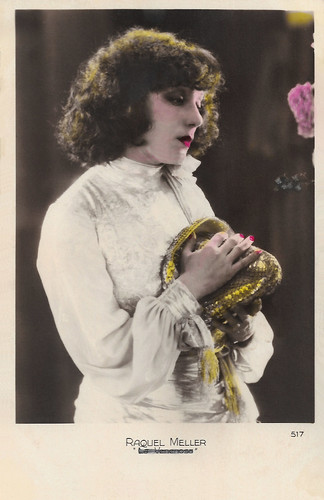
French postcard by Cinémagazine-Edition, Paris, no. 517. Photo: Raquel Meller in La venenosa/Poison Ivy (Roger Lion, 1928).
Raquel Meller was born Francisca Marqués López in Tarazona, Spain, in 1888.
She studied in Tudela (Spain), and Montpellier (France), and started working as a dressmaker. It was a customer, Marta Oliver, a.k.a. the vaudeville star Mrs. Oliver, who introduced her to the Music Hall.
She began using her stage name Raquel Meller in 1907. She moved to Madrid and there she became famous as a cuplé (couplet) singer. These torch songs were considered 'naughty' and beneath the dignity (and morals) of a decent, serious singer.
Raquel, with her beauty and charismatic presence, raised the genre to high art and made it acceptable for the entire family (till then they were played in men-only bistros). Songs such as La Violetera, El Relicario, and Flor del Mal became standards - thanks to her interpretations.
She was the first Spanish popular singer to succeed in both Europe and the Americas, especially in the United States where her recordings enjoyed great popularity and her live concerts broke box office records. At one point she was under an exclusive contract with the famous Schuberts.

Spanish postcard, but this studio photo is French and probably by R. Guilleminat, Paris.

French postcard by R. Guilleminat, Paris.
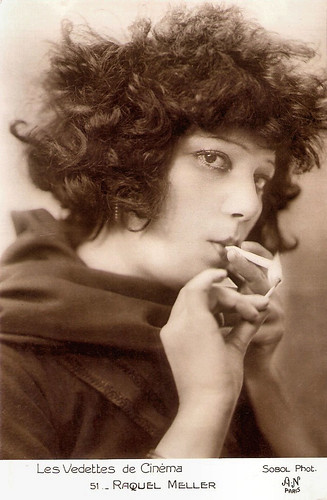
French postcard by A.N., Paris, in the series Les Vedettes de Cinéma, no. 51. Sent by mail in 1925. Photo: Sobol.

French postcard by Edition Paramount, Paris. Photo: Paramount. Publicity still from Les opprimés/The Oppressed (Henry Roussel, 1923).
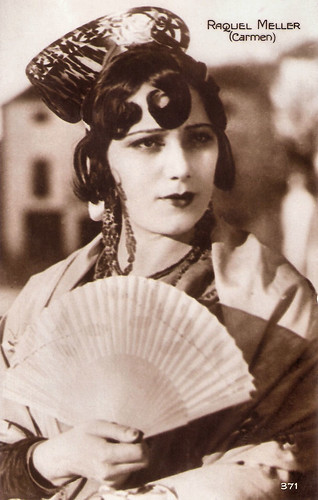
French postcard by Cinémagazine-Edition, Paris, no. 371. Photo: publicity still for Carmen (Jacques Feyder, 1926).
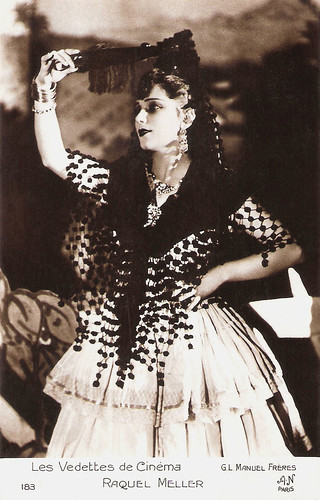
French postcard in the Les Vedettes de Cinema series by A.N., Paris, no. 183. Photo: G.L. Manuel Frères.
Raquel Meller was also a hit on the big screen. She made her film debut in the Spanish film Los arlequines de seda y oro/The Harlequins of Silk and Gold (Ricardo de Baños, 1919).
In France, she starred in such major films as Les opprimés/The Oppressed (Henry Roussel, 1923), Carmen (Jacques Feyder, 1926) opposite handsome Austrian star Fred Louis Lerch, and Nocturne (Marcel Silver, 1927) again opposite Lerch.
Meller is best remembered for Violettes impériales/Imperial Violets (Henry Roussel, 1924), a historical romantic drama set during the reign of Napoleon III of France.
Meller played a Spanish flower girl who saves an attack on the life of the French empress Eugenie de Montijo (played by Suzanne Blanchetti), by taking her place in her carriage. When the carriage is overthrown by the anarchist's bomb, the girl survives because of the masses of violets in the imperial carriage, the empress's favourite flowers.
In 1932, Henry Roussel made a sound version, again with Meller, and in 1948 an operetta version was made of the film. A tinted copy of the silent film was beautifully restored by the BFI some years ago and a clip of the film is visible in Kevin Brownlow's Cinema Europe series. However, we are still waiting for the DVD.
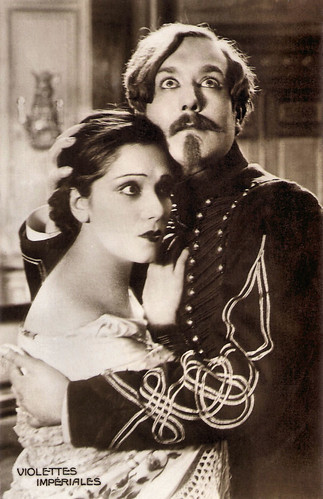
French postcard by Cinémagazine-Edition. Photo: publicity still for Violettes impériales/Imperial Violets (Henry Roussel, 1924) with André Roanne.
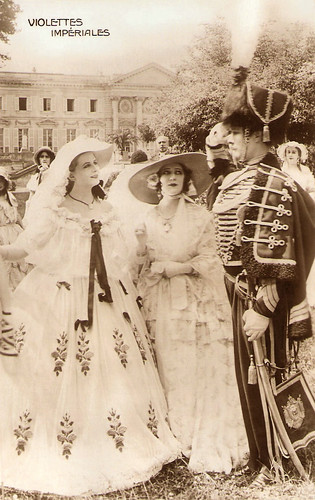
French postcard by Cinémagazine-Edition. Photo: publicity still for Violettes impériales/Imperial Violets (Henry Roussel, 1924) with Suzanne Blanchetti.
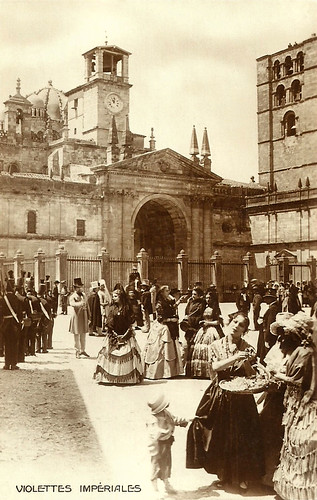
French postcard by Edition Cinémagazine. Photo: publicity still for Violettes impériales/Imperial Violets (Henry Roussel, 1924).

French postcard by Edition Cinémagazine. Photo: publicity still for Violettes impériales/Imperial Violets (Henry Roussel, 1924).
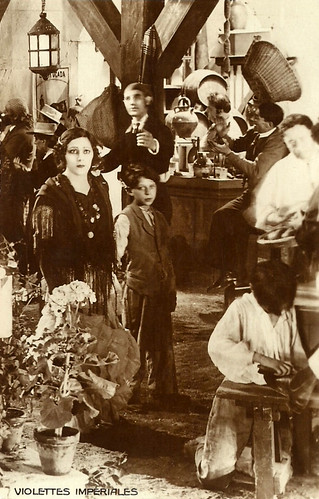
French postcard by Edition Cinémagazine. Photo: publicity still for Violettes impériales/Imperial Violets (Henry Roussel, 1924).
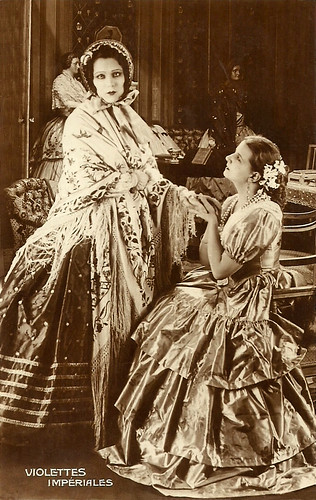
French postcard by Edition Cinémagazine. Photo: publicity still for Violettes impériales/Imperial Violets (Henry Roussel, 1924) with Suzanne Blanchetti.
Even if Sarah Bernhardt called her a 'genius', Raquel Meller could be impossible on the set.
When Jacques Feyder directed her in Carmen (1926), based on the oft-filmed Prosper Merimée novel, and Meller refused a kissing scene, he shouted that this was just how writer Prosper Merimée had intended it. At which Meller shouted back: I don't care about this Mr. Merimee. Where does he live? I'll call him by phone!
Hal Erickson writes at AllMovie: "Director Feyder manages to transform this timeworn story into a feast for the eyes, especially during the climactic bullfighting sequence. When released in America in 1928, Carmen did surprisingly well, considering that Fox Pictures had recently produced its own version of the same story, with Dolores Del Rio as the ill-fated heroine."
Charles Chaplin, a big Meller fan, used her song La Violetera for the score of his classic City Lights (1931). She filmed in Hollywood several musical shorts for Fox at the advent of talkies and was a big draw in the vaudeville circuits for many years.
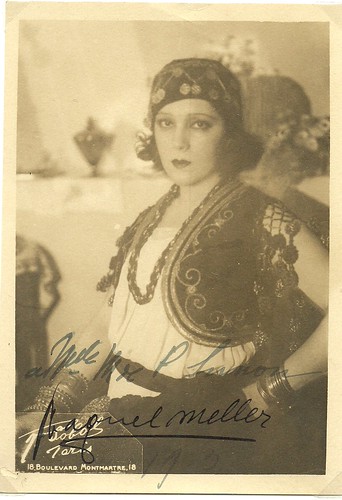
French postcard. Photo: Sobol, Paris. Collection: Didier Hanson.

French postcard. Raquel Meller in Violettes impériales by Henry Roussel.

French postcard by Cinémagazine-Edition, Paris, no. 165. Photo: J. Kruger. Publicity still for La terre promise (Henry Roussel, 1925).
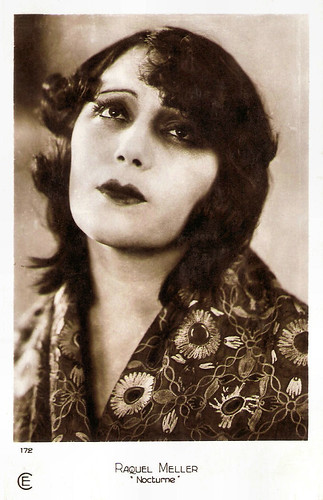
French postcard by Cinémagazine-Edition, Paris, no. 172. Photo: publicity still for Nocturne (Marcel Silver, 1927).
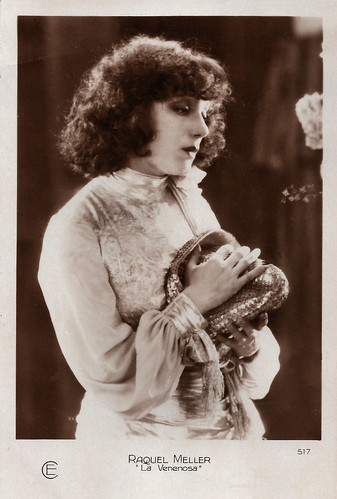
French postcard by Cinémagazine-Edition, Paris, no. 517. Photo: Raquel Meller in La venenosa/Poison Ivy (Roger Lion, 1928).

French postcard by J.R.P.R., Paris, no. 151. Photo: G.L. Manuel Frères. Cf.
The Spanish Civil War and the Second World War put an abrupt end to Raquel Meller's career.
She first left for Argentina and later retired to Barcelona. She only surfaced again in 1957 in the wake of Sara Montiel's enormous success in the films El Ultimo Cuple/The Last Torch Song (Juan de Orduña, 1957) and La Violetera (Luis César Amadori, 1958) in which Montiel revived Raquel's greatest hits.
Meller hated it and threatened legal action but couldn't do anything. She attempted several big comebacks, like in the vaudeville show Ha Salido Blanco y Negro! (1958), which were all both critical and commercial failures.
Bitterly, Raquel Meller retired in Barcelona and died there in 1962.
Meller's private life was always followed with great interest by the media and the public. She was imperious, ruthless (especially with the competition), lovable, funny, temperamental, witty, and totally egomaniac. Her love life was described as 'healthy plus' and among her many lovers, there were royalty, heads of state, and assorted VIPs.
Raquel Meller was married to Gomez Carillo and the French impresario Edmond Salac. She could never bear children so she adopted a boy and a girl. After her death in 1962, a book was published in France in which the author claimed that Raquel was instrumental in turning over Mata Hari to the French authorities since the famous spy-dancer was fooling around with one of her lovers.
The whole Raquel Meller-Mata Hari publicity was exploited in the film La Reina del chantecler/The Queen of Chantecler (Rafael Gil, 1962), starring Sara Montiel.
Most of Raquel Meller's recordings were considered lost for years, but lately, they have been showing up on CD.

Spanish minicard in the Escenas selectas de cinematografía series by Chocolates Guillèn, Series A, no. 1. Raquel Meller and André Roanne in Les Opprimés/Flanders under Philip II (Henry Roussel, 1923), released in Spain as La Rosa de Flandes. It was the first film shot at Hippolyte Kempeneer's Mechelen studios.
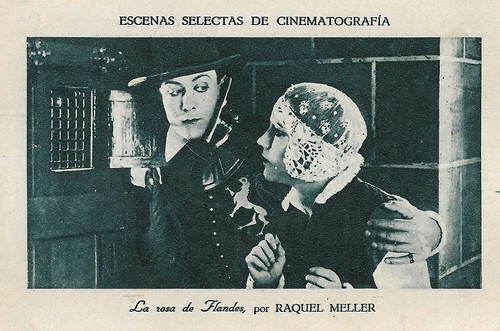
Spanish minicard in the Escenas selectas de cinematografía series by Chocolates Guillèn, Series A, no. 7. Raquel Meller and André Roanne in Les Opprimés/Flanders under Philip II (Henry Roussel, 1923), released in Spain as La Rosa de Flandes. It was the first film shot at Hippolyte Kempeneer's Mechelen studios.
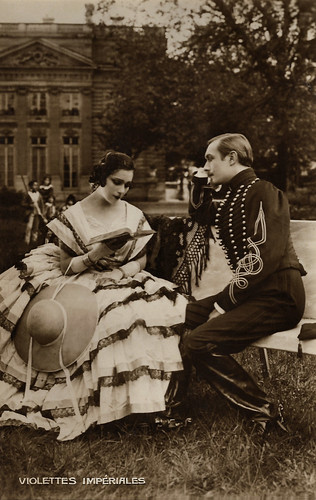
French postcard by Cinémagazine-Edition. Photo: Raquel Meller and André Roanne in Violettes impériales/Imperial Violets (Henry Roussel, 1924).

German postcard by Ross Verlag, no. 1664/3. Photo: Films Albatros / Hirschel-Sofar-Film. Raquel Meller in Carmen (Jacques Feyder, 1926). Hirschel-Sofar was a German distributor.
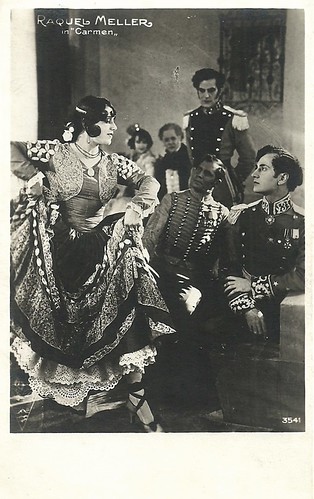
Italian postcard by G. Vettori, Bologna, no. 3541. Photo: Albatros. Raquel Meller in Carmen (Jacques Feyder, 1926).
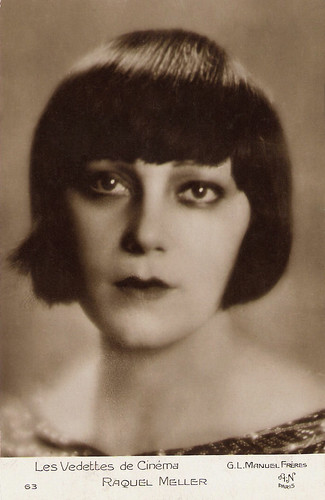
French postcard in the Les Vedettes de Cinéma Series by A.N., Paris, no. 63. Photo: G.L. Manuel Frères.

French postcard by Cinémagazine Edition, no. 339. Photo: G.L. Manuel Frères.

Romanian postcard.
Original version of La Violetera. Raquel Meller sung it for the first time in 1907 at the Teatro Arnau in Barcelona. Source: Yoyama2 (YouTube).
Sources: M.O. Martinez (IMDb), Hal Erickson (AllMovie), Wikipedia (Spanish), and IMDb.
This post was last updated on 1 March 2021.
French postcard by Editions Cinémagazine. Photo: P. Apers.
French postcard by Ed. Art de Comoedia, quotidien des théâtres. Concessionnaire: Editions Lafayette, Paris, no. 20.
French postcard by Editions Filma, no. 151. Photo: P. Apers.
French postcard by Editions P-C, Paris, no. 21. Raquel Meller sang the slow-fox 'Adieu, mon rêve' (Farewell, my dream). Text by Géo Koger and music by Vincent Scotto. Copyright: Editions Salabert, Paris, 1932.
French postcard by J.R.P.R., Paris, no. 151. Photo: G.L. Manuel Frères, Paris.
French postcard by Cinémagazine-Edition, Paris, no. 517. Photo: Raquel Meller in La venenosa/Poison Ivy (Roger Lion, 1928).
Naughty Songs
Raquel Meller was born Francisca Marqués López in Tarazona, Spain, in 1888.
She studied in Tudela (Spain), and Montpellier (France), and started working as a dressmaker. It was a customer, Marta Oliver, a.k.a. the vaudeville star Mrs. Oliver, who introduced her to the Music Hall.
She began using her stage name Raquel Meller in 1907. She moved to Madrid and there she became famous as a cuplé (couplet) singer. These torch songs were considered 'naughty' and beneath the dignity (and morals) of a decent, serious singer.
Raquel, with her beauty and charismatic presence, raised the genre to high art and made it acceptable for the entire family (till then they were played in men-only bistros). Songs such as La Violetera, El Relicario, and Flor del Mal became standards - thanks to her interpretations.
She was the first Spanish popular singer to succeed in both Europe and the Americas, especially in the United States where her recordings enjoyed great popularity and her live concerts broke box office records. At one point she was under an exclusive contract with the famous Schuberts.
Spanish postcard, but this studio photo is French and probably by R. Guilleminat, Paris.
French postcard by R. Guilleminat, Paris.
French postcard by A.N., Paris, in the series Les Vedettes de Cinéma, no. 51. Sent by mail in 1925. Photo: Sobol.
French postcard by Edition Paramount, Paris. Photo: Paramount. Publicity still from Les opprimés/The Oppressed (Henry Roussel, 1923).
French postcard by Cinémagazine-Edition, Paris, no. 371. Photo: publicity still for Carmen (Jacques Feyder, 1926).
French postcard in the Les Vedettes de Cinema series by A.N., Paris, no. 183. Photo: G.L. Manuel Frères.
Spanish Flower Girl
Raquel Meller was also a hit on the big screen. She made her film debut in the Spanish film Los arlequines de seda y oro/The Harlequins of Silk and Gold (Ricardo de Baños, 1919).
In France, she starred in such major films as Les opprimés/The Oppressed (Henry Roussel, 1923), Carmen (Jacques Feyder, 1926) opposite handsome Austrian star Fred Louis Lerch, and Nocturne (Marcel Silver, 1927) again opposite Lerch.
Meller is best remembered for Violettes impériales/Imperial Violets (Henry Roussel, 1924), a historical romantic drama set during the reign of Napoleon III of France.
Meller played a Spanish flower girl who saves an attack on the life of the French empress Eugenie de Montijo (played by Suzanne Blanchetti), by taking her place in her carriage. When the carriage is overthrown by the anarchist's bomb, the girl survives because of the masses of violets in the imperial carriage, the empress's favourite flowers.
In 1932, Henry Roussel made a sound version, again with Meller, and in 1948 an operetta version was made of the film. A tinted copy of the silent film was beautifully restored by the BFI some years ago and a clip of the film is visible in Kevin Brownlow's Cinema Europe series. However, we are still waiting for the DVD.
French postcard by Cinémagazine-Edition. Photo: publicity still for Violettes impériales/Imperial Violets (Henry Roussel, 1924) with André Roanne.
French postcard by Cinémagazine-Edition. Photo: publicity still for Violettes impériales/Imperial Violets (Henry Roussel, 1924) with Suzanne Blanchetti.
French postcard by Edition Cinémagazine. Photo: publicity still for Violettes impériales/Imperial Violets (Henry Roussel, 1924).
French postcard by Edition Cinémagazine. Photo: publicity still for Violettes impériales/Imperial Violets (Henry Roussel, 1924).
French postcard by Edition Cinémagazine. Photo: publicity still for Violettes impériales/Imperial Violets (Henry Roussel, 1924).
French postcard by Edition Cinémagazine. Photo: publicity still for Violettes impériales/Imperial Violets (Henry Roussel, 1924) with Suzanne Blanchetti.
Impossible Genius
Even if Sarah Bernhardt called her a 'genius', Raquel Meller could be impossible on the set.
When Jacques Feyder directed her in Carmen (1926), based on the oft-filmed Prosper Merimée novel, and Meller refused a kissing scene, he shouted that this was just how writer Prosper Merimée had intended it. At which Meller shouted back: I don't care about this Mr. Merimee. Where does he live? I'll call him by phone!
Hal Erickson writes at AllMovie: "Director Feyder manages to transform this timeworn story into a feast for the eyes, especially during the climactic bullfighting sequence. When released in America in 1928, Carmen did surprisingly well, considering that Fox Pictures had recently produced its own version of the same story, with Dolores Del Rio as the ill-fated heroine."
Charles Chaplin, a big Meller fan, used her song La Violetera for the score of his classic City Lights (1931). She filmed in Hollywood several musical shorts for Fox at the advent of talkies and was a big draw in the vaudeville circuits for many years.
French postcard. Photo: Sobol, Paris. Collection: Didier Hanson.
French postcard. Raquel Meller in Violettes impériales by Henry Roussel.
French postcard by Cinémagazine-Edition, Paris, no. 165. Photo: J. Kruger. Publicity still for La terre promise (Henry Roussel, 1925).
French postcard by Cinémagazine-Edition, Paris, no. 172. Photo: publicity still for Nocturne (Marcel Silver, 1927).
French postcard by Cinémagazine-Edition, Paris, no. 517. Photo: Raquel Meller in La venenosa/Poison Ivy (Roger Lion, 1928).
French postcard by J.R.P.R., Paris, no. 151. Photo: G.L. Manuel Frères. Cf.
Imperious, Lovable, and Totally Egomaniac
The Spanish Civil War and the Second World War put an abrupt end to Raquel Meller's career.
She first left for Argentina and later retired to Barcelona. She only surfaced again in 1957 in the wake of Sara Montiel's enormous success in the films El Ultimo Cuple/The Last Torch Song (Juan de Orduña, 1957) and La Violetera (Luis César Amadori, 1958) in which Montiel revived Raquel's greatest hits.
Meller hated it and threatened legal action but couldn't do anything. She attempted several big comebacks, like in the vaudeville show Ha Salido Blanco y Negro! (1958), which were all both critical and commercial failures.
Bitterly, Raquel Meller retired in Barcelona and died there in 1962.
Meller's private life was always followed with great interest by the media and the public. She was imperious, ruthless (especially with the competition), lovable, funny, temperamental, witty, and totally egomaniac. Her love life was described as 'healthy plus' and among her many lovers, there were royalty, heads of state, and assorted VIPs.
Raquel Meller was married to Gomez Carillo and the French impresario Edmond Salac. She could never bear children so she adopted a boy and a girl. After her death in 1962, a book was published in France in which the author claimed that Raquel was instrumental in turning over Mata Hari to the French authorities since the famous spy-dancer was fooling around with one of her lovers.
The whole Raquel Meller-Mata Hari publicity was exploited in the film La Reina del chantecler/The Queen of Chantecler (Rafael Gil, 1962), starring Sara Montiel.
Most of Raquel Meller's recordings were considered lost for years, but lately, they have been showing up on CD.
Spanish minicard in the Escenas selectas de cinematografía series by Chocolates Guillèn, Series A, no. 1. Raquel Meller and André Roanne in Les Opprimés/Flanders under Philip II (Henry Roussel, 1923), released in Spain as La Rosa de Flandes. It was the first film shot at Hippolyte Kempeneer's Mechelen studios.
Spanish minicard in the Escenas selectas de cinematografía series by Chocolates Guillèn, Series A, no. 7. Raquel Meller and André Roanne in Les Opprimés/Flanders under Philip II (Henry Roussel, 1923), released in Spain as La Rosa de Flandes. It was the first film shot at Hippolyte Kempeneer's Mechelen studios.
French postcard by Cinémagazine-Edition. Photo: Raquel Meller and André Roanne in Violettes impériales/Imperial Violets (Henry Roussel, 1924).
German postcard by Ross Verlag, no. 1664/3. Photo: Films Albatros / Hirschel-Sofar-Film. Raquel Meller in Carmen (Jacques Feyder, 1926). Hirschel-Sofar was a German distributor.
Italian postcard by G. Vettori, Bologna, no. 3541. Photo: Albatros. Raquel Meller in Carmen (Jacques Feyder, 1926).
French postcard in the Les Vedettes de Cinéma Series by A.N., Paris, no. 63. Photo: G.L. Manuel Frères.
French postcard by Cinémagazine Edition, no. 339. Photo: G.L. Manuel Frères.
Romanian postcard.
Original version of La Violetera. Raquel Meller sung it for the first time in 1907 at the Teatro Arnau in Barcelona. Source: Yoyama2 (YouTube).
Sources: M.O. Martinez (IMDb), Hal Erickson (AllMovie), Wikipedia (Spanish), and IMDb.
This post was last updated on 1 March 2021.