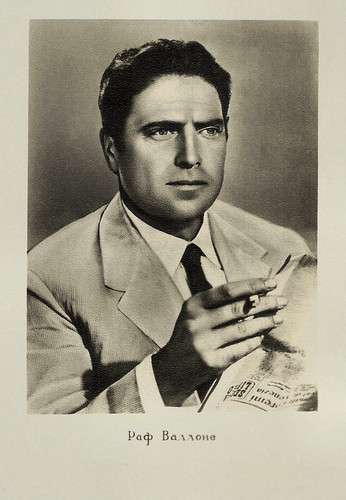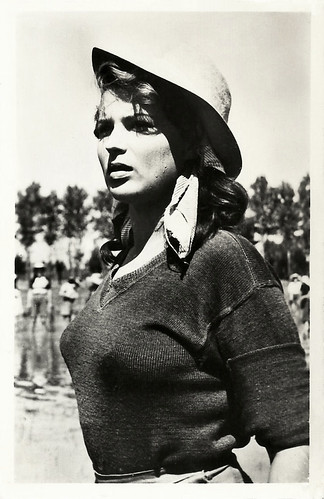
Dutch postcard by Filmverhuurkantoor Centrafilm, Dordrecht. Photo: Lux Film Rome. Silvana Mangano in Riso amaro/Bitter Rice (Giuseppe de Santis, 1949).

Dutch postcard by Centrafilm, Dordrecht. Photo: Vittorio Gassman and Silvana Mangano in Riso amaro/Bitter Rice (Giuseppe de Santis, 1949). Collection: Geoffrey Donaldson Institute.
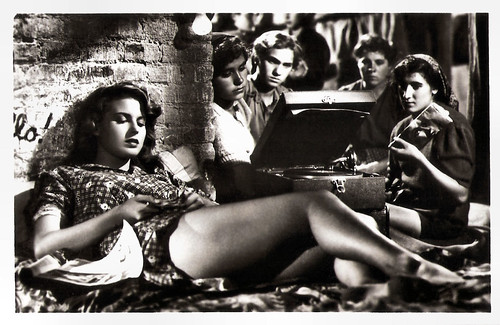
Dutch postcard by Centrafilm, Dordrecht. Photo: Silvana Mangano in Riso amaro/Bitter Rice (Giuseppe de Santis, 1949). Collection: Geoffrey Donaldson Institute.

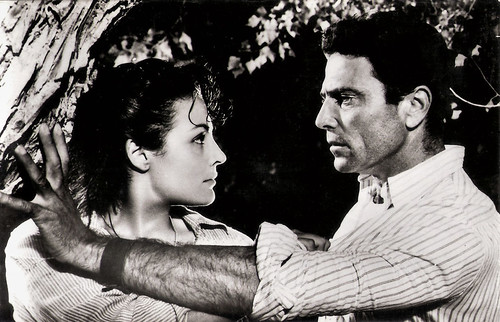
Dutch postcard by Centrafilm, Dordrecht. Photo: Doris Dowling and Raf Vallone in Riso amaro/Bitter Rice (Giuseppe de Santis, 1949). Collection: Geoffrey Donaldson Institute.
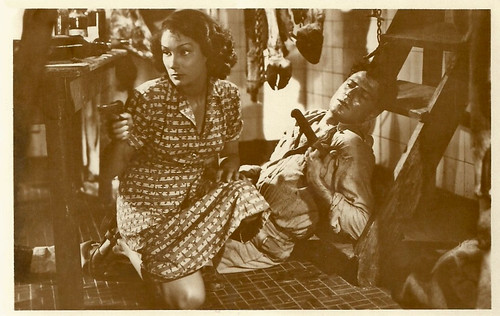
Dutch postcard by Centrafilm, Dordrecht. Photo: Lux. Doris Dowling and Raf Vallone in Riso amaro/Bitter Rice (Giuseppe de Santis, 1949).
Is Riso amaro a Neo-Realist film?
At the time, Neo-Realism was about only 7 years old. Films like Roma Citta Aperta by Roberto Rossellini had taken the world by storm and overwhelmed international audiences and festival juries. But the Neo-Realist films quickly changed in character and Riso amaro/Bitter Rice lead to a dispute among film critics about the sexualisation of the lead character and the melodramatic presence of death and suicide in the film.
At IMDb, Debblyst explains: “Neo-Realist principles (i.e. no stars, mix of professional and non-professional actors, location-only shooting, rejection of ‘beauty’/classicism/romanticism, stressing on ‘ordinary’ people and ‘real-life’ themes) were being stretched: stars were joining in (including international ones, like Ingrid Bergman, or starlets like American Doris Dowling here), productions got bigger and more expensive, crews more professional, equipment more sophisticated, ‘ordinary’ people were being replaced by Olympic beauties (or do ordinary people EVER look like Silvana Mangano or Vittorio Gassman?), ‘ordinary’ characters were getting very complex, and real life was being traded by elaborate, far from realistic drama.”
Riso amaro begins at the start of the rice-planting season in northern Italy. Trying to escape the law, two small-time criminals, Francesca (Doris Dowling) and Walter (Vittorio Gassman), hide amongst the crowds of female workers heading to the rice fields of the Po Valley.
While attempting to board the train for the fields, the pair runs into Silvana (Silvana Mangano), a voluptuous peasant rice worker. Francesca boards the train with her, in an effort to avoid the police. Silvana introduces her to the planter's way of life. Francesca does not have a work permit, and struggles with the other ‘illegals’ to find a place in the rice fields. After initial resistance from documented workers and bosses, the scabs are allowed a place in the fields.
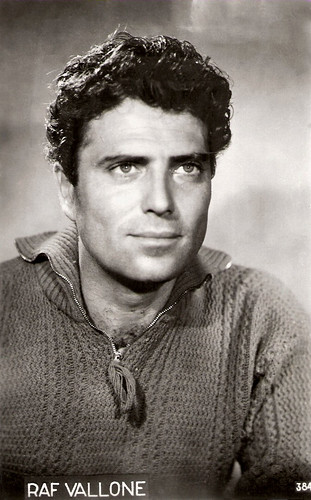
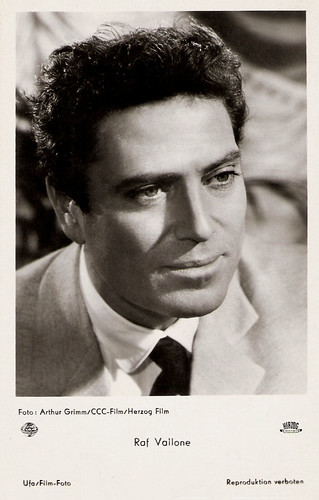
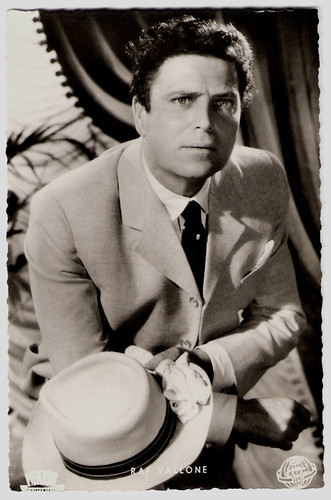
In the fields, Silvana and Francesca meet a soon-to-be-discharged soldier, Marco (Raf Vallone), who unsuccessfully tries to attract Silvana's interest. Toward the end of the working season, Walter arrives at the fields, intending to steal a large quantity of rice. Excited by his criminal lifestyle, Silvana becomes attracted to Walter. She causes a diversion to help him carry out the heist, but Francesca and Marco manage to stop Walter and his accomplices.
Francesca and Silvana face each other, armed with pistols; Francesca confronts Silvana and explains that she has been manipulated by Walter. In response, Silvana turns her gun toward Walter and murders him. Soon afterwards, her guilt leads her to commit suicide. As the other rice workers depart, they pay tribute to her by sprinkling rice upon her body.
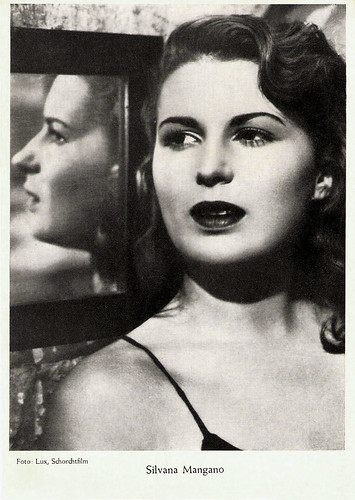
German collectors card. Photo: Lux / Schorchtfilm. Silvana Mangano in Riso amaro/Bitter Rice (Giuseppe de Santis, 1949).

Belgian postcard by Nieuwe Merksemsche Chocolaterie, Merksem. Photo: Lux Film Rome. Silvana Mangano in Riso amaro/Bitter Rice (Giuseppe de Santis, 1949).

German postcard by Netter's Star Verlag, Berlin. Photo: Lux Film Rome. Silvana Mangano in Riso amaro/Bitter Rice (Giuseppe de Santis, 1949).

Spanish postcard by Archivo Bermejo, 1953. Photo: Lux Films / Rey Soria. Silvana Mangano in Riso amaro/Bitter Rice (Giuseppe de Santis, 1949).

Spanish postcard, 1953. Photo: Lux Films / Rey Soria. Silvana Mangano in Riso amaro/Bitter Rice (Giuseppe de Santis, 1949).
Is Riso amaro merely a shocker?
The Italian title of the film, Riso amaro, is based on a pun. The Italian word ‘riso’ can mean either ‘rice’ or ‘laughter’, 'riso amaro' can be taken to mean either ‘bitter laughter’ or ‘bitter rice’.
Lucia Bosé was the director's first choice for the role of Silvana. It wasn't until he met former Miss Rome Silvana Mangano by chance that he decided to cast her in the film. In the film, Silvana chews gum and dances the boogie-woogie in an American way in the film. With her character’s downfall director Giuseppe De Santis seems to have intended to show his condemnation of the products of American capitalism.
Ironically it was Silvana who made the film one of the biggest box office hits of Neo-Realism cinema. To the standards of 1949, Mangano's performance in the film was shocking. Her hotpants and voluptuous figure earned Riso amaro a lot of publicity, in particular in strongly Roman Catholic Italy. But Riso amaro has more qualities than just being a shocker.
W. Visser at IMDb: “Although its mold of 1949 appears somewhat melodramatic today, the black and white Riso Amaro (= Italian for Bitter Rice) surely ranks among the classics in film history. This very Italian product by Giuseppe de Santis shows a pretty ordinary crime story, excellently interwoven with an impressive decor of harsh season labor in the rice-fields of Northern Italy. The thousands of women, up to their ankles in the water, breaking their backs in the burning sun to earn a few bucks, make a truly great setting.”
The film was selected as one of 100 Italian films to be saved, a collection of films that "changed the collective memory of the country between 1942 and 1978". The collection was established by the Venice Film Festival in collaboration with Cinecittà and curated by Fabio Ferzetti, with input from Gianni Amelio and other Italian film critics. Many of the films selected represent the ‘Golden Age’ of Italian cinema, which was manifested in the Neorealism movement.

Belgian postcard by Nieuwe Merksemsche Chocolaterie, Merksem. Photo: Lux Film, Rome. Silvana Mangano in Riso Amaro/Bitter Rice (Giuseppe de Santis, 1949).
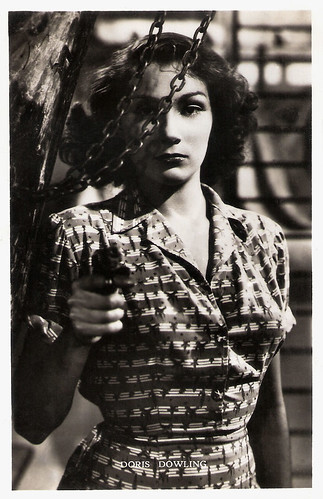
Belgian postcard by Nieuwe Merksemsche Chocolaterie S.P.R.L., Merksem (Anvers). Photo: Lux Film, Rome. Doris Dowling in Riso amaro/Bitter Rice (Giuseppe de Santis, 1949).
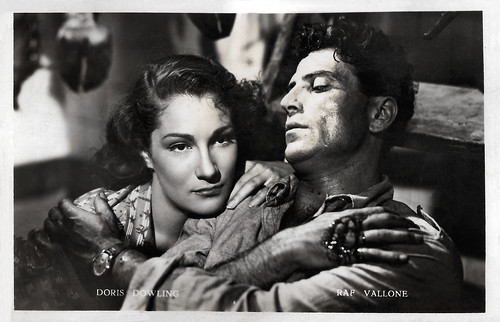
Belgian postcard by Nieuwe Merksemsche Chocolaterie S.P.R.L., Merksem (Anvers). Photo: Doris Dowling and Raf Vallone in Riso amaro/Bitter Rice (Giuseppe de Santis, 1949).

Italian postcard by Ed. B. B. - V. Photo: publicity still for Riso Amaro/Bitter Rice (Giuseppe De Santis, 1949). Caption: Il canto allevia il lavoro (Singing alleviates work).
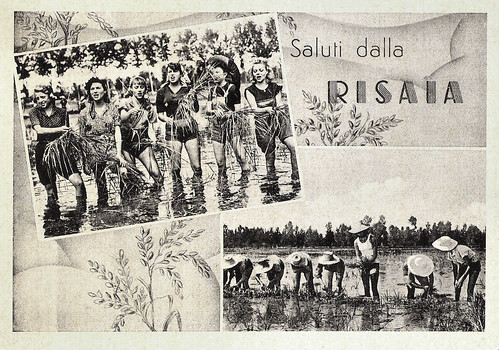
Italian postcard by Ed. B. B. - V., no. 72087. Photos: publicity stills for Riso Amaro/Bitter Rice (Giuseppe De Santis, 1949). Caption: Saluti dalla Risaia (greetings from the paddy fields).

British card by International Exchange, Glasgow. Silvana Mangano in Riso Amaro/Bitter Rice (Giuseppe De Santis, 1949).
Sources: W. Visser (IMDb), Debbylyst (IMDb), Wikipedia and IMDb.