Showing posts with label Karina Bell. Show all posts

17 August 2023

Revolutionshochzeit (1928)

EFSP's co-editor Ivo Blom is in Germany, where he visits the Bonn Stumfilmtage. Tonight he attends the screening of Revolutionshochzeit/The Last Night (1929), a revolutionary drama which shows the sophistication with which a "mere entertainment film" could be made in the late 1920s. The stage play, 'Revolutionsbryllup', on which the film is based, by the famous Danish writer Sophus Michaëlis, had previously been filmed four times in Denmark and Germany. This last silent film adaptation is a masterstroke of international cooperation: a Danish director, A.W. Sandberg, staged a Danish play with French content on behalf of a German production company. The small ensemble consisted of the Swede Gösta Eckman, the Italian Diomira Jacobini, the Austrian Fritz Kortner, the German Walter Rilla and the Dane Karina Bell. And the 35mm print that is shown in Bonn comes from the Danish Film Institute in Copenhagen.

Diomira Jacobini and Gösta Ekman in Revolutionsbryllup
Danish postcard by Alex. Vincent's Kunstforlag, Eneret, no. 253. Photo: Diomira Jacobini and Gösta Ekman in Revolutionshochzeit/ The Last Night (A.W. Sandberg, 1927).

Diomira Jacobini and Gösta Ekman in Revolutionsbryllup (1928)
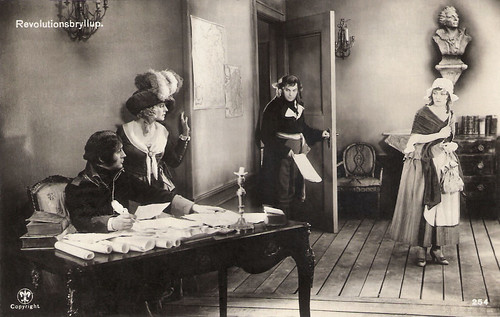
Danish postcard by Alex. Vincent's Kunstforlag, Eneret, no. 254. Photo: publicity still for Revolutionshochzeit/The Last Night (A.W. Sandberg, 1928). This was a German-Danish dramatisation of Sophus Michaëlis' play 'Revolutionsbryllup' (Revolutionary Wedding) and produced by Terra-Filmkunst. This card shows left Gösta Ekman and Karina Bell and in the back Fritz Kortner as the Jacobine Monteloup, and right Diomira Jacobini whose character, the aristocratic Alaine, has changed clothes with her maid Leontine (Karina Bell) to get a pass to leave Paris.

Paris in 1793, in the midst of the French Revolution


Revolutionshochzeit/Revolution Wedding (A.W. Sandberg, 1928) evolves in Paris in 1793, in the midst of the French Revolution. To fulfil her late father's last wish, the Comtesse Alaine de l'Estelle has become engaged to the noble Erneste de Tressailles.

Alaine de l’Estelle (Diomira Jacobini) and her maid Leontine (Karina Bell) try to flee Paris. Alaine is expected by her fiance, Ernest de Tresailles (Walter Rilla), at the castle of Trionville.

Erneste is fighting as a so-called émigré officer in the Austrian army against the Republicans. When Erneste is stationed near Alaine's castle of Trionville, he visits her in order to marry quickly. But that's when a Republican army led by the cold-hearted citizen-commissar Jacobine Monteloup (Fritz Kortner) invades the chateau and arrests Erneste.

As an émigré officer and enemy of the people, he is sentenced to death. In order to save Erneste, Alaine asks the good-natured Republican lieutenant Marc-Arron (Gösta Ekman) for help. He is a member of the Jacobines, who right after the marriage of Ernest and Alaine occupy Trionville.

For the love of Alaine, Marc tries to help Ernest and, consequently, is arrested and executed.
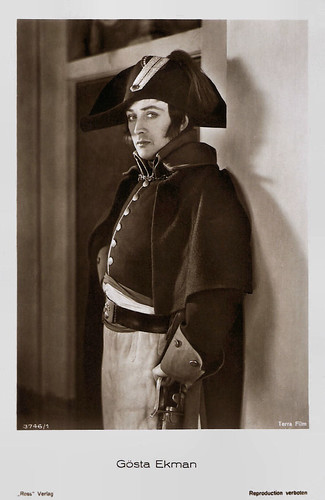
Gösta Ekman in Revolutionsbryllup/ Revolutionshochzeit
German postcard by Ross Verlag, no. 3746/1, 1928-1929. Photo: Terra Film. Gösta Ekman in the Revolutionshochzeit/Revolution Wedding (A.W. Sandberg, 1928).
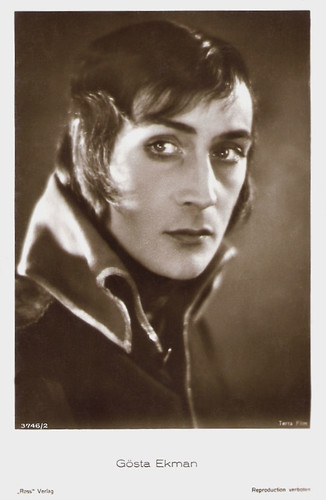
Gösta Ekman in Revolutionshochzeit (1928)
German postcard by Ross Verlag, no. 3746/2, 1928-1929. Photo: Terra Film. Gösta Ekman in the Revolutionshochzeit/Revolution Wedding (A.W. Sandberg, 1928).

A still enjoyable film full of excitement


Revolutionshochzeit/Revolution Wedding (A.W. Sandberg, 1928) is an adaptation by Norbert Falk and Robert Liebmann of the 1906 play of the same name by Sophus Michaelis and was produced by the Berlin company Terra-Film AG. Filming took place in the Terra Glass House and the surrounding area of Paris.

After passing through the Reich film censors, who gave the film the rating "Volksbildend" (educating the people), it premiered in Berlin (Mozartsaal) on 3 October 1928. In the following weeks, it was shown in other European countries, and later worldwide.

Revolutionshochzeit/Revolution Wedding was described by contemporary critics as a "top work", a "great film" and a "great revolutionary film". In particular, the courage of the tragic ending and the performance of Gösta Ekman and the direction of Anders Wilhelm Sandberg were praised.

Hans Wollenberg in Lichtbild-Bühne, no. 239, 4.10.1928: A. W. Sandberg, the Danish director, not only proves to be a master of the magnificent, splendidly moving and animated mass scenes but rather, above the outer unfolding, devotes all his love to the inner human core and thus to the actual play scenes with the finest feeling for the unravelling of the human heart, makes his directorial achievement an artistic deed. One must realise the unusual tasks that this demanding subject confronted the director with in order to appreciate the rich and great art of interpretation to which it owes its realisation as a silent film.

Revolutionshochzeit/Revolution Wedding was popular with the public, but after the film had been shown in cinemas, it fell into oblivion. It took till 2010 for a print from Moscow to emerge at the film archive of Toulouse, which was sent to the Filmmuseum Potsdam, where it was restored and re-premiered in March 2011. It was considered then to have an overdose of pathos and heroism, but it is also an enjoyable film full of excitement.

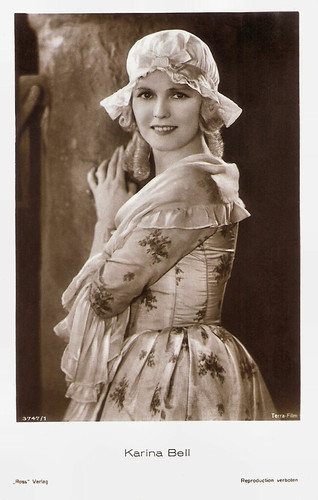
Karina Bell in Revolutionsbryllup (1928)
German postcard by Ross Verlag, no. 3747/1, 1928-1929. Photo: Terra Film. Karina Bell in Revolutionshochzeit/The Last Night (A.W. Sandberg, 1928).

Diomira Jacobini in Revolutionshochzeit (1928)
German postcard by Ross Verlag, no. 3748/1, 1928-1929. Source: Terra-Film. Diomira Jacobini in Revolutionshochzeit/The Last Night (A.W. Sandberg, 1928).

Sources: Bonn Stumfilmtage (German), Wikipedia (German) and IMDb.

02 May 2016

Karina Bell

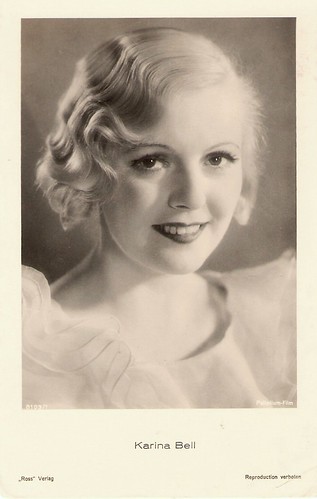
Charming Danish actress Karina Bell (1898-1979) was the most popular female star of the Nordisk Film Kompagni in the 1920s. The blond and slim actress was the beauty ideal of her generation. She also appeared in silent German and Swedish films. In later life, she became the CEO of a Danish brewery.

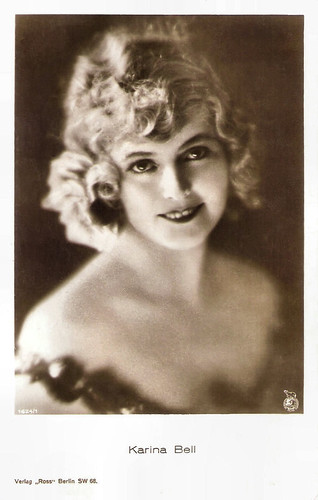
Karina Bell
German postcard by Ross Verlag, no. 1624/1, 1927-1928. Photo: Nordisk Film. Publicity still for Klovnen/The Clown (A.W. Sandberg, 1926).

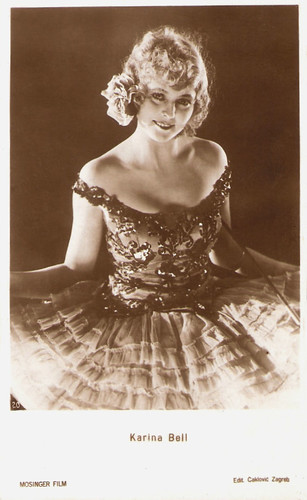
Karina Bell
Yugoslavian postcard by Edit. Cakovic, Zagreb, no. 3747/1. Photo: Mosinger Film. Publicity still for Klovnen/The Clown (A.W. Sandberg, 1926).

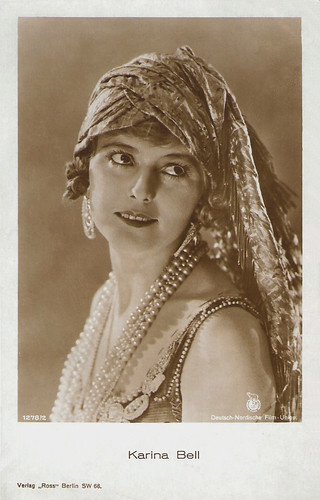
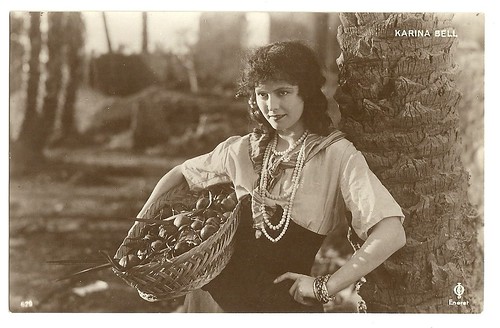
Karina Bell
German postcard by Ross Verlag, no. 1278/2, 1927-1928. Photo: Nordisk Film / Deutsch-Nordische Film-Union. Publicity still for Maharadjahens yndlingshustru III/The Maharaja's Favourite Wife III (A.W. Sandberg, 1926).

Karina Bell
German postcard by Ross Verlag, no. 3747/1, 1928-1929. Photo: Terra Film. Publicity still for Revolutionshochzeit/The Last Night (A.W. Sandberg, 1928).

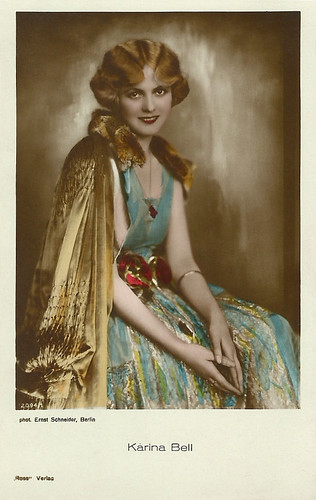
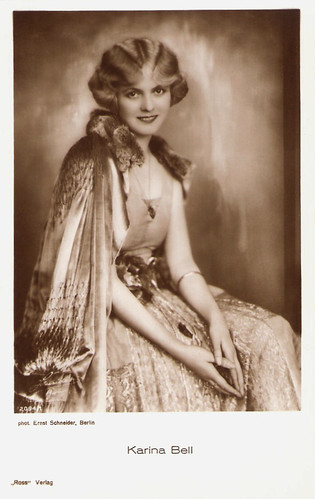
Karina Bell
German postcard by Ross Verlag, no. 2094/1, 1927-1928. Photo: Ernst Schneider, Berlin. Collection: Didier Hanson.

Nordisk


Karina Bell was born Karina Parkov in Hellerup, Denmark, in 1898. She was the daughter of Hans Peter Hansen and Anette Marie Nielsen. She followed lessons at the ballet school of Emilie Walbom and at age 21, she made her stage debut with the leading role in 'Tornerose' (Sleeping Beauty) (1919) at Det nye Teater (The New Theatre).

Soon her first film appearance followed in Blade af Satans Bog/Leaves from Satan's Book (1919, released in 1921) by the now legendary director Carl Theodor Dreyer. Next, she appeared in the Swedish production En ung mans väg/A young man's road (Carl Barcklind, 1919) opposite Philip Bech.

Bell also played in Benjamin Christensen’s presumed lost film Helgeninderne/Helge Indians (1921) and in his famous fictionalised documentary Häxan/Häxan: Witchcraft Through the Ages (1922), showing the evolution of witchcraft, from its pagan roots to its confusion with hysteria in modern Europe.

Her breakthrough was the Charles Dickens adaptation David Copperfield (A.W. Sandberg, 1922). Anders Wilhelm Sandberg was between 1916 and 1926 the leading director at the Nordisk studio. Karina Bell would star in a string of 15 films by Sandberg. Together they would also make for Nordisk Paa Slaget 12/Twelve O'Clock (1923), Den Sidste dans/The Last Dance (1923), the comedy Kaerlighedsoen/Love Island (1924) with Gunnar Tolnaes and Wienerbarnet (1924).

She also played the title role in another Dickens adaptation Lille Dorrit/Little Dorrit (A.W. Sandberg, 1924), with Frederik Jensen. Other films by Sandberg were Kan kvinder fejle?/Can women fail? (1924), Morænen/Moraine (1924), Min Ven Privatdetektiven/My Friend, the Private Detective (1924), Fra Piazza del Popolo/Mists of the Past (1925), and Maharajahens Yndlingshustru/The Maharadjah's Favourite Wife (1926).

Gunnar Tolnaes and Karina Bell in Honeymoon Island
Former Kingdom of Yugoslavia (Croatian) postcard by Ed. Jos Caklovic, Zagreb. Photo: Nordisk / Mosinger-Film. Gunnar Tolnaes and Karina Bell in Kærligheds-Øen/ Honeymoon Island (A.W. Sandberg, 1924).

Karina Bell in Kan Kvinder fejle
Danish postcard by Eneret, no. 629. Photo: publicity still for Kan Kvinder fejle/Can women fail? (A.W. Sandberg, 1924). This romantic comedy was partly shot in Liguria, Italy. Director A.W. Sandberg told the newspapers the film crew started filming in Trieste and at Lake Garda, but in two days two and a half meters of snow fell, forcing the crew to withdraw to Verona and Venice. As winter still chased the crew, they moved on to Bordighera on the Italian Riviera. Here they got finally the weather they wanted, and the images were recorded under a scorching sun in 30-35 degree heat, according to Sandberg. After their return from Italy, the crew shot interior shots in Valby, where among other things a set was built that envisioned 'a wealthy home'. To make the interior as compelling as possible, Sandberg almost emptied his apartment at Nørregade to provide props, such as chairs with embroidery made by his wife Elsa Fröhlich, paintings of snowy landscapes made by his father-in-law Thaulow, and an old dresser with bronze female statues by sculptor Jean René Gauguin, son of painter Paul Gauguin.

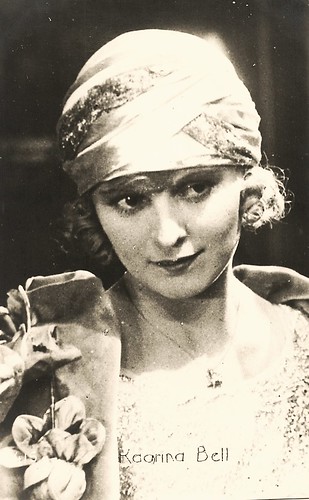
Karina Bell
Finnish postcard by Kortcentralem, Korttikeskus, 1925. Karina Bell is written as Kaarina Bell.

Diomira Jacobini and Gösta Ekman in Revolutionsbryllup
Danish postcard by Alex. Vincent's Kunstforlag, Eneret, no. 254. Photo: publicity still for Revolutionsbryllup/The Last Night (A.W. Sandberg, 1927). This was a German-Danish dramatization of Sophus Michaëlis' play Revolutionshochzeit (Revolutionary Wedding), with Gösta Ekman, Karina Bell, and Diomira Jacobini. The film was produced by Terra-Filmkunst.

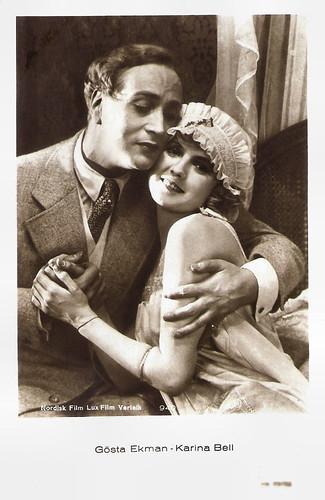
Gösta Ekman and Karina Bell in Klovnen (1926)
Austrian postcard by Iris Verlag, no. 949. Photo: Nordisk Film / Lux Film Verleih. Publicity still for Klovnen/The Clown (A.W. Sandberg, 1926) with Gösta Ekman.

Berlin


In 1926, Karina Bell followed A.W. Sandberg when he left for Berlin. In Germany, she starred in Eheskandal in Hause Fromont jun. und Risler sen./Wedding Scandal in the House of Fromont Jr. and Risler Sr. (A.W. Sandberg, 1927) with Lucy Doraine, Nora Gregor and Fred Louis Lerch.

In the period piece Revolutionshochzeit/The Last Night (A.W. Sandberg, 1928), she co-starred with Diomiro Jacobini, Gösta Ekman and Fritz Kortner.

She also starred in Phantome des Glücks/Phantoms of Happiness (Reinhold Schünzel, 1929). She played a dancer opposite Michael Chekhov and Gaston Modot. The film was originally made as a silent, then re-released in 1930 with an added soundtrack.

After the arrival of the sound film, she returned to Denmark. She performed in theatres in Copenhagen and Oslo, and she made two sound films: Nyhavn 17/New Harbour 17 (George Schneevoigt, 1933) and one last film with A.W. Sandberg, the comedy 5 raske piger/Five Healthy Girls (1933).

In 1934 she married Knud P. Parkov, director of the Wiibroes Bryggeri (Wiibroes beer brewery), and gave up her stage and film career. When her husband died in 1949 she took over as CEO at Wiibroes under the name Karen Gudrun Louise Parkov. Karina Bell died in Denmark in 1979, at the age of 80.

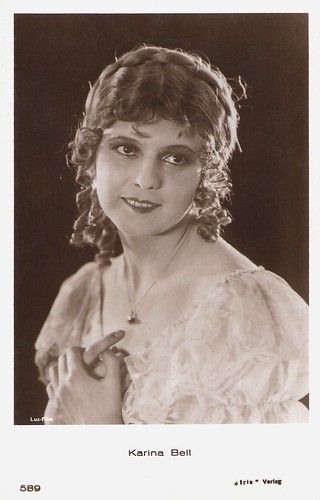
Karina Bell
Austrian postcard by Iris Verlag, no. 589. Photo: Lux-Film.

Karina Bell
German postcard by Ross Verlag, no. 2094/1, 1927-1928. Photo: Ernst Schneider, Berlin.

Karina Bell
German postcard by Ross Verlag, no. 3167/1, 1927-1928. Photo: DEFU.

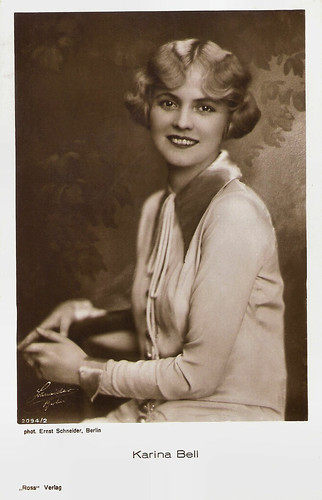
Karina Bell
German postcard by Ross Verlag, no. 3094/2, 1927-1928. Photo: Ernst Schneider, Berlin.

Karina Bell
German Postcard by Ross Verlag, no. 8103/1, 1933-1934. Photo: Palladium-film.

Sources: Danish Film Institute (Danish), Den danske film database (Danish), Wikipedia (Swedish and English) and IMDb.

This post was last updated on 16 July 2023.