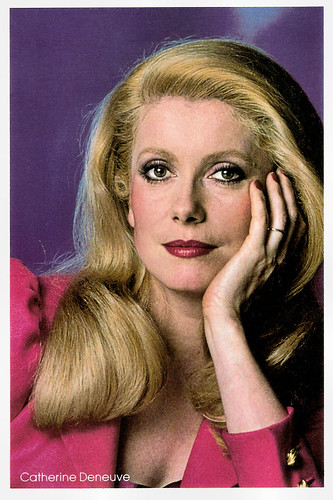
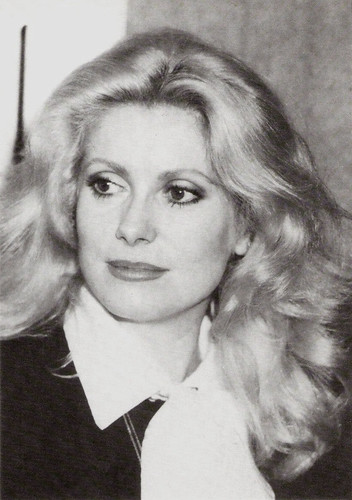
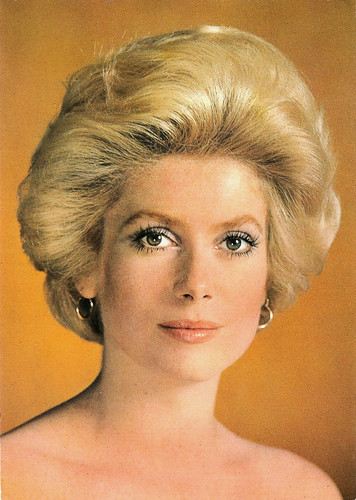
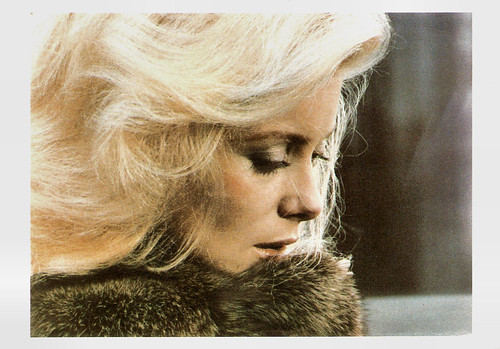
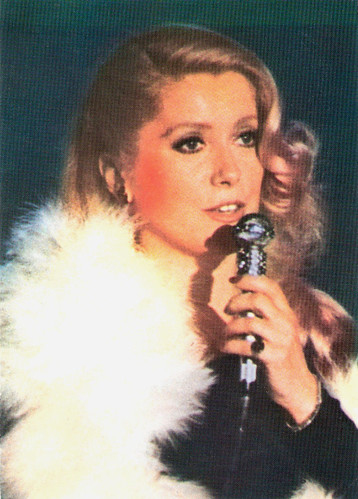
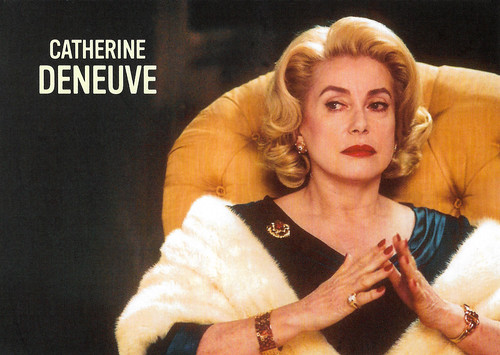
Today it's the 81h birthday of elegant Catherine Deneuve (1943). She is an icon of French cinema who has graced the screen for more than six decades. She gained recognition in the 1960s for her portrayal of cool, mysterious beauties in classic films by directors like Luis Buñuel, Roman Polanski and François Truffaut. Apart from being a great actress, she is also an archetype for Gallic beauty. From 1985 to 1989, she succeeded Brigitte Bardot as the model for the national symbol Marianne, seen on French coins and stamps. Since then she had new successes with such directors as Lars von Trier and François Ozon. Joyeux anniversaire, Mme. Deneuve!
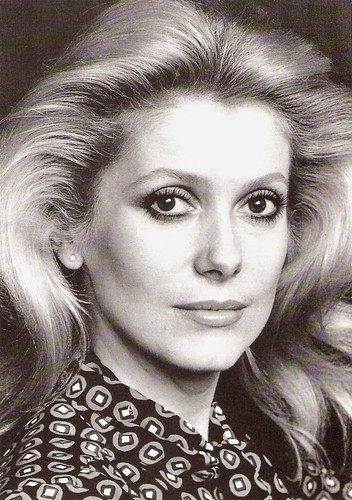
French postcard by E.D.U.G., no. 378. Photo: Sam Lévin.
East-German postcard by VEB Progress Film-Vertrieb, Berlin, no. 2522, 1965. Retail price: 0,20 MDN. Photo: Sam Lévin.
East-German postcard by VEB Progress Film-Vertrieb, Berlin, no. 2533, 1966. Retail price: 0,20 MDN.
French postcard by PSG, no. 1410.
French collector card by Publistar. Photo: Patrick de Mervellec.
French postcard by Éditions Hazan, Paris, in the Collection Magie Noire, no. 6435, 1994. Photo: Raymond Depardon / Magnum Photos. Catherine Deneuve in La chamade/Heartbeat (Alain Cavalier, 1968).
East German postcard by VEB Progress Film-Vertrieb, Berlin, no. 3/71.
Romanian postcard by Casa Filmului Acin.
Romanian postcard by Casa Filmului Acin, no. 568.
Romanian postcard by InterCONTEMPress.
Vintage card. Photo: Lapeyronnie.
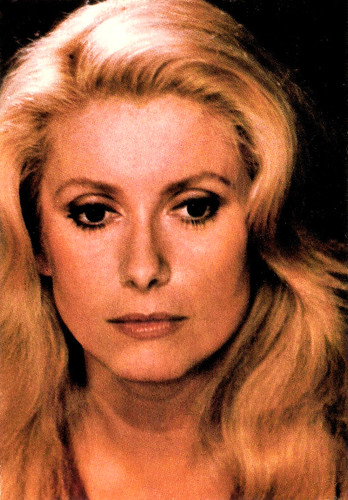
American postcard by The American Postcard Co., 1981, no. 285. Photo: Douglas Kirkland / Contact.
Elegant Catherine Deneuve (1943) is an icon of the French cinema. She gained recognition in the 1960s for her portrayal of cool, mysterious beauties in classic films of directors like Luis Buñuel, Roman Polanski and François Truffaut. Apart from being a great actress, she is also an archetype for Gallic beauty. From 1985 to 1989, she succeeded Brigitte Bardot as the model for the national symbol Marianne, seen on French coins and stamps. Since then she had new successes with such directors as Lars von Trier and François Ozon.
Romanian postcard by Casa Filmului Acin, no. 568.
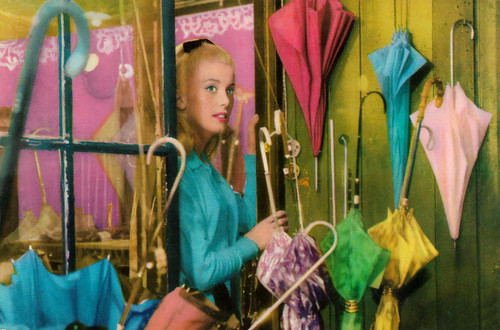
Spanish postcard by Archivo Bermejo for Kores Carboplan, no. C-195, 1964. Photo: Radio Films. Catherine Deneuve in Les parapluies de Cherbourg (Jacques Demy, 1964). The Spanish title was Los Paraguas de Cherburgo.
East German postcard by VEB Progress Film-Vertrieb, Berlin, no. 2771, 1967. Samy Frey and Catherine Deneuve in La costanza della ragione/The consistency of reason (Pasquale Festa Campanile, 1964).
French postcard by La Cinémathèque française, no CF 5002, 1997. Photo: Hélène Jeanbrau / Ciné-Tamaris. Catherine Deneuve and Françoise Dorléac in Les Demoiselles de Rochefort/The Young Girls of Rochefort (Jacques Demy, 1967).
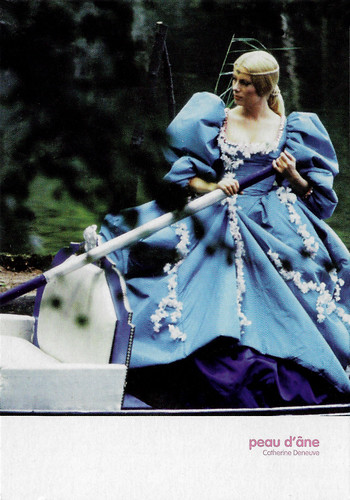
French postcard by Editions d'art Yvon, Paris, no. 40-110-07. Photo: Park Film / KIM. Publicity still for Peau d'âne/Donkey Skin (Jacques Demy, 1970). Caption: 'La Princesse reçoit la peau d'âne' (The princess receives the donkey skin).
The umbrellas of Cherbourg
Catherine Deneuve was born Catherine Fabienne Dorléac in 1943, in Paris, France. She was the third of four daughters to the stage actors Maurice Dorléac and Renée Deneuve, who was the French voice of Esther Williams, and whose name Catherine uses. Her sisters were actress Françoise Dorléac, Sylvie Dorléac and Danielle Dorléac.
When Catherine was 13 she had the opportunity to play in Les Collégiennes/The Twilight Girls (André Hunebelle, 1956) during the summer school holidays with her sister Sylvie, and she accepted because she was curious to see how a film was made. She was credited as Catherine Dorléac. She began using her mother's maiden name professionally in 1960, to differentiate herself from her sister Françoise Dorléac, then an upcoming actress.
Catherine continued with small parts in minor films until she met film director Roger Vadim, the former husband of Brigitte Bardot. Stunning and only 17 years old, Deneuve and the 32-year-old Vadim began romancing. She dyed her naturally brown hair blonde to please Vadim, who gave her a leading part in the Marquis de Sade adaptation Le vice et la vertu/Vice and Virtue (Roger Vadim, 1963).
Her breakthrough came the next year with the musical Les parapluies de Cherbourg/The Umbrellas of Cherbourg (Jacques Demy, 1964) in which she gave an unforgettable performance as a romantic middle-class girl who falls in love with a young soldier (Nino Castelnuovo) but gets imprisoned in a loveless marriage with another man (Marc Michel). The film was nominated for five Academy Awards.
Demy also cast Deneuve in the less successful Les demoiselles de Rochefort/The Young Girls of Rochefort (Jacques Demy, 1967), with her elder sister Françoise Dorléac. That year Françoise would die in a fatal car crash on the French Riviera, only 25 years old. The sisters were extremely close and Deneuve was devastated.
French postcard by La Cinémathèque française, no. CF 5004, 1998. Photo: Ciné Tamaris / Collection C.T. Catherine Deneuve and Nino Castelnuovo in Les parapluies de Cherbourg (Jacques Demy, 1964).
Romanian postcard by Casa Filmului Acin. Catherine Deneuve in Un monsieur de compagnie/I Was a Male Sex Bomb (Philippe de Broca, 1964).
East German postcard by VEB Progress Film-Vertrieb, Berlin, no. 2769, 1967. Catherine Deneuve in La costanza della ragione/The consistency of reason (Pasquale Festa Campanile, 1964).
Romanian postcard by Casa Filmului Acin, no. 147. Catherine Deneuve in Benjamin ou Les mémoires d'un puceau/The Diary of an Innocent Boy (Michel Deville, 1967).
Romanian postcard by Casa Filmului Acin, no. 120. Photo: Françoise Dorléac and Catherine Deneuve in Les Demoiselles de Rochefort/The Young Girls of Rochefort (Jacques Demy, 1967).
Belle de jour
Catherine Deneuve had her English-speaking film debut in Roman Polanski’s shocking psychological thriller Repulsion (Roman Polanski, 1965). She delivered a creepy performance, as Carol, a sexually repressed, paranoid schizophrenic. Her descent into madness results in her murdering men who lust after her.
Deneuve was again a sensation as a bored housewife who fulfils her sexual fantasies while working as an afternoon call girl in Luis Buñuel’s masterpiece Belle de jour/Beauty of the Day (Luis Buñuel, 1967) with Jean Sorel and Michel Piccoli.
James Travers at French Films: "The casting of Catherine Deneuve as Séverine is a marvellous example of serendipity. At the time, she was in a relationship with the film director François Truffaut, who was so impressed with her acting skill that he lobbied Buñuel to give her a lead role in his next film. Buñuel was initially lukewarm towards Deneuve and insisted that she should not perform. Ever the professional, Deneuve obliged and delivered a non-performance par excellence that was perfectly suited for the film. It is the actress’s ice-cold aloofness and the tight grip she has on her emotions that makes her so perfect for the role of Séverine."
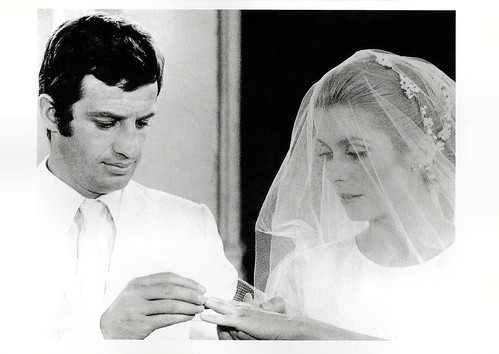
She also worked with the Spanish director on Tristana (Luis Buñuel, 1970), in which she again portrayed an innocent beauty exploited by a lecherous older man, this time played by Fernando Rey. Unlike in Belle de Jour, her character in Tristana achieved independence and eventually exacted revenge on the man who exploited her. The film garnered an Academy Award nomination for Best Foreign Language Film. She gave another great performance in a dual role opposite Jean-Paul Belmondo in La sirène du Mississipi/Mississipi Mermaid (François Truffaut, 1969, a kind of apotheosis of her ‘beautiful ice maiden’ persona. When their private relationship failed, Truffaut reportedly had a nervous breakdown.
Romanian postcard by Casa Filmului Acin, no. 165. Catherine Deneuve in Manon 70/French Mistress (Jean Aurel, 1968).
French postcard by Éditions Hazan, Paris, in the Collection Magie Noire, no. 6435, 1994. Photo: Raymond Depardon / Magnum Photos. Catherine Deneuve in La chamade/Heartbeat (Alain Cavalier, 1968).
French postcard in the Collection Magie Noire by Éditions Hazan, Paris, no. 6247, 1991. Catherine Deneuve and Jean-Paul Belmondo in La Sirène du Mississipi/Mississippi Mermaid (François Truffaut, 1969).
French postcard by Cinetamaris and Arte Video to promote the DVD and CD box 'Intégrale Jacques Demy'. Photo: M.P. Lavoix / Succession Demy. Catherine Deneuve in Peau d'âne/Monkey Skin (Jacques Demy, 1970).
French postcard, no. C139. Photo: Catherine Deneuve, Michel Piccoli and Darry Cowl in Touche pas la femme blanche/Don't Touch the White Woman! (Marco Ferreri, 1974).
Chanel no. 5
Catherine Deneuve was the muse of fashion designer Yves Saint-Laurent, who dressed her for Belle de jour, La chamade/Heartbeat (Alain Cavalier, 1968), La sirène du Mississipi, Un flic/A Cop (Jean-Pierre Melville, 1972), Liza (Marco Ferreri, 1972) and The Hunger (Tony Scott, 1983). She was also the face of Chanel no. 5 in the 1970s and caused sales of the perfume to soar.
In the US, the press nominated her as 'the world's most elegant woman'. She appeared then in two American movies, the comedy The April Fools (Stuart Rosenberg, 1969) opposite Jack Lemmon, and the crime drama Hustle (Robert Aldrich, 1975) with Burt Reynolds. However, she remained active in European films during the 1970s, although she didn't find parts of the same calibre as her roles in the 1960s.
Deneuve reunited with Jacques Demy for the fairytale Peau d'âne/Donkey Skin (Jacques Demy, 1970) with Jean Marais, and made five films together with Marcello Mastroianni: Ça n'arrive qu'aux autres/It Only Happens to Others (Nadine Trintignant, 1971), Liza (Marco Ferreri, 1972), L'événement le plus important depuis que l'homme a marché sur la lune/A Slightly Pregnant Man (Jacques Demy, 1973), Touche pas à la femme blanche/Don't Touch the White Woman! (Marco Ferreri, 1974), and Les cent et une nuits de Simon Cinéma/A Hundred and One Nights of Simon Cinema (Agnès Varda, 1995).
In 1989, she was back with a magnificent role in Le dernier métro/The Last Metro (François Truffaut, 1980) as a stage actress in Nazi-occupied Paris. It was the first of six films in which she starred opposite Gérard Depardieu. For her performance, she won a César Award, and the film, which won an Academy Award for Best Foreign Language Film, revived her international career.
Deneuve played a bisexual vampire in the slick The Hunger (Tony Scott, 1983), with David Bowie and Susan Sarandon. The role brought her a significant lesbian following. Her appearance in the romantic thriller, Le Lieu de crime/Scene of the Crime (André Techiné, 1986), with Danielle Darrieux, was also well-received.
French postcard by Sofraneme, Levallois Perret, 1980.
French postcard by E.D.U.G., Paris, no. 506. Photo: Sam Lévin.
Romanian postcard by Casa Filmului Acin. Photo: Catherine Deneuve and Alain Delon in Le choc/Shock (Robin Davis, 1982).
Romanian postcard by Casa Filmului Acin, no. 43 072. Photo: Catherine Deneuve and Jean-Louis Trintignant in Le bon plaisir (Francis Girod, 1984).
French postcard by Les Cartophiles du pays Nantes / Office du Tourisme, Nantes, no. CPN 197. Photo: Yannick Pasquet. Richard Bohringer and Catherine Deneuve on the set of La reine blanche/The White Queen (Jean-Loup Hubert, 1991). The film was shot in Trentemoult between 17 June and 9 August 1990.
During the 1990s, Deneuve continued to appear in a large number of films. She was very good opposite Vincent Perez in the epic drama Indochine/Indochina (Regis Warnier, 1992) as a plantation owner in the 1930s. For this role, she earned her first Academy Award nomination and a second César Award.
She starred in several films by André Téchiné, including Ma saison préférée/My Favorite Season (1993) and Les Voleurs/The Thieves (1995), with Daniel Auteuil. She joined the documentary L'Univers de Jacques Demy (Agnès Varda, 1995), to show tribute to the director who made the film that brought her to fame.
In 1998, she won acclaim and the Volpi Cup at the Venice Film Festival for her performance as a jewellers widow in Place Vendôme (Nicole Garcia, 1998) and in 1999 she appeared in five films, Est-Ouest/East-West (Régis Wargnier, 1999), Pola X (Leos Carax, 1999), Belle-maman/Beautiful Mother (Gabriel Aghion, 1999), and Le vent de la nuit/The Wind of the Night (Philippe Garrel, 1999) and the wonderful Le temps retrouvé/Marcel Proust's Time Regained (Raoul Ruiz, 1999) with Emmanuelle Béart and John Malkovich.
The following year, she surprised everyone with her portrayal of the factory worker sidekick of Icelandic singer Bjork in the melancholy musical Dancer in the Dark (Lars von Trier, 2000). She had seen Von Trier’s Breaking the Waves (1996) and was so impressed with the Danish director; that she wrote him a letter requesting a part in one of his upcoming projects. He obliged, and her performance provided further proof that she was much more than a pretty face, and had always been. Though it polarised critics and audiences alike, the film was selected for the Palme d'Or at the Cannes Film Festival.
French postcard by Editions La Malibran, Paris, no. MC 18.
Romanian postcard by Casa Filmului Acin.
Vintage postcard, no. 2071.
French postcard by Editions F. Nugeron, no. 71. Photo: J. Ritchie.
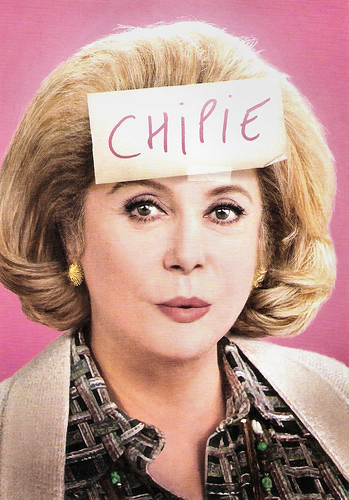
Belgian Freecard by Boomerang. Photo: Mandarin Cinema. Catherine Deneuve in Potiche/Trophy Wife (François Ozon, 2010). Caption: Chipie.
8 Femmes
In 2002, Catherine Deneuve shared the Silver Bear Award for Best Ensemble Cast at the Berlin International Film Festival for her performance in the musical comedy 8 Femmes/8 Women (François Ozon, 2002). It was another triumph. In 2005 she published her diary 'A l'ombre de moi-meme' (Close Up and Personal: The Private Diaries of Catherine Deneuve), in which she writes about her experiences shooting the films Indochine, and Dancer in the Dark.
At the unheard-of age of 62, she signed a deal with Mac Cosmetics in 2006, and a year later, nabbed a contract modelling for Louis Vuitton. She voiced the mother in Persepolis (Vincent Paronnaud, Marjane Satrapi, 2007), an animated film based on Satrapi´s graphic novel of the same name. Her daughter Chiara Mastroianni voiced the anti-Disney heroine, a rebellious, teenage Iranian girl who loves heavy metal. The edgy animated feature was nominated for an Academy Award.
In 2008, Deneuve appeared in her 100th film, Un conte de Noël/A Christmas Tale (Arnaud Desplechin, 2008). However, she continued to work steadily making at least two or three films per year. She reunited with director François Ozon for the hilarious comedy Potiche/Trophy Wife (2010) and was the Queen of England in the comic book adaptation Astérix et Obélix: Au service de Sa Majesté/Astérix and Obélix: On Her Majesty's Secret Service (Laurent Tirard, 2012). In both films, she co-starred with Gérard Depardieu. Mark Deming writes at AllMovie in his review of Potiche: "They just don't make movie stars like Catherine Deneuve anymore. It's not just a matter of her beauty, though she's still a radiantly lovely woman at the age of 67 - Deneuve has the rare ability to seem perfectly naturalistic while firmly holding the screen with her presence, and she can effortlessly play both comedy and drama, sometimes moving back and forth between both in a single picture without ever seeming less than authentic."
The following year, she could be seen in the cinema opposite Mylène Demongeot in Elle s'en va/She Leaves (Emmanuelle Bercot, 2013). Since then, she appeared in writer/director Pierre Salvadori's comedy-drama Dans la cour/In the Courtyard (2014), and André Téchiné's drama L'Homme qu'on aimait trop/In the Name of My Daughter (2014). The latter is a fictionalised account of the true story of the events surrounding the life of Agnès Le Roux, a casino's heiress, before and after her unresolved disappearance in the fall of 1977. Deneuve also co-starred alongside Catherine Frot, in writer/director Martin Provost's French drama Sage femme/The Midwife (2017).
Catherine Deneuve's only marriage was from 1965 to 1972 with British photographer David Bailey. The couple divorced in 1972 but remained friends. Deneuve has two children: actor Christian Vadim (1963), from her relationship with Roger Vadim, and Chiara Mastroianni (1972), from her relationship with Marcello Mastroianni. She is now the grandmother of Milo (1997) and Anna (2003) and resides in the luxurious neighbourhood of Saint Germain des Pres in Paris. In November 2019, the actress suffered a mild stroke but there was no damage to her motor functions. Five weeks later, she was released from the hospital and spent the remainder of 2019 recuperating at her Paris home. Since then she acted in the films De son vivant/Peaceful (Emmanuelle Bercot, 2021) with Benoît Magimel and the biographical comedy Bernadette (Léa Domenach, 2023) with Deneuve in the titular role of Bernadette Chirac, French politician and the widow of the former president Jacques Chirac. More than 65 years after her debut, Catherine Deneuve continues to be one of the major stars of European cinema.
Dutch postcard by Cinemien / Lumière. Catherine Deneuve in 8 Femmes/8 Women (François Ozon, 2002). Interestingly, the card was published to promote another Deneuve film, Sage femme/The Midwife (Martin Provost, 2017).
Dutch promotion card by Cherry Pickers Film. Catherine Deneuve (far left) in Fête de Famille/Happy Birthday (Cédric Kahn, 2019).
Jacques Demy's colourful musical Peau d'âne/Donkey Skin (1970) is a combination of Jean Cocteau's classic La Belle et la Bête/Beauty and the Beast (1946) and Disney's Cinderella (1950) with music composed by Michel Legrand. Demy retells a strange and complex fairy tale of a princess who disguises herself in a donkey skin and flees the kingdom so she won't have to marry the king who happens to be her father. Jacques Demy loved fairy tales since his childhood, and with Peau d'âne/Donkey Skin, he finally succeeded in adapting one and made his greatest film.
French postcard by Editions d'art Yvon, Paris, no. 40-110-07. Photo: Parc Film / KIM. Catherine Deneuve in Peau d'âne (Jacques Demy, 1970). Caption: The princess receives the donkey skin.
French postcard by Editions d'art Yvon, Paris, no. 40-110-02. Photo: Parc Film / KIM. Jean Marais and Catherine Deneuve in Peau d'âne/Donkey Skin (Jacques Demy, 1970). Caption: Peau d'âne (Donkey Skin), a tale by Charles Perrault, a film by Jacques Demy. The Princess asks the King, her father, for a moon-coloured dress.
He declares that he will marry the woman whose finger fits the ring
'Peau d'âne' is a beloved French fairy tale by Charles Perrault from 1695. The tale had only been adapted for the big screen once, in 1908 by Albert Capellani. This short black-and-white silent film was based on a stage version of the fairy tale first performed in 1838 at the Porte-Saint-Martin theatre. The authors, Émile Vanderburch and Laurencin, had modified the plot and left the incest dimension out: in their version the princess had to wear a donkey skin as a punishment for her coquettishness and no longer to escape her father's eyes. Throughout the nineteenth century, this play was a great popular success in France.
In Jacques Demy's version, Peau d'âne/Doney Skin (1970), a king (Jean Marais) and queen (Catherine Deneuve) live happily until her sudden death. The dying queen makes her husband promise that his next wife will be as beautiful as she. The king decides to marry his own graceful and charming daughter (also Catherine Deneuve). She's willing, but her fairy godmother, Lily Fairy (Delphine Seyrig) serves as a social conscience, intent on thwarting incest.
Lily instructs the princess to request a series of dresses impossible to make. However, the king's tailor succeeds. So the fairy plots the princess's escape, wearing the skin of the king's prize donkey. The Princess goes to another kingdom and everyone seems to think she's an ugly scullery maid. Her disguise arouses hostility, but she manages to keep her secret.
In the woods, she has a chance encounter with the wandering prince of a neighbouring castle. Prince Charming (Jacques Perrin) sees who she really is and is smitten. Love-struck, he retires to his sickbed and asks that Donkey Skin be instructed to bake him a cake to restore him to health. In the cake, he finds a ring that the princess has placed there and is thus sure that his love for her is reciprocated. He declares that he will marry the woman whose finger fits the ring.
All the women of marriageable age assemble at the prince's castle and try on the ring one by one, in order of social status. Last of all is the lowly Donkey Skin, who is revealed to be the princess when the ring fits her finger. At the wedding of the prince and the princess, the lilac fairy and the king arrive by helicopter and declare that they too are to be married.
French postcard by Croissant, Paris, no. 3666. Photo: Film Pathé. Publicity still for Peau d'âne/Donkey Skin (Albert Capellani, 1908). Caption L'infante coiffée d'une peau d'âne (The princess wears a donkey skin). The actress is unknown.
Romanian calendar card by Casa Filmui Acin, 1973. Catherine Deneuve and Jacques Perrin in Peau d'âne/Donkey Skin (Jacques Demy, 1970). Collection: Alina Deaconu.
Romanian calendar card by Casa Filmui Acin, 1973. Catherine Deneuve in Peau d'âne/Donkey Skin (Jacques Demy, 1970). Collection: Alina Deaconu.
A certain uninhibited streak, tending to be more daring than traditional French filmmakers
After achieving worldwide success with his third feature, the enchanting musical Les parapluies de Cherbourg/The Umbrellas of Cherbourg (1964), Jacques Demy was courted by Hollywood. He and his wife, fellow director Agnès Varda, spent two years (1967-1969) working in Los Angeles, with each of them making a film there. Demy made Model Shop (1969) with the financial support of Columbia. Although the film was a commercial failure, Demy's American producers offered him the chance to direct a new film in the United States, A Walk in the Spring Rain, starring Ingrid Bergman and Anthony Quinn. Demy eventually gave up his position to Guy Green. He wanted to return to France to make Peau d'âne, which he already had in mind for some time. French producer Mag Bodard had visited him in Hollywood to tell him that she had the financing and that Catherine Deneuve wanted to play the princess.
Peau d'âne/Donkey Skin (1970) became Demy's first film after returning to France. Since childhood, he was fascinated by Charles Perrault's strange and complex fairy tale. As a boy, he had staged puppet shows of all of Perrault's stories. Fairy tales remained a strong presence in his life. Demy wrote a script for a Sleeping Beauty film in the 1950s and ended up putting fairy tale references in both Lola (1961) and Les parapluies de Cherbourg/The Umbrellas of Cherbourg (1964). In 1962 he started working on a script for a film based on the fairy tale 'Peau d'ane'.
Demy considered Brigitte Bardot and the American Anthony Perkins, who filmed a lot in Europe at the time, for the title roles. The two actors agreed to take on the role but the production costs were too high for a director who was almost unknown at the time. The triumph of Les Demoiselles de Rochefort/The Young Girls of Rochefort (1967) changed all that. However, the involvement of his muse Catherine Deneuve was instrumental in securing financing for the production.
Demy's screenplay respected the problematic theme of the original tale, which the director would reuse in his final film, Trois places pour le 26 (1988). Enriched by his American experience, Demy may have developed a certain uninhibited streak, tending to be more daring than traditional French filmmakers. Demy's Peau d'ane invites you to a bizarre and surreal world, full of bold colours, real-life French châteaux, living statues, and fairy magic. The costumes by Italian designer Gitt Magrini are wild and wonderful. The film looks almost like animation coming to life.
Catherine Deneuve is an ideal and delicate princess and Jean Marais is very convincing in his role of tormented and jaded king. It was his final role in the cinema. Marais's casting refers to Jean Cocteau's fairy tale film La Belle et la Bête/ Beauty and the Beast (Jean Cocteau, René Clément, 1946), in which Marais played the beast. Also, the use of live actors to portray human statues in the castles, and simple special effects such as slow motion and reverse motion were an homage to Cocteau's film. There are other surreal touches in Peau d'âne, such as the king's throne shaped like a giant cat, and the courtiers and horses that are painted blue in the princess's kingdom, and red in the prince's kingdom. Peau d'âne (1970) proved to be Jacques Demy's biggest success in France with a total of 2,198,576 admissions. In France, the film is now considered a cult classic. It was Demy's top box office hit of all his work. Peau d'ane was restored in 2003 and 2014 under the direction of Agnès Varda. The film was also adapted for the stage in 2018 at the Théâtre Marigny
French postcard by Michel Lavoix, 2013. Photo: ciné-tamaris. Jacques Perrin as the Prince in Peau d'âne/Donkey Skin (Jacques Demy, 1970). Caption: The Rose: You were singing about love, are you looking for it? The Prince: Obviously, Rose, like everyone else... The Rose: So keep going, it's a question of trust.
French postcard by Cinetamaris and Arte Video to promote the DVD and CD box 'Intégrale Jacques Demy'. Photo: M.P. Lavoix / Succession Demy. Catherine Deneuve in Peau d'âne/Monkey Skin (Jacques Demy, 1970).
French postcard by Editions d'art Yvon, Paris, no. 40-110-07. Photo: Parc Film / KIM. Micheline Presle and Jacques Perrin in Peau d'âne/Donkey Skin (Jacques Demy, 1970). Caption: Donkey Skin. A Tale by Charles Perrault. A film written and directed by Jacques Demi. My mother, I want Donkey Skin to make me a cake.