German dancer Rita Sacchetto (1879-1959) was internationally successful with her Tanzbilder. In the 1910s she became a star of the Danish Nordisk Film Company.

French postcard by Serie VK, no. 2639/6.

German postcard by Verlag Herm. Leiser, Berlin-Wilm, no. 8041.

Postcard by GCS, no. 1610/2.
Dance Pictures
Rita Sacchetto was born as Margherita Sacchetto in Munich, Germany, in 1879. She was the daughter of a respected Venetian painter and an Austrian woman. Two of her brothers also became painters. She decided to become a dancer after seeing a performance by Isadora Duncan in 1902. She attended dance classes and made her first appearance in the Münchner Künstlerhaus in 1905, performing sarabandes, gavottes, minuettes, tarantellas, and Oriental dances. In her dances, which she called Tanzbilder (Dance Pictures), she followed the tradition of the Tableaux Vivants of paintings of famous artists like Thomas Gainsborough or Joshua Reynolds. Her success led to an invitation to perform her odalisque dance in a production of Georges Bizet's opera Djamilah in Vienna, where such artists as Gustav Klimt, Kolo Moser, and Joseph Hoffmann liked her dances. In 1908 and 1909 she made a tour though North and South America. Loïe Fuller invited her to perform a solo at the New York Metropolitan Opera, and in 1910 she gave at the Met an entire dance concert featuring her Botticelli dances, Siamese dance, and a large-scale pantomime called The Intellectual Awakening of Woman, which used Edvard Grieg's Peer Gynt suites and a group of thirty female dancers. Later that year she embarked on a tour of Russia, which led to a collaboration with fashion designer Paul Poiret at his private theatre in Paris, where she impersonated a famous painting of the Empress Eugenie wearing her original dress.

German Postcard by Verlag: Gastspieldirektion Rita Sacchetto, München (Munich), Serie E 3. Photo: F. Grainer, München. Photo: Rita Sacchetto in a costume of Empress Eugenie.

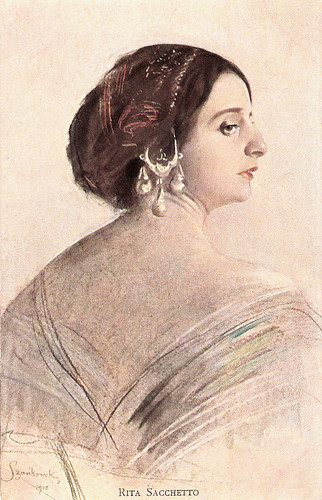
German Postcard by Raphael Tuck & Sons, and R. Wagner, München, Series Fürstliche Frauen, no. 1238. Portrait by Baron B. de Szankowski.

German postcard by Verlag Herm. Leiser, Berlin-Wilh., no. 3037. Photo: F. Grainer, München (Munich).
Nordisk
By 1912 Rita Sacchetto was back in Munich as Alexander Sacharoff's partner in a pair dance team. But the collaboration was brief. A concert in Copenhagen, Denmark, was apparently a 'fiasco,' but it brought Rita to the attention of the Nordisk film company, which never had enough female stars for the sensational erotic melodramas that made Danish films competitive on the European market. She appeared as the ballet dancer Odette in Ballettens Datter/Unjustly Accused (Holger-Madsen, 1913). Nordisk then hired Sacchetto to star in films for the astonishing salary of 7,000 kroner per picture, but she made many quite successful films including Fra Fryste til Knejpevaert/The Gambler's Wife (Holger-Madsen, 1913) and Den Skønne Evelyn/Evelyn the Beautiful (A.W. Sandberg, 1916) with a script by Carl Theodor Dreyer. According to Karl Toepfer in his study Empire of Ecstasy: Nudity and Movement in German Body Culture, 1910-1935 "Sacchetto exuded a dusky, melancholy beauty that seemed even more refined and aristocratic, a 'breeze of perfume,' when displayed in opulent historical costumes. Although she excluded modern paintings of women from her graceful productions, she was probably the first to use silent film as a model for composing dances."

German Postcard by Verl. Hermann Leiser, Berlin-Wilm, no. 1756. Photo: F. Grainer, München.

German postcard by Verlag Herm. Leiser, Berlin-Wilm., no. 1683.

German Postcard by Verlag Hermann Leiser, Berlin-Wilm., no. 6990. Photo: Gerlach & Co. Collection: Didier Hanson.
Technical Defects and Long-faded Tastes
In 1914 Rita Sacchetto moved from Munich to Berlin und started a dance school in her villa. Anita Berber and Valeska Gert belonged to her most famous pupils. She also appeared in German films like Sabina (Louis Neher, 1918). In 1917 she married the Polish Count and sculptor Auguste Zamoyski. In 1918 she returned for a year to Munich. In 1924 one of the count's friends accidentally shot Sacchetto in the foot, and only this misfortune prevented her from continuing to dance in public, even though she was already forty-four years old. Apparently her beauty compensated for all her technical defects and long-faded tastes. She returned with her husband to Poland. In 1930 the couple moved to Italy and in the 1930s she worked occasionally in Italian film productions. Rita Sacchetto died in 1959 in Nervi near Genua. Karl Toepfer concludes: "It was easy to sneer at Sacchetto; critics obviously did after she entered the movies, and Berber and Gert made a point of desecrating her gaudy, pictorial historicism. But few dancers enjoyed such popular international acclaim, and the reason for her success lay in her attempts to historicize her beauty; like an old painting, the danced movement of the body suspended time itself and, indeed, turned the present into a luxurious cinematic image of the past."

German Postcard by Verlag Hermann Leiser, Berlin-Wilm., no. 7186. Collection: Didier Hanson.

German Postcard by Verlag Hermann Leiser, Berlin, no. 7185. Collection: Didier Hanson.

German postcard by Verlag Gastspieldirektion Rita Sacchetto, München, Serie F. 3. Photo: F. Grainer, München (Munich).

German Postcard by Photochemie, Berlin, no. K. 243. Photo: Alex Binder. Collection: Didier Hanson.
Sources: Karl Toepfer (Empire of Ecstasy), Wikipedia (German) and IMDb.
French postcard by Serie VK, no. 2639/6.
German postcard by Verlag Herm. Leiser, Berlin-Wilm, no. 8041.
Postcard by GCS, no. 1610/2.
Dance Pictures
Rita Sacchetto was born as Margherita Sacchetto in Munich, Germany, in 1879. She was the daughter of a respected Venetian painter and an Austrian woman. Two of her brothers also became painters. She decided to become a dancer after seeing a performance by Isadora Duncan in 1902. She attended dance classes and made her first appearance in the Münchner Künstlerhaus in 1905, performing sarabandes, gavottes, minuettes, tarantellas, and Oriental dances. In her dances, which she called Tanzbilder (Dance Pictures), she followed the tradition of the Tableaux Vivants of paintings of famous artists like Thomas Gainsborough or Joshua Reynolds. Her success led to an invitation to perform her odalisque dance in a production of Georges Bizet's opera Djamilah in Vienna, where such artists as Gustav Klimt, Kolo Moser, and Joseph Hoffmann liked her dances. In 1908 and 1909 she made a tour though North and South America. Loïe Fuller invited her to perform a solo at the New York Metropolitan Opera, and in 1910 she gave at the Met an entire dance concert featuring her Botticelli dances, Siamese dance, and a large-scale pantomime called The Intellectual Awakening of Woman, which used Edvard Grieg's Peer Gynt suites and a group of thirty female dancers. Later that year she embarked on a tour of Russia, which led to a collaboration with fashion designer Paul Poiret at his private theatre in Paris, where she impersonated a famous painting of the Empress Eugenie wearing her original dress.
German Postcard by Verlag: Gastspieldirektion Rita Sacchetto, München (Munich), Serie E 3. Photo: F. Grainer, München. Photo: Rita Sacchetto in a costume of Empress Eugenie.
German Postcard by Raphael Tuck & Sons, and R. Wagner, München, Series Fürstliche Frauen, no. 1238. Portrait by Baron B. de Szankowski.
German postcard by Verlag Herm. Leiser, Berlin-Wilh., no. 3037. Photo: F. Grainer, München (Munich).
Nordisk
By 1912 Rita Sacchetto was back in Munich as Alexander Sacharoff's partner in a pair dance team. But the collaboration was brief. A concert in Copenhagen, Denmark, was apparently a 'fiasco,' but it brought Rita to the attention of the Nordisk film company, which never had enough female stars for the sensational erotic melodramas that made Danish films competitive on the European market. She appeared as the ballet dancer Odette in Ballettens Datter/Unjustly Accused (Holger-Madsen, 1913). Nordisk then hired Sacchetto to star in films for the astonishing salary of 7,000 kroner per picture, but she made many quite successful films including Fra Fryste til Knejpevaert/The Gambler's Wife (Holger-Madsen, 1913) and Den Skønne Evelyn/Evelyn the Beautiful (A.W. Sandberg, 1916) with a script by Carl Theodor Dreyer. According to Karl Toepfer in his study Empire of Ecstasy: Nudity and Movement in German Body Culture, 1910-1935 "Sacchetto exuded a dusky, melancholy beauty that seemed even more refined and aristocratic, a 'breeze of perfume,' when displayed in opulent historical costumes. Although she excluded modern paintings of women from her graceful productions, she was probably the first to use silent film as a model for composing dances."
German Postcard by Verl. Hermann Leiser, Berlin-Wilm, no. 1756. Photo: F. Grainer, München.
German postcard by Verlag Herm. Leiser, Berlin-Wilm., no. 1683.
German Postcard by Verlag Hermann Leiser, Berlin-Wilm., no. 6990. Photo: Gerlach & Co. Collection: Didier Hanson.
Technical Defects and Long-faded Tastes
In 1914 Rita Sacchetto moved from Munich to Berlin und started a dance school in her villa. Anita Berber and Valeska Gert belonged to her most famous pupils. She also appeared in German films like Sabina (Louis Neher, 1918). In 1917 she married the Polish Count and sculptor Auguste Zamoyski. In 1918 she returned for a year to Munich. In 1924 one of the count's friends accidentally shot Sacchetto in the foot, and only this misfortune prevented her from continuing to dance in public, even though she was already forty-four years old. Apparently her beauty compensated for all her technical defects and long-faded tastes. She returned with her husband to Poland. In 1930 the couple moved to Italy and in the 1930s she worked occasionally in Italian film productions. Rita Sacchetto died in 1959 in Nervi near Genua. Karl Toepfer concludes: "It was easy to sneer at Sacchetto; critics obviously did after she entered the movies, and Berber and Gert made a point of desecrating her gaudy, pictorial historicism. But few dancers enjoyed such popular international acclaim, and the reason for her success lay in her attempts to historicize her beauty; like an old painting, the danced movement of the body suspended time itself and, indeed, turned the present into a luxurious cinematic image of the past."
German Postcard by Verlag Hermann Leiser, Berlin-Wilm., no. 7186. Collection: Didier Hanson.
German Postcard by Verlag Hermann Leiser, Berlin, no. 7185. Collection: Didier Hanson.
German postcard by Verlag Gastspieldirektion Rita Sacchetto, München, Serie F. 3. Photo: F. Grainer, München (Munich).
German Postcard by Photochemie, Berlin, no. K. 243. Photo: Alex Binder. Collection: Didier Hanson.
Sources: Karl Toepfer (Empire of Ecstasy), Wikipedia (German) and IMDb.