Showing posts with label Hesperia. Show all posts

25 February 2020

Il potere sovrano (1916)

Today, EFSP presents another film special based on a series of Spanish 'Chocolate cards' from the collection of Ivo Blom. The Barcelone based company Chocolate Pi made a series of six collectors cards with stills of the Italian film Il potere sovrano/Temporal Power (Baldassarre Negroni, Percy Nash, 1916), produced by Tiber Film. The Spanish title on the cards is Poder Soberano and the Spanish distributor was J. Verdaguer. Star of the drama is Hesperia, one of the divas of the Italian silent screen.

Ignazio Lupi, Floriana and Alberto Collo in Il potere sovrano (1916)
Spanish postcard by Chocolate Pi, Barcelona, no. 1. Photo: J. Verdaguer / Tiber Film. Ignazio Lupi, Floriana and Alberto Collo in Il potere sovrano (Baldassarre Negroni, Percy Nash, 1916).

Emilio Ghione and Hesperia in Il potere sovrano (1914)
Spanish postcard by Chocolate Pi, Barcelona, no. 2. Photo: J. Verdaguer / Tiber Film. Emilio Ghione and Hesperia in Il potere sovrano (Baldassarre Negroni, Percy Nash, 1916).

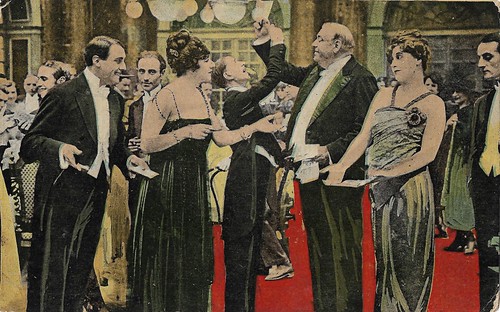
Diana D'Amore and Alberto Collo in Il potere sovrano (1916)
Spanish postcard by Chocolate Pi, Barcelona, no. 3. Photo: J. Verdaguer / Tiber Film. Diana d'Amore and Alberto Collo in Il potere sovrano (Baldassarre Negroni, Percy Nash, 1916).

Breaking the decorum


Il potere sovrano (Baldassarre Negroni, Percy Nash, 1916) takes place in a fictive Kingdom. Lotys (Hesperia) is the idol of the people. Therd (Emilio Ghione), a journalist, a man of action, and manager of the paper The Idea, is also beloved by his compatriots. Their ideals unite Lotys and Therd.

The King (Ignazio Lupi) lives distanced from his people and has left governing to his ministers. The government threatens Therd with arrest if he doesn't stop his actions. In the Royal Palace the crown prince (Alberto Collo) escapes monotony and etiquette by a secret affair with Gloria Ronsard (Diana d'Amore), The Queen (Floriana) knows about it but fears exposure and disgrace.

The people suffer from hunger, and Lotys decides to write to the King directly. Meanwhile, the Grand Chancellor (Alfonso Cassini), head of the government, raises import taxes and makes an agreement with a banker, Jost (Orlando), to fund military expenses. While the papers back the government, the King receives the letter that his government abuses his people and leaves them in hunger. He postpones his signature under the new arms law.

Incognito he visits a manifestation by Lotys and Therd and is so impressed by her speech he talks to her, but when the police arrive, he flees. The King is more and more impressed by Lotys and meets her more often, to the chagrin of Therd, who is secretly in love with her too. When the King hears about the secret deals between the banker and his Grand Chancellor, he is outraged. Lotys manages to obtain documents of the banker that will indicate the minister's corruption. In full uniform and before his whole government The King has the banker arrested.

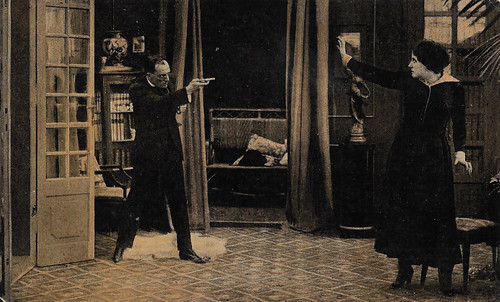
The people hear about the arrest. The King, eager to get closer to his people, decides to open the Palace of Fine Arts. Lotys is in the first row and cries out her love to him when he passes, breaking the decorum, and passing out. That night Therd sees the King leaving Lotys' house, and in a jealous fit, he demands Lotys to choose him instead. She refuses, so he shoots her. Her last words to the King are forgiving for Therd, claiming she committed suicide because of the impossible situation. The King spreads her ashes out into the sea.

Il potere sovrano was based on the novel 'Temporal Power: a Study in Supremacy' (1902) by Marie Corelli and scripted by the two directors. Cinematographers were Giorgio Ricci and Antonio Cufaro, sets were designed by Giulio Lombardozzi. The film got its censorship card on 17 October 1916, but premiered quite later, in Rome on 10 January 1917. The censor forbid to use the English title in Italy, but that title was still often used. Though the press was not in favour, audiences flocked to the cinemas to see the film.

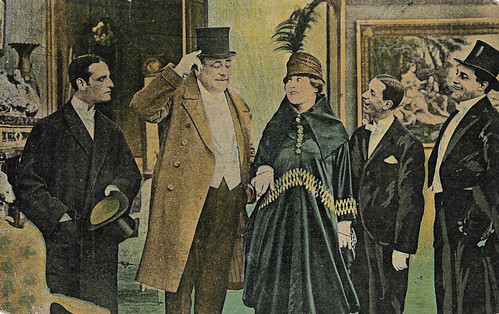
Ignazio Lupi and Alfonso Cassini in Il potere sovrano (1916)
Spanish postcard by Chocolate Pi, Barcelona, no. 4. Photo: J. Verdaguer / Tiber Film. Publicity still for Il potere sovrano (Baldassarre Negroni, Percy Nash, 1916). Ignazio Lupi as the King on the left and Alfonso Cassini as the Lord Chancellor on the right (the blond, elder man). The man in the middle may be Orlando (banker Jost).

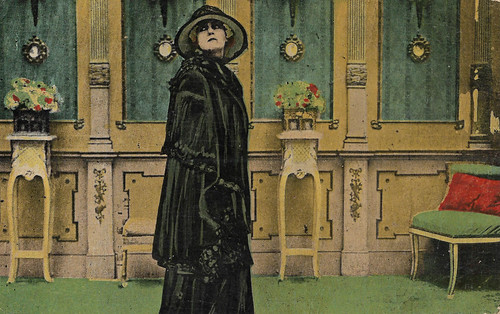
Hesperia in Il potere sovrano (1916)
Spanish postcard by Chocolate Pi, Barcelona, no. 5. Photo: J. Verdaguer / Tiber Film. Hesperia in Il potere sovrano (Baldassarre Negroni, Percy Nash, 1916).

Hesperia and Emilo Ghione in Il potere sovrano (1916)
Spanish postcard by Chocolate Pi, Barcelona, no. 6. Photo: J. Verdaguer / Tiber Film. Hesperia and Emilio Ghione in Il potere sovrano (Baldassarre Negroni, Percy Nash, 1916).

Sources: Sempre in penombra (Italian), IMDb and the collectors cards.

27 January 2020

Hesperia

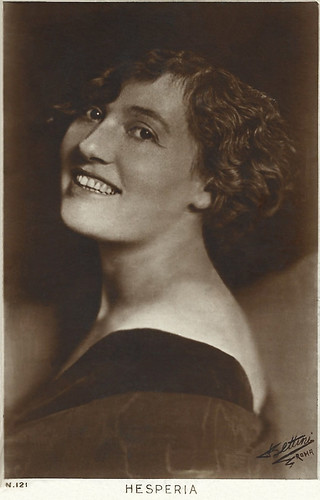
Hesperia (1885-1959), was one of the Italian divas of the silent screen. In her films, she could get into uncontrollable rages but also into wildly merry moods. Hesperia often worked with director Baldassarre Negroni, who later became her husband. In later life, the formerly 'dishonoured woman' whose family had once closed the door to her because of her vaudeville career, became a countess.

Hesperia
Italian postcard by Ed. A. Traldi, Roma. Photo: Pinto, Roma.

Hesperia
Romanian postcard by Edition S.A.R.P.I.C., Bucharest, no. 52.

Hesperia
Italian postcard by Ed. A. Traldi, Milano, no. 465.

Hesperia
Italian postcard by Ed. Fotocelere, Torino, no. 216.

Hesperia
Spanish postcard by Leonar.

Tableaux Vivants


Hesperia was born as Olga Mambelli in 1885 in Bertinora, Italy. Her niece was film actress Pauline Polaire, who also appeared in Italian silent films.

Hesperia started her career as a child actor at the Teatro Comunale, the local theatre in Meldola in the Italian Romagna, where she grew up.

Between 1910 and 1912 she had her breakthrough as vaudeville artist with tableaux vivants of sculptures and paintings, performing all around Italy. Her parents considered her hence a dishonoured woman and closed the door to her.

Baron Fassini of the Roman Cines film company saw a future star in this quite matron like woman. He put her into films, first in two- and three-reelers, often paired with Ignazio Lupi.

Among these early films were silent shorts like Quando la donna vuole.../When the woman wants ... (N.N., 1912), Altruismo/Altruism (N.N., 1912), and La madre/The Mother (Baldassarre Negroni, 1913) with Leda Gys. Hesperia proved to be as well a good dramatic actress as a comedienne.

Hesperia
Possibly a Turkish or Egyptian postcard. Hesperia as Casque d'Or in Anime buie (Emilio Ghione, 1916). See also Silents please.

Hesperia in L'aigrette
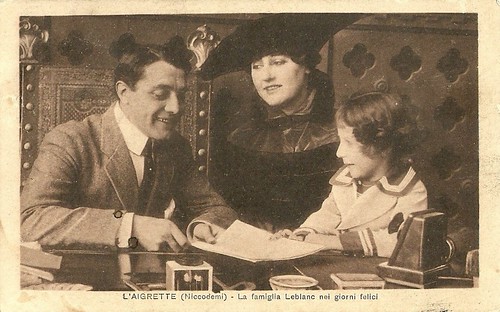
Italian postcard by IPA CT Duplex, no. 5105. Photo: Tiber Film, Roma. Hesperia and Ida Carloni Talli in L'aigrette (Baldassarre Negroni, 1917). This was an adaptation of a play by Dario Niccodemi. The countess of Saint-Servant (Ida Carolini Talli) has raised her son Enrico (Tullio Carminati) to be proud of his name and title, and to cherish honour and virtue, symbolised by the feather of her aigrette. In reality the countess is hunted by creditors, the castle is falling apart. Enrico falls in love with Susanne Leblanc (Hesperia), wife of banker, and in return she loads him with money in order to restore the castle. Her husband (André Habay) is not so happy with this kind of charity...

Hesperia and André Habay in L'aigrette
Italian postcard by IPA CT Duplex, no. 5107. Photo: Tiber Film, Roma. Hesperia and André Habay in L'aigrette (Baldassarre Negroni, 1917). Caption: 'The Leblanc family in happier days.'
Hesperia in La cuccagna
Italian postcard by Tiber Film, Roma, no. 5071. Photo: IPA CT Duplex.
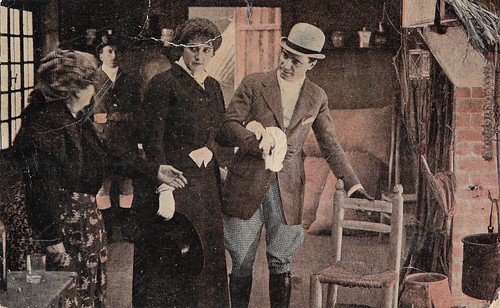
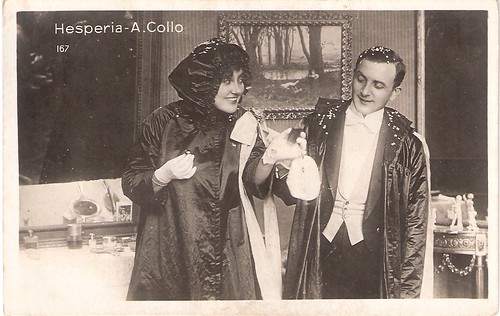
Saccard (Claudio Nicola) surprises Renée (Hesperia) and Max (Alberto Collo) in La cuccagna (Baldassarre Negroni, 1917). The film was an adaptation of Emile Zola's 'La curée' (The Kill). Hesperia is Renata/Renée, second wife of the cunning and wealthy Saccard, who married young Renata for her money. She has an affair with Saccard's son Max, played by Collo. In the end money triumphs instead of love, just as in Zola's novel. On this postcard the father (left) looks not much older than the son (right).

Hesperia
Italian postcard by Ed. Vettori, Bologna, no. 167.  Hesperia and Alberto Collo in La cuccagna (Baldassarre Negroni, 1917). In the end, money triumphs instead of love, just as in Emile Zola's novel, 'La curée'. That's why some Italian critics thought the film title La cuccagna (Abundance) was too cheerful, while 'La curée' literally means 'The Loot' and the official English title of the novel is 'The Kill'.

Incontrollable Rages


In 1914, Hesperia switched to Milano-Films, with her future husband, film director Baldassarre Negroni. He had already been directing her at Cines. For a while he was also the artistic director at Milano.

Among their films for Milano were L'ultima battaglia/The Last Battle (Baldassarre Negroni, 1914) with Livio Pavanelli, Vizio atavico/Atavistic Vice (Baldassarre Negroni, 1914) starring Mercedes Brignone, and Nel nido straniero/Stranger in the nest (Baldassarre Negroni, 1914).

In 1915, when Italy joined the Allies in the First World War and Milano had to stop producing, Negroni took Hesperia with him to the Tiber Film company in Rome, where Francesca Bertini just had left for the Caesar company.

A strong competition between the two leading ladies started, exploiting both the typical diva repertory of boulevard drama, leading to simultaneous adaptations of Alexandre Dumas fils' 'La dame aux camélias' in 1915. While Bertini remained more solemn, Hesperia could get into uncontrollable rages but also wildly merry moods.

The following years, Hesperia appeared at Tiber-Film in such films as Marcella (Baldassarre Negroni, 1915) based on a play by Victorien Sardou, La morsa/The Vice (Emilio Ghione, 1916) and La donna di cuori/The queen of hearts (Baldassarre Negroni, 1917) wih Tullio Carminati.

Between 1912 and 1923, the year she married count Negroni and withdrew from film business, Hesperia made some 70 films, mostly impeccable and often popular bourgeois dramas and comedies.

Even later films such as Il figlio di Madame Sans-Gêne/The son of Madame Sans-Gêne (Baldassarre Negroni, 1921) with her niece Pauline Polaire knew to draw crowds in Italy.

In 1938, the by now countess Olga Negroni had a small reappearance on Italian screens in the film Orgoglio/Pride, (Marco Elter, 1938) starring Fosco Giachetti and shot at the Cinecittà film studios.

In 1959, Hesperia passed away in Rome, Italy. The countess was 73.

Hesperia and André Habay in La principessa di Bagdad (1918)
Spanish postcard. Hesperia and André Habay in La principessa di Bagdad/The Princess of Bagdad (Baldassarre Negroni, 1918).

Hesperia in La principessa di Bagdad (1918)
Spanish collectors card in the Colec. cromos cinematográficos by Chocolat Imperiale, no. 5 (in a serie of 6 cromos). Photo: Tiber-Film, Roma / J. Verdaguer, Barcelona. Hesperia in La principessa di Bagdad/The Princess of Bagdad (Baldassarre Negroni, 1918).

Hesperia in Vertigine (1919)
Spanish collectors card the Colec. cromos cinematográficos by Chocolat Imperial, Series of 6 'cromos', no. 1. Photo: Grandes Exclusivas Verdaguer / FAI. Hesperia and Giovanni Schettini (the man at left) in El Vertigo, Spanish title for the Italian silent drama Vertigine/Vertigo (Baldassarre Negroni, 1919). Unknown is who the man at right is.

Hesperia and Tullio Carminati in Vertigine (1919)
Spanish collectors card the Colec. cromos cinematográficos by Chocolat Imperial, Series of 6 'cromos', no. 5. Photo: Grandes Exclusivas Verdaguer / FAI. Hesperia and Tullio Carminati in Vertigine/Vertigo (Baldassarre Negroni, 1919).

Il figlio di Madame Sans-Gêne (1921)
French postcard by Le Deley, Paris. Photo: U.C.I. / Gaumont / Tiber Film. Publicity still for the Italian silent film Il figlio di Madame Sans-Gêne (Baldassarre Negroni, 1921). Adapted from the novel by Emile Moreau. The women here may be Hesperia and Pauline Polaire (Mme Ambzac).

Hesperia in La belle Madame Hebert (1922)
Italian postcard. Photo: Tiber Film. Hesperia and probably Carlo Troisi in La belle Madame Hebert (Baldassarre Negroni, 1922). The film was an adaptation of the homonymous French play by Abel Hermant.

Hesperia
Italian postcard by Ed. G. Vettori, Bologna.

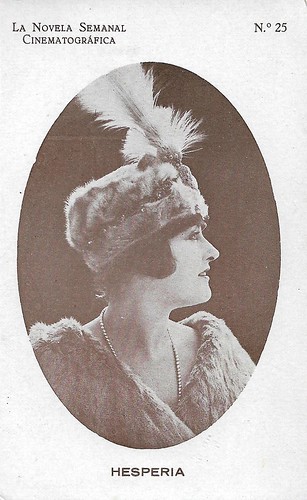
Hesperia,
Spanish postcard by La novela semanal cinematografica, no. 25.

Hesperia
Italian postcard by Ed. A. Traldi, Milano, no. 581.

Hesperia
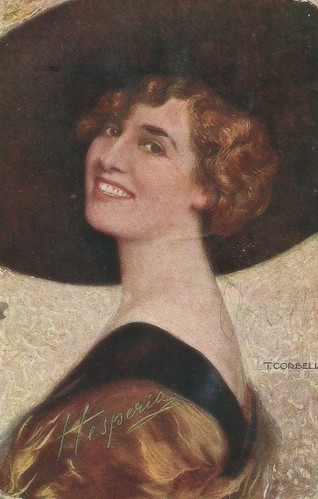
Italian postcard by Uff. Rev. Stampa, Milano, no. 229, 2-4-1917. Hesperia by Tito Corbella.

Source: Vittorio Martinelli, Le dive del silenzio; Tonino Simoncelli, Hesperia, stella del varietà e diva del muto (in Griffithiana, Issues 55-56), and IMDb.

17 December 2019

Vertigine (1919)

Hesperia, Tullio Carminati and Ida Carloni Talli were the stars of the Italian silent drama Vertigine/Vertigo love (Baldassarre Negroni, 1919), produced by Film d'Arte Italiana (FAI). In Spain the film was distributed as El Vertigo and Chocolat Imperial published a series of six coloured 'cromos' of the film.

Hesperia in Vertigine (1919)
Spanish collectors card by Chocolat Imperial, Grandes Exclusivas Verdaguer, no. 1 (in a series of 6 'cromos'). Photo: FAI. Hesperia in Vertigine (Baldassarre Negroni, 1919). Unknown is who the two men are.

Hesperia, Giovanni Schettini and Tullio Carminati in Vertigine (1919)
Spanish collectors card by Chocolat Imperial, Grandes Exclusivas Verdaguer, no. 2 (in a series of 6 'cromos'). Photo: FAI. Giovanni Schettini, Hesperia and Tullio Carminati in Vertigine (Baldassarre Negroni, 1919).

Hesperia and Tullio Carminati in Vertigine (1919)
Spanish collectors card by Chocolat Imperial, Grandes Exclusivas Verdaguer, no. 3 (in a series of 6 'cromos'). Photo: FAI. Tullio Carminati and Hesperia in Vertigine (Baldassarre Negroni, 1919).

Two men who marked her rise and fall


None of our sources describes the plot of Vertigine/Vertigo love (Baldassarre Negroni, 1919), but happily the plot is described on the back of the Spanish collectors cards. We translated the Spanish texts for this post.

A party takes place at the Royal Palace in Birlandia, when the Prince Regent substitutes the Royal couple Marisa and Carlos de Seydoon who are dethroned. Carlos is killed by counter-revolutionaries, while Marisa, chased from the court, leads a life as countess Marisa de Seydoon (Hesperia).

She goes to Rome by train, by chance in the same compartment as count Enzo (Tullio Carminati) who is unaware of her beauties, so she uses all her assets to seduce him. They get acquainted at the dinner wagon and because of trouble with the train, they share the same hotel.

They make several excursions together during which their love blossoms. They meet on old study friend of Enzo, Fausto Ursini (Giovanni Schettini). Ursini visits Enzo because he needs money as creditors want to take away the estate so dear to his mother (Ida Carloni Talli). Touched, Enzo helps him and buys the estate.

Marisa passes wonderful days at the estate, while both she and Fausto's mother don't know it is by now Enzo's property. While Enzo is away, and the summer blossoms drug Fausto and Marisa, the two young people fall in love, even if Marisa keeps her distance. When Enzo returns, Marisa is afraid he may find out and accuses Fausto of ingratitude towards Enzo.

Fausto's mother suspects something is going on, but also Enzo notices Marisa is not herself. She finally admits Fausto has declared her his love. Enzo, blind of rage, reacts to Fausto, who admits his guilt and offers his life. Enzo instead forces Fausto to reveal his mother the truth. Fausto cannot cope with so much disgrace to his mother, so he commits suicide.

Enzo, realising that his woman will now forever doubt him, disappears. Marisa, who before felt the weight of her crown, now left by Enzo, retires to a lonely villa, to mourn over her tragic fate and the loss of both men who marked her rise and fall.

The female star of the film, Hesperia, was one of the Italian divas of the silent screen. She often worked with director Baldassarre Negroni, who also became her husband.

At the time, Giuseppe Lega, in the magazine Apollon, thought Vertigine/Vertigo love (Baldassarre Negroni, 1919) was a rather old-fashioned drama. He called it below the level of the talent of the young scriptwriter Luciano Doria, who adapted his own novel in cooperation with director Baldassarre Negroni. Hesperia made the most of it, Tullio Carminati could have been better, while best was Ida Carloni Talli.

Hesperia, Tullio Carminati and Giovanni Schettini  in Vertigine (1919)
Spanish collectors card by Chocolat Imperial, Grandes Exclusivas Verdaguer, no. 4 (in a series of 6 'cromos'). Photo: FAI. Giovanni Schettini, Tullio Carminati and Hesperia in Vertigine (Baldassarre Negroni, 1919).

Hesperia and Tullio Carminati in Vertigine (1919)
Spanish collectors card by Chocolat Imperial, Grandes Exclusivas Verdaguer, no. 5 (in a series of 6 'cromos'). Photo: FAI. Hesperia and Tullio Carminati in Vertigine (Baldassarre Negroni, 1919).

Ida Carloni Talli and Giovanni Schettini in Vertigine (1919)
Spanish collectors card by Chocolat Imperial, Grandes Exclusivas Verdaguer, no. 6 (in a series of 6 'cromos'). Photo: FAI. Ida Carloni Talli and Giovanni Schettini in Vertigine (Baldassarre Negroni, 1919).

Sources: Vittorio Martinelli (Il cinema muto italiano: I film del dopoguerra, 1919 - Italian), icff.co.uk and IMDb.

09 November 2016

Il figlio di Madame Sans-Gêne (1921)

The Italian silent film Il figlio di Madame Sans-Gêne/The Son of Madame Sans-Gêne (Baldassarre Negroni, 1921) was based on the novel by Emile Moreau. Madame Sans-Gêne was played by the Italian diva Hesperia.

Il figlio di Madame Sans-Gêne (1921)
French postcard by Le Deley, Paris. Photo: U.C.I. / Gaumont / Tiber Film. Publicity still for Il figlio di Madame Sans-Gêne (Baldassarre Negroni, 1921), with Hesperia and Pauline Polaire.

Il figlio di Madame Sans-Gêne (1921)
French postcard by Le Deley, Paris. Photo: U.C.I. / Gaumont / Tiber Film. Publicity still for Il figlio di Madame Sans-Gêne (Baldassarre Negroni, 1921), with Enrico Scatizzi and Carlo Troisi.

Madame Sans-Gêne


In Il figlio di Madame Sans-Gêne/The Son of Madame Sans-Gêne, sergeant Lefèvre (Enrico Scatizzi) meets an ironing lady (Hesperia) at a 'bal populaire' during the celebrations of the first successes of the French Revolution. They marry and have a son, Antonio. Lefèvre proves himself on the European battlefields and he becomes Marshal and Duke of Danzig. His wife becomes Madame Sans-Gêne, Duchess of Danzig.

When Antonio (Carlo Troisi) has grown up, he falls in love with a young noble lady (Pauline Polaire), but she is already promised to the seigneur Ambzac, a Royalist conspirator. When the girl marries D'Ambzac, Antonio decides to flee with her, and steals money from his father. When the theft is found out, Antonio asks to be sent to the battle front as punishment. There he is charged to ask for reinforcements, but during his travels he meets D'Ambzac again His wife has returned to him, and Antonio forgets his mission.

Condemned to death for high treason, it is his father who signs his death warrant. He brings a gun to his son in prison to spare him the shame of the execution, but finds his wife in the cell instead, who has traded places with her son. During his flight Antonio discovers an enemy plan and informs the command. When at the end of the day victory is celebrated, the parents find their son dying. He dies in his mother's arms, while the Emperor Napoleon decorates him with the Legion of Honour.

Il figlio di Madame Sans-Gêne, produced by Tiber-film, had its Roman premiere on 12 December 1921. The film was praised in the Italian press. The Cine-Fono journal thought the film well respected history and expressed the right emotions, without too much artifice. The film had sets by renowned artist Camillo Innocenti.

But the film was particularly praised for its acting. La vita cinematografica thought the story old-style romantic, but direction and performance of Scatizzi, Hesperia and Troisi were well above the average and lifted the story to a new level. Hesperia had appeared since 1912 in Italian films and had made some very popular films. The diva was married to the director of her film, Baldassarre Negroni.

Il figlio di Madame Sans-Gêne (1921)
French postcard by Le Deley, Paris. Photo: U.C.I. / Gaumont / Tiber Film. Publicity still for Il figlio di Madame Sans-Gêne (Baldassarre Negroni, 1921). Here Hesperia as Madame Sans-Gêne is portrayed similarly to François Gérard's portrait of Juliette Récamier.

Il figlio di Madame Sans-Gêne (1921)
French postcard by Le Deley, Paris. Photo: U.C.I. / Gaumont / Tiber Film. Publicity still for Il figlio di Madame Sans-Gêne (Baldassarre Negroni, 1921), with Hesperia as the woman dressed as soldier in the middle.

Source: Vittorio Martinelli (Il cinema muto italiano, 1921-1922 - Italian), Wikipedia and IMDb.

24 May 2015

L'aigrette (1917)

L'aigrette/The egret (1917) is a silent Italian film by Baldassare Negroni. The film, produced by Tiber Film in Rome, was an adaptation by Negroni of a stage play by Dario Niccodemi. Stars were Hesperia, Tullio Carminati and André Habay.

Tullio Carminati and Ida Carloni Talli in L'aigrette
Italian postcard by IPA CT Duplex, no. 5103. Photo: Tiber Film, Roma. Tullio Carminati and Ida Carloni Talli in L'aigrette (Baldassarre Negroni, 1917). Caption: The lady of the egret.

Tullio Carminati and Ida Carloni Talli in L'aigrette
Italian postcard by IPA CT Duplex, no. 5104. Photo: Tiber Film. Tullio Carminati and Ida Carloni-Talli in L'aigrette (Baldassarre Negroni, 1917). Caption: The pardon.

Hesperia in L'aigrette
Italian postcard by IPA CT Duplex, no. 5105. Photo: Tiber Film, Roma. Hesperia (at right) and Ida Carloni Talli in L'aigrette (Baldassarre Negroni, 1917). Caption: The vile market of the Countess of Saint-Servant.

Cherishing Honour and Virtue


The countess of Saint-Servant (Ida Carloni Talli) has raised her son Enrico (Tullio Carminati) to be proud of his name and title and to cherish honour and virtue, symbolised by the feather of her aigrette (egret). In reality, the countess is hunted by creditors, the castle is falling apart.

Enrico falls in love with Susanne Leblanc (Hesperia), wife of a banker, and, unknowing to Enrico, in return, she loads his mother with money in order to restore the family castle and pay off the many debts.

Her husband Claudio (André Habay) is not so happy with this kind of charity and reveals to Enrico that he and his mother have been living on his lover's expenses for years. Enrico is devastated, as his image of his mother and his lover collapses.

It's not entirely clear how the film proceeds, but Dario Niccodemi's play tells Enrico has a fatal confrontation with his mother about the lies and gifts, but she answers she did all this for him only.

Finally, Susanna succeeds in preventing Enrico to kill himself and to come to his senses. He will flee with her, and start a life of working.

Ida Carloni Talli in L'aigrette (1917)
Italian postcard by IPA CT Duplex, no. 5106. Photo: Tiber Film. Ida Carloni Talli in L'aigrette (Baldassarre Negroni, 1917). Caption: The Countess of Saint-Servant in the grip of her creditors.

Hesperia and André Habay in L'aigrette
Italian postcard by IPA CT Duplex, no. 5107. Photo: Tiber Film, Roma. André Habay and Hesperia in L'aigrette (Baldassarre Negroni, 1917). Caption: The Leblanc family in happier days.

Hesperia, Carminati and Habay in L'aigrette
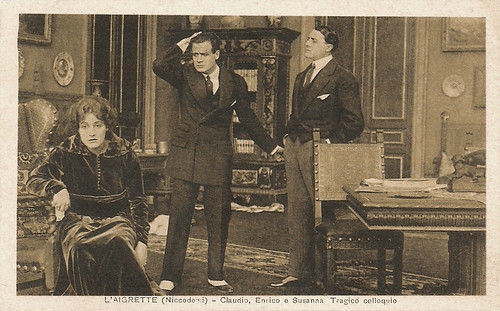
Italian postcard by IPA CT Duplex, no. 5108. Photo: Tiber Film. Hesperia, Tullio Carminati and André Habay in L'aigrette (Baldassarre Negroni, 1917). Caption: Claudio, Enrico, and Susanna. Tragic conversation.

A Wonderful Cast


L'aigrette was written as a comedy in three acts in 1912 and had been the first play by Dario Niccodemi. His comedies represent the bourgeois drama in an ironic and sentimental way, in which his characters are modeled on the society of the beginning of the century.

Niccodemi wrote several plays and screenplays. Films based on his work include L'ombra/The shadow (Mario Caserini, 1917) with Vittoria Lepanto, La nemica/The enemy (Ivo Ulliminati, 1917) and Scampolo, filmed in 1917 with Margot Pellegrinetti, in 1928 with Carmen Boni, in 1932 with Dolly Haas, in 1941 with Lilia Silvi, and in 1958 with Romy Schneider.

L'aigrette has a wonderful cast with stars of the silent Italian cinema, like Tullio Carminati, André Habay, Diomira Jacobini, Ida Carloni Talli, and of course in the leading role Hesperia.

Tullio Carminati (1895-1971) had a long-standing career from the 1910s to the 1960s. He played in Italian, German, American, British, and French films as well as on Italian, American and British stages.

André Habay (1883-1941) aka Andrea Habay (also written as Habaj or Kabaj) acted in modern dramas and in diva films such as Sangue blu/Blue Blood (Nino Oxilia, 1914) and Rapsodia satanica/Satan's Rhapsody (Nino Oxilia, 1917). Later, he also starred as Petronius in the epic Quo vadis? (Gabriellino D'Annunzio, Georg Jacoby, 1925).

Ida Carloni Talli (1860-1940) was a well-known Italian stage actress, who also acted in 92 Italian silent films. And Hesperia (1885-1959), was one of the greatest divas of the Italian silent screen. She often worked with director Baldassarre Negroni, who later became her husband.

André Habay in L'aigrette (1917)
Italian postcard by IPA CT Duplex, no. 5109. Photo: Tiber Film. André Habay in L'aigrette (Baldassarre Negroni, 1917) Caption: Claudio doing business at the stock exchange.

Hesperia in L'aigrette (1917)
Italian postcard by IPA CT Duplex, no. 5110. Photo: Tiber Film. Hesperia, Ida Carloni Talli, and probably Diomira Jacobini in L'aigrette (Baldassarre Negroni, 1917). Caption: The countess of Saint-Servant (Talli) presents Susanna (Hesperia) the young duchess of Frontenac (Jacobini).

Tullio Carminati and Diomira Jacobini in L'aigrette (1917)
Italian postcard by IPA CT Duplex, no. 5111. Photo: Tiber Film. Tullio Carminati and probably Diomira Jacobini in L'aigrette (Baldassarre Negroni, 1917). Caption: Enrico and his fiancee, the duchess of Frontenac.

Sources: Dario Niccodemi (L'aigrette - Italian),  Vittorio Martinelli (Il Cinema Muto Italiano, vol. 1917),  Wikipedia (Italian) and IMDb.

This post was last updated on 16 May 2020.

31 January 2015

La Cuccagna (1917)

The Italian diva Hesperia was the star of the silent drama La Cuccagna/The Bonanza (Baldassarre Negroni, 1917). The film was an adaptation of Emile Zola's La curée. Hesperia is Renata/Renée, second wife of the cunning and wealthy Saccard, who married young Renata for her money. She has an affair with Saccard's son Max, played by Alberto Collo. In the end money triumphs over love, just as in Zola's novel.

La Cuccagna
Italian postcard by IPA CT. V. Uff. Rev. St. Terni, no. 5070. Photo: Tiber Film. Caption: "Renata and Massimo love each other." Postcard for La Cuccagna (Baldassarre Negroni, 1917), starring Hesperia and Alberto Collo.

Hesperia in La cuccagna
Italian postcard by IPA CT V. Uff. Rev. St. Terni, no. 5071. Photo: Tiber Film. Caption: "Saccard surprises Renata and Max Postcard for La Cuccagna (Baldassarre Negroni, 1917). On this postcard the father (Claudio Nicola at left) looks not much older than the son (Alberto Collo at right).

La Cuccagna
Italian postcard by IPA CT. V. Uff. Rev. St. Terni, no. 5072. Photo: Tiber Film. Caption: "Massimo and Luisa are betrothed. The jealousy of Renata." Postcard for La Cuccagna (Baldassarre Negroni, 1917), starring Hesperia.

La Cuccagna
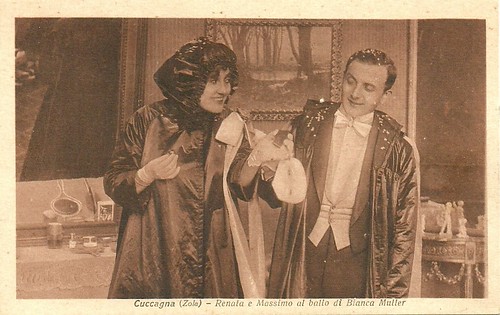
Italian postcard by IPA CT. V. Uff. Rev. St. Terni, no. 5073. Photo: Tiber Film. Caption: "Renata and Massimo at the ball of Bianca Muller." Postcard for La Cuccagna (Baldassarre Negroni, 1917), starring Hesperia and Alberto Collo.

La Cuccagna
Italian postcard by IPA CT. V. Uff. Rev. St. Terni, no. 5074. Photo: Tiber Film. Caption: "Saccard cannot pay the bills of his wife anymore." Postcard for La Cuccagna (Baldassarre Negroni, 1917), starring Hesperia and Claudio Nicola.

Money triumphs over Love


Hesperia (1885-1959), was one of the divas of the Italian silent screen. She often worked with director Baldassarre Negroni, who later became her husband.

La Cuccagna was a liberal adaptation of Emile Zola's La curée, cutting Zola's socialist critique on bourgeois building speculation and nouveau riche under the Second Empire, and keeping the Phaedra-like, private intrigue of a triangular affair.

Hesperia is Renata/Renée, second wife of the cunning and wealthy Saccard (Claudio Nicola), originally Aristide Rougon, who married young Renata for her money, with Saccard's sister Sidonie as intermediate.

Years after, his son from his first marriage, Max/Massimo (Alberto Collo), develops an affair with his stepmother Renata - an affair which Saccard initially tolerates in exchange for Renata's inheritance. They claim to have an open marriage.

In the end money triumphs instead of love, just as in Zola's novel. Massimo is married to young Luisa (Diana d'Amore), the daughter of rich banker Mareuil (Ignazio Lupi), when Saccard claims he cannot pay Renata's bills anymore.

Renata is so shocked Massimo leaves her for wealth and youth she first maddens, then develops meningitis and dies.

La Cuccagna
Italian postcard by IPA CT. V. Uff. Rev. St. Terni, no. 5076. Photo: Tiber Film. Caption: "Massimo had been raised in a provincial college." Postcard for La Cuccagna (Baldassarre Negroni, 1917), starring Hesperia, Alberto Collo and Claudio Nicola.

La Cuccagna
Italian postcard by IPA CT. V. Uff. Rev. St. Terni, no. 5077. Photo: Tiber Film. Caption: "Renata had turned Massimo in un 'viveur'." Postcard for La Cuccagna (Baldassarre Negroni, 1917), starring Claudio Nicola, Hesperia and Alberto Colla.

Ida Carloni Talli in La cuccagna
Italian postcard by IPA CT. V. Uff. Rev. St. Terni, no. 5078. Photo: Tiber Film. Caption: "Sidonia hosted meetings between her female and her male customers." Postcard for La Cuccagna (Baldassarre Negroni, 1917), starring Hesperia and Ida Carloni Talli as Sidonia.

La Cuccagna
Italian postcard by IPA CT. V. Uff. Rev. St. Terni, no. 5079. Photo: Tiber Film. Caption: "Renata and Massimo agree to elope." Postcard for La Cuccagna (Baldassarre Negroni, 1917), starring Hesperia and Alberto Collo.

La Cuccagna
Italian postcard by IPA CT. V. Uff. Rev. St. Terni, no. 5080. Photo: Tiber Film. Caption: "The nocturnal meetings of Massimo and Renata." Postcard for La Cuccagna (Baldassarre Negroni, 1917), starring Hesperia and Alberto Collo.

How true are her heartbeats


In the Italian film journal La vita cinematografica (22/28.2.1917), Pier da Castello regretted the loss of the social critique but praised Hesperia's performance:

"How naively she smiles, how heartily she laughs, how she knows to be tender, languid and mischievous!

How true are her heartbeats and her worries, how pathetic are her despairs, how sad and bitter her tears.

How true and human is her desperate rage! Hesperia does not act. She lives her part, defies every confrontation and surpasses any expectation.

Whoever sees her in La cuccagna must connect her with the female sovereigns of the gesture, among the silent actresses who unsurpassable know to express any emotion."

La Cuccagna
Italian postcard by IPA CT. V. Uff. Rev. St. Terni, no. 5081. Photo: Tiber Film. Caption: "Renata has heard about the wedding between Massimo and Luisa." Postcard for La Cuccagna (Baldassarre Negroni, 1917), starring Hesperia and Alberto Colla.

La Cuccagna
Italian postcard by IPA CT. V. Uff. Rev. St. Terni, no. 5082. Photo: Tiber Film. Caption: "At the Half Lent ball. All is lost for Renata." Postcard for La Cuccagna (Baldassarre Negroni, 1917), starring Hesperia.

Source: Vittorio Martinelli (Il Cinema Muto Italiano - Italian) and IMDb.