Showing posts with label Esther de Boer-van Rijk. Show all posts

30 September 2018

Esther de Boer-van Rijk

Esther de Boer-van Rijk (1853-1937) was the most popular Dutch actress ever. She was a national icon as the tragic fisherwoman Kniertje in the stage classic 'Op hoop van zegen' (The Good Hope) by Herman Heijermans and played the role again in both a silent (1918) and a sound film version (1934). She also appeared in a dozen other Dutch silent films.

Esther de Boer van Rijk in Op Hoop van Zegen
DDutch postcard by M.B. & Z. Photo: Maarseveen, Den Haag / M.H.D. Film. Esther de Boer van Rijk in Op hoop van zegen/The Good Hope (Alex Benno, 1934).

Ultramodern pieces


Esther van Rijk was born in Rotterdam, The Netherlands in 1853. She was the daughter of administrator Moses van Rijk and seamstress Adriana Wolfhart.

Esther was the fourteenth and youngest child in a simple Jewish Orthodox family. From an early age, the stage attracted her, against the wishes of her parents.

In 1874, she played her first role as a professional actress as Laura in 'Emma Berthold' by J.J. Cremer. In 1881, she married the musician Henri de Boer, with whom she had a child, Sophie de Vries-de Boer. A year later the family moved to Amsterdam.

After several years of farces and vaudeville, she developed into an actress specialising in avant-garde theatre pieces by authors like Henrik Ibsen, August Strindberg and Emile Zola. These were for that time ultramodern pieces about everyday reality, in which actors had to play as faithfully as possible.

From 1893, she worked for the Nederlandsche Toneel Vereeniging (The Dutch Theatre Association) under director Louis Chrispijn and later she worked for its successor, De Toneelvereeniging (The Theatre Association).

Esther de Boer van Rijk
Dutch postcard by Weenenk & Snel, Den Haag. Photo: Willem Coret.

Esther de Boer van Rijk
Dutch postcard by Foto-Industrie De Voorkeur, Amsterdam. Photo: Leenheer. Inscription by author Herman Heijermans.

Poverty and honour


With her natural acting style, Esther de Boer-van Rijk became the key feature of the social-conscious stage work by Herman Heijermans. Her first roles in his plays were Ester in 'Ghetto' (1898) and Engel in 'Het Zevende Gebod' (The Seventh Commandment) (1899).

In 1900 followed the highlight of her career, as the fisherman’s widow Kniertje in 'Op hoop van Zegen' (The Good Hope) (1900), a role she played 1200 times. Driven by poverty and honour, Kniertje sends the last of her kin to sea. Her two sons will work on the ship Op hoop van zegen. Unknown to them, the ship is falling apart at the seams and rotting to boot, so the greedy owner Bos has gotten it heavily insured.

Later, De Boer-van Rijk was also featured in the film versions of 1918 and 1934. Other roles in Heijermans plays included Annemie the maid in 'De Meid' (The Maid) (1908), Mother Schulz in 'Glück Auf, spel van de mijnen' (Glück Auf, play of the mines) (1911), and Eva in 'Eva Bonheur' (1917).

Heijermans did not admire her work unconditionally: "The great artiste is great in the petty-bourgeois environment, into the atmosphere that I loved. She is more or less deficit in the romantic and classical repertoire or in the salon pieces”, he wrote in 1916.
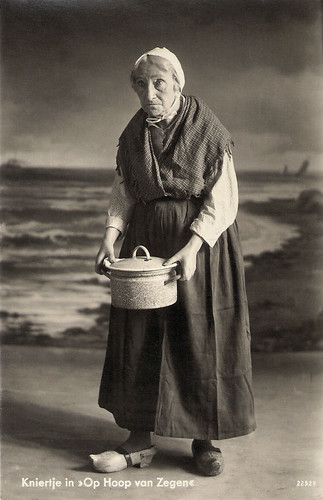
Esther de Boer-van Rijk in Op Hoop van Zegen
Dutch postcard by Foto-Industrie De Voorkeur, Amsterdam, no 22927. Photo: Leenheer. Esther de Boer-van Rijk in her Kniertje costume.

Esther de Boer-van Rijk in Op Hoop van Zegen (1934)
Dutch postcard by M.B. & Z. Photo: Maarseveen, Den Haag / M.H.D. Film. Esther de Boer-van Rijk in Op hoop van zegen/The Good Hope (Alex Benno, 1934).

Socially conscious drama


After the dissolution of De Toneelvereeniging in 1924, Esther de Boer-van Rijk founded the Gezelschap Esther de Boer-van Rijk (Company Esther de Boer-van Rijk) and in 1933 the De Boer-van Rijk ensemble. But she also played in all the major companies of its time, even abroad. In a London performance as Kniertje she made a big impression, although she played the role (in an entirely English-speaking cast) in Dutch.

Her popularity was enormous, partly because her performance had contributed to the elimination of wrongs for which Heijermans in his socially conscious drama had raised the issue.

She also appeared in several Dutch silent films. In 1913, she made her film debut in the sea drama De Bertha/The Bertha (Louis H. Chrispijn Senior, 1913) with Annie Bos.

The next year, she appeared in Een telegram uit Mexico/A Telegram from Mexico (Louis H. Chrispijn Senior, 1914) about a Dutch colonist who gets caught up in the Mexican revolution. It was produced by Hollandia Filmfabriek, the main Dutch silent film studio.

Other Hollandia productions were Gebroken levens /Broken Lives (Louis H. Chrispijn Senior, 1914), De vrouw Clasina/The Woman Clasina (Maurits Binger, 1915) and Het geheim van den vuurtoren/The Secret of the Lighthouse (Maurits Binger, 1915) in which she played the mother of smuggler Alex Benno.
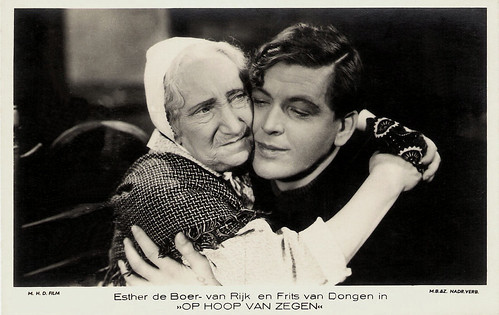
Esther de Boer-van Rijk and Frits van Dongen in Op Hoop van Zegen (1934)
Dutch postcard by M.B. & Z. Photo: Maarseveen, Den Haag / M.H.D. Film. Publicity still for Op hoop van zegen/The Good Hope (Alex Benno, 1934) with Frits van Dongen.
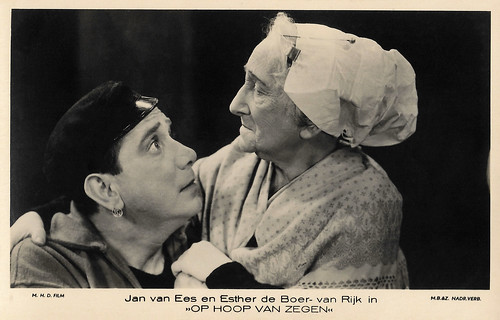
Jan van Ees and Esther de Boer-van Rijk in Op hoop van Zegen (1934)
Dutch postcard by M.B. & Z. (M. Bonnist & Zonen, Amsterdam). Photo: Dick van Maarseveen, Den Haag / M.H.D. Film. Publicity still for Op Hoop van Zegen (1934, Alex Benno, Louis Saalborn) with Jan van Ees. Collection Geoffrey Donaldson Institute.

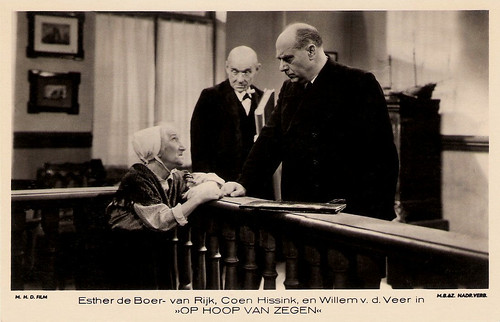
Esther de Boer-van Rijk and Coen Hissink in Op hoop van zegen (1934)
Dutch postcard by M.B. & Z. Photo: Maarseveen, Den Haag / M.H.D. Film. Esther de Boer-van Rijk and Coen Hissink in Op hoop van zegen/The Good Hope (Alex Benno, 1934).

The Good Hope


Esther de Boer-van Rijk also worked for other studios, such as Rembrandt Film in the family drama Diamant/Diamond (Johan Gildemeijer, 1916) as the wife of Louis Bouwmeester. Then followed the first film version of Op hoop van zegen/The Good Hope (Maurits Binger, 1918) with Annie Bos and Jan van Dommelen. Only a part of this film is known to exist.

Her later silent films include Cirque Hollandais/Circus Hollandais (Theo Frenkel Senior, 1924) with Louis Bouwmeester and De cabaret-prinses/The Cabaret Princess (Theo Frenkel Senior, 1925).

Her final film and her only sound production was the second version of Op hoop van zegen/The Good Hope (1934), directed by Alex Benno. The film, co-starring Frits van Dongen and Jan van Ees as her sons, became one of the most successful productions of Dutch pre-war cinema.

Chip Douglas at IMDb: “Esther de Boer van Rijk carries the picture as Kniertje and gives a moving performance. It's a good thing she got the chance to be seen and heard on film so her iconic portrayal has been preserved (and luckily, it has).” Her autobiography 'Ik kijk terug. Episodes uit mijn leven' (I look back. Episodes of my life) appeared also in 1934.

Esther de Boer-van Rijk died in 1937 in Amsterdam. She was 84.

Esther de Boer-van Rijk in Op Hoop van Zegen (1934)
Dutch postcard by M.B. & Z. (M. Bonnist & Zonen, Amsterdam). Photo: Dick van Maarseveen, Den Haag / M.H.D. Film. Publicity still for Op Hoop van Zegen/The Good Hope (Alex Benno, Louis Saalborn, 1934) with Aaf Bouber.

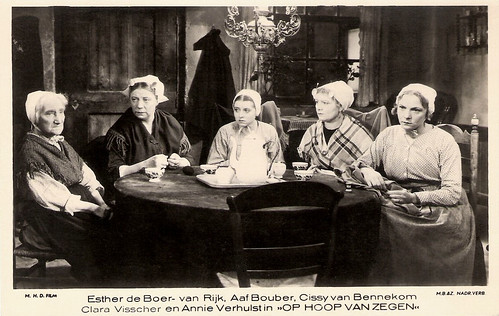
Esther de Boer van Rijk, Aaf Bouber, Cissy van Bennekom, Clara Visscher, and Annie Verhulst, in Op Hoop van Zegen
Dutch postcard by M.B. & Z. (M. Bonnist & Zonen, Amsterdam). Photo: Dick van Maarseveen, Den Haag / M.H.D. Film. PAaf Bouber, Cissy van Bennekom, Clara Visscher and Annie Verhulst in Op Hoop van Zegen (Alex Benno, Louis Saalborn, 1934).

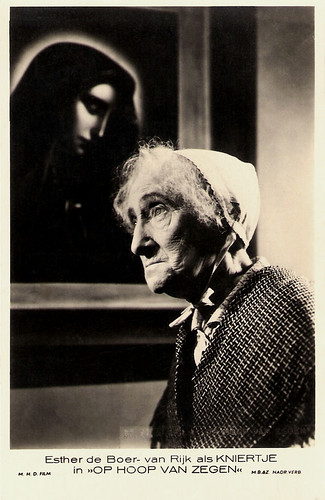
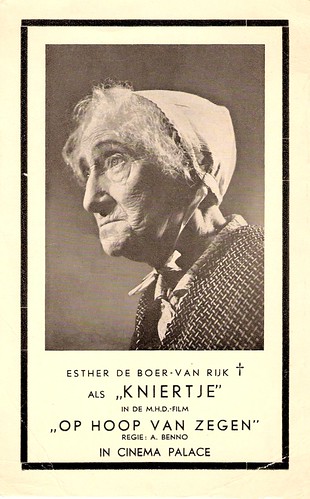
Esther de Boer van Rijk in Op Hoop van Zegen
Dutch postcard by Cinema Palace / M.H.D.-Film. Publicity still for Op hoop van zegen/The Good Hope (Alex Benno, Louis Saalborn, 1934). Probably published to commemorate the death of De Boer-van Rijk in 1937.

Sources: Joosje Lakmaker (Ons Amsterdam - Dutch), Chip Douglas (IMDb), Film in Nederland, Huygens Instituut (Dutch), Wikipedia (Dutch) and IMDb.

This post was last updated on 11 June 2023.

27 September 2018

Op hoop van zegen (1934)

Today, a new edition of The Netherlands Film Festival starts in the city of Utrecht. The NFF is every year both the home of Dutch cinema and the leading platform for the Netherlands’ national film culture. The 38th edition takes place from 27 September – 5 October 2018, and celebrates the achievements of Dutch filmmakers. And EFSP joins the fun again with The Netherlands Film Star Postcard Festival. We begin with a film special on the early Dutch sound film Op hoop van zegen/The Good Hope (Alex Benno, 1934). There are four film adaptations of Herman Heijermans' stage classic Op hoop van zegen about a fishermen's tragedy: produced in 1918, 1924, 1934, and 1986. The 1934 version stars the iconic Esther de Boer-van Rijk, the senior actress who won a special mention at the Venice Film Festival of 1935 for her intensely tragic performance as Kniertje.

Esther de Boer-van Rijk in Op Hoop van Zegen
Dutch postcard by M.B. & Z / M.H.D. Film. Photo: Dick van Maarseveen, Den Haag. Publicity still for Op hoop van zegen/The Good Hope (Alex Benno, 1934). Collection: Geoffrey Donaldson Institute.

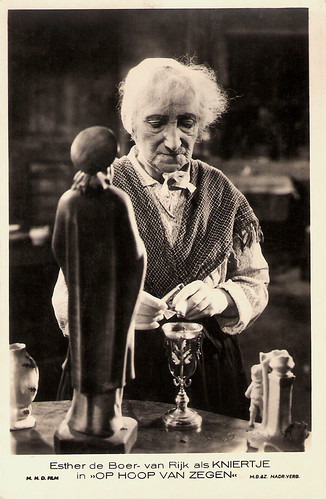
Esther de Boer van Rijk in Op Hoop van Zegen
Dutch postcard by M.B. & Z / M.H.D. Film. Photo: Dick van Maarseveen, Den Haag. Publicity still for Op hoop van zegen (Alex Benno, 1934).

Esther de Boer van Rijk, 6
Dutch postcard by M.B. & Z. (M. Bonnist & Zonen, Amsterdam). Photo: Dick van Maarseveen, Den Haag / M.H.D. Film. Publicity still for Op Hoop van Zegen (Alex Benno, 1934). Collection: Geoffrey Donaldson Institute.

Herman Heijermans


The play Op Hoop van Zegen (1900) is still staged in the Netherlands, and it remains the most popular play by Herman Heijermans (1864–1924).

Heijermans was the leading Dutch dramatist at the close of the 19th century. He was a writer of strong realistic and socialistic tendencies who single-handedly brought Dutch theatre into the modern time.

Op Hoop van Zegen takes place in a fishing village. A conflict between the fishermen and their employer ends in tragedy with the unsound boat setting out to sea and sinking with all hands and the owner pocketing the insurance money.

The third film version of 1934 was the first sound version and is also the first too survive intact. Of the two silent versions, only bits and pieces remain.

Alex Benno, the director of the 1934 version, worked as a gopher on the 1918 version and also appeared as an extra.

It was his dream to make a sound version of the film and to use the same lead actress, Esther de Boer-van Rijk, who had become synonymous with the part of Kniertje on stage. Willem van der Veer, who played the youngest son Barendje in the 1918 version, was cast as the unscrupulous Reder Bos this time around.

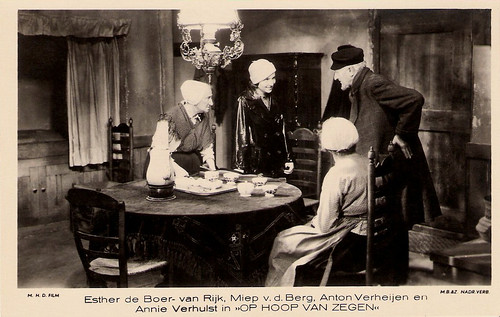
Esther de Boer-van Rijk, Annie Verhulst, Op Hoop van Zegen
Dutch postcard by M.B. & Z. (M. Bonnist & Zonen, Amsterdam). Photo: Dick van Maarseveen, Den Haag / M.H.D. Film. Publicity still for Op Hoop van Zegen/The Good Hope (Alex Benno, 1934) with Esther de Boer-van Rijk, Miep van den Berg, Anton Verheijen and Annie Verhulst. Collection: Geoffrey Donaldson Institute.

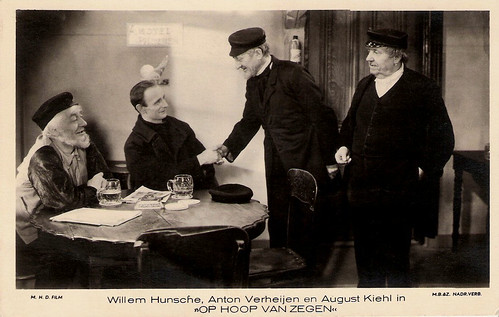
Willem Hunsche, Anton Verheijen, August Kiehl, Op Hoop van Zegen
Dutch postcard by M.B. & Z. (M. Bonnist & Zonen, Amsterdam). Photo: Dick van Maarseveen, Den Haag / M.H.D. Film. Publicity still for Op Hoop van Zegen (Alex Benno, 1934) with Willem Hunsche, Anton Verheijen and August Kiehl. Collection: Geoffrey Donaldson Institute.

Esther de Boer-van Rijk, Coen Hissink, Willem v.d. Veer, Op Hoop van Zegen
Dutch postcard by M.B. & Z. (M. Bonnist & Zonen, Amsterdam). Photo: Dick van Maarseveen, Den Haag / M.H.D. Film. Publicity still for Op Hoop van Zegen (Alex Benno, 1934) with Esther de Boer-van Rijk, Coen Hissink and Willem v.d. Veer. Collection: Geoffrey Donaldson Institute.

Esther de Boer van Rijk and Coen Hissink in Op hoop van zegen (1934)
Dutch postcard by M.B. & Z / M.H.D. Film. Photo: Maarseveen, Den Haag. Publicity still for Op hoop van zegen (Alex Benno, 1934) with Esther de Boer van Rijk and Coen Hissink.

Esther de Boer-van Rijk, Frits van Dongen, Op Hoop van Zegen
Dutch postcard by M.B. & Z / M.H.D. Film. Photo: Dick van Maarseveen, Den Haag. Publicity still for Op hoop van zegen/The Good Hope (Alex Benno, 1934) with Esther de Boer-van Rijk and Frits van Dongen.

Esther de Boer-van Rijk


The star of the 1934 film version was the 80-year-old Esther de Boer-van Rijk, the most popular Dutch actress ever.

She had played the tragic fisherwoman Kniertje in the first performance of Op hoop van zegen on stage in 1900 and the role had made a national icon of her. Through the years, she had played Kniertje again and again.

Driven by poverty and honour, Kniertje sends the last of her kin to sea. Her two sons will work on the ship Op Hoop van Zegen, of which some people in town doubt it is seaworthy.

She played Kniertje again in the first silent film version of 1918 directed by Maurits Binger and repeated the role in the 1934 sound version directed by Alex Benno. In the latter, the film actors Frits van Dongen and Jan van Ees played her two sons.

De Boer-van Rijk also appeared in a dozen more Dutch silent films, but Kniertje would always be her biggest success.

Jan van Ees, Esther de Boer-van Rijk, Op hoop van Zegen
Dutch postcard by M.B. & Z. (M. Bonnist & Zonen, Amsterdam). Photo: Dick van Maarseveen, Den Haag / M.H.D. Film. Publicity still for Op Hoop van Zegen (Alex Benno, 1934) with Jan van Ees and Esther de Boer-van Rijk. Collection: Geoffrey Donaldson Institute.

Esther de Boer van Rijk, Aaf Bouber, Cissy van Bennekom, Clara Visscher, and Annie Verhulst, in Op Hoop van Zegen
Dutch postcard by M.B. & Z. (M. Bonnist & Zonen, Amsterdam). Photo: Dick van Maarseveen, Den Haag / M.H.D. Film. Publicity still for Op Hoop van Zegen (Alex Benno, 1934) with Esther de Boer-van Rijk, Aaf Bouber, Cissy van Bennekom, Clara Visscher, and Annie Verhulst. Collection: Geoffrey Donaldson Institute.

Esther de Boer-van Rijk, Aaf Bouber in Op Hoop van Zegen
Dutch postcard by M.B. & Z. (M. Bonnist & Zonen, Amsterdam). Photo: Dick van Maarseveen, Den Haag / M.H.D. Film. Publicity still for Op Hoop van Zegen (Alex Benno, 1934) with Esther de Boer-van Rijk and Aaf Bouber.

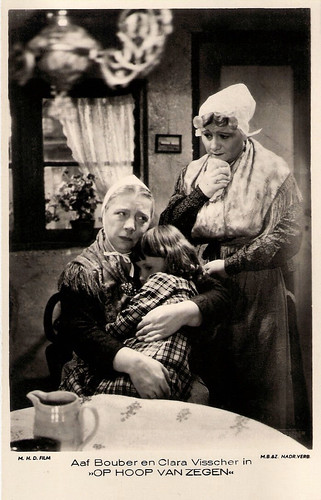
Aaf Bouber and Clara Visscher in Op hoop van zegen (1934)
Dutch postcard by M.B. & Z. (M. Bonnist & Zonen, Amsterdam). Photo: Dick van Maarseveen, Den Haag / M.H.D. Film. Publicity still for Op Hoop van Zegen (Alex Benno, 1934) with Aaf Bouber and Clara Visscher. Collection: Geoffrey Donaldson Institute.

Esther de Boer van Rijk in Op Hoop van Zegen
Dutch postcard by Cinema Palace / M.H.D.-Film. Publicity still for Op hoop van zegen/The Good Hope (Alex Benno, 1934). Probably published to commemorate the death of Esther de Boer-van Rijk in 1937.

Sources: Wikipedia and IMDb.