This evening's show in Teatro Verdi in Pordenone is a screening of Der Müde Tod / Destiny (1921) by Fritz Lang with live accompaniment by Ilya Poletaev. Star is the German, Dutch-born film actress Lil Dagover (1887-1980), an exotic, dark beauty, who featured prominently during the golden age of the German silent cinema. She had her breakthrough as the prey of Dr. Caligari's monster in the classic expressionist film Das Cabinet des Dr. Caligari (1920). In Der Müde Tod, she plays a young woman who is determined to rescue her fiancé from death. Death, in human form, reluctantly allows the desperate woman the chance to bring her beloved back to life via three successive scenarios. Each is set in a distinct cultural and historical realm, offering contrasting possibilities for the film’s visual design.
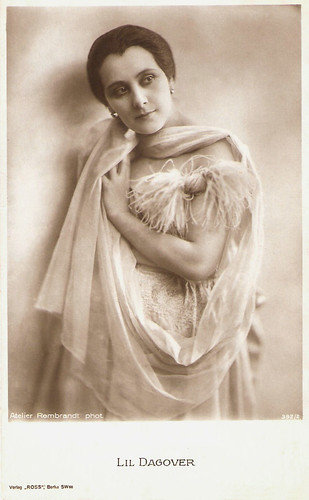
German postcard by Ross Verlag, Berlin, no. 392/2, 1919-1924. Photo: Atelier Rembrandt, Berlin.
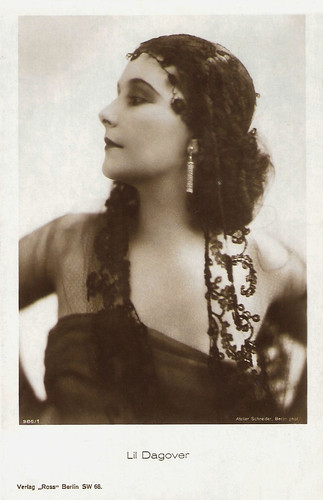
German postcard by Ross Verlag, Berlin, no. 905/1, 1925-1926. Photo: Atelier Schneider, Berlin.
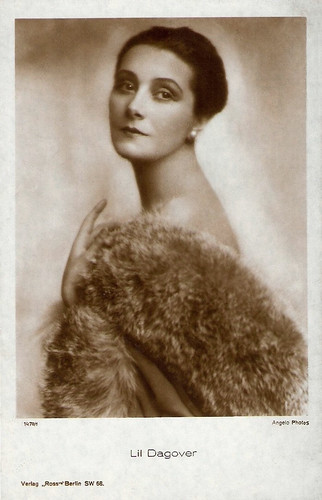
German postcard by Ross Verlag, Berlin, no. 1470/1, 1927-1928. Photo: Angelo Photos.
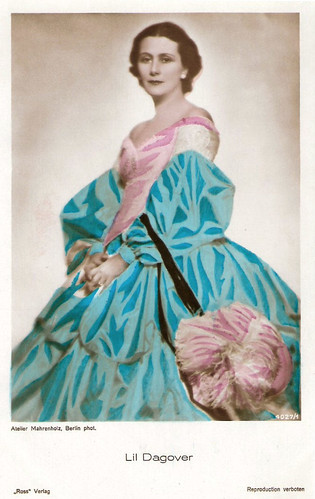
German postcard by Ross Verlag, Berlin, no. 4027/1, 1929-1930. Photo: Atelier Mahrenholz, Berlin.

German postcard by Ross Verlag, Berlin, no. 5424/1, 1930-1931. Photo: Lola - Kreutzberg - Film.

Italian postcard by Rizzoli, 1940. Photo: Ufa.
Lil Dagover was born Maria Antonia Siegelinde Martha Seubert in Madiun on the island of Java in the Dutch East Indies, now Indonesia, in 1887 (some sources say 1894 or 1897). She was the daughter of a forest ranger in the service of the Dutch colonial authorities.
From the age of 10, she was educated in Baden-Baden, Germany. She made her film debut in 1913 as a snake dancer in Schlangentanz / Snake Dance, a documentary by Louis Held. Although she never got acting lessons, she played parts in Die Retterin/The Saviour (Christa Christensen, 1916), Lebendig tot/Living Dead (Alwin Neuss, 1918) and Die Maske / The Mask (Ewald André Dupont, 1919).
In 1917, she married actor Fritz Daghofer, who was 25 years her senior. He introduced her to the directors Robert Wiene and Fritz Lang. The couple divorced in 1919, and the union produced a daughter, Eva Marie, born the year of the divorce. Lil kept her husband's surname but slightly changed it to Dagover. Eva married Hungarian director Géza von Radványi in 1930.
Lil Dagover's career gathered speed with Die Spinnen / The Spiders (Fritz Lang, 1919-1920) and Harakiri (Fritz Lang, 1919). In the latter film, she already impersonated the fine lady whom she usually played in her future films. Next, she appeared in the classic expressionist film Das Cabinet des Dr. Caligari / The Cabinet of Dr. Caligari (Robert Wiene, 1920). In this film, her jet-black hair parted in the middle and flattened to the shape of her head, her long, white face, and her huge, expressive eyes all served to create the archetypal, victimised heroine of the expressionist melodramas.
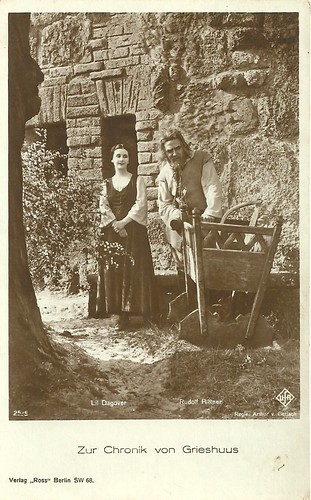
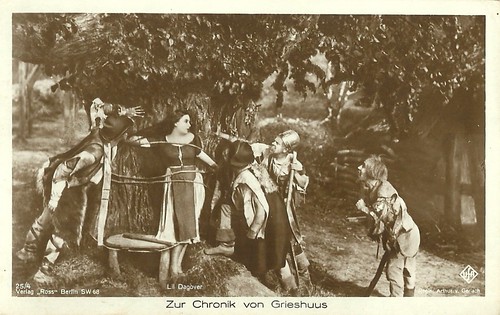
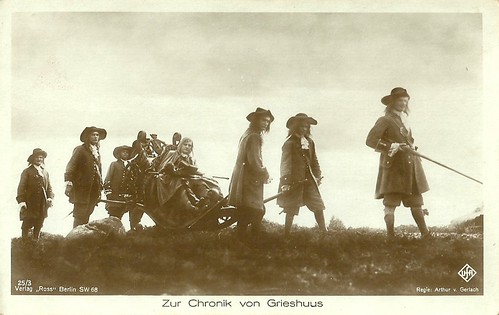
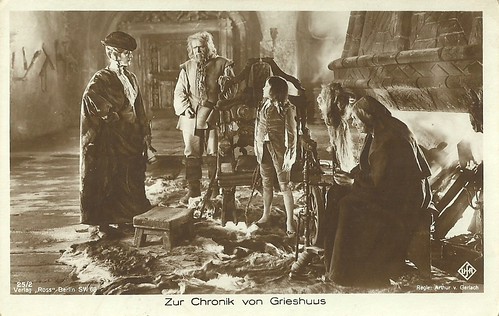
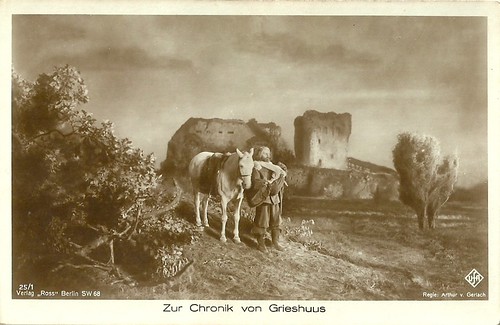
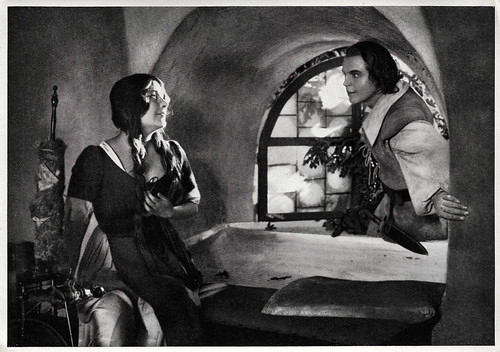
For Fritz Lang, she played in two more masterpieces, Der müde Tod / Destiny (Fritz Lang, 1921), as a woman begging Death to hand her lover back, and Dr. Mabuse, der Spieler - Ein Bild der Zeit / Dr. Mabuse: the Gambler (Fritz Lang, 1922). She also appeared in two silent classics by Friedrich Wilhelm Murnau, Phantom / The Phantom (F.W. Murnau, 1922) with Alfred Abel, and Tartüff / Tartuffe (F.W. Murnau, 1925) with Emil Jannings, and in Zur Chronik von Grieshuus / At the Grey House (Arthur von Gerlach, 1925).

Spanish postcard by La Novela Semanal Cinematografica, no. 353.
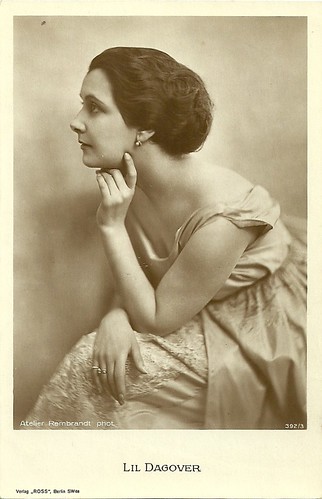
German postcard by Ross Verlag, no. 392/3, 1919-1924. Photo: Atelier Rembrandt.
![Lil Dagover [?] in Der Tänzer (1919)](https://live.staticflickr.com/65535/49731201423_940d6dedc8.jpg)
German postcard by Ross Verlag, no. 632/1, 1919-1924. Photo: Maxim Film. Lil Dagover in Der Tänzer / The Dancer (Carl Froehlich, 1919) and based on the novel by Felix Holländer.
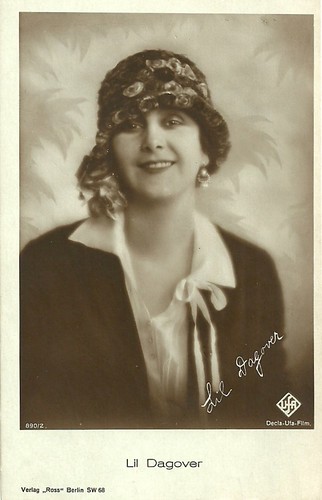
German postcard by Ross Verlag, no. 890/2, 1925-1926. Photo: Decla-Ufa-Film.

German postcard by Ross Verlag, no. 3970/1, 1928-1929. Photo: Ufa.
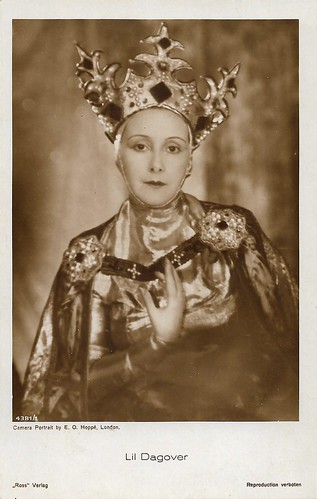
German postcard by Ross Verlag, no. 4381/1, 1929-30. Photo: E.O. Hoppé, London. Hoppé shot many celebrities on and off the Ufa film sets in Berlin in 1927-1928.
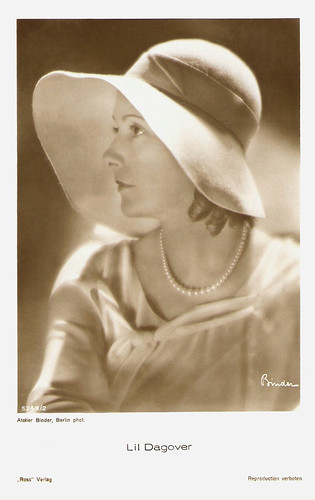
German postcard by Ross Verlag, no. 5249/2, 1930-1931. Photo: Atelier Binder.

German postcard by Ross Verlag, no. 5706/1, 1930-1931. Photo: Atelier Schneider, Berlin.
In 1925, Lil Dagover made her stage debut under the direction of Max Reinhardt. In the following years, she played in Reinhardt’s Deutsches Theater in Berlin and also at the Salzburg Festival. Apart from trips to Sweden, France, and Hollywood, most of her career and fate were linked to that of German cinema.
Initially, her role was that of the frail, menaced heroine, but gradually her fine and evanescent beauty changed over time. Film historian Vittorio Martinelli describes in 'Cinegrafie' that "her face became calmer, her figure acquired a harmonious and restful opulence which, together with the natural elegance of her bearing and the constant accuracy of her style of dressing, turned her into a 'Salondame', a lady of the screen."
In 1926, she married producer Georg Witt, who produced many of her following films. Roles in Die Brüder Schellenberg / The Brothers Schellenberg (Karl Grune, 1926) opposite Conrad Veidt, Der geheime Kurier / The Secret Courier (Gennaro Righelli, 1928) with Ivan Mozzhukhin and Ungarische Rhapsodie / Hungarian Rhapsody (Hanns Schwarz, 1928) with Willy Fritsch, were well suited to her new allure.
She also made several films in Sweden for directors Olof Molander and Gustaf Molander and appeared in French silent films. Her last film appearance of the 1920s was in the French silent film Monte Cristo (Henri Fescourt, 1929) opposite Jean Angelo and Marie Glory.
With her theatre experience, she easily survived the coming of sound. In 1930, she made her sound debut in the crime comedy Va Banque (Erich Waschneck, 1930). Her deep voice went down well in such films as the popular operetta Der Kongreß tanzt / The Congress Dances (Erik Charell, 1931). She also visited Hollywood, where she appeared in The Woman from Monte Carlo (Michael Curtiz, 1931) with Walter Huston, shot on location in the United States. It was not a success, and she returned to Germany.

German postcard by Ross Verlag, no. 3143. Photo Decla. Carl de Vogt and Lil Dagover in Die Spinnen, 1. Teil - Der Goldene See (Fritz Lang, 1919). Caption: Decla-Abenteuerklasse "Die Spinnen, 1. Abenteuer "Der Goldene See". (Decla-adventure class "The Spiders", 1st adventure "The Golden Lake".) Sent by mail in 1924.

Swiss-German-British postcard by News Productions, Baulmes / Filmwelt Berlin, Bakede / News Productions, Stroud, no. 56535. Photo: Collection Cinémathèque Suisse, Lausanne. Conrad Veidt and Lil Dagover in Das Kabinett des Dr. Caligari / Das Cabinet des Dr. Caligari (Robert Wiene, 1920), produced by Decla Film, Berlin - Bolz und Cie.

German postcard by Ross Verlag, no. 25/7. Photo: Ufa. Lil Dagover and Paul Hartmann in the German silent film Zur Chronik von Grieshuus / The Chronicles of the Gray House (Arthur von Gerlach, 1925).
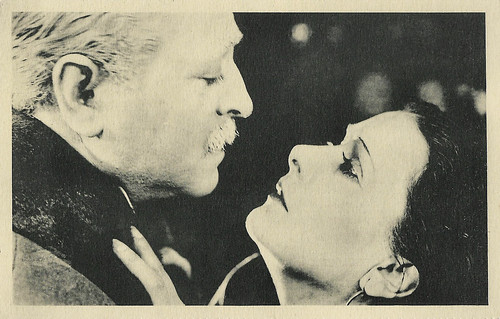
French postcard by Film français Aubert, Paris. Photo: Gaston Jacquet and Lil Dagover in Le Tourbillon de Paris / The Maelstrom of Paris (Julien Duvivier, 1928).
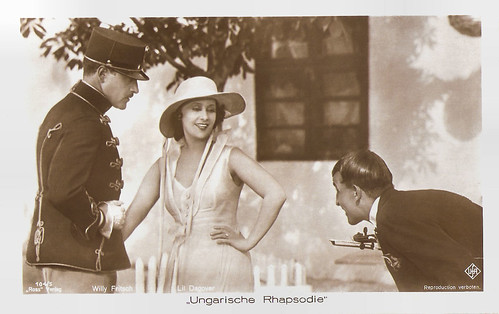
German postcard by Ross Verlag, no. 104/5. Photo: Ufa. Willy Fritsch and Lil Dagover in Ungarische Rhapsodie / Hungarian Rhapsody (Hanns Schwarz, 1928).

French postcard by Cinémagazine-Edition, no. 702. Photo: Sofar / Greenbaum-Film. Lil Dagover as Empress Maria Theresia in the period drama La Bague impériale, the French release title of the German film Der Günstling von Schönbrunn (Erich Waschneck, Max Reichmann, 1929), with Ivan Petrovich in the male lead as Colonel Trenck.

German postcard by Ross Verlag, no. 131/7. Photo: Ufa. Conrad Veidt as Count Metternich and Lil Dagover as Countess in Der Kongress tanzt / The Congress dances (Erik Charell, 1931).

German postcard by Ross Verlag, no. A 2260/1, 1939-1940. Photo: Baumann / Ufa. Viktor Staal and Lil Dagover in Umwege zum Glück / Detours to happiness (Fritz Peter Buch, 1939).
Reportedly, Lil Dagover was a close friend of Adolph Hitler. She avoided overt political involvement and generally appeared in popular costume musicals and comedies during World War II. However, she acted in army shows and at war theatres and in 1944 she received the War Merits Cross.
During the Nazi era, she starred in films like the Oscar Wilde adaptation Lady Windermeres Fächer / Lady Windermere's Fan (Heinz Hilpert, 1935), Der Höhere Befehl / The Higher Command (Gerhard Lamprecht, 1935), Schlussakkord / Final Accord (Detlev Sierck (Douglas Sirk), 1936), the first (short) German colour film Das Schönheitsfleckchen / The Little Beauty Mark (Rolf Hansen, 1936), Kreutzersonate / The Kreutzer Sonata (Veit Harlan, 1937) and Bismarck (Wolfgang Liebeneiner, 1940).
She easily continued her career in post-war Germany and acted occasionally on stage and television. She played ‘age parts’ in films like Vom Teufel gejagt/Hunted by the Devil (Victor Tourjansky, 1950), Rosen im Herbst / Roses in Autumn (Rudolf Jugert, 1955), Bekenntnisse des Hochstaplers Felix Krull / Confessions of Felix Krull (Kurt Hoffmann, 1957) and Buddenbrooks / The Buddenbrooks (Alfred Weidenmann, 1959), an adaptation of the Thomas Mann novel with Liselotte Pulver.
A great succès d'estime was her role as an eccentric old woman in the Edgar Wallace adaptation Die seltsame Gräfin / The Strange Countess (Josef von Báky, 1961). The last highlights of the ‘Grande Dame’ comprised the Academy Award-nominated and Golden Globe-winning for Best Foreign-Language Foreign Film of 1974 - Der Fusssgänger / The Pedestrian (Maximilian Schell, 1973), Karl May (Hans-Jürgen Syberberg, 1974), the crime-drama Der Richter und sein Henker / Getting Away with Murder (Maximilian Schell, 1975) with Donald Sutherland, and Geschichten aus dem Wiener Wald / Tales from the Vienna Woods (Maximilian Schell, 1979).
Her film career lasted over half a century, and she won many awards, including the Bundesfilmpreis in 1954 and the Filmband in Gold in 1962. She justly titled her memoirs 'Ich war die Dame' (I was the Lady) in 1979. Lil Dagover died in 1980, in Munich, Germany, at the age of 92. She was buried at the Waldfriedhof Grünwald cemetery in Munich.

German postcard by Ross Verlag, no. 6024/2, 1931-1932. Photo: Atelier Manassé, Wien. Lil Dagover in Elisabeth von Österreich / Elisabeth of Austria (Adolf Trotz, 1931). Collection: Geoffrey Donaldson Institute.
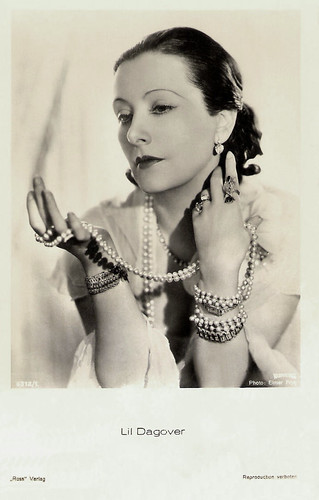
German postcard by Ross Verlag, Berlin, no. 6312/1, 1931-1932. Photo: Elmer Fry.

German postcard by Ross Verlag, Berlin, no. 6777/1, 1931-1932. Photo: Atelier Schenker, Berlin. Collection: Didier Hanson.
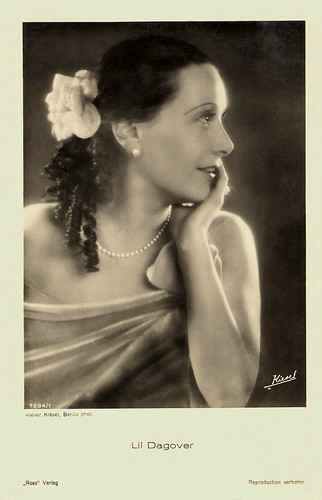
German postcard by Ross Verlag, Berlin, no. 7084/1, 1932-1933. Photo: Atelier Kiesel, Berlin.
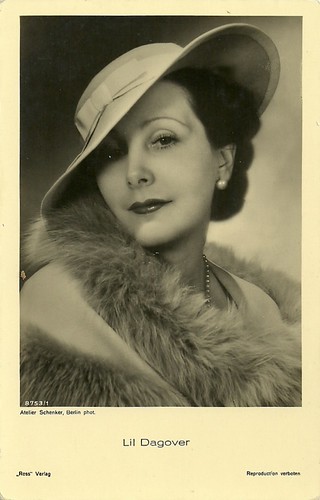
German postcard by Ross Verlag, no. 8753/1, 1933-1934. Photo: Atelier Schenker, Berlin.
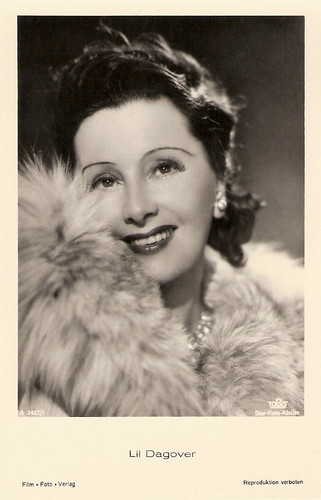
German postcard by Film-Foto-Verlag, no. A 3427/1, 1941-1944. Photo: Star-Foto-Atelier / Tobis.
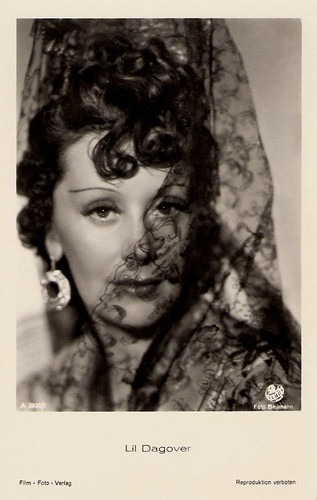
German postcard by Film-Foto-Verlag, no. A 3920/1, 1941-1944. Photo: Baumann / Terra. Lil Dagover in Musik in Salzburg / Music in Salzburg (Herbert Maisch, 1944).
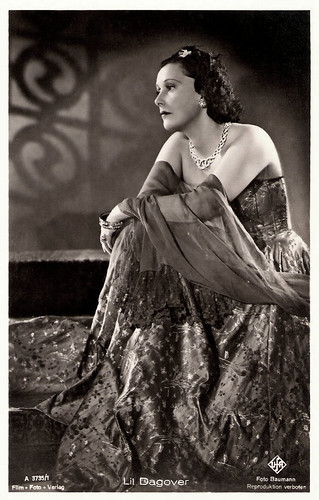
German postcard by Film-Foto-Verlag, no. A 3735/1, 1941-1944. Photo: Baumann.
Sources: Le Giornate del Cinema Muto, Vittorio Martinelli (Portraits of Ladies in 'Cinegrafie 12: Divine Apparitions'), Hans Michael Bock (Filmportal.de - German), Thomas Staedeli (Cyranos), Filmreference.com, Wikipedia (German and English) and IMDb.
German postcard by Ross Verlag, Berlin, no. 392/2, 1919-1924. Photo: Atelier Rembrandt, Berlin.
German postcard by Ross Verlag, Berlin, no. 905/1, 1925-1926. Photo: Atelier Schneider, Berlin.
German postcard by Ross Verlag, Berlin, no. 1470/1, 1927-1928. Photo: Angelo Photos.
German postcard by Ross Verlag, Berlin, no. 4027/1, 1929-1930. Photo: Atelier Mahrenholz, Berlin.
German postcard by Ross Verlag, Berlin, no. 5424/1, 1930-1931. Photo: Lola - Kreutzberg - Film.
Italian postcard by Rizzoli, 1940. Photo: Ufa.
Victimised heroine
Lil Dagover was born Maria Antonia Siegelinde Martha Seubert in Madiun on the island of Java in the Dutch East Indies, now Indonesia, in 1887 (some sources say 1894 or 1897). She was the daughter of a forest ranger in the service of the Dutch colonial authorities.
From the age of 10, she was educated in Baden-Baden, Germany. She made her film debut in 1913 as a snake dancer in Schlangentanz / Snake Dance, a documentary by Louis Held. Although she never got acting lessons, she played parts in Die Retterin/The Saviour (Christa Christensen, 1916), Lebendig tot/Living Dead (Alwin Neuss, 1918) and Die Maske / The Mask (Ewald André Dupont, 1919).
In 1917, she married actor Fritz Daghofer, who was 25 years her senior. He introduced her to the directors Robert Wiene and Fritz Lang. The couple divorced in 1919, and the union produced a daughter, Eva Marie, born the year of the divorce. Lil kept her husband's surname but slightly changed it to Dagover. Eva married Hungarian director Géza von Radványi in 1930.
Lil Dagover's career gathered speed with Die Spinnen / The Spiders (Fritz Lang, 1919-1920) and Harakiri (Fritz Lang, 1919). In the latter film, she already impersonated the fine lady whom she usually played in her future films. Next, she appeared in the classic expressionist film Das Cabinet des Dr. Caligari / The Cabinet of Dr. Caligari (Robert Wiene, 1920). In this film, her jet-black hair parted in the middle and flattened to the shape of her head, her long, white face, and her huge, expressive eyes all served to create the archetypal, victimised heroine of the expressionist melodramas.
For Fritz Lang, she played in two more masterpieces, Der müde Tod / Destiny (Fritz Lang, 1921), as a woman begging Death to hand her lover back, and Dr. Mabuse, der Spieler - Ein Bild der Zeit / Dr. Mabuse: the Gambler (Fritz Lang, 1922). She also appeared in two silent classics by Friedrich Wilhelm Murnau, Phantom / The Phantom (F.W. Murnau, 1922) with Alfred Abel, and Tartüff / Tartuffe (F.W. Murnau, 1925) with Emil Jannings, and in Zur Chronik von Grieshuus / At the Grey House (Arthur von Gerlach, 1925).
Spanish postcard by La Novela Semanal Cinematografica, no. 353.
German postcard by Ross Verlag, no. 392/3, 1919-1924. Photo: Atelier Rembrandt.
German postcard by Ross Verlag, no. 632/1, 1919-1924. Photo: Maxim Film. Lil Dagover in Der Tänzer / The Dancer (Carl Froehlich, 1919) and based on the novel by Felix Holländer.
German postcard by Ross Verlag, no. 890/2, 1925-1926. Photo: Decla-Ufa-Film.
German postcard by Ross Verlag, no. 3970/1, 1928-1929. Photo: Ufa.
German postcard by Ross Verlag, no. 4381/1, 1929-30. Photo: E.O. Hoppé, London. Hoppé shot many celebrities on and off the Ufa film sets in Berlin in 1927-1928.
German postcard by Ross Verlag, no. 5249/2, 1930-1931. Photo: Atelier Binder.
German postcard by Ross Verlag, no. 5706/1, 1930-1931. Photo: Atelier Schneider, Berlin.
Salondame
In 1925, Lil Dagover made her stage debut under the direction of Max Reinhardt. In the following years, she played in Reinhardt’s Deutsches Theater in Berlin and also at the Salzburg Festival. Apart from trips to Sweden, France, and Hollywood, most of her career and fate were linked to that of German cinema.
Initially, her role was that of the frail, menaced heroine, but gradually her fine and evanescent beauty changed over time. Film historian Vittorio Martinelli describes in 'Cinegrafie' that "her face became calmer, her figure acquired a harmonious and restful opulence which, together with the natural elegance of her bearing and the constant accuracy of her style of dressing, turned her into a 'Salondame', a lady of the screen."
In 1926, she married producer Georg Witt, who produced many of her following films. Roles in Die Brüder Schellenberg / The Brothers Schellenberg (Karl Grune, 1926) opposite Conrad Veidt, Der geheime Kurier / The Secret Courier (Gennaro Righelli, 1928) with Ivan Mozzhukhin and Ungarische Rhapsodie / Hungarian Rhapsody (Hanns Schwarz, 1928) with Willy Fritsch, were well suited to her new allure.
She also made several films in Sweden for directors Olof Molander and Gustaf Molander and appeared in French silent films. Her last film appearance of the 1920s was in the French silent film Monte Cristo (Henri Fescourt, 1929) opposite Jean Angelo and Marie Glory.
With her theatre experience, she easily survived the coming of sound. In 1930, she made her sound debut in the crime comedy Va Banque (Erich Waschneck, 1930). Her deep voice went down well in such films as the popular operetta Der Kongreß tanzt / The Congress Dances (Erik Charell, 1931). She also visited Hollywood, where she appeared in The Woman from Monte Carlo (Michael Curtiz, 1931) with Walter Huston, shot on location in the United States. It was not a success, and she returned to Germany.
German postcard by Ross Verlag, no. 3143. Photo Decla. Carl de Vogt and Lil Dagover in Die Spinnen, 1. Teil - Der Goldene See (Fritz Lang, 1919). Caption: Decla-Abenteuerklasse "Die Spinnen, 1. Abenteuer "Der Goldene See". (Decla-adventure class "The Spiders", 1st adventure "The Golden Lake".) Sent by mail in 1924.
Swiss-German-British postcard by News Productions, Baulmes / Filmwelt Berlin, Bakede / News Productions, Stroud, no. 56535. Photo: Collection Cinémathèque Suisse, Lausanne. Conrad Veidt and Lil Dagover in Das Kabinett des Dr. Caligari / Das Cabinet des Dr. Caligari (Robert Wiene, 1920), produced by Decla Film, Berlin - Bolz und Cie.
German postcard by Ross Verlag, no. 25/7. Photo: Ufa. Lil Dagover and Paul Hartmann in the German silent film Zur Chronik von Grieshuus / The Chronicles of the Gray House (Arthur von Gerlach, 1925).
French postcard by Film français Aubert, Paris. Photo: Gaston Jacquet and Lil Dagover in Le Tourbillon de Paris / The Maelstrom of Paris (Julien Duvivier, 1928).
German postcard by Ross Verlag, no. 104/5. Photo: Ufa. Willy Fritsch and Lil Dagover in Ungarische Rhapsodie / Hungarian Rhapsody (Hanns Schwarz, 1928).
French postcard by Cinémagazine-Edition, no. 702. Photo: Sofar / Greenbaum-Film. Lil Dagover as Empress Maria Theresia in the period drama La Bague impériale, the French release title of the German film Der Günstling von Schönbrunn (Erich Waschneck, Max Reichmann, 1929), with Ivan Petrovich in the male lead as Colonel Trenck.
German postcard by Ross Verlag, no. 131/7. Photo: Ufa. Conrad Veidt as Count Metternich and Lil Dagover as Countess in Der Kongress tanzt / The Congress dances (Erik Charell, 1931).
German postcard by Ross Verlag, no. A 2260/1, 1939-1940. Photo: Baumann / Ufa. Viktor Staal and Lil Dagover in Umwege zum Glück / Detours to happiness (Fritz Peter Buch, 1939).
War merits cross
Reportedly, Lil Dagover was a close friend of Adolph Hitler. She avoided overt political involvement and generally appeared in popular costume musicals and comedies during World War II. However, she acted in army shows and at war theatres and in 1944 she received the War Merits Cross.
During the Nazi era, she starred in films like the Oscar Wilde adaptation Lady Windermeres Fächer / Lady Windermere's Fan (Heinz Hilpert, 1935), Der Höhere Befehl / The Higher Command (Gerhard Lamprecht, 1935), Schlussakkord / Final Accord (Detlev Sierck (Douglas Sirk), 1936), the first (short) German colour film Das Schönheitsfleckchen / The Little Beauty Mark (Rolf Hansen, 1936), Kreutzersonate / The Kreutzer Sonata (Veit Harlan, 1937) and Bismarck (Wolfgang Liebeneiner, 1940).
She easily continued her career in post-war Germany and acted occasionally on stage and television. She played ‘age parts’ in films like Vom Teufel gejagt/Hunted by the Devil (Victor Tourjansky, 1950), Rosen im Herbst / Roses in Autumn (Rudolf Jugert, 1955), Bekenntnisse des Hochstaplers Felix Krull / Confessions of Felix Krull (Kurt Hoffmann, 1957) and Buddenbrooks / The Buddenbrooks (Alfred Weidenmann, 1959), an adaptation of the Thomas Mann novel with Liselotte Pulver.
A great succès d'estime was her role as an eccentric old woman in the Edgar Wallace adaptation Die seltsame Gräfin / The Strange Countess (Josef von Báky, 1961). The last highlights of the ‘Grande Dame’ comprised the Academy Award-nominated and Golden Globe-winning for Best Foreign-Language Foreign Film of 1974 - Der Fusssgänger / The Pedestrian (Maximilian Schell, 1973), Karl May (Hans-Jürgen Syberberg, 1974), the crime-drama Der Richter und sein Henker / Getting Away with Murder (Maximilian Schell, 1975) with Donald Sutherland, and Geschichten aus dem Wiener Wald / Tales from the Vienna Woods (Maximilian Schell, 1979).
Her film career lasted over half a century, and she won many awards, including the Bundesfilmpreis in 1954 and the Filmband in Gold in 1962. She justly titled her memoirs 'Ich war die Dame' (I was the Lady) in 1979. Lil Dagover died in 1980, in Munich, Germany, at the age of 92. She was buried at the Waldfriedhof Grünwald cemetery in Munich.
German postcard by Ross Verlag, no. 6024/2, 1931-1932. Photo: Atelier Manassé, Wien. Lil Dagover in Elisabeth von Österreich / Elisabeth of Austria (Adolf Trotz, 1931). Collection: Geoffrey Donaldson Institute.
German postcard by Ross Verlag, Berlin, no. 6312/1, 1931-1932. Photo: Elmer Fry.
German postcard by Ross Verlag, Berlin, no. 6777/1, 1931-1932. Photo: Atelier Schenker, Berlin. Collection: Didier Hanson.
German postcard by Ross Verlag, Berlin, no. 7084/1, 1932-1933. Photo: Atelier Kiesel, Berlin.
German postcard by Ross Verlag, no. 8753/1, 1933-1934. Photo: Atelier Schenker, Berlin.
German postcard by Film-Foto-Verlag, no. A 3427/1, 1941-1944. Photo: Star-Foto-Atelier / Tobis.
German postcard by Film-Foto-Verlag, no. A 3920/1, 1941-1944. Photo: Baumann / Terra. Lil Dagover in Musik in Salzburg / Music in Salzburg (Herbert Maisch, 1944).
German postcard by Film-Foto-Verlag, no. A 3735/1, 1941-1944. Photo: Baumann.
Sources: Le Giornate del Cinema Muto, Vittorio Martinelli (Portraits of Ladies in 'Cinegrafie 12: Divine Apparitions'), Hans Michael Bock (Filmportal.de - German), Thomas Staedeli (Cyranos), Filmreference.com, Wikipedia (German and English) and IMDb.