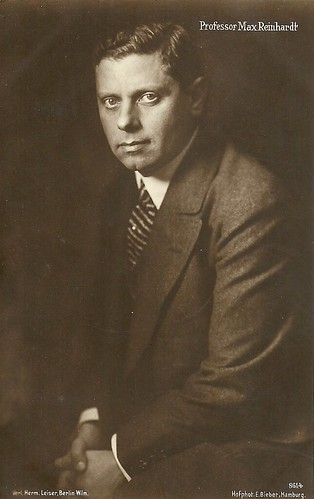
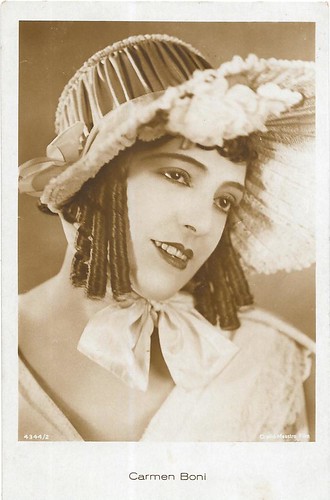
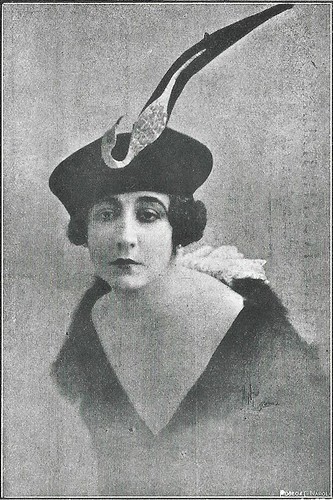
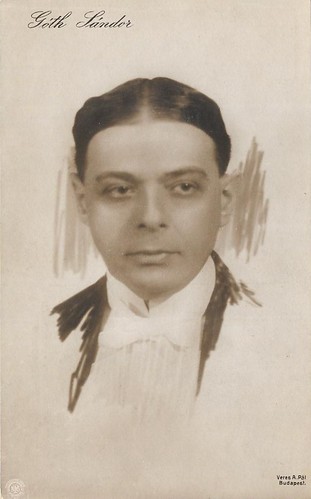
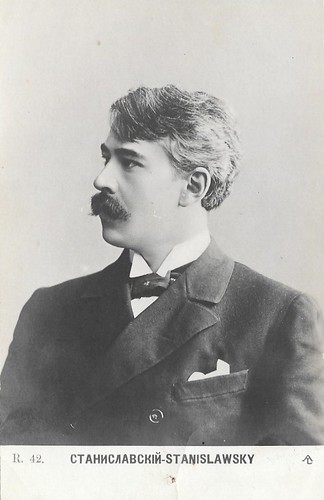
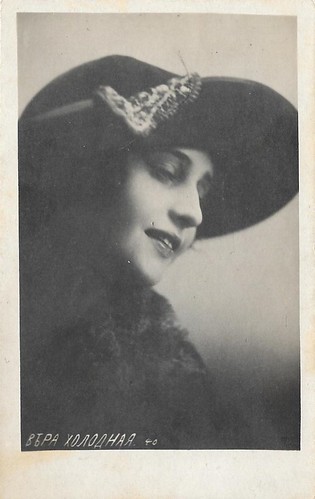
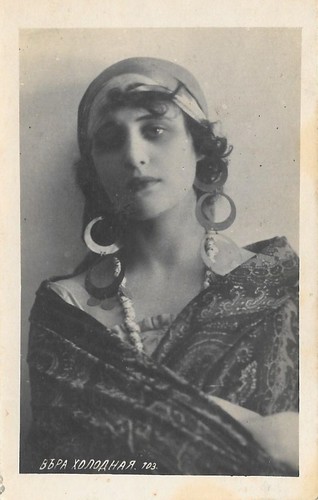
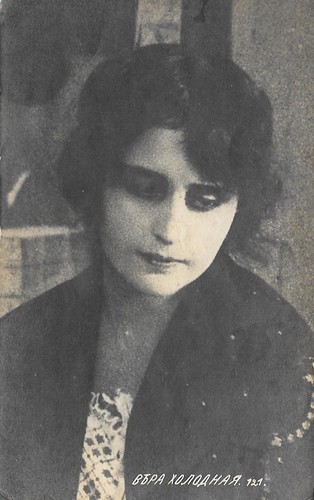
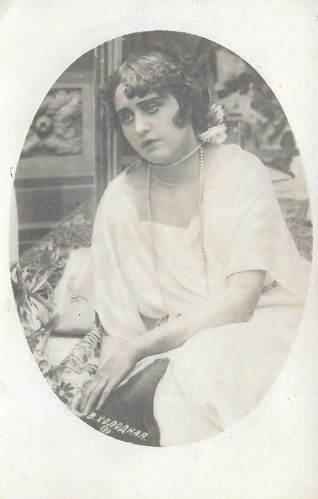
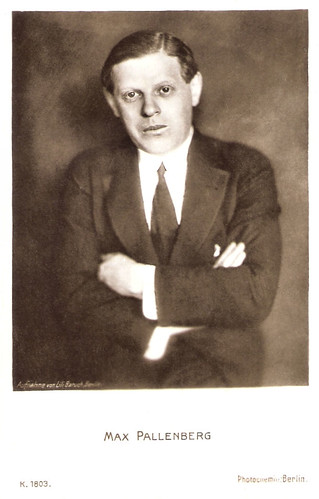
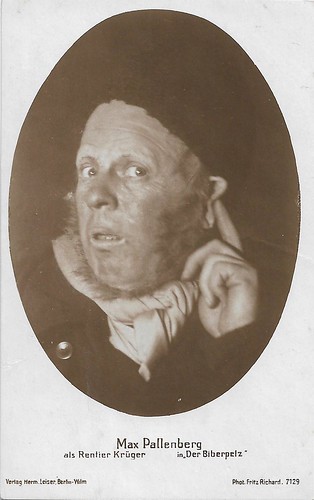
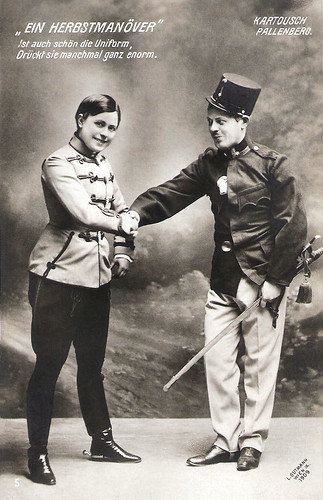
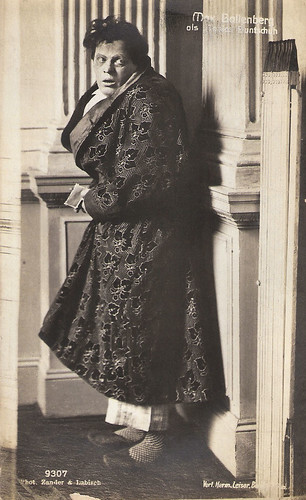
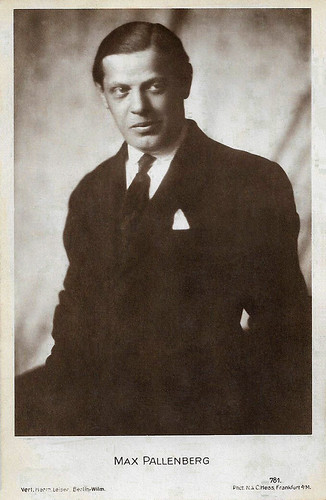
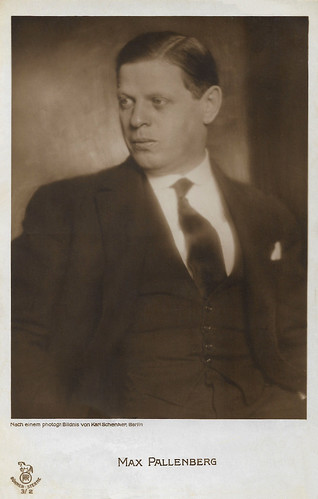
German postcard by Verlag Hermann Leiser, Berlin, no. 8615. Photo: Hofphot. E. Bieber, Hamburg. Collection: Didier Hanson.
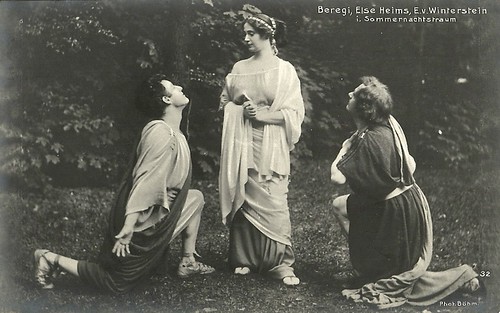
German postcard by Jos Paul Böhm, München, no. 32. Photo: Jos Paul Böhm, München. Eduard von Winterstein, Oscar Beregi, and Else Heims in the play 'Sommernachtstraum', Max Reinhardt's staging of Shakespeare's 'Midsummer Night's Dream'. It was first staged by Reinhardt in 1905.
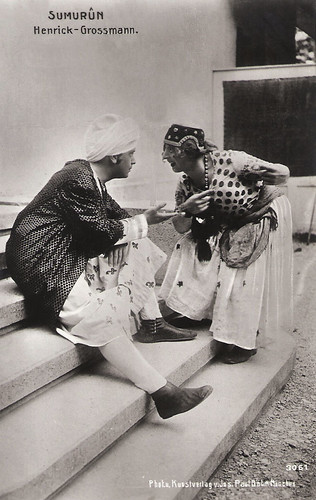
German postcard by Photo und Kunstverlag Jos. Paul Böhm, München, no. 3061. Photo: publicity still for Sumurun (Max Reinhardt, 1910) with at right Richard Grossman as the old woman. But who is the man left, Henrick? Richard Grossman played 'Die alte' (the old woman) in Max Reinhardt's first film, Sumurun (1910), based on a Pantomime by Friedrich Freksa. Perhaps this photo was made for Reinhardt's stage production, 'Sumurun' (1909) at the Kammerspielen des Deutsches Theaters. Grete Wiesenthal played the lead as Sumurun and she would repeat her role in the 1910 film version. Leopoldine Konstantin played the dancer both on stage as in the 1910 film. However, of the four main male actors - Alexander Moissi (as Nur Al Din), Rudolf Schildkraut, Paul Wegener (as the old Sheik) and Eduard von Winterstein (as his son) - only Von Winterstein returned in Reinhardt's film version, but now in the role of the old Sheik. And Wegener would return as the old Sheik in the 1920 film version of Sumurun by Ernst Lubitsch.

German postcard by Verlag Hermann Leiser, no. 4553a, Berlin. Photo: Zander & Labisch, Berlin. Caption: King Oedipus. Paul Wegener in 'Oedipus Rex', Sophocles's classic tragedy, directed by Max Reinhardt in a translation by Hugo von Hofmannsthal, first performed in 1910, first in a Summer festival in Munich and in the Fall in a circus arena Berlin. Stars were Paul Wegener as Oedipus and Tilla Durieux as Jocasta, though some considered the masses of extras performing the Thebans to be the real stars. Emily Bilski, in Berlin Metropolis: Jews and the New Culture, 1890-1918, writes: "Oedipus was the first major theater-in-the-round production in modern times that featured masses of actors performing for a mass audience."
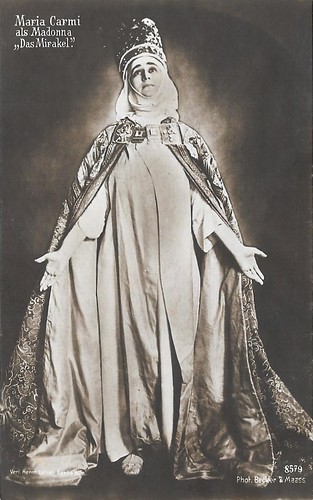
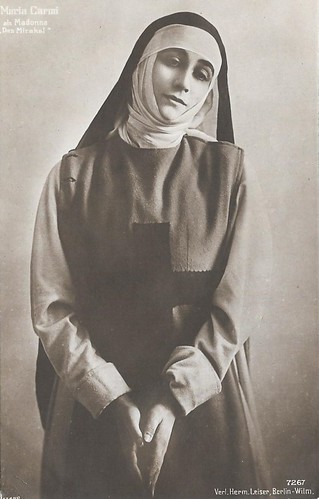
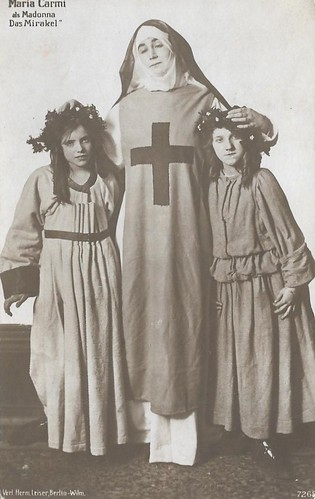
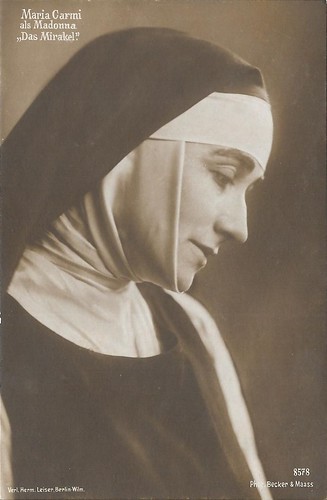
German postcard by Verlag Hermann Leiser, Berlin, no. 8579. Photo: Becker & Maass. Maria Carmi as the Madonna in Das Mirakel/The Miracle (Cherry Kearton, Max Reinhardt, 1912).

German postcard by Verlag Hermann Leiser, Berlin, no. 8614, 1916. Photo: Hofphot. E. Bieber, Hamburg. Collection: Didier Hanson.
His early landmark of genius
Max Reinhardt was born Maximilian Goldmann in 1873 in the spa town of Baden near Vienna where his parents were spa guests. He was the oldest of seven children of Wilhelm Goldmann, a Jewish merchant from Stupava, Hungary, and his wife Rachel Lea Rosi "Rosa" Goldmann (née Wengraf). Wilhelm was a corset maker and the family – officially Reinhardt after 1904 – lived in Vienna, the capital and residential city of the Austro-Hungarian monarchy, where they belonged to the organised Jewish Community of Vienna.
As a boy, Max haunted the Hofburg Theater and tried to see every play. Having finished school, he began an apprenticeship at a bank but already took acting lessons at the Sulkowsky Theater in Matzleinsdorf. In 1890, he gave his debut on a private stage in Vienna with the stage name Max Reinhardt, possibly after the protagonist Reinhard Werner in Theodor Storm's novella 'Immensee'. In 1893 he performed at the re-opened Salzburg City Theatre. One year later, Reinhardt relocated to Germany, joining the Deutsches Theater ensemble in Berlin under director Otto Brahm, who had brought the drama of Henrik Ibsen to Germany. In Berlin, Max achieved great success as an actor and director.
In 1901, Reinhardt together with Friedrich Kayßler and several other young artists created a lighthearted revue, 'Schall und Rauch' (Sound and Smoke), to which Reinhardt contributed sketches. Playing before invited audiences, it was so successful that it was transformed into a serious work and settled into the Kleines Theater (Little Theatre) in 1902. Reinhardt planned a full season and directed his first play, Oscar Wilde’s 'Salomé'. It was the first of numerous stages.
From 1903 to 1905, he managed the Neues Theater (present-day Theater am Schiffbauerdamm). By the end of 1904, he had directed 42 plays. William McPeak at IMDb: "These were all a part of his evolving philosophy of the harmony of stage design, costumes, language, music, and choreography as a whole unified artwork, Gesamtkunstwerk. He was influenced by several figures, August Strindberg for one, but most significantly by Richard Wagner and his operatic ideal that the director must pull together all aspects of art in his production. Reinhardt's infusion gave new dimensions to German theater."
His early landmark of genius was the production in 1905 of William Shakespeare’s 'A Midsummer Night’s Dream' with a wooded forest revolving stage - turning to reveal progressive new scenes. He became famous for the realistic direction of huge crowd scenes. Hovahnness Israel Pilikian at Encyclopaedia Britannica: "Reinhardt’s staging was swift, light, and joyous, capturing for audiences the theatrical brilliance that had been buried for so long beneath productions devoted to a ponderous, reverent delivery of Shakespeare’s words."
In 1906, he acquired the Deutsches Theater (German Theatre) and placated Brahm, who was furious over his breach of contract. At age 32, Reinhardt had reached the pinnacle of his profession. He completely rebuilt the German theatre, introducing the latest technological innovations in scenic design, and started a school. Purchasing a tavern next door, Reinhardt remodeled it into a small theatre for plays that needed intimacy with the audience. He summarised his new concept in theatre with the word 'Kammerspiele', chamber plays. William McPeak at IMDb: " This all opened Reinhardt to even more experimental ideas in staging with sometimes nightmarish and vivid lighting techniques. He began introducing the expressionist plays to the German-speaking public. "
In 1911, Max Reinhardt premiered with Karl Vollmöller's 'The Miracle' in Olympia, London, gaining an international reputation. It was Reinhardt’s most spectacular work and, at the same time, probably the most characteristic. Reinhardt was fascinated by the emotional richness of Roman Catholic rites and Gregorian chants. His production of 'The Miracle' involved more than 2,000 actors, musicians, dancers, and other personnel. Hovahnness Israel Pilikian at Encyclopaedia Britannica: "Performed without dramatic dialogue, it was a modern-day reunification of drama and ritual. It was pure theatre in the most archetypal sense."
From 1915 to 1918, Reinhardt also worked as director of the Volksbühne theatre and after World War I, he re-opened the Großes Schauspielhaus (after World War II renamed into Friedrichstadtpalast) in 1919, following its expressionist conversion by Hans Poelzig. In 1919 he opened an enormous arena theatre, the 'Grosses Schauspielhaus' (Great Playhouse), but known as the 'Theatre of the Five Thousand', which included a large revolving stage. Many of his biggest productions were done here, including Shakespeare and Greek plays. In the 1920s he built the two Boulevard Theaters on the Kurfürstendamm in Berlin. By 1930, he ran eleven stages in Berlin and, in addition, managed the Theater in der Josefstadt in Vienna from 1924 to 1933.
In 1920, Reinhardt established the Salzburg Festival with composer Richard Strauss and playwright Hugo von Hofmannsthal, notably directing an annual production of the morality play 'Jedermann'(Everyman) in which God sends Death to summon a representative of mankind for judgment. He staged the play in the city’s cathedral square. With Reinhardt’s support, the Salzburg Festival became an annual event, bringing about a new interest in the dramas of the Middle Ages from which Jedermann was adapted. Alexander Moissi played the role of Everyman in seven Festival summers – until his last performance on 30 August 1931. Although Moissi was, in fact, a baptised Christian, his name struck Antisemites as Jewish, and "Moissi the Jew" was subjected to a nasty campaign of character assassination by Salzburg Antisemites and Nazis who demanded that Festival president Baron Puthon refuse to involve the star of the Reinhardt ensembles in Berlin, Vienna and Salzburg in the 1932 season. When Moissi refused to play the role of Everyman if he was otherwise excluded, the Festival replaced him.
Reinhardt staged fourteen plays in the Festival city: 'Jedermann'(Everyman), 'The Great World Theater of Salzburg', 'The Hypochondriac', Das Mirakel (The Miracle), 'The Green Flute', 'Turandot', 'Servant of Two Masters', William Shakespeare's 'A Midsummer's Night Dream', 'Love and Intrigue', 'The Thief', 'Victoria', 'The Difficult', 'Stella' and finally 'Faust' in 1933. Mephisto was played by Max Pallenberg, a member of Reinhardt's ensemble at the German Theatre, whose Salzburg Festival roles also included The devil in 'Jedermann'(Everyman), Argan in 'The Hypochondriac', and Truffaldino in 'Turandot'. Pallenberg also had to leave the place of his triumphs, Berlin, in 1933.
In the United States, Max Reinhardt also successfully directed 'The Miracle' in 1924 and a popular stage version of 'A Midsummer Night's Dream' in 1927. By employing powerful staging techniques, and integrating stage design, language, music and choreography, Reinhardt introduced new dimensions into German theatre. He founded the drama schools Hochschule für Schauspielkunst 'Ernst Busch' in Berlin and the Max Reinhardt Seminar in Vienna, which is arguably the most important German-language acting school. Many alumni of these schools made their careers in film.
In 1918 Reinhardt purchased the castle Schloss Leopoldskron in Salzburg, formerly a summer palace of Salzburg's rulers, the Prince-Archbishops, which had fallen into disrepair. While living in it for nearly 20 years, he painstakingly restored the castle. He had to flee due to the Nazis' increasing anti-Semitic aggressions. The castle was seized following Germany's Anschluss annexation of Austria in 1938. After the war, the castle was restored to Reinhardt's heirs, and subsequently, the home and grounds became famous as the filming site for the early scenes of the Von Trapp family gardens in the film The Sound of Music.

German postcard by Verlag Hermann Leiser, Berlin-Wilm., no. 1957. Eduard von Winterstein as Faust in 'Faust' directed by Max Reinhardt (1913-1916).

German postcard by Verlag Hermann Leiser, Berlin-Wilm., no. 3008. Photo: Nicola Perscheid. Else Eckersberg as countess Liszka and Johannes Riemann in the play 'Fasching' (Farsang; Fashions for Men) by Ferenc Molnar, directed by Max Reinhardt at the Deutsches Theater in 1917. Sent by mail in 1917.
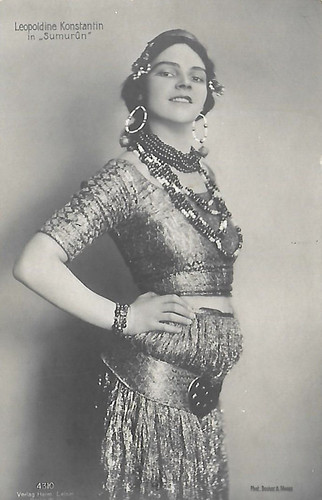
German postcard by Verlag Hermann Leiser, no. 4310. Photo: Becker & Maass. Collection: Didier Hanson. Leopoldine Konstantin in Sumurun (Max Reinhardt, 1910).

German postcard by Verlag Hermann Leiser, Berlin, no. 4552. Photo: Becker & Maass. Caption: Paul Wegener as King Oedipus.

German postcard by Verleih Hermann Leiser, Berlin-Wilmersdorf, no. 7758. Maria Carmi in Das Mirakel/The Miracle (Cherry Kearton, Max Reinhardt, 1912). Collection: Didier Hanson.
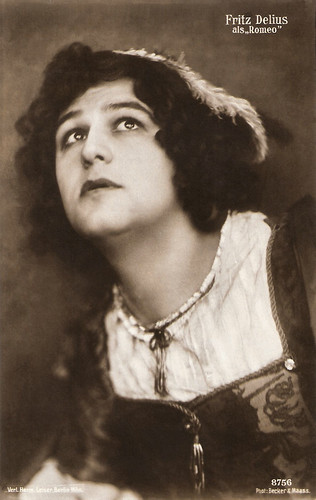
German postcard by Herm. Leiser, Berlin-Wilm., no. 8756. Photo: Becker & Maass. Fritz Delius as Romeo in 'Romeo and Juliet' by William Shakespeare, probably under the direction of Max Reinhardt, ca. 1913.

German postcard by Herm. Leiser, Berlin-Wilm., no. 8760. Photo: Becker & Maass. Fritz Delius as Ferdinand in a 1917 stage production of Friedrich Schiller's 'Kabale und Liebe' (Intrigue and Love), under the direction of Max Reinhardt.
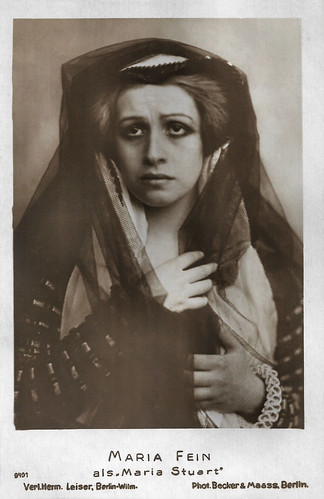
German postcard by Verlag Hermann Leiser, Berlin-Wilm., no. 9491. Photo: Becker & Maass, Berlin. Maria Fein in the title role of Friedrich Schiller's 'Maria Stuart' (Mary Stuart) in a performance at the German Theater in Berlin, 1916.
A feast for starving souls
Max Reinhardt took a greater interest in the film than most of his contemporaries in the theatre world. He made films as a director and from time to time also as a producer. His first staging was the film Sumurûn (1910). After that, Reinhardt founded his own film company.
He sold the film rights for the film adaptation of the play Das Mirakel/The Miracle to Joseph Menchen, whose full-colour film, The Miracle (1912), gained worldwide success. Controversies around the staging of Das Mirakel, which was shown in the Vienna Rotunde in 1912, led to Reinhardt's retreat from the project. The author of the play, Reinhardt's friend and confidant Karl Gustav Vollmoeller, had French director Michel Carré finish the shooting.
Reinhardt made two films, Die Insel der Seligen/Isle of the Blessed (1913) and Eine venezianische Nacht/Venetian Nights (1914), under a four-picture contract for the German film producer Paul Davidson. Both films demanded much of cameraman Karl Freund because of Reinhardt's special shooting needs, such as filming a lagoon in the moonlight.
Die Insel der Seligen/Isle of the Blessed attracted attention due to its erotic nature. Its ancient mythical setting included sea gods, nymphs, and fauns, and the actors appeared naked. However, the film also fit in with the strict customs of the late German and Austrian empires. The actors had to live up to the demands of double roles. Wilhelm Diegelmann and Willy Prager played the bourgeois fathers as well as the sea gods, Ernst Matray a bachelor and a faun, Leopoldine Konstantin the Circe.
The shooting for Eine venezianische Nacht/Venetian Nights by Karl Gustav Vollmoeller took place in Venice. Maria Carmi played the bride, Alfred Abel the young stranger, and Ernst Matray Anselmus and Pipistrello. The shooting was disturbed by a fanatic who incited the attendant Venetians against the German-speaking staff. Both films received negative reviews from the press and the public. The other two films called for in the contract were never made.
At the end of August 1934, Max Reinhardt traveled to the US for the first time since the 1920s and in 1935 he began the process of gaining American citizenship in Los Angeles – where his two sons Wolfgang and Gottfried Reinhardt, lived with their mother, his first wife, actress Else Heims. After many difficulties gaining divorces for the two of them, he was finally able to marry his long-term lover and partner the actress Helene Thimig in Reno, Nevada, in June 1935.
In 1935, Reinhardt directed his first film in Hollywood, a film version of A Midsummer Night's Dream. He used a cast that included James Cagney, Mickey Rooney, Joe E. Brown, and Olivia de Havilland. Mickey Rooney and Olivia de Havilland had also appeared in Reinhardt's 1934 stage production, which was staged at the Hollywood Bowl. The Nazis banned the film because of the Jewish ancestry of both Reinhardt and Felix Mendelssohn, whose music (arranged by Erich Wolfgang Korngold) was used throughout the film.
William McPeak at IMDb: "Shakespeare's lines were cut for public consumption, but there was so much to see - who would notice. In Depression-era America, the movie theater had taken the place of Reinhardt's all-encompassing theater as a haven - and that was certainly fine with him. And here was a feast for starving souls. Reinhardt's multi-faceted approach to theater shone in all its entertaining best-through Warner stage design efficiency. There was the realist extravagance in forested backdrops, but the wonderful ballet of the coming of night with dancer Nini Theilade was distilled expressionism. Other ballet sequences featuring the fairies-children and adults - were choreographed by Bronislava Nijinska (the great Nijinsky's sister). Reinhardt conjured all his and the camera's magic to create the summation of a lifetime of stagecraft."
After the Anschluss of Austria to Nazi-governed Germany in 1938, he emigrated first to Britain, then to the United States. Reinhardt opened the Reinhardt School of the Theatre in Hollywood, on Sunset Boulevard. Several notable stars of the day received classical theatre training, among them actress Nanette Fabray. In 1940, he became a naturalised citizen of the United States. At that time, he was married to his second wife, actress Helene Thimig, daughter of actor Hugo Thimig. His staging of 'Everyman' in modern dress was followed by an unrealised plan for an all-black production of it. The final years of his life were filled with lesser fortunes and poor health, and he died speechless. Max Reinhardt died of a stroke in New York City in 1943 and is interred at Westchester Hills Cemetery in Hastings-on-Hudson, Westchester County, New York. He was 70 years old.
Max Reinhardt had inspired a whole generation of theatre and film directors including F.W. Murnau, Paul Leni, Ernst Lubitsch, William Dieterle, and Otto Preminger. They spread his word to the rest of the world. Reinhardt's papers and literary estate are housed at Binghamton University (SUNY), in the Max Reinhardt Archives and Library. His sons by first wife Else Heims (m. 1910–1935), Wolfgang and Gottfried Reinhardt, were well-regarded film producers. One of his grandsons (by adoption), Stephen Reinhardt, was a labor lawyer who served notably on the United States Court of Appeals for the Ninth Circuit from his appointment by Jimmy Carter in 1980 until his death in 2018. Another grandson, Michael Reinhardt, is a successful fashion photographer. In 2015 his granddaughter Jelena Ulrike Reinhardt was appointed as researcher at the University of Perugia in German literature.

British postcard. Rotary Photo, E.C., No. 4229 R. Camera study by Arbuthnot & Hoppe. Martin Harvey as Oedipus in Oedipus Rex staged in Covent Garden, London, and opening January 1912. It was produced by Max Reinhardt and based on an adaptation of Sophocles' play by Gilbert Murray. Previously, Reinhardt had already staged a - successful - German version by Hugo von Hofmannsthal, opening in Vienna in 1910. Writer W.B. Yeats saw the London production and called it the most imaginative production of a play he ever saw.

British postcard by Rotary Photo, no. 7701 C. Photo: Hoppe, London. Publicity still of the London stage production of 'Das Mirakel' (The Miracle) (1912) by Max Reinhardt with Maria Carmi as the Madonna. Here she has just cured the lame.
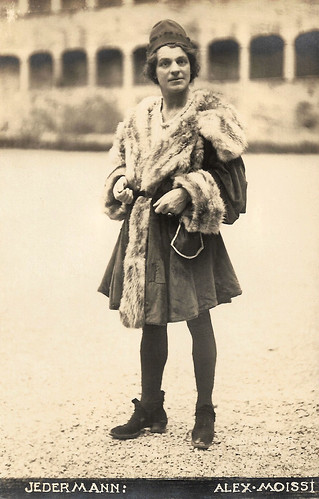
Austrian postcard by Traub, Salzburg. Photo: Atelier K. Hintner. Alexander Moissi as Jedermann in the stage production Jedermann (Everyman) at the Salzburger Festspiele. Max Reinhardt directed Moissi in this production in 1919 and 1920 and from 1926 till 1931.

Austrian postcard by Traub, Salzburg. Photo: Ernst Maier (Atelier K. Hintner). Alexander Moissi as Jedermann in the stage production Jedermann (Everyman) at the Salzburger Festspiele. Max Reinhardt directed Moissi in this production in 1919 and 1920 and from 1926 till 1931. Caption: Everyman in front of the cathedral.

German postcard by Verlag Herm. Leiser, Berlin-Wilm., no. 8747. Photo: Becker & Maass. Helene Thimig as Gretchen in Reinhardt's stage production of Goethe's Faust (1920).

German postcard by Verlag Hermann Leiser, Berlin, no. 9143. Photo: Fritz Richard. Bruno Decarli as Robespierre in the play 'Dantons Tod' (Danton's Death) by Georg Büchner.
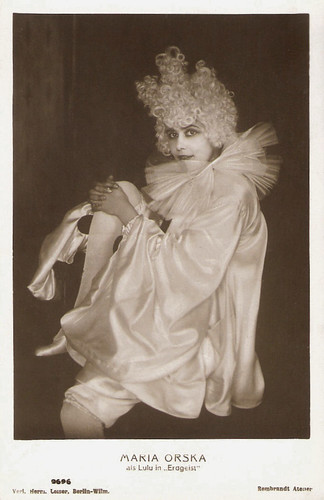
German postcard by Verlag Hermann Leiser, Berlin-Wilm., no. 9696. Photo: Rembrandt Arelier. Maria Orska in her role as Lulu in the stage play Erdgeist (Earth Spirit) by Franz Wedekind directed in 1916 by Max Reinhardt.
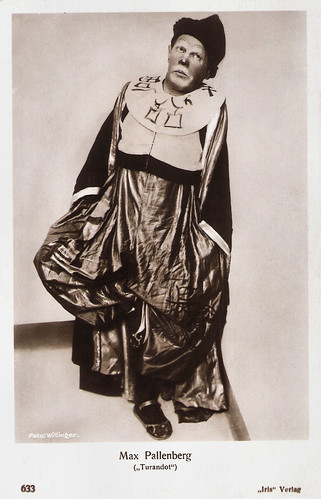
Austrian postcard by Iris Verlag, no. 633. Photo: Laszlo Willinger. Under the direction of Max Reinhardt, Max Pallenberg played Traffaldino in 'Turandot' (1926) by Giacomo Puccini at the Salzburger Festspiele.

German postcard by Wellington. Photo: Eilinger, Salzburg. Rosamond Pinchot as Hippolyta and Paul Hartmann as Theseus in 'Ein Sommernachtstraum' (A Midsummernight's Dream) by William Shakespeare. This photo was taken for the stage production at the Salzburger Festspiele in 1927, directed by Max Reinhardt.

Vintage postcard by L&O, no. 65359. Photo: Ellinger. Ewald Balser as Faust in the stage play 'Faust' (1937) by Johann Wolfgang von Goethe directed by Max Reinhardt at the Salzburger Festspiele.
Sources: Hovahnness Israel Pilikian (Encyclopaedia Britannica), William McPeak (IMDb), Salzburg Stumbling Blocks, Wikipedia, and IMDb.