Showing posts with label Pierre Blanchar. Show all posts

13 October 2018

Le joueur d'échecs (1927)

Today is the final day of Le Giornate del Cinema Muto, the world’s leading international silent-film festival in Pordenone. We wave the festival goodbye with a post on the closing event in Teatro Verdi, a screening of the masterpiece Le joueur d'échecs/The Chess Player (Raymond Bernard, 1927). A French silent film on the historical automaton The Turk, which turned out to be one of the most successful hoaxes ever pulled off. The film score by Henri Rabaud will be performed live by the Orchestra San Marco of Pordenone and the conductor will be Mark Fitz-Gerald.

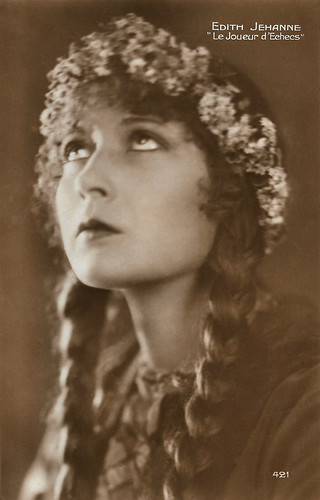
Édith Jéhanne in Le joueur d'échecs
Édith Jéhanne. French postcard by Cinémagazine-Edition, Paris, no. 421. Photo: publicity still for Le joueur d'échecs/ The Chess Player (Raymond Bernard, 1927).

Pierre Blanchar in Le joueur d'échecs (1927)
Pierre Blanchar. French postcard by Cinémagazine-Edition, Paris, no. 422. Photo: publicity still for Le joueur d’échecs/The Chess Player (Raymond Bernard, 1927).

A chess-playing machine known as The Turk


Le joueur d'échecs/The Chess Player (Raymond Bernard, 1927) is based on a novel by Henry Dupuy-Mazuel. It is a historical drama set in the late 18th century during the Russian domination of Polish Lithuania, and elements of the plot are drawn from the story of the chess-playing automaton known as The Turk.

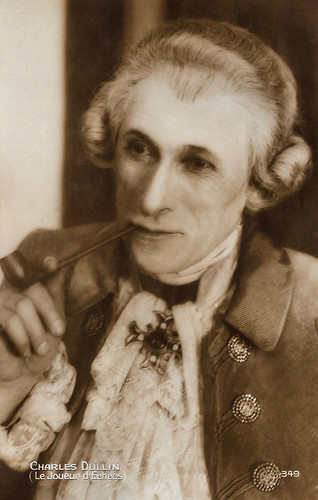
In 1776, a young Polish patriot, Boleslas Vorowski (Pierre Blanchar), is wounded in an abortive uprising against the Russian forces in Vilnius. A reward for his capture is offered but he is sheltered by Baron von Kempelen (Charles Dullin). Von Kempelen is an inventor of lifelike automata, who plans to smuggle Vorowski, a skilful chess-player, to Germany concealed inside The Turk. Vorowski finds his true self, not on the battlefield, but in the wholly unreal world of chess.

Baron von Kempelen, is based on a real-life inventor who stunned the courts of Europe with his life-size mechanical dolls. Wolfgang von Kempelen (1734-1804) was a Hungarian-born engineer who became known for many inventions, most famously his chess-playing machine, The Turk, which he created in 1769 to entertain the Empress Maria Theresa.

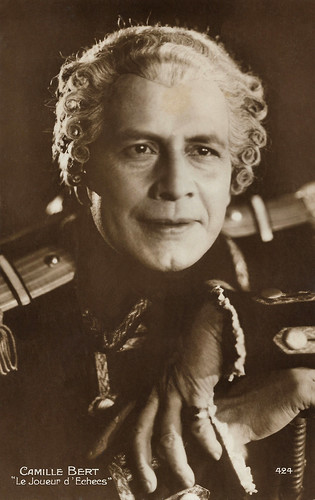
Major Nicolaïeff (Camille Bert), a Russian rival of Vorowski, challenges The Turk to a game and is defeated, but he realises that the machine is being secretly operated by Vorowski. He arranges for The Turk to be sent to Moscow to entertain the Russian Empress Catherine II (Marcelle Charles-Dullin). When The Turk refuses to allow Catherine to cheat, the Empress orders that the automaton is to be executed by firing squad at dawn. During a masked ball, von Kempelen replaces Vorowski inside The Turk, to enable him to escape with his lover Sophie Novinska (Édith Jéhanne). Nicolaïeff, who has been sent to search von Kempelen's house, is slain by the inventor's sabre-wielding automata.

It is estimated that the historical Turk defeated 98% of its opponents, who included such luminaries as Napoleon and Benjamin Franklin during Kempelen's lifetime. After the Baron's death, a successor continued to exhibit the Turk, who faced off against Edgar Allan Poe and Charles Babbage, the man who attempted to create the first computer, the 'difference engine', partly inspired by his encounter with Kempelen's marvellous automaton. The Turk remained a popular phenomenon for 85 years, until its owner deliberately revealed how the trick was done and mothballed the gadget.

Camille Bert in Le Joueur d'échecs
Camille Bert. French postcard by Cinémagazine-Edition, Paris, no. 424. Photo: publicity still for Le Joueur d'échecs/The Chess Player (Raymond Bernard, 1927). In the film Camille Bert plays Major Nikolaieff, the Russian adversary of the protagonist, the Polish freedom fighter Boleslas Vorowski (Pierre Blanchar).

Charles Dullin in Le joueur d'échecs (1927)
Charles Dullin. French postcard by Cinémagazine-Edition, Paris, no. 349. Photo: publicity still for Le joueur d'échecs/The Chess Player (Raymond Bernard, 1927).

A spectacular cavalry charge


Le joueur d'échecs/The Chess Player (1927) was the second film which Raymond Bernard made for the Société des Films Historiques, although on this occasion its subject matter of the Polish struggle for independence from Russia did not correspond with the company's avowed devotion to French history. Some scenes were filmed on location in Poland with the assistance of the Polish army.

For many of the other spectacular locations, 35 sets were created at the studios in Joinville by Robert Mallet-Stevens and Jean Perrier; the most spectacular was the facade and courtyard of the Winter Palace, which covered some 5000 square metres of land beside the studio.

Additional special effects were provided by the British film designer W. Percy Day. Filming began on 15 March 1926 and was completed on 31 October, leaving Bernard only two months for its post-production before the premiere in January 1927. An orchestral score was written for the film by Henri Rabaud.

The gala premiere at the Marivaux cinema in Paris was a huge success and the film went on to have a first run of three months at that cinema before its general release in the summer of 1927. Audiences were particularly impressed by the spectacular cavalry charge imagined by Sophie as she sings the Polish hymn of independence. This daydream sequence is daringly intercut with the actual battle - a fiasco whose leaders are killed and maimed, bringing no glory to either Russian imperialists or Polish rebels.

The press reception in France was generally enthusiastic. The film was released in the UK in early 1928, and in the USA in 1930, where however the reviewer for The New York Times was unimpressed. David Melville at IMDb: "Comparable to Abel Gance's Napoleon in its scale and stylistic bravura, this romantic epic (...) differs from the more famous film in its lack of nationalist fervour and Tricolour bombast. Its one 'rousing battle scene' is a pure fantasy, a daydream of its naive heroine as she thumps out a patriotic hymn on her piano. (...) director Raymond Bernard conjures up an eerily perverse atmosphere of ETA Hoffman-style Gothic Expressionism."

A restoration of the film was undertaken in the 1980s, led by Kevin Brownlow and David Gill. In the absence of any definitive negative or print, it required the collaboration of several European film archives from which material in several variant copies was collated; sources in an East German archive and the Cinémathèque Municipale in Luxembourg provided the most complete material. The finished tinted print received its first screenings in London in 1990, with Rabaud's score conducted by Carl Davis.


Scene from Le joueur d'échecs/The Chess Player (Raymond Bernard, 1927) in which von Kempelen presents The Turk. Source: Compujedrez (YouTube).

Sources: David Melville (IMDb), John G. Nettles (Pop Matters), Wikipedia and IMDb.

27 December 2016

Pierre Blanchar

Pierre Blanchar (1892-1963) was one of France's most popular show business personalities. He made many memorable stage appearances and appeared in 54 films. Blanchar often played characters who were complex and tortured. During the war he also worked as a film director.

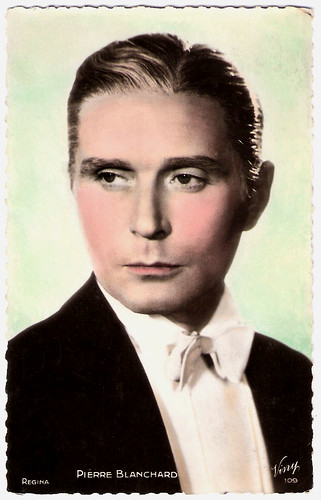
Pierre Blanchar
French postcard by Viny, no. 109. Photo: Regina.
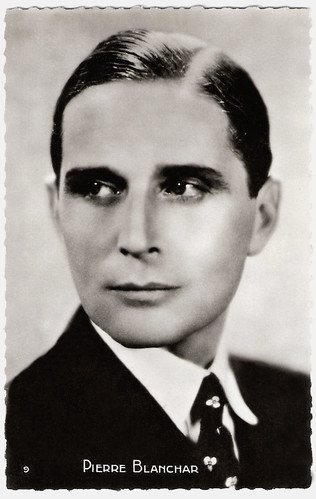
Pierre Blanchar
French postcard by Editions P.I., Paris, no. 9.
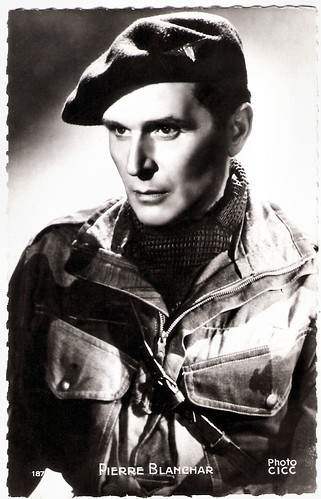
Pierre Blanchar
French postcard by Editions P.I., Paris, no. 187. Collection Les Carbones Korès 'Carboplane'. Photo: CICC. Pierre Blanchar in Bataillon du ciel/They Are Not Angels (Alexander Esway, 1947).

Papa Goodheart


Gustave Pierre Blanchard was born in Philippeville, Algeria (now Skikda, Algeria) in 1892.

He learned his craft at the Paris Conservatory, and made the first of many memorable stage appearances in 1919 (some sources say 1920). In 1922 he made his film début in the silent film Jocelyn (Léon Poirier, 1922).

Many leading roles followed in such silent films as Papa bon cœur/Papa Goodheart (Henry Krauss, 1922), Geneviève (Léon Poirier, 1923), Aux jardins de Murcie/Heritage (René Hervil, Louis Mercanton, 1923), La Terre promise/Promised Land (Henry Roussel, 1925) with Raquel Meller, Le Joueur d'échecs/The Chess Player (Raymond Bernard, 1927), and Le Capitaine Fracasse/Captain Fracasse (Alberto Cavalcanti, Henry Wulschleger, 1929) with the young Charles Boyer.

He also appeared in the German production Diane - Die geschichte einer Pariserin/Diane, the Story of a Paris Woman (Erich Waschneck, 1929) starring Olga Tschechova.
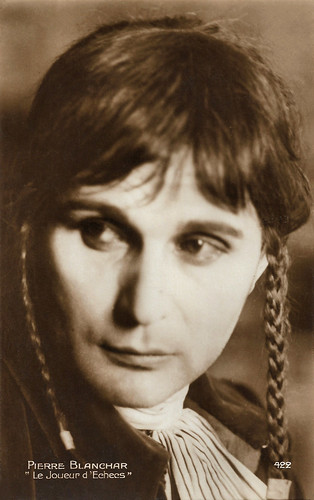
Pierre Blanchar in Le joueur d'échecs (1927)
French postcard by Cinémagazine-Edition, Paris, no. 422. Photo: publicity still for Le joueur d’échecs/The Chess Player (Raymond Bernard, 1927).
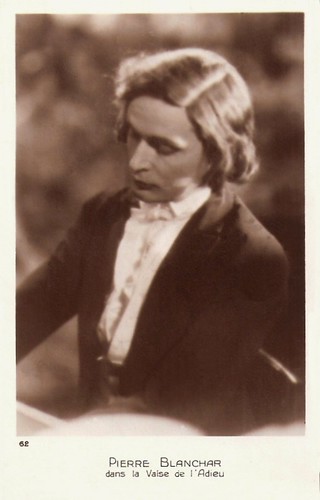
Pierre Blanchar as Chopin
French postcard by Edition Cinemagazine, Paris, no. 62. Photo: Publicity still for La Valse de l'Adieu (Henry Roussel, 1928), a biographical film on the life of composer and pianist Frederic Chopin.
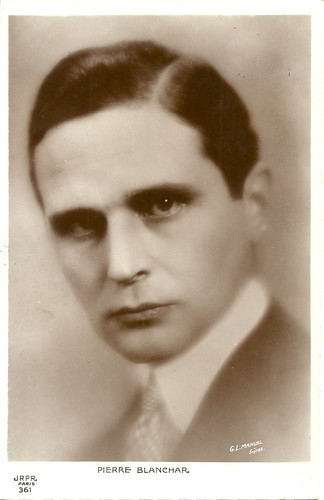
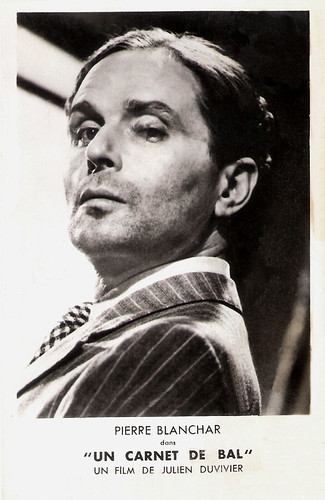
Pierre Blanchar in Un Carnet de Bal (1937)
French postcard by Edition Chantal, Paris. Photo: publicity still for Un Carnet de Bal/Dance Program (Julien Duvivier, 1937).

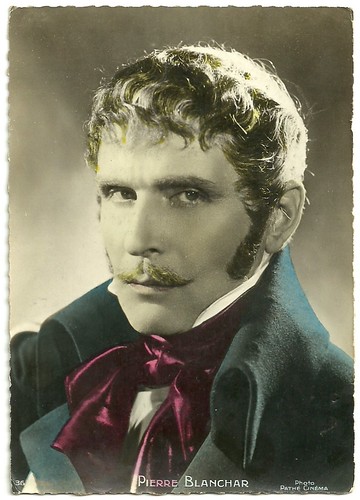
Pierre Blanchar
French postcard by Editions P.I., Paris, no. 36. Photo: Pathé Cinéma, Pierre Blanchar in Pontcarral, colonel d'empire/Pontcarral, colonel of the empire (Jean Delannoy, 1942).

Napoleon


Pierre Blanchar often chose to play characters which were complex and tortured, like Adjudant Gilbert Demachy in the war drama Les Croix de bois/The Wooden Crosses (Raymond Bernard, 1932) or Captain de Saint-Avit in the classic L'Atlantide (Georg Wilhelm Pabst, 1932) opposite Brigitte Helm.

At the film festival of Venice he was awarded the Volpi Cup as Best Actor for his role as Raskolnikov in Crime et châtiment/Crime and Punishment (Pierre Chenal, 1935).

Pierre Blanchar was the archetypical romantic and gloomy hero, but he did not neglect comedies, like Amants et voleurs/Lovers and Thieves (Raymond Bernard, 1935) with Arletty and Michel Simon, and Le Coupable/The Culprit (Raymond Bernard, 1937) with Madeleine Ozeray.

Other classic films of the 1930s were L’homme de nulle part/The Late Mathias Pascal (Pierre Chanal, 1937) with Isa Miranda, Mademoiselle Docteur (Georg Wilhelm Pabst, 1937) with Dita Parlo, Un carnet de bal/Dance Program (Julien Duvivier, 1937) with Marie Bell.

In 1937 he appeared also in the Alexander Pushkin adaptation La Dame de pique/Queen of Spades (1937, Fyodor Otsep), L'Affaire du courrier de Lyon (Claude Autant-Lara, Maurice Lehmann, 1937), L'Homme de nulle part/Courier of Lyons (Pierre Chenal, 1937) with Dita Parlo, and L'Étrange Monsieur Victor/Strange M. Victor (Jean Grémillon, 1938) starring Raimu.

One of Blanchar's most famous screen characterizations was Napoleon in the British A Royal Divorce (Jack Raymond, 1938) with Ruth Chatterton as Josephine de Beauharnais.
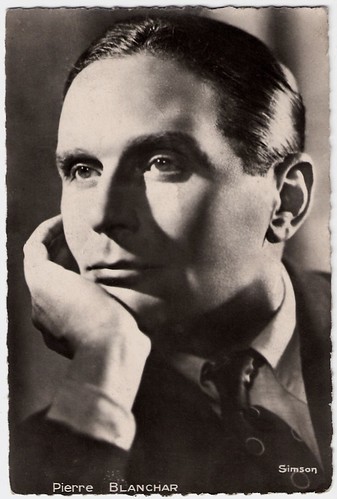
Pierre Blanchar
French postcard by Editions Chantal, Rueil-Malmaison. Photo: Simson.
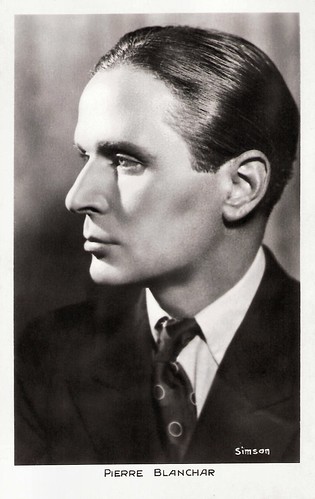
Pierre Blanchar
French postcard. Photo: Simson.

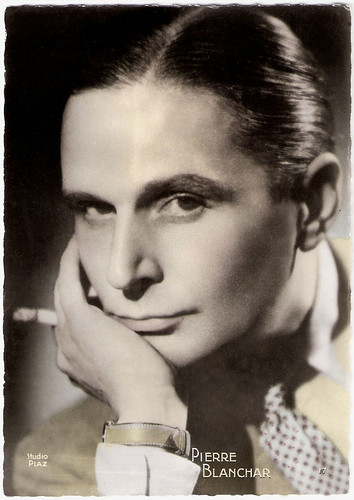
Pierre Blanchar
French postcard by Editions O.P., Paris, no. 17. Photo: Studio Piaz.

Resistance


Before and during the Second World War, Pierre Blanchar was often requested for French-German productions by Union France-Allemagne. During the occupation of France he starred in L'Empreinte du Dieu/Two Women (Léonide Moguy, 1940), the never completed La Prière aux étoiles/The Prayer to the Stars (Marcel Pagnol, 1941), and Pontcarral, colonel d'empire/Piontcarral, Colonel of the Empire (Jean Delannoy, 1942).

He also directed two films, Secrets (1942) and Un seul amour/One Love (1943) with Micheline Presle and Gaby André.

Later he became a member of the resistance and in August 1944 he commented vibrantly the images of the liberation of Paris in the cinema newsreels.

After the war he was highly praised for his touching performance in La Symphonie pastorale (Jean Delannoy, 1946) as a minister who falls in love with a blind girl (Michèle Morgan).

This success soon was followed by roles in Patrie/Homeland (Louis Daquin, 1946), and Après l'amour/After the Love (Maurice Tourneur, 1948).

Another special role was Captain Ferane in the film Le Bataillon du ciel/They Are Not Angels (Alexander Esway, 1947), based on the novel by Joseph Kessel. This role was inspired on the life and death of Pierre Marienne (1908-1944), one of the forces behind the liberation of France. As Lieutenant Paratrooper of the fourth bataillon of the Spécial Air Service (S.A.S.) of the Free French Forces he was parachuted in Bretagne on 5 June 1944 in the frame of D-Day. After taking part in the battle of Saint Marcel on 18 June 1944, he was assassinated in the Morhiban by the French army on 12 July 1944. Blanchar had known Pierre Marienne who had worked in the pre-war cinema. He also physically resembled Marienne.
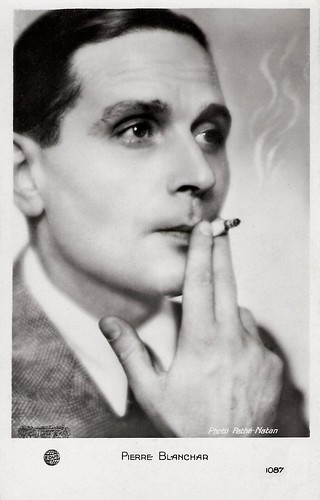
Pierre Blanchar
French postcard by E.D.U.G., no. 1087. Photo: Pathé / Natan.
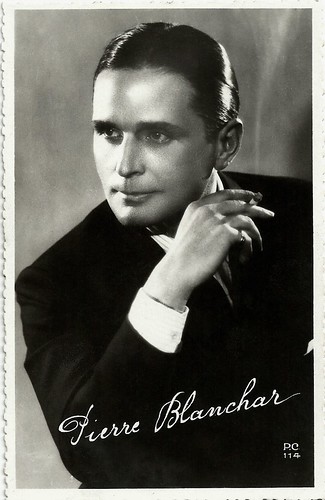
Pierre Blanchar
French postcard, no. 114. Photo: P.C.
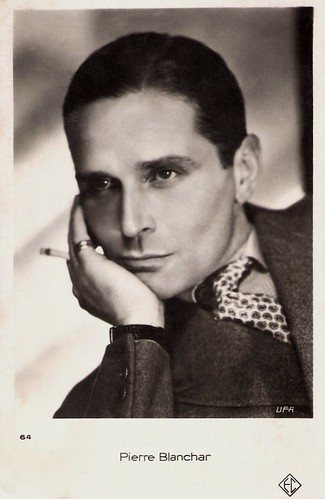
Pierre Blanchar
French postcard by EC, no. 64. Photo: Ufa.
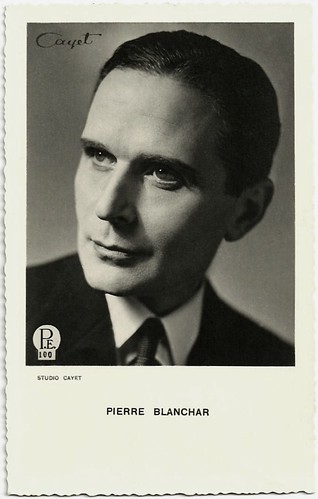
Pierre Blanchar
Belgian postcard by Photo Edition, Brussels, no. 100. Photo: Studio Cayet. Jo Cayet (1907-1987) was a famous Brussels based photographer.

Long Interval


Pierre Blanchar’s film career slowed down in the 1950s. After the title role of the comedy Mon ami Sainfoin/My Friend Sainfoin (Marc-Gilbert Sauvajon, 1950) there was a long interval till 1959.

That year he played supporting roles in Du rififi chez les femmes/Rififi and the Women (Alex Joffé, 1959) with Nadja Tiller, and the fairytale Katia/Magnificent Sinner (Robert Siodmak, 1959) with Romy Schneider.

His last film, Le Monocle noir/The Black Monocle (Georges Lautner, 1961), was shot at the château de Josselin in the Morbihan.

Pierre Blanchar died of a brain tumor in 1963, in Suresnes, France. He was married to Marte Vinot. They had a daughter actress Dominique Blanchar.


Scene from Le Joueur d'échecs/The Chess Player (1927) with Pierre Blanchar and Edith Jehanne. Source: Skazibus (YouTube).


La symphonie pastorale 1 6, by Jean, Delannoy. door jhhvideoteach
First scenes of La Symphonie pastorale (1946). Source:  jhhvideoteach (Daily Motion).

Sources: Hal Erickson (AllMovie), Wikipedia (French), and IMDb.